Comparison

Lion vs Snow Leopard

Lion (Panthera leo) and Snow Leopard (Panthera uncia) both belong to the genus Panthera (roaring cats) and part ways below it. Both are recorded in 2 countries.

Lion

Lion

Panthera leo

GinaFranchi, CC BY-SA 4.0, via Wikimedia Commons

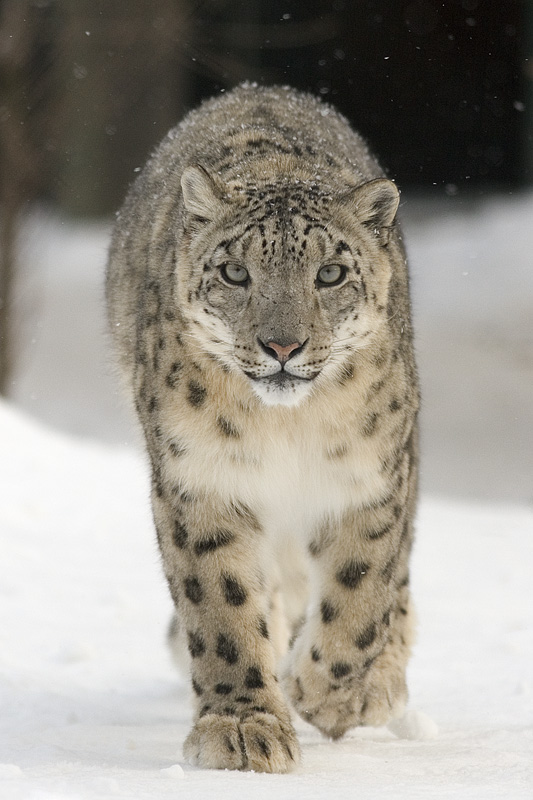
Snow Leopard

Snow Leopard

Panthera uncia

Bernard Landgraf, CC BY-SA 3.0, via Wikimedia Commons

How they differ

The lion has fur ranging from light buff and silvery grey to yellowish red and dark brown, while the snow leopard has thick whitish-to-grey fur with black spots and larger rosettes. The lion is social and forms prides, while the snow leopard is solitary and mostly active around dawn and twilight. The lion inhabits grasslands, savannahs and shrublands, while the snow leopard commonly rests near cliffs and ridges.

LionSnow Leopard
AppearanceLion fur ranges from light buff and silvery grey to yellowish red and dark brown, and its undersides are generally lighter.The snow leopard has thick whitish-to-grey fur, black spots on its head and neck, larger rosettes on its back and flanks, and a whitish underbelly.
Social behaviourLions form prides generally consisting of related females and cubs alongside one or several adult males unrelated to the females.The snow leopard is solitary.
ActivityLions are generally more active during daylight than other wild cats.The snow leopard is mostly active around dawn and twilight.
DietLions primarily prey on medium-sized and large hoofed mammals, including antelopes, zebras and wildebeest.The snow leopard predominantly consumes larger-bodied wild hoofed mammals, including Himalayan blue sheep, Himalayan tahr, argali, markhor and wild goats.
ThreatsHabitat loss, conflicts with humans and poaching threaten lions.Habitat destruction, poaching, reduced prey availability, retaliatory killings and climate change threaten snow leopards.

Written from the checked facts listed further down. Statements that the sources did not support were removed.

Side by side

LionSnow Leopard
Scientific namePanthera leo (Linnaeus, 1758)Panthera uncia (Schreber, 1775)
English nameLionSnow Leopard
GroupMammalsMammals
ClassMammalia MammalMammalia Mammal
OrderCarnivora CarnivoresCarnivora Carnivores
FamilyFelidae CatsFelidae Cats
GenusPanthera Roaring CatsPanthera Roaring Cats
Named in17581775
Red List categoryVulnerableVulnerable
Countries on record35 countries10 countries
GBIF occurrence records17,888 records399 records

Rows where the two agree are shown in grey.

Where each is found

Both recorded in 2 countries

Only Lion (33)

Only Snow Leopard (8)

From Catalogue of Life checklists and GBIF occurrence records. A country missing from a list means no record is held, which is not proof of absence.

Checked facts

LionSnow Leopard
Appearance
  • Lion fur ranges from light buff and silvery grey to yellowish red and dark brown. English Wikipedia
  • The undersides of lions are generally lighter in colour than the rest of their fur. English Wikipedia
  • Newborn lions have dark spots that fade as they mature, although faint spots can remain on their legs and undersides. English Wikipedia
  • Every lion has a tail ending in a dark, hairy tuft. English Wikipedia
  • The snow leopard has thick whitish-to-grey fur with black spots on its head and neck and larger rosettes on its back, flanks and bushy tail. English Wikipedia
  • The snow leopard has a short muzzle, domed forehead and large nasal cavities. English Wikipedia
  • The snow leopard has small, rounded ears, broad paws and a thick tail. English Wikipedia
  • The snow leopard has thick fur with individual hairs measuring 5–12 cm long. English Wikipedia
  • The snow leopard has a whitish underbelly. English Wikipedia
  • The snow leopard has long canine teeth measuring 28.6 mm. English Wikipedia
  • The snow leopard has short legs and a stocky body. English Wikipedia
Size
Habitat
  • Lions inhabit grasslands, savannahs, and shrublands. English Wikipedia
  • African lions prefer grassy plains, savannahs, river-bordering scrub, and open woodlands with bushes. English Wikipedia
  • Lions rarely enter closed forests. English Wikipedia
  • African lions can inhabit tropical moist forests in West Africa and montane forests in East Africa. English Wikipedia
  • Lions have been recorded at elevations of up to 3,600 metres on Mount Elgon. English Wikipedia
  • African lion habitats predominantly consist of savannahs receiving 300 to 1,500 millimetres of annual rainfall. English Wikipedia
  • The snow leopard inhabits alpine and subalpine zones, particularly at elevations of 3,000–4,500 m. English Wikipedia
  • The snow leopard prefers rocky, broken terrain. English Wikipedia
  • During summer, the snow leopard commonly occupies alpine meadows and rocky regions above the tree line at elevations of 2,700–6,000 m. English Wikipedia
  • During winter, the snow leopard descends to elevations of approximately 1,200–2,000 m. English Wikipedia
  • The snow leopard can move through snow up to 85 cm deep. English Wikipedia
  • Snow leopards occupy alpine habitats at elevations ranging from 900 to 4,500 m. pmc.ncbi.nlm.nih.gov
Diet
  • The snow leopard is a carnivore that actively hunts its prey. English Wikipedia
  • The snow leopard's preferred wild prey includes Himalayan blue sheep, Himalayan tahr, argali, markhor and wild goats. English Wikipedia
  • The snow leopard also hunts smaller mammals, including Himalayan marmots, pikas and voles. English Wikipedia
  • The snow leopard also preys on domestic livestock. English Wikipedia
  • The snow leopard consumes grass and twigs in addition to animal prey. English Wikipedia
  • The snow leopard's preferred prey generally weighs between 36 and 76 kg. English Wikipedia
  • In the Himalayas, the snow leopard commonly hunts Himalayan blue sheep, Siberian ibex, white-bellied musk deer and wild boar. English Wikipedia
  • The snow leopard's preferred prey species have an average weight of approximately 55 ± 5 kg. pmc.ncbi.nlm.nih.gov
  • The snow leopard's diet can include pikas, hares and game birds such as chukar partridges and snowcocks. pmc.ncbi.nlm.nih.gov
  • An individual snow leopard requires approximately 1.5 kg of meat per day. pmc.ncbi.nlm.nih.gov
  • Across its range, the snow leopard predominantly consumes larger-bodied wild hoofed mammals, with prey selection varying according to availability. dsc.duq.edu
  • Livestock accounts for between 0% and 33% of the snow leopard's dietary repertoire in the studied populations. dsc.duq.edu
Behaviour
  • Lions are social animals that form groups called prides. English Wikipedia
  • Lion prides generally consist of related females and cubs alongside one or several adult males unrelated to the females. English Wikipedia
  • Female lions usually hunt cooperatively. English Wikipedia
  • Lions are generally more active during daylight than other wild cats but can become nocturnal and crepuscular when persecuted. English Wikipedia
  • Female lions are the primary hunters and leaders within their prides. nationalgeographic.com
  • Male lions defend pride territories by scent-marking, roaring, and chasing away intruding animals. nationalgeographic.com
  • Young male lions eventually leave their birth prides and establish their own prides by taking over groups led by other males. nationalgeographic.com
  • Young lions generally do not participate in hunting until approximately one year of age. nationalgeographic.com
  • Female lions commonly raise their cubs cooperatively. nationalgeographic.com
  • The snow leopard is solitary and is mostly active around dawn and twilight. English Wikipedia
  • The snow leopard commonly rests near cliffs and ridges that provide vantage points and shade. English Wikipedia
  • The snow leopard uses its long, flexible tail to maintain balance in rocky terrain. English Wikipedia
  • The snow leopard can wrap its thick, fur-covered tail around its face for protection while sleeping. English Wikipedia
ReproductionNo checked fact yet
LifespanNo checked fact yet
Distribution
  • African lions occur in scattered populations across sub-Saharan Africa. English Wikipedia
  • The snow leopard is native to the mountain ranges of Asia, extending from the eastern Hindu Kush and Himalayas to southern Siberia, Mongolia and western China. English Wikipedia
Conservation
  • The lion has been classified as Vulnerable on the IUCN Red List since 1996. English Wikipedia
  • Lion populations in African countries declined by approximately 43 percent since the early 1990s. English Wikipedia
  • Habitat loss and conflicts with humans are major concerns contributing to lion population declines. English Wikipedia
  • African lions have disappeared from approximately 94 percent of their historical range. nationalgeographic.com
  • Poaching threatens lions because their bones and other body parts are valuable in illegal wildlife trade. nationalgeographic.com
  • The snow leopard is classified as Vulnerable on the IUCN Red List in document 1. English Wikipedia
  • The global population of mature snow leopards is estimated at fewer than 10,000 individuals. English Wikipedia
  • Poaching and habitat destruction are major threats to the snow leopard. English Wikipedia
  • The snow leopard is listed in Appendix I of CITES. English Wikipedia
  • Snow leopards are threatened by habitat loss, reduced prey availability, retaliatory killings and climate change. dsc.duq.edu
  • Reduced availability of wild prey can increase livestock predation and retaliatory killings of snow leopards. pmc.ncbi.nlm.nih.gov
  • Conservation of the snow leopard depends partly on maintaining populations of its preferred wild prey. pmc.ncbi.nlm.nih.gov
Uses
  • Lions have been exhibited in zoological gardens since the late eighteenth century. English Wikipedia
  • Lions have been widely depicted in sculptures, paintings, national flags, literature, and films. English Wikipedia
  • The snow leopard is widely used in heraldry and as an emblem in Central Asia and parts of North India. English Wikipedia

In brief

Lion

The African Lion is the second-largest felid species after the tiger. African lions occur in scattered populations across sub-Saharan Africa. African lions are social animals that form groups called prides, generally consisting of related females and cubs alongside one or several adult males. Full profile

Snow Leopard

The Snow Leopard inhabits alpine and subalpine zones in the mountain ranges of Asia. It has thick whitish-to-grey fur with black spots and rosettes, broad paws, short legs and a thick, bushy tail. Full profile

Compare something else

Page built on 24 November 2026 from the data on the two species pages, where every source is listed.

Cite this page

ScientificNames.org. (2026). Lion vs Snow Leopard. Retrieved November 24, 2026, from https://scientificnames.org/compare/lion-vs-snow-leopard