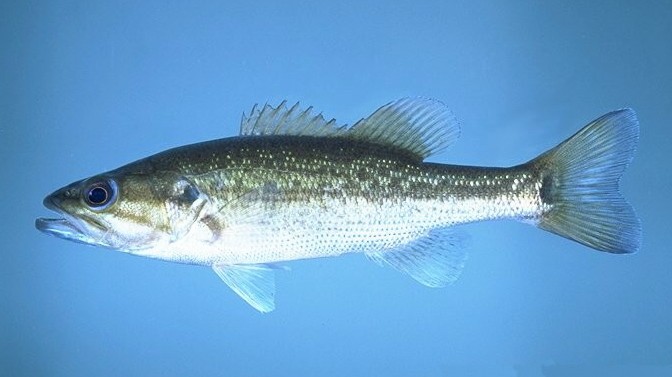
| Appearance | - The smallmouth bass has a slender, muscular, elongated body adapted for powerful swimming. English Wikipedia
- Its dorsal coloration ranges from golden-olive to dark brown and fades to yellowish white on the underside. English Wikipedia
- Its body typically has dark brown vertical bars or blotches, while its head has dark brown horizontal bars. English Wikipedia
- The protruding jaw generally does not extend behind the eyes, which are red or brown. English Wikipedia
- The fish has two dorsal fins separated by a shallow notch, with 9–11 spiny rays in the front fin and 13–15 soft rays in the rear fin. English Wikipedia
- Its sides have golden flecks on most scales and vertical bars that may be broken or vary in visibility. dfo-mpo.gc.ca
- Its dorsal fins appear joined together as one fin. dfo-mpo.gc.ca
- Its body colour becomes darker with more pronounced contrasting markings in clear water and lighter with less distinct markings in cloudy water. dfo-mpo.gc.ca
| - The spotted bass has prominent rows of dark spots below its lateral line. English Wikipedia
- The spotted bass has scales on the base portion of its second dorsal fin. English Wikipedia
- Its first and second dorsal fins are clearly connected. English Wikipedia
- Its upper jaw bone does not extend back to or beyond the rear edge of the eyes. English Wikipedia
- The spotted bass lacks the vertical body bars characteristic of smallmouth bass. English Wikipedia
- The spotted bass has small black spots below the lateral line that are absent in largemouth and smallmouth bass. English Wikipedia
- Juvenile spotted bass can have an orange band at the base of the tail followed by a black band and a white edge. English Wikipedia
- The spotted bass has a smaller mouth than the largemouth bass. English Wikipedia
- The maxilla does not extend beyond the eye when the mouth is fully closed. dwr.virginia.gov
- The spotted bass has a small patch of teeth on its tongue. dwr.virginia.gov
- Dark blotches, often connected, extend across the midline of the body. dwr.virginia.gov
|
|---|
| Size | | |
|---|
| Habitat | - The species typically inhabits cool, clear rivers and lakes with rocky or sandy substrates. animaldiversity.org
- It prefers cool water and commonly occupies shoals, submerged logs, and moderately shallow rocky or sandy areas. dfo-mpo.gc.ca
- In streams, the species typically occupies areas with relatively swift currents. animaldiversity.org
- In lakes, it uses structures such as logs, rocky outcroppings, and pier posts as habitat. animaldiversity.org
- The species is seldom found in dense aquatic vegetation. dfo-mpo.gc.ca
| - The spotted bass prefers cool and warm mountain streams and reservoirs with rocky bottoms. English Wikipedia
- The spotted bass commonly occupies flowing streams, rivers, and reservoirs with aquatic vegetation, submerged logs, and rocky or riprap walls. English Wikipedia
- The spotted bass generally inhabits waters with more current than those preferred by largemouth bass. English Wikipedia
- The spotted bass can inhabit water as deep as 30 metres. English Wikipedia
- The spotted bass occupies water that is too warm for smallmouth bass but generally swifter-moving than water preferred by largemouth bass. dwr.virginia.gov
- The spotted bass prefers cover provided by large woody debris, undercut banks, trees, rocks, and submerged aquatic vegetation. dwr.virginia.gov
|
|---|
| Diet | - Its diet includes crayfish, amphibians, insects, and smaller fish. English Wikipedia
- Smallmouth bass also consume tadpoles, frogs, and plant material. dfo-mpo.gc.ca
- Fry and juveniles primarily feed on zooplankton and insect larvae. animaldiversity.org
- Adults sometimes consume the young of other parents belonging to their species. animaldiversity.org
| - The spotted bass feeds on insects, crustaceans, frogs, annelid worms, and smaller fish. English Wikipedia
- The spotted bass commonly consumes small fishes, crayfish, and aquatic insects. English Wikipedia
- Young spotted bass initially consume copepods and other small crustaceans before beginning to eat insects. English Wikipedia
- The spotted bass consumes approximately half as much fish as the largemouth bass. English Wikipedia
- Spotted bass in Virginia feed heavily on other fish, amphibians, crayfish, and insects. dwr.virginia.gov
|
|---|
| Behaviour | - Smallmouth bass are highly visual predators that actively seek clear water. animaldiversity.org
- Individual fish may occupy territories extending several hundred yards and containing multiple large structures used as cover. animaldiversity.org
- When water temperatures fall below 16 °C, smallmouth bass often migrate towards deeper pools and enter a semi-hibernation state. English Wikipedia
- During cold-weather semi-hibernation, the fish move sluggishly and feed very little. English Wikipedia
- Individual smallmouth bass may travel 12 miles in a single day in a stream, creek, or river. English Wikipedia
| - The spotted bass captures prey by opening its mouth and generating negative pressure to draw prey inside. English Wikipedia
- Spotted bass are described as aggressive feeders that opportunistically consume catchable prey that fits in their mouths. dwr.virginia.gov
|
|---|
| Reproduction | - Smallmouth bass generally begin spawning in spring or early summer when water temperatures reach 15–18 °C. English Wikipedia
- Successful spawning requires a clean substrate consisting of stone, rock, or gravel. English Wikipedia
- Females can lay as many as 21,100 eggs, which males guard in their nests. English Wikipedia
- Males excavate and guard small, round nests. animaldiversity.org
- Females may deposit eggs in the nests of several different males, while several females may also spawn in one male's nest. animaldiversity.org
- Females lay more than 2,000 eggs during each spawning event. animaldiversity.org
- Smallmouth bass eggs typically hatch within four to six days. animaldiversity.org
- Newly hatched fry remain in the nest for approximately two weeks before dispersing. animaldiversity.org
- Male smallmouth bass are solely responsible for parental care and guard both eggs and fry. animaldiversity.org
| |
|---|
| Lifespan | | No checked fact yet |
|---|
| Distribution | - The native range includes the upper and middle Mississippi River basin, the Saint Lawrence River–Great Lakes system, the Champlain Valley, and the Hudson Bay basin. English Wikipedia
| - The spotted bass is native to the Mississippi River basin and Gulf states from central Texas to the Florida panhandle. English Wikipedia
- The native range of the spotted bass extends into the western Mid-Atlantic states. English Wikipedia
- The spotted bass has been introduced into western North Carolina and Virginia. English Wikipedia
|
|---|
| Conservation | - Smallmouth bass is not considered a conservation concern. animaldiversity.org
- Accidental introductions through live-bait use and unauthorized transfers between waterbodies contribute to the species' recent spread. dfo-mpo.gc.ca
| - The spotted bass has become established as an invasive species in some isolated waters of southern Africa. English Wikipedia
- The spotted bass was held responsible for declines in native fiery redfin and Cape galaxias abundance in South Africa. English Wikipedia
|
|---|
| Uses | | |
|---|
| Similar species | - The largemouth bass (Micropterus salmoides), spotted bass (Micropterus punctulatus), and Coosa bass (Micropterus coosae) are identified as similar species. animaldiversity.org
| - The spotted bass is frequently mistaken for the largemouth bass because of their similar coloration. English Wikipedia
- The spotted bass is also frequently confused with the smallmouth bass. English Wikipedia
- The spotted bass is known to hybridize with the smallmouth bass. English Wikipedia
|
|---|