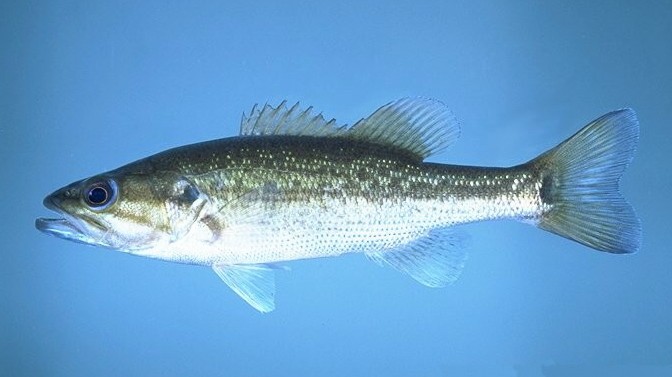
| Appearance | - The spotted bass has prominent rows of dark spots below its lateral line. English Wikipedia
- The spotted bass has scales on the base portion of its second dorsal fin. English Wikipedia
- Its first and second dorsal fins are clearly connected. English Wikipedia
- Its upper jaw bone does not extend back to or beyond the rear edge of the eyes. English Wikipedia
- The spotted bass lacks the vertical body bars characteristic of smallmouth bass. English Wikipedia
- The spotted bass has small black spots below the lateral line that are absent in largemouth and smallmouth bass. English Wikipedia
- Juvenile spotted bass can have an orange band at the base of the tail followed by a black band and a white edge. English Wikipedia
- The spotted bass has a smaller mouth than the largemouth bass. English Wikipedia
- The maxilla does not extend beyond the eye when the mouth is fully closed. dwr.virginia.gov
- The spotted bass has a small patch of teeth on its tongue. dwr.virginia.gov
- Dark blotches, often connected, extend across the midline of the body. dwr.virginia.gov
| |
|---|
| Size | | |
|---|
| Habitat | - The spotted bass prefers cool and warm mountain streams and reservoirs with rocky bottoms. English Wikipedia
- The spotted bass commonly occupies flowing streams, rivers, and reservoirs with aquatic vegetation, submerged logs, and rocky or riprap walls. English Wikipedia
- The spotted bass generally inhabits waters with more current than those preferred by largemouth bass. English Wikipedia
- The spotted bass can inhabit water as deep as 30 metres. English Wikipedia
- The spotted bass occupies water that is too warm for smallmouth bass but generally swifter-moving than water preferred by largemouth bass. dwr.virginia.gov
- The spotted bass prefers cover provided by large woody debris, undercut banks, trees, rocks, and submerged aquatic vegetation. dwr.virginia.gov
| - The species inhabits small creeks, rivers, and waterfalls in temperate regions. animaldiversity.org
- Individuals commonly occupy shallow water at depths of approximately 0.5–0.6 m. animaldiversity.org
- The species commonly occupies shoreline areas rather than midstream habitats. animaldiversity.org
- Larger individuals occupy deeper and warmer water sections when submerged features provide cover. animaldiversity.org
- Juveniles can occupy water depths of up to 3 m. animaldiversity.org
- The species is commonly associated with rocky runs and pools in creeks and small to medium-sized rivers. fws.gov
- Juveniles select microhabitats with greater canopy cover and slower-flowing pools. animaldiversity.org
|
|---|
| Diet | - The spotted bass feeds on insects, crustaceans, frogs, annelid worms, and smaller fish. English Wikipedia
- The spotted bass commonly consumes small fishes, crayfish, and aquatic insects. English Wikipedia
- Young spotted bass initially consume copepods and other small crustaceans before beginning to eat insects. English Wikipedia
- The spotted bass consumes approximately half as much fish as the largemouth bass. English Wikipedia
- Spotted bass in Virginia feed heavily on other fish, amphibians, crayfish, and insects. dwr.virginia.gov
| - The species feeds opportunistically on fish and invertebrates, particularly adult aquatic and terrestrial insects. English Wikipedia
- Larger individuals commonly consume crayfish, dobsonfly nymphs, mayfly nymphs and adults, and damselfly nymphs. English Wikipedia
- Juveniles feed mainly on aquatic insects. English Wikipedia
- Juveniles have also been observed preying on mosquitofish in shallow water. English Wikipedia
|
|---|
| Behaviour | - The spotted bass captures prey by opening its mouth and generating negative pressure to draw prey inside. English Wikipedia
- Spotted bass are described as aggressive feeders that opportunistically consume catchable prey that fits in their mouths. dwr.virginia.gov
| - The species feeds at the water surface, within the water column, and along the bottom. English Wikipedia
- Larger individuals tend to dominate deep, low-velocity pools, while smaller individuals primarily occupy shallow, fast-moving riffles. English Wikipedia
|
|---|
| Reproduction | | |
|---|
| Distribution | - The spotted bass is native to the Mississippi River basin and Gulf states from central Texas to the Florida panhandle. English Wikipedia
- The native range of the spotted bass extends into the western Mid-Atlantic states. English Wikipedia
- The spotted bass has been introduced into western North Carolina and Virginia. English Wikipedia
| No checked fact yet |
|---|
| Conservation | - The spotted bass has become established as an invasive species in some isolated waters of southern Africa. English Wikipedia
- The spotted bass was held responsible for declines in native fiery redfin and Cape galaxias abundance in South Africa. English Wikipedia
| - The U.S. Fish and Wildlife Service classifies the species' overall risk assessment category in the contiguous United States as uncertain. fws.gov
- The history of invasiveness is classified as data deficient because information about introduction and trade impacts is lacking. fws.gov
- New Jersey is the only U.S. state reported to regulate this species. fws.gov
|
|---|
| Uses | | - The species has been stocked outside its native range in several U.S. states and Puerto Rico for sportfishing. fws.gov
|
|---|
| Similar species | - The spotted bass is frequently mistaken for the largemouth bass because of their similar coloration. English Wikipedia
- The spotted bass is also frequently confused with the smallmouth bass. English Wikipedia
- The spotted bass is known to hybridize with the smallmouth bass. English Wikipedia
| No checked fact yet |
|---|