Species · Fishes
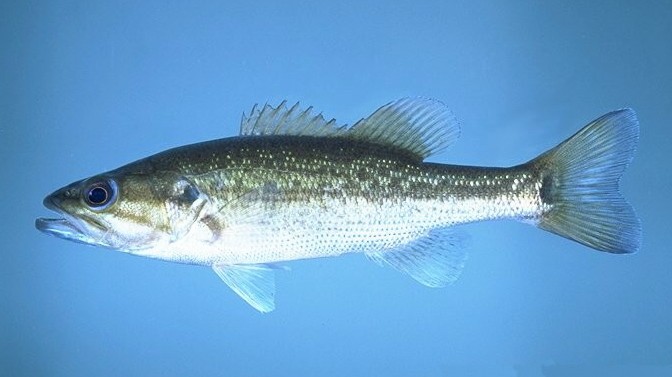
Redeye Bass Micropterus coosae
The scientific name of the Redeye Bass is Micropterus coosae. It is a species of fish in the family Centrarchidae (sunfishes), order Centrarchiformes. The name dates from 1940.
- Scientific name
- Micropterus coosae Hubbs & Bailey, 1940
- Common name
- Redeye Bass
- Genus
- Micropterus
- Family
- Centrarchidae (Sunfishes)
- Order
- Centrarchiformes
- Class
- Teleostei
- Red List category
- LC Least Concern
- Environment
- freshwater
- Recorded in
- 2 countries
- Name status
- accepted in the Catalogue of Life

Overview
Micropterus coosae inhabits small creeks, rivers, and waterfalls in temperate regions. It is distinguished by typically bright red eyes and a silver-white crescent on the posterior half of the eyeball.
Written 26 November 2026 from the sources listed below. Each statement was checked against the passage it cites; statements that could not be supported were removed.
Appearance
Adults typically have bright red eyes with a distinctive silver-white crescent on the posterior half of the eyeball. The cheeks typically have three dark bars, and the back and sides are generally olive to brown with darker brown mottling.[1][2][3][4]
Approximately 76% of individuals have zero to six vertical black blotches near the front of the body. The upper and lower margins of the caudal fin have white, turquoise, or red iridescent coloration.[5][6]
The anterior dorsal fin has dark green spines tipped in white, while the posterior dorsal fin has a red upper half and a green base. The pelvic fins are white with black streaks, and the pectoral fins have red rays and transparent membranes.[7][8][9][10]
The fish has an elongate, slender body and a large mouth extending to or slightly behind the rear margin of the eye. The dorsal fin usually has ten spines and twelve rays, while the anal fin has three spines and usually ten rays.[11][12][13]
The tongue has a small tooth patch averaging approximately 2 mm in size. The species has 31 to 33 vertebrae.[14][15]
Adults typically measure between 15 and 47 cm in length, and most individuals weigh between 170 and 450 g. The largest reported individuals can weigh approximately 2,300 g.[16][17][18]
Newly hatched individuals measure approximately 2.2–2.5 cm and weigh 0.1 g. Females are slightly larger than males.[19][20]
Habitat
The species inhabits small creeks, rivers, and waterfalls in temperate regions. It is commonly associated with rocky runs and pools in creeks and small to medium-sized rivers.[21][22]
Individuals commonly occupy shallow water at depths of approximately 0.5–0.6 m and shoreline areas rather than midstream habitats. Larger individuals occupy deeper and warmer water sections when submerged features provide cover.[23][24][25]
Juveniles can occupy water depths of up to 3 m. They select microhabitats with greater canopy cover and slower-flowing pools.[26][27]
Diet
The species feeds opportunistically on fish and invertebrates, particularly adult aquatic and terrestrial insects. Larger individuals commonly consume crayfish, dobsonfly nymphs, mayfly nymphs and adults, and damselfly nymphs.[28][29]
Juveniles feed mainly on aquatic insects and have also been observed preying on mosquitofish in shallow water.[30][31]
Behaviour
The species feeds at the water surface, within the water column, and along the bottom. Larger individuals tend to dominate deep, low-velocity pools, while smaller individuals primarily occupy shallow, fast-moving riffles.[32][33]
Reproduction and life cycle
Spawning generally occurs when water temperatures reach 17–21 °C. The breeding season generally extends from late May to early July.[34][35]
Males construct nests in gravel patches or among loose branches in shallow water. Females generally deposit between 2,000 and 3,000 eggs per spawning event, and the eggs measure approximately 3.5 mm in diameter.[36][37][38]
Females generally reach sexual maturity at two to three years of age, while males generally reach sexual maturity at two years of age.[39][40]
Conservation
The U.S. Fish and Wildlife Service classifies the species' overall risk assessment category in the contiguous United States as uncertain. Its history of invasiveness is classified as data deficient because information about introduction and trade impacts is lacking.[41][42]
New Jersey is the only U.S. state reported to regulate this species.[43]
Uses
The species has been stocked outside its native range in several U.S. states and Puerto Rico for sportfishing.[44]
Classification of the Redeye Bass
| Kingdom | Animalia |
|---|---|
| Phylum | Chordata |
| Subphylum | Vertebrata |
| Infraphylum | Gnathostomata |
| Parvphylum | Osteichthyes |
| Gigaclass | Actinopterygii |
| Superclass | Actinopteri |
| Class | Teleostei (Teleost) |
| Order | Centrarchiformes |
| Family | Centrarchidae (Sunfishes) |
| Genus | Micropterus (Black Basses) |
| Species | Micropterus coosae Hubbs & Bailey, 1940 |
Where the Redeye Bass is found
Checklists and occurrence records place Micropterus coosae in 2 countries. GBIF holds 3,079 georeferenced records of it.
Countries
Regions and cities with the most records
- Georgia, United States 1,240
- Alabama, United States 1,185
- Tennessee, United States 332
- Cleveland, United States 116
- Oxford, United States 106
- Trussville, United States 85
- Canton, United States 83
- Auburn, United States 76
- South Carolina, United States 76
- Center Point, United States 74
- Dixiana, United States 73
- Calhoun, United States 69
- Talladega, United States 69
- Anniston, United States 65
- Dalton, United States 60
- Cartersville, United States 57
- Opelika, United States 57
- Alabaster, United States 55
- Helena, United States 55
- Pelham, United States 52
- Vestavia Hills, United States 52
- Cookeville, United States 50
- Hoover, United States 50
- California, United States 48
- Homewood, United States 48
- Acworth, United States 44
- Mountain Brook, United States 43
- Rome, United States 37
- Arizona, United States 36
- Woodstock, United States 36
- Birmingham, United States 35
- East Brainerd, United States 33
- Lost Mountain, United States 31
- Bessemer, United States 30
- Kennesaw, United States 28
- Gadsden, United States 27
A number beside a place is its count of GBIF occurrence records. A place without a number comes from a checklist alone. Records show where a species has been observed or collected, which can include escapes and vagrants.
Common names
English
- Redeye Bass
- Bartram's Bass
- Coosa Bass
Names in 6 other languages
- Czech
- okounek červenooký
- Danish
- Rødøjet ørredaborre
- Latvian
- Sarkanacu melnasaris
- Mandarin Chinese
- 紅眼黑鱸, 红眼黑鲈
- Portuguese
- Achigã-de-olho-vermelho
- Spanish
- Lobina ojicolorada
Related species
-
 Largemouth BassMicropterus salmoides
-
 Smallmouth BassMicropterus dolomieu
-
 Guadalupe BassMicropterus treculii
-
 Spotted BassMicropterus punctulatus
-
 Florida BassMicropterus floridanus
-
 Shoal BassMicropterus cataractae
- Alabama BassMicropterus henshalli
-
 Suwannee BassMicropterus notius
Compare
Questions and answers
What is the scientific name of the Redeye Bass?
The scientific name of the Redeye Bass is Micropterus coosae. Written with its author, the full name is Micropterus coosae Hubbs & Bailey, 1940.
Which family does the Redeye Bass belong to?
Micropterus coosae belongs to the family Centrarchidae, in the order Centrarchiformes and the class Teleostei.
Where is the Redeye Bass found?
Checklists and occurrence records place Micropterus coosae in 2 countries: United States and Puerto Rico.
What is the conservation status of the Redeye Bass?
The IUCN Red List category recorded for Micropterus coosae is Least Concern (LC).
What other names does the Redeye Bass have?
Micropterus coosae is also known in English as Bartram's Bass and Coosa Bass.
Are red eye bass rare?
The species' overall risk assessment category in the contiguous United States is classified as uncertain.[41]
What type of bass has red eyes?
The Redeye Bass (Micropterus coosae) typically has bright red eyes.[1]
Sources
Passages the profile rests on
- Adults typically have bright red eyes. Source passage: “Redeye bass eyes are bright red (hence, the common name).” — animaldiversity.org
- The posterior half of the eyeball has a distinctive silver-white crescent. Source passage: “the presence of a distinct silver-white crescent on the posterior (back) one-half of the eyeball” — English Wikipedia
- The cheeks typically have three dark bars. Source passage: “Unique from all other black basses, redeye typically have three dark bars on the cheek.” — English Wikipedia
- The back and sides are generally olive to brown with darker brown mottling. Source passage: “The back and sides of the fish are generally olive to brown with darker brown mottling.” — English Wikipedia
- The upper and lower margins of the caudal fin have white, turquoise, or red iridescent coloration. Source passage: “iridescent white, turquoise, or red on upper and lower margins of the caudal fin” — English Wikipedia
- Approximately 76% of individuals have zero to six vertical black blotches near the front of the body. Source passage: “Most individuals (about 76%) have 0–6 vertical black blotches near the front of the body” — English Wikipedia
- The anterior dorsal fin has dark green spines tipped in white. Source passage: “The anterior (front) dorsal fin has dark green spines tipped in white” — English Wikipedia
- The posterior dorsal fin has a red upper half and a green base. Source passage: “the base is green, the upper half red” — English Wikipedia
- The pelvic fins are white with black streaks. Source passage: “The pelvic fins are white with black streaks” — English Wikipedia
- The pectoral fins have red rays and transparent membranes. Source passage: “the pectoral fins have red rays with transparent membranes.” — English Wikipedia
- The fish has an elongate, slender body and a large mouth extending to or slightly behind the rear margin of the eye. Source passage: “The redeye is an elongate, slender fish with a large mouth that extends to or slightly behind the rear margin of the eye.” — English Wikipedia
- The dorsal fin usually has ten spines and twelve rays. Source passage: “The dorsal fin contains nine to 11 (usually 10) spines and 11 to 13 (usually 12) rays” — English Wikipedia
- The anal fin has three spines and usually ten rays. Source passage: “The anal fin contains three spines and nine to 11 (usually 10) rays.” — English Wikipedia
- The tongue has a small tooth patch averaging approximately 2 mm in size. Source passage: “measured to be approximately 2 mm in size on average.” — English Wikipedia
- The species has 31 to 33 vertebrae. Source passage: “Internally, these fish have 31 to 33 vertebrae.” — animaldiversity.org
- Adults typically measure between 15 and 47 cm in length. Source passage: “Adult redeye bass typically reach lengths of 15 to 47 cm.” — animaldiversity.org
- Most individuals weigh between 170 and 450 g. Source passage: “usually weighing 170 g to 450 g” — animaldiversity.org
- The largest reported individuals can weigh approximately 2,300 g. Source passage: “the largest individuals can weigh up to 2300 g.” — animaldiversity.org
- Newly hatched individuals measure approximately 2.2–2.5 cm and weigh 0.1 g. Source passage: “Redeye bass hatchlings are 2.2-2.5 cm in length and weigh 0.1 g.” — animaldiversity.org
- Females are slightly larger than males. Source passage: “Sexual dimorphism is present in this species, as females are slightly larger than males.” — animaldiversity.org
- The species inhabits small creeks, rivers, and waterfalls in temperate regions. Source passage: “Redeye bass are freshwater bass that live in small creeks, rivers, and waterfalls in the temperate zones.” — animaldiversity.org
- The species is commonly associated with rocky runs and pools in creeks and small to medium-sized rivers. Source passage: “commonly found in rocky runs and pools of creeks and in small to medium sized rivers.” — fws.gov
- Individuals commonly occupy shallow water at depths of approximately 0.5–0.6 m. Source passage: “typically at depths of ca. 0.5 to 0.6 m” — animaldiversity.org
- The species commonly occupies shoreline areas rather than midstream habitats. Source passage: “They also choose shoreline areas rather than mid-stream habitats” — animaldiversity.org
- Larger individuals occupy deeper and warmer water sections when submerged features provide cover. Source passage: “Larger redeye bass can be found in deeper, warmer water sections, mainly when there are instream features that provide cover.” — animaldiversity.org
- Juveniles can occupy water depths of up to 3 m. Source passage: “Juvenile bass live in deeper portions of the water, reaching depths of up to 3 m.” — animaldiversity.org
- Juveniles select microhabitats with greater canopy cover and slower-flowing pools. Source passage: “Juveniles also choose microhabitats with more canopy cover and pools with slower current velocities.” — animaldiversity.org
- The species feeds opportunistically on fish and invertebrates, particularly adult aquatic and terrestrial insects. Source passage: “they are opportunistic predators on fish and invertebrates, especially adult aquatic and terrestrial insects.” — English Wikipedia
- Larger individuals commonly consume crayfish, dobsonfly nymphs, mayfly nymphs and adults, and damselfly nymphs. Source passage: “Diet for large redeye bass typically includes crayfish, dobsonfly nymphs, mayfly nymphs and adults, and damselfly nymphs.” — English Wikipedia
- Juveniles feed mainly on aquatic insects. Source passage: “Small juveniles feed mainly on aquatic insects” — English Wikipedia
- Juveniles have also been observed preying on mosquitofish in shallow water. Source passage: “but have successfully preyed on mosquitofish in shallow water.” — English Wikipedia
- The species feeds at the water surface, within the water column, and along the bottom. Source passage: “They are opportunistic predators that feed on the surface, in the water column, and on the bottom.” — English Wikipedia
- Larger individuals tend to dominate deep, low-velocity pools, while smaller individuals primarily occupy shallow, fast-moving riffles. Source passage: “Larger redeye bass tend to dominate low velocity, deep pools, while smaller bass tend to be absent from these pools and are primarily found in shallow, fast-moving riffles.” — English Wikipedia
- Spawning generally occurs when water temperatures reach 17–21 °C. Source passage: “Spawning begins when water temperatures reach 17 to 21 °C.” — animaldiversity.org
- The breeding season generally extends from late May to early July. Source passage: “mating from late May to early July.” — animaldiversity.org
- Males construct nests in gravel patches or among loose branches in shallow water. Source passage: “Male redeye bass will build nests in gravel patches or loose branches in shallow water” — animaldiversity.org
- Females generally deposit between 2,000 and 3,000 eggs per spawning event. Source passage: “Females usually lay between 2000 and 3000 eggs at a time” — animaldiversity.org
- Eggs measure approximately 3.5 mm in diameter. Source passage: “Egg sizes for redeye bass are 3.5 mm.” — animaldiversity.org
- Females generally reach sexual maturity at two to three years of age. Source passage: “Female redeye bass reach sexual maturity at two to three years of age” — animaldiversity.org
- Males generally reach sexual maturity at two years of age. Source passage: “males reach sexual maturity slightly earlier, at two years of age.” — animaldiversity.org
- The U.S. Fish and Wildlife Service classifies the species' overall risk assessment category in the contiguous United States as uncertain. Source passage: “The Overall Risk Assessment Category for Micropterus coosae in the contiguous United States is Uncertain.” — fws.gov
- The history of invasiveness is classified as data deficient because information about introduction and trade impacts is lacking. Source passage: “The History of Invasiveness for M. coosae is classified as Data Deficient due to a lack of information regarding impacts of introduction and trade.” — fws.gov
- New Jersey is the only U.S. state reported to regulate this species. Source passage: “New Jersey is the only U.S. State that regulates this species.” — fws.gov
- The species has been stocked outside its native range in several U.S. states and Puerto Rico for sportfishing. Source passage: “have been stocked for sportfishing outside of their native range in several U.S. States and Puerto Rico.” — fws.gov
Data
- Catalogue of Life, 2026-10-16 XR cc by
- Global Biodiversity Information Facility CC BY 4.0
- Wikidata CC0
- GeoNames CC BY 4.0
- Wikimedia Commons per image; credit shown with each image
- Within the Catalogue of Life, this name comes from World Register of Marine Species cc by
References
- Hubbs, C. L., & Bailey, R. M. (1940). A revision of the black basses (Micropterus and Huro) with descriptions of four new forms. Miscellaneous Publications, Museum of Zoology, University of Michigan, 48: 1–51, Pls. 1–6, 2 maps. https://doi.org/10.2307/1437996 Link where the name was published
This species in other databases
- Catalogue of Life 43538
- Wikidata Q3768274
- iNaturalist 71149
- WoRMS urn:lsid:marinespecies.org:taxname:1014837
- ITIS 168163
Page built on 26 November 2026. See how the catalog is made and all sources and licences.
Cite this page
ScientificNames.org. (2026). Micropterus coosae (Redeye Bass). Retrieved November 26, 2026, from https://scientificnames.org/species/micropterus-coosae
“Micropterus coosae (Redeye Bass).” ScientificNames.org, 2026, scientificnames.org/species/micropterus-coosae. Accessed 26 Nov. 2026.
ScientificNames.org. “Micropterus coosae (Redeye Bass).” Accessed November 26, 2026. https://scientificnames.org/species/micropterus-coosae.
@misc{scientificnames_micropterus_coosae_redeye_bass,
  author = {{ScientificNames.org}},
  title = {Micropterus coosae (Redeye Bass)},
  year = {2026},
  url = {https://scientificnames.org/species/micropterus-coosae},
  note = {Accessed 2026-11-26}
}