Comparison
Mimic Octopus vs Greater Blue-ringed Octopus
Mimic Octopus (Thaumoctopus mimicus) and Greater Blue-ringed Octopus (Hapalochlaena lunulata) both belong to the family Octopodidae (scuttles) and part ways below it. Both are recorded in 4 countries.
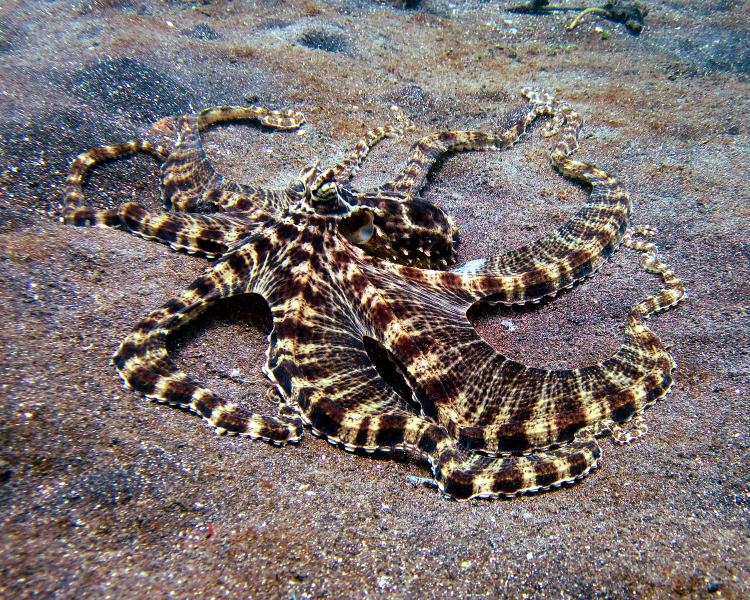


How they differ
The Mimic octopus (Thaumoctopus mimicus) reaches approximately 60 cm in total length, while the Greater blue-ringed octopus (Hapalochlaena lunulata) does not exceed 10 centimetres in total length according to one description.
| Mimic Octopus | Greater Blue-ringed Octopus | |
|---|---|---|
| Camouflage | The Mimic octopus (Thaumoctopus mimicus) uses chromatophores to camouflage itself. | The Greater blue-ringed octopus (Hapalochlaena lunulata) can use chromatophores to camouflage itself. |
| Diet | The Mimic octopus (Thaumoctopus mimicus) feeds on small fish, crabs, and worms. | The Greater blue-ringed octopus (Hapalochlaena lunulata) feeds on small crabs, shrimp and molluscs, and also captures small injured fish when opportunities arise. |
| Size | The Mimic octopus (Thaumoctopus mimicus) reaches approximately 60 cm in total length, including its arms. | The Greater blue-ringed octopus (Hapalochlaena lunulata) does not exceed 10 centimetres in total length, including its arms, according to one description. |
Written from the checked facts listed further down. Statements that the sources did not support were removed.
Side by side
| Mimic Octopus | Greater Blue-ringed Octopus | |
|---|---|---|
| Scientific name | Thaumoctopus mimicus M. Norman & Hochberg, 2005 | Hapalochlaena lunulata (Quoy & Gaimard, 1832) |
| English name | Mimic Octopus | Greater Blue-ringed Octopus |
| Group | Molluscs | Molluscs |
| Class | Cephalopoda Cephalopod | Cephalopoda Cephalopod |
| Family | Octopodidae Scuttles | Octopodidae Scuttles |
| Genus | Thaumoctopus Mimic Octopus | Hapalochlaena Blue-ringed Octopus |
| Named in | 2005 | 1832 |
| Red List category | Least Concern | Least Concern |
| Environment | marine | marine |
| Countries on record | 6 countries | 7 countries |
| GBIF occurrence records | 220 records | 237 records |
Rows where the two agree are shown in grey.
Where each is found
Both recorded in 4 countries
Only Mimic Octopus (2)
Only Greater Blue-ringed Octopus (3)
From Catalogue of Life checklists and GBIF occurrence records. A country missing from a list means no record is held, which is not proof of absence.
Checked facts
| Mimic Octopus | Greater Blue-ringed Octopus | |
|---|---|---|
| Appearance |
|
|
| Size |
|
|
| Habitat |
|
|
| Diet |
|
|
| Behaviour |
|
|
| Reproduction | No checked fact yet |
|
| Conservation | No checked fact yet |
|
| Other | No checked fact yet |
|
In brief
Mimic Octopus
Thaumoctopus mimicus inhabits muddy river-mouth bottoms, estuaries, and shallow offshore waters, primarily on sandy or silty seabeds at depths below 15 meters. Full profile
Greater Blue-ringed Octopus
Hapalochlaena lunulata is distinguished by approximately 60 blue rings across its skin, bordered by black lines. Full profile
Compare something else
Page built on 24 November 2026 from the data on the two species pages, where every source is listed.
Cite this page
ScientificNames.org. (2026). Mimic Octopus vs Greater Blue-ringed Octopus. Retrieved November 24, 2026, from https://scientificnames.org/compare/mimic-octopus-vs-greater-blue-ringed-octopus
“Mimic Octopus vs Greater Blue-ringed Octopus.” ScientificNames.org, 2026, scientificnames.org/compare/mimic-octopus-vs-greater-blue-ringed-octopus. Accessed 24 Nov. 2026.
ScientificNames.org. “Mimic Octopus vs Greater Blue-ringed Octopus.” Accessed November 24, 2026. https://scientificnames.org/compare/mimic-octopus-vs-greater-blue-ringed-octopus.
@misc{scientificnames_mimic_octopus_vs_greater_blue_ringed_octopus,
  author = {{ScientificNames.org}},
  title = {Mimic Octopus vs Greater Blue-ringed Octopus},
  year = {2026},
  url = {https://scientificnames.org/compare/mimic-octopus-vs-greater-blue-ringed-octopus},
  note = {Accessed 2026-11-24}
}