Species · Molluscs
Greater Blue-ringed Octopus Hapalochlaena lunulata
The scientific name of the Greater Blue-ringed Octopus is Hapalochlaena lunulata. It is a species of mollusc in the family Octopodidae (scuttles). The name dates from 1832.
- Scientific name
- Hapalochlaena lunulata (Quoy & Gaimard, 1832)
- Common name
- Greater Blue-ringed Octopus
- Genus
- Hapalochlaena
- Family
- Octopodidae (Scuttles)
- Class
- Cephalopoda
- Red List category
- LC Least Concern
- Environment
- marine
- Recorded in
- 7 countries
- Name status
- accepted in the Catalogue of Life

Overview
Hapalochlaena lunulata is distinguished by approximately 60 blue rings across its skin, bordered by black lines.
Written 24 November 2026 from the sources listed below. Each statement was checked against the passage it cites; statements that could not be supported were removed.
Appearance
The Greater Blue-ringed Octopus has approximately 60 blue rings distributed across its skin, each measuring approximately 7–8 millimetres in diameter. Black lines border the rings and increase their contrast.[1][2][3]
Its slightly flattened head terminates in a tip, and its eight arms are relatively short. Characteristic blue lines run through its eyes.[4][5][6]
When inactive, its background coloration varies from yellow ochre to light brown or whitish.[7]
Its total length, including its arms, is reported as not exceeding 10 centimetres in one description and approximately 12 centimetres in another. Its average body weight is approximately 80 grams.[8][9][10]
Habitat
It is a benthic animal that generally leads a solitary lifestyle. It lives in burrows and emerges to search for food or mates.[11][12]
The species has been collected from tide pools on Ishigaki Island, Okinawa Prefecture, Japan.[13]
Diet
The Greater Blue-ringed Octopus feeds on small crabs, shrimp and molluscs. It also captures small injured fish when opportunities arise.[14][15]
It captures prey by pouncing on it, grasping it with its arms and pulling it towards its mouth.[16]
Behaviour
The species is generally nocturnal and emerges at night to hunt. It spends considerable time concealed in crevices and can use chromatophores to camouflage itself.[17][18][19]
It flashes its iridescent blue rings as a warning signal of its venomous nature. Each warning flash lasts approximately one-third of a second.[20][21][22]
Reproduction and life cycle
Females carry their eggs beneath their arms during incubation. One description reports that females lay between 60 and 100 eggs.[23][24]
The incubation period is reported to last approximately one month. Females guard their eggs for approximately 50 days until hatching.[25][26]
Newly hatched individuals undergo a planktonic developmental stage before settling on the seabed. The female dies after guarding her eggs because she refuses to eat during this period.[27][28]
Conservation
The conservation status of blue-ringed octopus species is not formally classified as at risk according to the cited museum source.[29]
Classification of the Greater Blue-ringed Octopus
| Kingdom | Animalia |
|---|---|
| Phylum | Mollusca |
| Class | Cephalopoda (Cephalopod) |
| Subclass | Coleoidea |
| Superorder | Octopodiformes |
| Family | Octopodidae (Scuttles) |
| Genus | Hapalochlaena (Blue-ringed Octopus) |
| Species | Hapalochlaena lunulata (Quoy & Gaimard, 1832) |
Where the Greater Blue-ringed Octopus is found
Checklists and occurrence records place Hapalochlaena lunulata in 7 countries. GBIF holds 237 georeferenced records of it.
Countries
Regions and cities with the most records
- Daanbantayan, Philippines 20
- Bitung, Indonesia 13
- Dumaguete, Philippines 13
- Batangas, Philippines 10
- Sabah, Malaysia 10
- Denpasar, Indonesia 4
- Bali, Indonesia 3
A number beside a place is its count of GBIF occurrence records. A place without a number comes from a checklist alone. Records show where a species has been observed or collected, which can include escapes and vagrants.
Common names
English
- Greater Blue-ringed Octopus
- Blue-ringed Octopus
Names in 16 other languages
- Arabic
- أخطبوط أزرق الحلقات هلالي
- Chinese
- 大藍環章魚
- Czech
- chobotnice kroužkovaná
- Dutch
- Grote blauwring-octopus
- French
- Poulpe à anneaux bleus, poulpe aux anneaux bleus
- German
- Großer Blaugeringelter Krake
- Hebrew
- תמנון כחול-טבעות גדול
- Italian
- Polpo dagli anelli blu maggiore
- Japanese
- オオマルモンダコ
- Portuguese
- Polvo-de-anéis-azuis-grande
- Russian
- синекольчатый осьминог
- Spanish
- Pulpo de Anillos Azules
- Turkish
- Büyük mavi halkalı ahtapot
- Vietnamese
- Bạch tuộc đốm xanh lớn
- azb
- بؤیوک ماوی هالکالی آهتاپوتهاپالوچلانا لونولاتا
- yue
- 藍圈八爪魚
Synonyms
One other scientific name has been used for this species and is now treated as a synonym of Hapalochlaena lunulata.
- Octopus lunulatus Quoy & Gaimard, 1832
Related species
-
 Southern Blue-ringed OctopusHapalochlaena maculosa
-
 Blue-lined OctopusHapalochlaena fasciata
- Hapalochlaena nierstraszi
-
 Common OctopusOctopus vulgaris
-
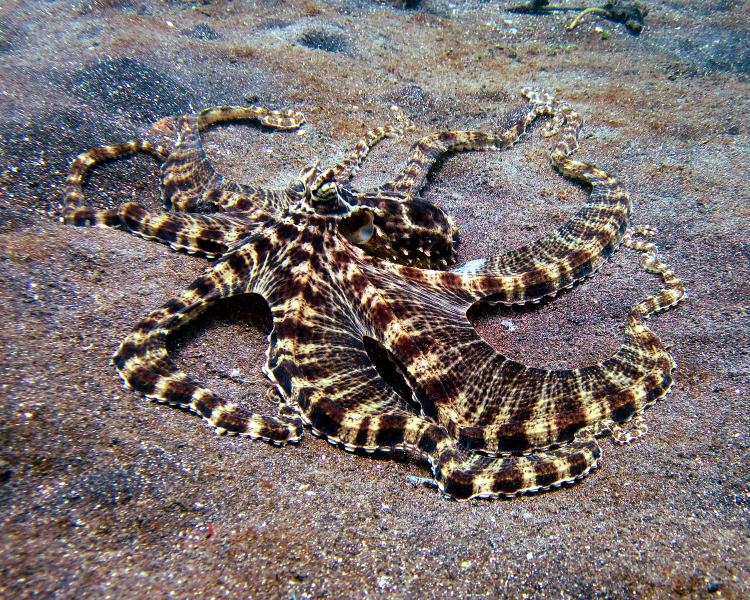 Mimic OctopusThaumoctopus mimicus
-
 Gold-spot OctopusAmphioctopus fangsiao
-
 Coconut OctopusAmphioctopus marginatus
-
 Star-sucker Pygmy OctopusOctopus wolfi
Compare
- Mimic Octopus vs Greater Blue-ringed Octopus
- Common Octopus vs Greater Blue-ringed Octopus
- Greater Blue-ringed Octopus vs Southern Blue-ringed Octopus
- Greater Blue-ringed Octopus vs Blue-lined Octopus
- Greater Blue-ringed Octopus vs Common Octopus
- Greater Blue-ringed Octopus vs Mimic Octopus
- Greater Blue-ringed Octopus vs Gold-spot Octopus
Questions and answers
What is the scientific name of the Greater Blue-ringed Octopus?
The scientific name of the Greater Blue-ringed Octopus is Hapalochlaena lunulata. Written with its author, the full name is Hapalochlaena lunulata (Quoy & Gaimard, 1832).
Which family does the Greater Blue-ringed Octopus belong to?
Hapalochlaena lunulata belongs to the family Octopodidae and the class Cephalopoda.
Where is the Greater Blue-ringed Octopus found?
Checklists and occurrence records place Hapalochlaena lunulata in 7 countries, including Philippines, Indonesia, Malaysia, Japan, Australia and Papua New Guinea.
What is the conservation status of the Greater Blue-ringed Octopus?
The IUCN Red List category recorded for Hapalochlaena lunulata is Least Concern (LC).
What other names does the Greater Blue-ringed Octopus have?
Hapalochlaena lunulata is also known in English as Blue-ringed Octopus.
How venomous is a blue-ringed octopus?
Tetrodotoxin is the principal identified toxin in the species, alongside three identified derivatives. The posterior salivary glands exhibit the highest measured toxicity among the examined body tissues, with a maximum recorded toxicity of 9276 mouse units per gram.[30][31][32]
Sources
Passages the profile rests on
- The species has approximately 60 blue rings distributed across its skin. Source passage: “The blue rings, which number around 60, are spread throughout the entirety of its skin.” — English Wikipedia
- Its blue rings measure approximately 7–8 millimetres in diameter. Source passage: “7 to 8 millimetres [0.28 to 0.31 in] in diameter” — English Wikipedia
- Its blue rings are bordered by black lines that increase their contrast. Source passage: “A black line, with thickness varying to increase contrast and visibility, borders the electric blue circles.” — English Wikipedia
- The species has a slightly flattened head that terminates in a tip. Source passage: “The head is slightly flattened dorsoventrally (front to back) and finished in a tip.” — English Wikipedia
- Its eight arms are relatively short. Source passage: “Its eight arms are relatively short.” — English Wikipedia
- The species has characteristic blue lines running through its eyes. Source passage: “The octopus also has characteristic blue lines running through its eyes.” — English Wikipedia
- Its background coloration varies from yellow ochre to light brown or whitish when inactive. Source passage: “from yellow ocher to light brown or even white-ish (when inactive).” — English Wikipedia
- Its total length, including its arms, does not exceed 10 centimetres according to one description. Source passage: “whose size does not exceed 10 centimetres (3.9 in), arms included” — English Wikipedia
- Its average body weight is approximately 80 grams. Source passage: “with an average weight of 80 grams (2.8 oz).” — English Wikipedia
- Another source reports a total length of approximately 12 centimetres including the arms. Source passage: “The greater blue-ringed octopus (Hapalochlaena lunulata) is about 12 centimetres long including its arms.” — nhm.ac.uk
- The species is a benthic animal that generally occupies a solitary lifestyle. Source passage: “is a benthic animal that has a solitary way of life” — English Wikipedia
- It lives in burrows and emerges to search for food or mates. Source passage: “it lives in a burrow and only comes out to search for food or a mate.” — English Wikipedia
- The species has been collected from tide pools on Ishigaki Island, Okinawa Prefecture, Japan. Source passage: “Living specimens were collected from tide pools on Ishigaki Island, Okinawa Prefecture, Japan” — pmc.ncbi.nlm.nih.gov
- Its diet includes small crabs, shrimp and molluscs. Source passage: “The blue-ringed octopus diet typically consists of small crabs, shrimp and mollusks.” — English Wikipedia
- It also captures small injured fish when opportunities arise. Source passage: “They also tend to take advantage of small injured fish if they can catch them.” — English Wikipedia
- It captures prey by pouncing on it, grasping it with its arms and pulling it towards its mouth. Source passage: “pouncing on its prey, seizing it with its arms, and then pulling it towards its mouth.” — English Wikipedia
- The species is generally nocturnal and emerges at night to hunt. Source passage: “They are usually nocturnal, emerging at night to hunt crustaceans and sometimes small fish.” — nhm.ac.uk
- It can use chromatophores to camouflage itself. Source passage: “blue-ringed octopuses can also use their chromatophores to help camouflage themselves.” — nhm.ac.uk
- The species spends considerable time concealed in crevices. Source passage: “They spend a lot of their time tucked away in crevices” — nhm.ac.uk
- The species flashes its iridescent blue rings as a warning signal. Source passage: “The octopus usually flashes its iridescent rings as a warning signal” — English Wikipedia
- Each warning flash lasts approximately one-third of a second. Source passage: “each flash lasting around a third of a second.” — English Wikipedia
- The species uses its blue rings as an aposematic warning of its venomous nature. Source passage: “The blue rings are an aposematic adornment to clearly show to all potential predators that the octopus is highly venomous.” — English Wikipedia
- Females carry their eggs beneath their arms during incubation. Source passage: “which are kept under the female's arms during the incubation period” — English Wikipedia
- One description reports that females lay between 60 and 100 eggs. Source passage: “The female lays between 60 and 100 eggs” — English Wikipedia
- The incubation period is reported to last approximately one month. Source passage: “which lasts about a month.” — English Wikipedia
- Females guard their eggs for approximately 50 days until hatching. Source passage: “guards them by carrying them under her arm until they hatch about 50 days later” — English Wikipedia
- Newly hatched individuals undergo a planktonic developmental stage before settling on the seabed. Source passage: “Newborns have a brief planktonic development passage before settling on the seabed.” — English Wikipedia
- The female dies after guarding her eggs because she refuses to eat during this period. Source passage: “The female then dies as she refuses to eat while she guards her eggs.” — English Wikipedia
- The conservation status of blue-ringed octopus species is not formally classified as at risk according to the cited museum source. Source passage: “While none of the species are formally considered to be at risk” — nhm.ac.uk
- The posterior salivary glands exhibit the highest measured toxicity among the examined body tissues. Source passage: “The posterior salivary glands exhibited the highest toxicity score” — pmc.ncbi.nlm.nih.gov
- The maximum recorded toxicity of the posterior salivary glands was 9276 mouse units per gram. Source passage: “with a maximum level of 9276 MU/g” — pmc.ncbi.nlm.nih.gov
- Tetrodotoxin was identified as the principal toxin in the species, alongside three identified derivatives. Source passage: “The main toxin in this toxic octopus was identified as TTX, along with 4-epi TTX, 4, 9-anhydroTTX and 6-epi TTX.” — pmc.ncbi.nlm.nih.gov
Data
- Catalogue of Life, 2026-10-16 XR cc by
- Global Biodiversity Information Facility CC BY 4.0
- Wikidata CC0
- GeoNames CC BY 4.0
- Wikimedia Commons per image; credit shown with each image
- Within the Catalogue of Life, this name comes from World Register of Marine Species cc by
This species in other databases
Page built on 24 November 2026. See how the catalog is made and all sources and licences.
Cite this page
ScientificNames.org. (2026). Hapalochlaena lunulata (Greater Blue-ringed Octopus). Retrieved November 24, 2026, from https://scientificnames.org/species/hapalochlaena-lunulata
“Hapalochlaena lunulata (Greater Blue-ringed Octopus).” ScientificNames.org, 2026, scientificnames.org/species/hapalochlaena-lunulata. Accessed 24 Nov. 2026.
ScientificNames.org. “Hapalochlaena lunulata (Greater Blue-ringed Octopus).” Accessed November 24, 2026. https://scientificnames.org/species/hapalochlaena-lunulata.
@misc{scientificnames_hapalochlaena_lunulata_greater_blue_ringed_octopus,
  author = {{ScientificNames.org}},
  title = {Hapalochlaena lunulata (Greater Blue-ringed Octopus)},
  year = {2026},
  url = {https://scientificnames.org/species/hapalochlaena-lunulata},
  note = {Accessed 2026-11-24}
}