Comparison
Demonic Poison Dart Frog vs Golden Poison Frog
Demonic Poison Dart Frog (Minyobates steyermarki) and Golden Poison Frog (Phyllobates terribilis) both belong to the subfamily Dendrobatinae and part ways below it.
Demonic Poison Dart Frog
Minyobates steyermarki
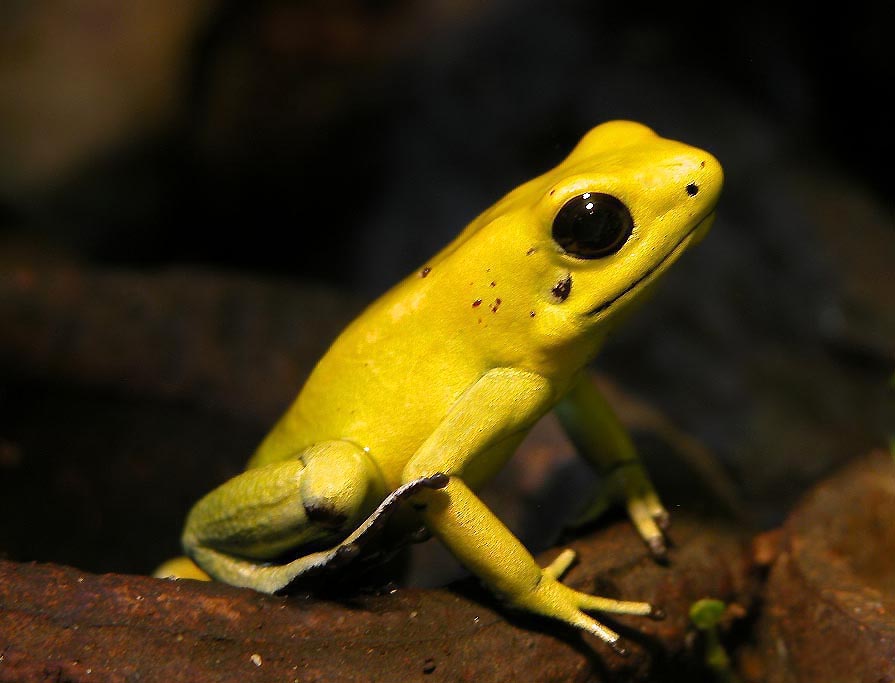

Side by side
| Demonic Poison Dart Frog | Golden Poison Frog | |
|---|---|---|
| Scientific name | Minyobates steyermarki (Rivero, 1971) | Phyllobates terribilis Myers, Daly & Malkin, 1978 |
| English name | Demonic Poison Dart Frog | Golden Poison Frog |
| Group | Amphibians | Amphibians |
| Class | Amphibia Amphibians | Amphibia Amphibians |
| Order | Anura Frogs | Anura Frogs |
| Family | Dendrobatidae Poison Dart Frog | Dendrobatidae Poison Dart Frog |
| Genus | Minyobates Demonic Poison Frogs | Phyllobates Golden Poison Frogs |
| Named in | 1971 | 1978 |
| Red List category | Critically Endangered | Endangered |
| Countries on record | 1 country | 2 countries |
| GBIF occurrence records | 142 records | 814 records |
Rows where the two agree are shown in grey.
Where each is found
Only Demonic Poison Dart Frog (1)
Only Golden Poison Frog (2)
From Catalogue of Life checklists and GBIF occurrence records. A country missing from a list means no record is held, which is not proof of absence.
Checked facts
| Demonic Poison Dart Frog | Golden Poison Frog | |
|---|---|---|
| Appearance |
|
|
| Size |
|
|
| Habitat |
|
|
| Diet | No checked fact yet |
|
| Behaviour |
|
|
| Reproduction |
|
|
| Distribution |
|
|
| Conservation |
|
|
| Name origin | No checked fact yet |
|
| Other |
|
|
In brief
Demonic Poison Dart Frog
Minyobates steyermarki is endemic to Cerro Yapacana in southern Venezuela, where it inhabits montane tepui forest. It is the only member of the genus Minyobates and has red to reddish-brown coloration with numerous small black spots. Full profile
Golden Poison Frog
Phyllobates terribilis is endemic to the Pacific coastal rainforests of Colombia. It produces batrachotoxins in its skin glands as a chemical defense. Full profile
Compare something else
Page built on 29 November 2026 from the data on the two species pages, where every source is listed.
Cite this page
ScientificNames.org. (2026). Demonic Poison Dart Frog vs Golden Poison Frog. Retrieved November 29, 2026, from https://scientificnames.org/compare/demonic-poison-dart-frog-vs-golden-poison-frog
“Demonic Poison Dart Frog vs Golden Poison Frog.” ScientificNames.org, 2026, scientificnames.org/compare/demonic-poison-dart-frog-vs-golden-poison-frog. Accessed 29 Nov. 2026.
ScientificNames.org. “Demonic Poison Dart Frog vs Golden Poison Frog.” Accessed November 29, 2026. https://scientificnames.org/compare/demonic-poison-dart-frog-vs-golden-poison-frog.
@misc{scientificnames_demonic_poison_dart_frog_vs_golden_poison_frog,
  author = {{ScientificNames.org}},
  title = {Demonic Poison Dart Frog vs Golden Poison Frog},
  year = {2026},
  url = {https://scientificnames.org/compare/demonic-poison-dart-frog-vs-golden-poison-frog},
  note = {Accessed 2026-11-29}
}