Comparison
Mud Salamander vs Texas Blind Salamander
Mud Salamander (Pseudotriton montanus) and Texas Blind Salamander (Eurycea rathbuni) both belong to the subfamily Hemidactyliinae and part ways below it. Both are recorded in 1 country.


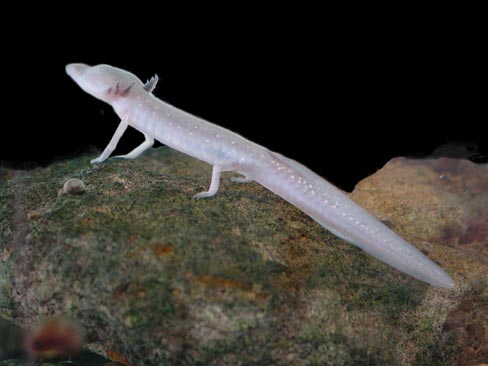
Texas Blind Salamander
Eurycea rathbuni
Photograph courtesy of Joe N. Fries, U.S. Fish and Wildlife Service, Public domain, via Wikimedia Commons

Side by side
| Mud Salamander | Texas Blind Salamander | |
|---|---|---|
| Scientific name | Pseudotriton montanus Baird, 1850 | Eurycea rathbuni (Stejneger, 1896) |
| English name | Mud Salamander | Texas Blind Salamander |
| Group | Amphibians | Amphibians |
| Class | Amphibia Amphibians | Amphibia Amphibians |
| Order | Caudata Salamanders | Caudata Salamanders |
| Family | Plethodontidae Lungless Salamanders | Plethodontidae Lungless Salamanders |
| Genus | Pseudotriton Mud Salamanders | Eurycea Brook Salamander |
| Named in | 1850 | 1896 |
| Red List category | Least Concern | Critically Endangered |
| Environment | freshwater, terrestrial | Not recorded |
| Countries on record | 1 country | 1 country |
| GBIF occurrence records | 2,047 records | 388 records |
Rows where the two agree are shown in grey.
Where each is found
Both recorded in 1 country
From Catalogue of Life checklists and GBIF occurrence records. A country missing from a list means no record is held, which is not proof of absence.
Checked facts
| Mud Salamander | Texas Blind Salamander | |
|---|---|---|
| Appearance |
|
|
| Size |
|
|
| Habitat |
|
|
| Diet |
|
|
| Behaviour |
|
|
| Reproduction |
|
|
| Distribution |
| No checked fact yet |
| Conservation |
|
|
| Uses |
|
|
| Similar species | No checked fact yet |
|
In brief
Mud Salamander
Pseudotriton montanus occurs from southern New York to northern Florida, with its western distribution extending to Kentucky and Tennessee. Adults are generally reddish-brown with distinct round black spots on their backs, while juveniles can be bright red. Full profile
Texas Blind Salamander
Eurycea rathbuni inhabits underground water-filled caves in the Edwards Aquifer. It has vestigial eyes covered by skin, red external gills, and a white body with little skin pigment. Full profile
Compare something else
Page built on 27 November 2026 from the data on the two species pages, where every source is listed.
Cite this page
ScientificNames.org. (2026). Mud Salamander vs Texas Blind Salamander. Retrieved November 27, 2026, from https://scientificnames.org/compare/mud-salamander-vs-texas-blind-salamander
“Mud Salamander vs Texas Blind Salamander.” ScientificNames.org, 2026, scientificnames.org/compare/mud-salamander-vs-texas-blind-salamander. Accessed 27 Nov. 2026.
ScientificNames.org. “Mud Salamander vs Texas Blind Salamander.” Accessed November 27, 2026. https://scientificnames.org/compare/mud-salamander-vs-texas-blind-salamander.
@misc{scientificnames_mud_salamander_vs_texas_blind_salamander,
  author = {{ScientificNames.org}},
  title = {Mud Salamander vs Texas Blind Salamander},
  year = {2026},
  url = {https://scientificnames.org/compare/mud-salamander-vs-texas-blind-salamander},
  note = {Accessed 2026-11-27}
}