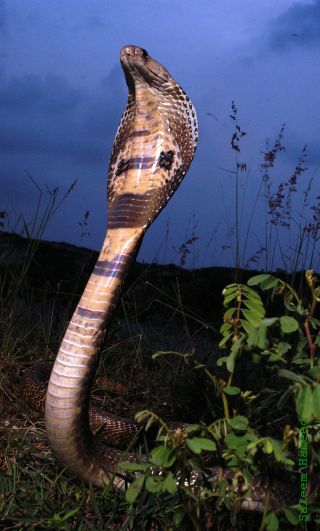
| Appearance | - The Chinese cobra typically has an iridescent black coloration with widely spaced pairs of yellow transverse lines. English Wikipedia
- Its abdominal surface is pearl-coloured or slate-coloured. English Wikipedia
- Its dorsal coloration is usually brown, grey, or black, sometimes with narrow, irregularly spaced light transverse lines. English Wikipedia
- Its hood markings vary from spectacle-shaped and mask-shaped to horseshoe-shaped or O-shaped patterns. English Wikipedia
- Its head is broad and slightly triangular, with a shape somewhat distinct from the neck. simple.wikipedia.org
- Its dorsal scales are smooth and glossy, while its dorsolateral scales are strongly oblique. simple.wikipedia.org
- Its body is heavy and slightly flattened, and it can become considerably flattened when threatened. simple.wikipedia.org
- Its nostrils are large and prominent. simple.wikipedia.org
- Its eyes are medium-sized, with dark dirty-yellow irises mottled with grey-black or blue-black coloration and round jet-black pupils. simple.wikipedia.org
- Its fangs are permanently erect and positioned at the front of the upper jaw. English Wikipedia
- Its ventral head and neck are white to light grey or light orange. simple.wikipedia.org
- The underside of its body and tail can range from white or grey to mottled dark grey or blackish. simple.wikipedia.org
- The hood's ventral surface may have two small dark spots followed by a dark transverse band. simple.wikipedia.org
| |
|---|
| Size | - Adults usually measure between 1.2 and 1.5 metres in length. pmc.ncbi.nlm.nih.gov
- The species can rarely reach a maximum length of 2 metres. English Wikipedia
- The species has 23–29 scale rows around the hood, usually 25–27. English Wikipedia
- It has 161–180 ventral scales, with males usually having 171 and females 173. English Wikipedia
- It has 37–51 pairs of subcaudal scales, with males usually having 48 pairs and females 46. English Wikipedia
| No checked fact yet |
|---|
| Habitat | - Its typical habitats include woodlands, shrublands, grasslands, and mangroves. English Wikipedia
- It occurs in rice paddy fields in maritime lowlands and in various types of montane forests. simple.wikipedia.org
- It inhabits clearings and riverbanks in primary monsoon-season and rain forests. simple.wikipedia.org
- It avoids dark forests with closed canopies. simple.wikipedia.org
- It occurs at elevations ranging from sea level to more than 2,000 metres. simple.wikipedia.org
- It commonly hides beneath leaves, sticks, and rocks. simple.wikipedia.org
- Higher population densities occur near human settlements, in secondary forests, and in rice paddy fields adjacent to forests. simple.wikipedia.org
| - The Indian cobra inhabits dense and open forests, plains, agricultural lands, rocky terrain, and wetlands. English Wikipedia
- The species also occurs in populated villages and city outskirts. English Wikipedia
- Its documented habitat range extends from sea level to 2,000 metres in altitude. English Wikipedia
- The Indian cobra is frequently found near water. English Wikipedia
- Its preferred hiding places include embankment holes, tree hollows, termite mounds, rock piles, and small mammal dens. English Wikipedia
- The species is absent from true desert regions. English Wikipedia
- Sri Lankan populations inhabit terrestrial habitats at elevations of up to 1,500 metres. pmc.ncbi.nlm.nih.gov
|
|---|
| Diet | | - The Indian cobra feeds on rodents, plovers, grebes, lizards, and frogs. English Wikipedia
- The species sometimes enters buildings while searching for rodents. English Wikipedia
|
|---|
| Behaviour | - The species is terrestrial, diurnal, and crepuscular. English Wikipedia
- It generally escapes rather than confronting humans. English Wikipedia
- When confronted, it can raise its forebody, spread its hood, and strike readily if necessary. simple.wikipedia.org
- It has been observed hunting during daylight and for up to two or three hours after sunset from March to October at ambient temperatures of 20–32°C. simple.wikipedia.org
| - The Indian cobra bites its prey quickly and subsequently waits for its venom to paralyse or kill it. English Wikipedia
- The species swallows its prey whole. English Wikipedia
|
|---|
| Reproduction | - The Chinese cobra is oviparous. English Wikipedia
- Gravid females lay between 6 and 23 eggs from May through the end of July. English Wikipedia
- Mating has been recorded from March through May in the western Tonkin mountains at elevations of 400–2,000 metres. simple.wikipedia.org
| |
|---|
| Distribution | - The species occurs in southeastern China, including Sichuan, Fujian, Guangdong, Guangxi, Guizhou, Hunan, Hubei, Zhejiang, Hong Kong, and Hainan. English Wikipedia
- Its distribution also includes Taiwan, northern Laos, and northern Vietnam. English Wikipedia
- It is more common in southern Vietnam. English Wikipedia
| - The Indian cobra is native to the Indian subcontinent. English Wikipedia
- Its documented distribution includes India, Pakistan, Sri Lanka, Bangladesh, and southern Nepal. English Wikipedia
|
|---|
| Conservation | - The Chinese cobra is listed as Vulnerable on the International Union for Conservation of Nature Red List. pmc.ncbi.nlm.nih.gov
- Wild populations have declined by 30% to 50% due to habitat loss and human hunting. pmc.ncbi.nlm.nih.gov
- The species is protected in some areas. pmc.ncbi.nlm.nih.gov
- Continued hunting has been associated with a reported deterioration in the species' wild conservation status from Vulnerable to Endangered. pmc.ncbi.nlm.nih.gov
| - The Indian cobra is protected under India's Wildlife Protection Act of 1972. English Wikipedia
|
|---|
| Uses | | |
|---|
| Similar species | - The Chinese cobra can be confused with the Monocled cobra (Naja kaouthia). English Wikipedia
- It can be distinguished from the Monocled cobra by its lower ventral and subcaudal scale counts. English Wikipedia
| - The Oriental rat snake (Ptyas mucosa) is frequently mistaken for the Indian cobra. English Wikipedia
- The monocled cobra can be distinguished from the Indian cobra by its O-shaped hood marking. English Wikipedia
|
|---|
| Other | - The Chinese cobra's venom consists mainly of postsynaptic neurotoxins and cardiotoxins. pmc.ncbi.nlm.nih.gov
- Four cardiotoxin analogues account for approximately 54% of the dry weight of its crude venom. simple.wikipedia.org
- The average venom yield recorded from captive snakes kept at a snake farm was approximately 250.8 mg, including 80 mg of dry weight. English Wikipedia
| |
|---|