Species · Reptiles
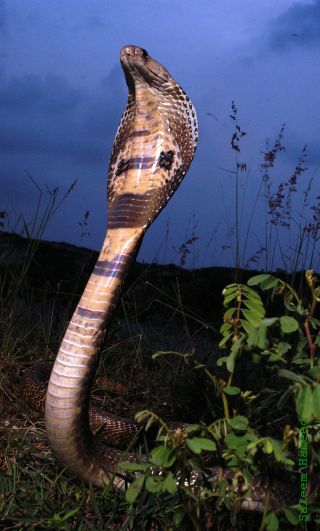
Chinese Cobra Naja atra
The scientific name of the Chinese Cobra is Naja atra. It is a species of reptile in the family Elapidae (cobras), order Squamata. The name dates from 1842.
- Scientific name
- Naja atra Cantor, 1842
- Common name
- Chinese Cobra
- Genus
- Naja
- Family
- Elapidae (Cobras)
- Order
- Squamata
- Class
- Reptilia
- Red List category
- VU Vulnerable
- Recorded in
- 6 countries
- Name status
- accepted in the Catalogue of Life

Overview
The Chinese cobra (Naja atra), also called the Taiwan cobra, is a species of cobra in the family Elapidae, found mostly in southern China and a couple of neighboring nations and islands. It is one of the most prevalent venomous snakes in China, which has caused many snakebite incidents to humans.
Classification of the Chinese Cobra
| Kingdom | Animalia |
|---|---|
| Phylum | Chordata |
| Subphylum | Vertebrata |
| Infraphylum | Gnathostomata |
| Parvphylum | Osteichthyes |
| Megaclass | Tetrapoda |
| Class | Reptilia (Reptile) |
| Order | Squamata (Snakes) |
| Suborder | Serpentes (Snakes) |
| Infraorder | Alethinophidia |
| Family | Elapidae (Cobras) |
| Genus | Naja (Cobras) |
| Species | Naja atra Cantor, 1842 |
Where the Chinese Cobra is found
Checklists and occurrence records place Naja atra in 6 countries across Asia. GBIF holds 2,070 georeferenced records of it.
Countries
Regions and cities with the most records
- Taiwan, Taiwan 568
- Guangdong, China 272
- Tsing Yi Town, Hong Kong 257
- Kwai Chung, Hong Kong 240
- Mei Foo, Hong Kong 239
- Tsuen Wan, Hong Kong 239
- Victoria, Hong Kong 230
- Pok Fu Lam, Hong Kong 229
- Sha Tin, Hong Kong 224
- Nam Cheong, Hong Kong 222
- Sham Shui Po, Hong Kong 219
- Sha Tin Wai, Hong Kong 216
- Mong Kok, Hong Kong 215
- Wong Tai Sin, Hong Kong 214
- Wan Chai, Hong Kong 211
- Hong Kong, Hong Kong 209
- Kowloon City, Hong Kong 204
- Siu Lek Yuen, Hong Kong 204
- Aberdeen, Hong Kong 200
- Sau Mau Ping, Hong Kong 189
- Tseung Kwan O, Hong Kong 189
- Ma On Shan, Hong Kong 184
- Tiu Keng Leng, Hong Kong 178
- Shap Pat Heung, Hong Kong 169
- LOHAS Park, Hong Kong 166
- Tuen Mun, Hong Kong 162
- Tai Po, Hong Kong 159
- San Tung Chung Hang, Hong Kong 158
- Tung Chung, Hong Kong 157
- Yuen Long San Hui, Hong Kong 155
- Ping Shan, Hong Kong 141
- Yuen Long, Hong Kong 138
- Yuen Long Kau Hui, Hong Kong 134
- Tin Shui Wai, Hong Kong 127
- Fanling, Hong Kong 122
- Shenzhen City Centre, China 98
1 more country has a few records outside this range
These countries hold a few records of Naja atra but lie outside the range the checklists give for it. Such records are often zoo or garden specimens, museum material or vagrants, so the species is not counted as occurring there.
Range as the checklists state it
China (S of the Yangtze River: Zhejiang, Fujian, Southern Anhui, Jiangxi, Hunan, Western Hubei, Guizhou, Guangdong, Guangxi, Hainan, Taiwan), N Vietnam
A number beside a place is its count of GBIF occurrence records. A place without a number comes from a checklist alone. Records show where a species has been observed or collected, which can include escapes and vagrants.
Common names
English
- Chinese Cobra
Names in 17 other languages
- Arabic
- ناشر صيني
- Chinese
- 中華眼鏡蛇, 眼鏡蛇, 舟山眼鏡蛇, 舟山眼镜蛇, 飯匙倩
- Czech
- kobra čínská
- Danish
- Kinesisk Spyttekobra
- Dutch
- Indochinese brilslang
- French
- Cobra chinois
- German
- Chinesische Kobra
- Hungarian
- kínai kobra
- Italian
- Cobra cinese, Cobra di Taiwan
- Japanese
- タイワンコブラ
- Norwegian Bokmål
- Kinesisk Kobra
- Polish
- kobra pospolita
- Portuguese
- Cobra-chinesa
- Russian
- Китайская кобра, Чёрная кобра
- Vietnamese
- Rắn hổ mang Trung Quốc
- bnn
- cintataku
- yue
- 饭铲头
Synonyms
6 other scientific names have been used for this species and are now treated as synonyms of Naja atra.
- Naia tripudians var. fasciata Boulenger, 1896
- Naja kaouthia atra Deraniyagala, 1960
- Naja sputatrix atra Lingenhole & Trutnau, 1989
- Naja tripudians var. larrata Steindachner, 1867
- Naja tripudians var. scopinucha Cope, 1859
- Naja tripudians var. unicolor Peters ex Martens, 1876
Related species
-
 Indian CobraNaja naja
-
 Egyptian CobraNaja haje
-
 Monocled CobraNaja kaouthia
-
 Caspian CobraNaja oxiana
-
 Forest CobraNaja melanoleuca
-
 Cape CobraNaja nivea
-
 Philippine CobraNaja philippinensis
-
 Red Spitting CobraNaja pallida
Compare
Questions and answers
What is the scientific name of the Chinese Cobra?
The scientific name of the Chinese Cobra is Naja atra. Written with its author, the full name is Naja atra Cantor, 1842.
Which family does the Chinese Cobra belong to?
Naja atra belongs to the family Elapidae, in the order Squamata and the class Reptilia.
Where is the Chinese Cobra found?
Checklists and occurrence records place Naja atra in 6 countries: Taiwan, China, Hong Kong, Vietnam, Macao and Japan.
What is the conservation status of the Chinese Cobra?
The IUCN Red List category recorded for Naja atra is Vulnerable (VU).
Sources
Data
- Catalogue of Life, 2026-10-16 XR cc by
- Global Biodiversity Information Facility CC BY 4.0
- Wikidata CC0
- English Wikipedia CC BY-SA 4.0
- GeoNames CC BY 4.0
- Wikimedia Commons per image; credit shown with each image
- Within the Catalogue of Life, this name comes from The Reptile Database cc by
References
- Cantor, T. (1842). General features of Chusan, with remarks on the flora and fauna of that island [part 3]. Ann. Mag. Nat. Hist. (1) 9: 481-493.
- Cope, E. D. (1860). Catalogue of the venomous serpents in the Museum of the Academy of Natural Sciences of Philadelphia, with notes on the families, genera and species. Proc. Acad. Nat. Sci. Philadelphia 1859: 332-347.
- Martens, E. von. (1876). Die Preussische Expedition nach Ostasien. Zoologischer Teil. Berlin: Decker Vol. 1: 412 Pp.
- Boulenger, G. A. (1896). Catalogue of the snakes in the British Museum, Vol. 3. London (Taylor & Francis), Xiv + 727 Pp.
- Rosén, N. (1904). Über die Kaumuskeln der Schlangen und ihre Bedeutung bei der Entleerung der Giftdrüse. Zool. Anz. 28: 1-7.
- Barbour, & Thomas. (1909). Notes on Amphibia and Reptilia from Eastern Asia. Proc. New England Zool. Club 4: 53-78, 2 Plates.
- Stejneger, L. (1910). The batrachians and reptiles of Formosa. Proc. US Natl. Mus. 38: 91-114.
- Wüster, & Wolfgang. (1993). A century of confusion: Asiatic cobras revisited. Vivarium 4 (4): 14-18.
- Wüster, W., Thorpe, R. S., Cox, M. J., Jintakune, P., & Nabhitabhata, J. (1995). Populuation systematics of the snake genus Naja (Reptilia: Serpentes: Elapidae) in Indochina: Multivariate morphometrics and comparative mitochondrial DNA sequencing (cytochrome oxidase I). J. Evol. Biol. 8: 493-510.
- Kabisch, K., Kühnel, K.-D. & Herrmann, H.-J. (1995). Impressionen von südchinesischen Märkten (2). TI-Magazin 27 (122): 62-67.
- Ji, X., P.-Y. Sun, H.-S. Zhang & S.-Y. Fu. (1997). Incubation and Utilization of Energy and Material during Embryonic Development in Eggs of Naja naja atra. Journal of Herpetology 31 (2): 302-306.
- Ji, X. & W.-G. Du. (2001). Effects of Thermal and Hydric Environments on Incubating Eggs and Hatchling Traits in the Cobra, Naja naja atra. Journal of Herpetology 35 (2): 186-194.
- Lazell, J. D. (2002). The herpetofauna of Shek Kwu Chau, South Chinese Sea, with descriptions of two new colubrid snakes. Mem. Hong Kong Nat. Hist. Soc. 25: 82 Pp.
- Ziegler, T. (2002). Die Amphibien und Reptilien eines Tieflandfeuchtwald-Schutzgebietes in Vietnam. Natur Und Tier Verlag (Münster), 342 Pp.
- Orlov, N.; Ananjeva, A.; Ryabov, S. & Rao, D.-Q. (2003). Die Giftschlangen Südchinas. Reptilia (Münster) 8 (44): 30-36.
- Orlov, N.; Ananjeva, A.; Ryabov, S. & Rao, D.-Q. (2003). Venomous snakes in Southern China. Reptilia (GB) (31): 22-29.
- Zhao, E. M. (2006). The snakes of China [in Chinese]. Hefei, China, Anhui Sience & Technology Publ. House, Vol. I, 372 Pp., Vol. II (Color Plates), 280 Pp.
- Lin, H.-C., Shou-Hsien Li, Jonathan Fong, & Si-Min Lin. (2008). Ventral coloration differentiation and mitochondrial sequences of the Chinese Cobra (Naja atra) in Taiwan. Conservation Genetics 9:1089–1097.
- Olivier, R. (2008). Kleine gifslangengalerij. Lacerta 66 (1-3): 47-57.
- Nguyen, S.V., Ho, C.T. and Nguyen, T.Q. (2009). Herpetofauna of Vietnam. Chimaira, Frankfurt, 768 Pp.
- Wallach, V.; Wüster, W. & Broadley, D.G. (2009). In praise of subgenera: taxonomic status of cobras of the genus Naja Laurenti (Serpentes: Elapidae). Zootaxa 2236: 26–36.
- Jiang Y, Li Y, Lee W, Xu X, Zhang Y, Zhao R, Zhang Y, & Wang W. (2011). Venom gland transcriptomes of two Elapid snakes (Bungarus multicinctus and Naja atra) and evolution of toxin genes. BMC Genomics 2011, 12:1.
- Winchell, S. (2011). Kobras. Reptilia (Münster) 16 (89): 16-22.
- Wallach, Van; Kenneth L. Williams, Jeff Boundy. (2014). Snakes of the World: A Catalogue of Living and Extinct Species. [type catalogue]. Taylor and Francis, CRC Press, 1237 Pp.
- WANG, Z., Longhui LIN, & Xiang JI. (2014). Unhatched and Hatched Eggshells of the Chinese Cobra Naja atra. Asian Herpetological Research 5 (4): 276-280 Doi 10.3724/SP.J.1245.2014.00276.
This species in other databases
Page built on 25 November 2026. See how the catalog is made and all sources and licences.
Cite this page
ScientificNames.org. (2026). Naja atra (Chinese Cobra). Retrieved November 25, 2026, from https://scientificnames.org/species/naja-atra
“Naja atra (Chinese Cobra).” ScientificNames.org, 2026, scientificnames.org/species/naja-atra. Accessed 25 Nov. 2026.
ScientificNames.org. “Naja atra (Chinese Cobra).” Accessed November 25, 2026. https://scientificnames.org/species/naja-atra.
@misc{scientificnames_naja_atra_chinese_cobra,
  author = {{ScientificNames.org}},
  title = {Naja atra (Chinese Cobra)},
  year = {2026},
  url = {https://scientificnames.org/species/naja-atra},
  note = {Accessed 2026-11-25}
}