Comparison

Northern Grasshopper Mouse vs Southern Grasshopper Mouse

Northern Grasshopper Mouse (Onychomys leucogaster) and Southern Grasshopper Mouse (Onychomys torridus) both belong to the genus Onychomys (grasshopper mouse) and part ways below it. Both are recorded in 2 countries.

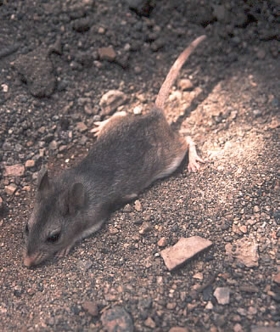
Northern Grasshopper Mouse

Northern Grasshopper Mouse

Onychomys leucogaster

NPS, Public domain, via Wikimedia Commons

Southern Grasshopper Mouse

Southern Grasshopper Mouse

Onychomys torridus

National Park Service, Public domain, via Wikimedia Commons

Side by side

Northern Grasshopper MouseSouthern Grasshopper Mouse
Scientific nameOnychomys leucogaster (Wied-Neuwied, 1841)Onychomys torridus (Coues, 1874)
English nameNorthern Grasshopper MouseSouthern Grasshopper Mouse
GroupMammalsMammals
ClassMammalia MammalMammalia Mammal
OrderRodentia RodentRodentia Rodent
FamilyCricetidae New World Mice and RatsCricetidae New World Mice and Rats
GenusOnychomys Grasshopper MouseOnychomys Grasshopper Mouse
Named in18411874
Red List categoryLeast ConcernLeast Concern
Countries on record3 countries2 countries
GBIF occurrence records18,212 records7,481 records

Rows where the two agree are shown in grey.

Where each is found

Both recorded in 2 countries

Only Northern Grasshopper Mouse (1)

From Catalogue of Life checklists and GBIF occurrence records. A country missing from a list means no record is held, which is not proof of absence.

Checked facts

Northern Grasshopper MouseSouthern Grasshopper Mouse
Appearance
  • The northern grasshopper mouse has a stout body and a short tail. depts.ttu.edu
  • Its upperparts are drab brown, while its nose, sides, cheeks, and underparts are white. depts.ttu.edu
  • It has a conspicuous white tuft at the anterior base of each ear. depts.ttu.edu
  • Its tail is usually less than 30% of its total body length. depts.ttu.edu
  • The species has smaller teeth than many other mice, with pointed cusps. animaldiversity.org
SizeNo checked fact yet
  • Its total body length, including the tail, ranges from 120 to 163 mm. English Wikipedia
  • Its head-and-body length averages 9–13 cm, and its tail measures 3–6 cm. animaldiversity.org
  • The tail accounts for an average of 33.9% of the animal's body length. English Wikipedia
  • Females have an average tail length of 4.58 cm, compared with 4.50 cm in males. English Wikipedia
Habitat
  • The species inhabits shortgrass prairies, sand dunes, and sagebrush deserts. animaldiversity.org
  • Northern grasshopper mice commonly occupy sandy soils where they construct burrows. animaldiversity.org
  • Northern grasshopper mice use burrows made by other small mammals. depts.ttu.edu
Diet
  • Animal matter accounts for approximately 89% of the species' natural diet, while plant material accounts for 11%. depts.ttu.edu
  • Grasshoppers are among the species' principal seasonal food items. depts.ttu.edu
  • The species consumes insects, including grasshoppers, scorpions, beetles, crickets, and moths. animaldiversity.org
  • Northern grasshopper mice prey on other rodents, including members of their own species. animaldiversity.org
  • The species also consumes a variety of plants. depts.ttu.edu
  • Captive northern grasshopper mice are particularly fond of raw liver and newborn mice. depts.ttu.edu
  • Arthropods constitute almost the entire diet of the southern grasshopper mouse. English Wikipedia
  • Its prey includes little pocket mice and western harvest mice. English Wikipedia
  • Arizona bark scorpions are among its prey, and the mouse can consume them despite repeated stings. English Wikipedia
  • Seeds, plants, and vegetables account for approximately 10–25% of its diet. animaldiversity.org
  • Its animal prey also includes rodents belonging to the genera Peromyscus, Perognathus, and Microtus. animaldiversity.org
Behaviour
  • The species is predominantly nocturnal. English Wikipedia
  • Southern grasshopper mice are highly aggressive predators. English Wikipedia
  • They stalk prey before rushing forward and killing it with a bite to the head. animaldiversity.org
  • They are capable of climbing well and remain active throughout the year. animaldiversity.org
  • Individuals are generally solitary and defend their territories aggressively against intruders. animaldiversity.org
  • They sometimes live in male-female pairs throughout the year. animaldiversity.org
  • They produce a loud, piercing vocalization lasting between 0.7 and 1.2 seconds. animaldiversity.org
  • Their characteristic vocalization can be heard by humans at distances of up to 100 metres. animaldiversity.org
  • They give their characteristic call when confronting adversaries or before killing prey. animaldiversity.org
  • They sometimes kill and eat other members of their species when threatened or food is scarce. animaldiversity.org
  • Live crickets are preferred over dead crickets. English Wikipedia
  • The species can temporarily become insensitive to pain after receiving Arizona bark scorpion venom. English Wikipedia
Reproduction
  • Breeding occurs throughout the year in some parts of the species' range in Texas. depts.ttu.edu
  • The breeding season in Texas extends at least from February through October. depts.ttu.edu
  • Females can produce three to six litters annually. depts.ttu.edu
  • Litters contain between two and six young, averaging approximately four. depts.ttu.edu
  • The gestation period lasts between 32 and 47 days. depts.ttu.edu
  • Newborn young are pink and hairless, apart from their prominent whiskers, and weigh approximately 2 g. depts.ttu.edu
  • Newborn young have closed eyes and ears. depts.ttu.edu
  • Sexual maturity is reached at approximately three months of age. depts.ttu.edu
  • Females spend considerable time caring for their young until the offspring reach 14 days of age. animaldiversity.org
Distribution
  • The species occurs from southwestern Canada through the western United States into northwestern Mexico. animaldiversity.org
  • Its range extends from the Pacific coast eastward to western Minnesota and Iowa. animaldiversity.org
  • The species occurs in Mexico and the United States states of Arizona, California, Nevada, New Mexico, and Utah. English Wikipedia
Conservation
  • The northern grasshopper mouse is classified as a species of least concern by the IUCN. depts.ttu.edu
  • The species is not listed on federal or state concerned-species lists in Texas. depts.ttu.edu
  • The species is described as common across central and eastern Montana and faces no threats. fieldguide.mt.gov
Uses
  • The species has been suggested as a potential natural predator of agricultural insect pests. animaldiversity.org
  • Northern grasshopper mice can become tame in captivity and are kept as pets. animaldiversity.org
  • The species benefits farmers by consuming insects and rodents that could otherwise damage crops. animaldiversity.org
Similar species
  • Onychomys leucogaster resembles Onychomys arenicola but is larger, heavier, and shorter-tailed. depts.ttu.edu
No checked fact yet

In brief

Northern Grasshopper Mouse

Onychomys leucogaster inhabits shortgrass prairies, sand dunes, and sagebrush deserts, commonly occupying sandy soils where it constructs burrows. It has a stout body, a short tail, drab brown upperparts, white underparts, and pointed teeth, and it preys on insects and other rodents. Full profile

Southern Grasshopper Mouse

Onychomys torridus inhabits hot, arid valleys, scrub deserts, shortgrass prairies, and desert scrub. It is a predominantly nocturnal predator that feeds mainly on arthropods and can consume Arizona bark scorpions despite repeated stings. Full profile

Compare something else

Page built on 29 November 2026 from the data on the two species pages, where every source is listed.

Cite this page

ScientificNames.org. (2026). Northern Grasshopper Mouse vs Southern Grasshopper Mouse. Retrieved November 29, 2026, from https://scientificnames.org/compare/northern-grasshopper-mouse-vs-southern-grasshopper-mouse