Species · Mammals
Northern Grasshopper Mouse Onychomys leucogaster
The scientific name of the Northern Grasshopper Mouse is Onychomys leucogaster. It is a species of mammal in the family Cricetidae (new world mice and rats), order Rodentia. The name dates from 1841.
- Scientific name
- Onychomys leucogaster (Wied-Neuwied, 1841)
- Common name
- Northern Grasshopper Mouse
- Genus
- Onychomys
- Family
- Cricetidae (New World Mice and Rats)
- Order
- Rodentia
- Class
- Mammalia
- Red List category
- LC Least Concern
- Recorded in
- 3 countries
- Name status
- accepted in the Catalogue of Life

Overview
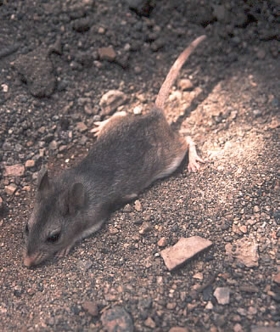
Onychomys leucogaster inhabits shortgrass prairies, sand dunes, and sagebrush deserts, commonly occupying sandy soils where it constructs burrows. It has a stout body, a short tail, drab brown upperparts, white underparts, and pointed teeth, and it preys on insects and other rodents.
Written 26 November 2026 from the sources listed below. Each statement was checked against the passage it cites; statements that could not be supported were removed.
Appearance
The Northern Grasshopper Mouse has a stout body and a short tail, usually less than 30% of its total body length. Its upperparts are drab brown, while its nose, sides, cheeks, and underparts are white.[1][2][3]
A conspicuous white tuft is present at the anterior base of each ear. The species has smaller teeth than many other mice, with pointed cusps.[4][5]
Habitat
The Northern Grasshopper Mouse inhabits shortgrass prairies, sand dunes, and sagebrush deserts. It commonly occupies sandy soils where it constructs burrows.[6][7]
Northern Grasshopper Mice also use burrows made by other small mammals.[8]
Diet
Animal matter accounts for approximately 89% of the Northern Grasshopper Mouse's natural diet, while plant material accounts for 11%. Its diet includes insects such as grasshoppers, scorpions, beetles, crickets, and moths.[9][10]
Grasshoppers are among its principal seasonal food items. The species also preys on other rodents, including members of its own species, and consumes a variety of plants.[11][12][13]
Captive Northern Grasshopper Mice are particularly fond of raw liver and newborn mice.[14]
Behaviour
Northern Grasshopper Mice are primarily solitary and nocturnal. They spend the daytime sheltering in an intricate burrow system and remain active throughout the year.[15][16][17]
Their activity is influenced by lunar phases, photoperiod, and daily weather. Individuals travel continuously throughout their territories.[18][19]
Reproduction and life cycle
Breeding occurs throughout the year in some parts of the species' range in Texas. The breeding season in Texas extends at least from February through October.[20][21]
Females can produce three to six litters annually, with each litter containing between two and six young and averaging approximately four. The gestation period lasts between 32 and 47 days.[22][23][24]
Newborn young are pink and hairless, apart from their prominent whiskers, and weigh approximately 2 g. Their eyes and ears are closed at birth.[25][26]
Females spend considerable time caring for their young until the offspring reach 14 days of age. Sexual maturity is reached at approximately three months of age.[27][28]
Conservation
The Northern Grasshopper Mouse is classified as a species of least concern by the IUCN. It is not listed on federal or state concerned-species lists in Texas.[29][30]
The species is described as common across central and eastern Montana and faces no threats.[31]
Uses
The Northern Grasshopper Mouse has been suggested as a potential natural predator of agricultural insect pests. It can become tame in captivity and is kept as a pet.[32][33]
Similar species
Onychomys leucogaster resembles Onychomys arenicola but is larger, heavier, and shorter-tailed.[34]
Classification of the Northern Grasshopper Mouse
| Kingdom | Animalia |
|---|---|
| Phylum | Chordata |
| Subphylum | Vertebrata |
| Infraphylum | Gnathostomata |
| Parvphylum | Osteichthyes |
| Megaclass | Tetrapoda |
| Class | Mammalia (Mammal) |
| Subclass | Theria |
| Infraclass | Eutheria |
| Order | Rodentia (Rodent) |
| Suborder | Myomorpha (Mice) |
| Superfamily | Muroidea |
| Family | Cricetidae (New World Mice and Rats) |
| Subfamily | Neotominae |
| Genus | Onychomys (Grasshopper Mouse) |
| Species | Onychomys leucogaster (Wied-Neuwied, 1841) |
Where the Northern Grasshopper Mouse is found
Checklists and occurrence records place Onychomys leucogaster in 3 countries across North America. GBIF holds 18,212 georeferenced records of it.
Countries
Regions and cities with the most records
- New Mexico, United States 2,588
- Colorado, United States 2,558
- Saskatchewan, Canada 2,224
- Texas, United States 1,561
- Kansas, United States 1,113
- Utah, United States 936
- Arizona, United States 885
- Wyoming, United States 497
- Oklahoma, United States 410
- Nevada, United States 310
- Garden City, United States 296
- Rio Rancho, United States 272
- Alberta, Canada 260
- Nebraska, United States 219
- Albuquerque, United States 189
- El Paso, United States 161
- Enchanted Hills, United States 137
- Washington, United States 135
- Sunland Park, United States 122
- Horizon City, United States 119
- Ciudad Juárez, Mexico 117
- Socorro, United States 115
- Socorro Mission Number 1 Colonia, United States 115
- Montana, United States 102
- South Valley, United States 102
- North Dakota, United States 101
- California, United States 87
- Chihuahua, Mexico 78
- Hays, United States 72
- Nuevo León, Mexico 69
- South Dakota, United States 63
- Oregon, United States 59
- Tamaulipas, Mexico 55
- Colorado Springs, United States 54
- Idaho, United States 52
- Laramie, United States 51
Range as the checklists state it
Middle America
North America
A number beside a place is its count of GBIF occurrence records. A place without a number comes from a checklist alone. Records show where a species has been observed or collected, which can include escapes and vagrants.
Common names
English
- Northern Grasshopper Mouse
Names in 9 other languages
- Czech
- křeček hmyzožravý
- Dutch
- Noordelijke Sprinkhaanmuis
- Finnish
- heinäsirkkahiiru
- French
- souris à sauterelles
- Japanese
- キタバッタマウス
- Norwegian Bokmål
- Nordlig Gresshoppemus
- Polish
- pasikoniszka białobrzucha
- Russian
- Северный кузнечиковый хомячок
- Spanish
- Ratón chapulinero norteño, Ratón-saltamontes norteño
Synonyms
16 other scientific names have been used for this species and are now treated as synonyms of Onychomys leucogaster.
- Hydudaeus leucogaster (Wied-Neuwied, 1841) Wied-Neuwied, 1841
- Hypudaeus leucogaster Wied-Neuwied, 1841
- Mus missouriensis Audubon & Bachman, 1851
- Onychomys arcticeps Rhoads, 1898
- Onychomys fuliginosus Merriam, 1890
- Onychomys leucogaster albescens Merriam, 1904
- Onychomys leucogaster breviauritus Hollister, 1913
- Onychomys leucogaster brevicaudus Merriam, 1891
- Onychomys leucogaster capitulatus Hollister, 1913
- Onychomys leucogaster melanophrys Merriam, 1889
- Onychomys leucogaster pallidus Herrick, 1885
- Onychomys leucogaster utahensis Goldman, 1939
- Onychomys leucogriseus fuscogriseus Anthony, 1913
- Onychomys longipes Merriam, 1889
- Onychomys melanophrys pallescens Merriam, 1890
- Onychomys ruidosae Stone & Rehn, 1903
Related species
-
 Southern Grasshopper MouseOnychomys torridus
- Mearns's Grasshopper MouseOnychomys arenicola
-
 MuskratOndatra zibethicus
-
 European HamsterCricetus cricetus
-
 Golden HamsterMesocricetus auratus
-
 Winter White Dwarf HamsterPhodopus sungorus
-
 European Water VoleArvicola amphibius
- Indefatigable Galapagos MouseNesoryzomys indefessus
Compare
Questions and answers
What is the scientific name of the Northern Grasshopper Mouse?
The scientific name of the Northern Grasshopper Mouse is Onychomys leucogaster. Written with its author, the full name is Onychomys leucogaster (Wied-Neuwied, 1841).
Which family does the Northern Grasshopper Mouse belong to?
Onychomys leucogaster belongs to the family Cricetidae, in the order Rodentia and the class Mammalia.
Where is the Northern Grasshopper Mouse found?
Checklists and occurrence records place Onychomys leucogaster in 3 countries: United States, Canada and Mexico.
What is the conservation status of the Northern Grasshopper Mouse?
The IUCN Red List category recorded for Onychomys leucogaster is Least Concern (LC).
Why is it called grasshopper mouse?
Grasshoppers are among the species' principal seasonal food items.[11]
Can you own a grasshopper mouse?
Northern Grasshopper Mice can become tame in captivity and are kept as pets.[33]
What does the grasshopper mouse eat?
It eats insects, including grasshoppers, scorpions, beetles, crickets, and moths, as well as other rodents and a variety of plants. Animal matter accounts for approximately 89% of its natural diet, while plant material accounts for 11%.[9][10][12][13]
Where do grasshopper mice live?
The Northern Grasshopper Mouse inhabits shortgrass prairies, sand dunes, and sagebrush deserts. Its range extends from southwestern Canada through the western United States into northwestern Mexico, from the Pacific coast eastward to western Minnesota and Iowa.[6][35][36]
Sources
Passages the profile rests on
- The northern grasshopper mouse has a stout body and a short tail. Source passage: “A stout-bodied, short-tailed mouse similar to O. arenicola but larger, heavier, and shorter tailed” — depts.ttu.edu
- Its upperparts are drab brown, while its nose, sides, cheeks, and underparts are white. Source passage: “upperparts drab brown; the nose, sides, cheeks, and underparts white” — depts.ttu.edu
- Its tail is usually less than 30% of its total body length. Source passage: “tail usually <30% of total length” — depts.ttu.edu
- It has a conspicuous white tuft at the anterior base of each ear. Source passage: “tuft at anterior base of ear white and conspicuous” — depts.ttu.edu
- The species has smaller teeth than many other mice, with pointed cusps. Source passage: “Teeth are smaller than many other mice, with pointed cusps reflecting their carnivorous diet.” — animaldiversity.org
- The species inhabits shortgrass prairies, sand dunes, and sagebrush deserts. Source passage: “Onychomys leucogaster live in shortgrass prairies, sand dunes and in sage brush desert.” — animaldiversity.org
- Northern grasshopper mice commonly occupy sandy soils where they construct burrows. Source passage: “These are primarily areas with sandy soil in which they build their burrows.” — animaldiversity.org
- Northern grasshopper mice use burrows made by other small mammals. Source passage: “They are reputed to usurp the burrows of other small mammals rather than take the time to construct their own.” — depts.ttu.edu
- Animal matter accounts for approximately 89% of the species' natural diet, while plant material accounts for 11%. Source passage: “animal matter makes up nearly 89% of their natural food, plant material only 11%.” — depts.ttu.edu
- The species consumes insects, including grasshoppers, scorpions, beetles, crickets, and moths. Source passage: “They feed primarily on insects, including grasshoppers, scorpions, beetles, crickets, and moths.” — animaldiversity.org
- Grasshoppers are among the species' principal seasonal food items. Source passage: “one of their chief food items in season is grasshoppers.” — depts.ttu.edu
- Northern grasshopper mice prey on other rodents, including members of their own species. Source passage: “They have been known to eat rodents as well, including other O. leucogaster .” — animaldiversity.org
- The species also consumes a variety of plants. Source passage: “numerous other kinds of insects, scorpions, small mice, and a variety of plants contribute to their diet.” — depts.ttu.edu
- Captive northern grasshopper mice are particularly fond of raw liver and newborn mice. Source passage: “Captives are especially fond of raw liver and newborn mice.” — depts.ttu.edu
- Northern grasshopper mice are primarily solitary. Source passage: “Northern grasshopper mice are primarily solitary.” — animaldiversity.org
- The species is nocturnal and spends the daytime sheltering in an intricate burrow system. Source passage: “Onychomys leucogaster are nocturnal and hide in an intricate burrow system during the day.” — animaldiversity.org
- The species remains active throughout the year. Source passage: “Since grasshopper mice are active year round and nocturnal” — animaldiversity.org
- Its activity is influenced by lunar phases, photoperiod, and daily weather. Source passage: “their activity is influenced by lunar phases, photoperiod, and daily weather.” — animaldiversity.org
- Individuals travel continuously throughout their territories. Source passage: “They are wanderers and travel continuously throughout their territory.” — depts.ttu.edu
- Breeding occurs throughout the year in some parts of the species' range in Texas. Source passage: “breeding may occur throughout most of the year in some parts of its range within Texas.” — depts.ttu.edu
- The breeding season in Texas extends at least from February through October. Source passage: “The breeding season extends at least from February to October” — depts.ttu.edu
- Females can produce three to six litters annually. Source passage: “Three to six litters of young may be produced annually” — depts.ttu.edu
- Litters contain between two and six young, averaging approximately four. Source passage: “The litter size varies from two to six, averaging about four.” — depts.ttu.edu
- The gestation period lasts between 32 and 47 days. Source passage: “The gestation period varies from 32 to 47 days” — depts.ttu.edu
- Newborn young are pink and hairless, apart from their prominent whiskers, and weigh approximately 2 g. Source passage: “At birth, the young are pink and hairless (except for the prominent vibrissae) and weigh about 2 g each.” — depts.ttu.edu
- Newborn young have closed eyes and ears. Source passage: “The eyes and ears are closed” — depts.ttu.edu
- Sexual maturity is reached at approximately three months of age. Source passage: “Sexual maturity is reached in about 3 months” — depts.ttu.edu
- Females spend considerable time caring for their young until the offspring reach 14 days of age. Source passage: “The female rears an average of four young which she spends much time caring for until they are 14 days old.” — animaldiversity.org
- The northern grasshopper mouse is classified as a species of least concern by the IUCN. Source passage: “The IUCN lists the northern grasshopper mouse as a species of least concern” — depts.ttu.edu
- The species is not listed on federal or state concerned-species lists in Texas. Source passage: “it does not appear on the federal or state lists of concerned species.” — depts.ttu.edu
- The species is described as common across central and eastern Montana and faces no threats. Source passage: “Species is common across central and eastern Montana and faces no threats.” — fieldguide.mt.gov
- The species has been suggested as a potential natural predator of agricultural insect pests. Source passage: “it has been suggested that O. leucogaster may be able to serve as a natural predator against pests that commonly disturb agriculture.” — animaldiversity.org
- Northern grasshopper mice can become tame in captivity and are kept as pets. Source passage: “They also make interesting pets, and become tame in captivity.” — animaldiversity.org
- Onychomys leucogaster resembles Onychomys arenicola but is larger, heavier, and shorter-tailed. Source passage: “similar to O. arenicola but larger, heavier, and shorter tailed” — depts.ttu.edu
- The species occurs from southwestern Canada through the western United States into northwestern Mexico. Source passage: “Onychomys leucogaster , the Northern grasshopper mouse, can be found from southwestern Canada throughout the western United States into northwestern Mexico.” — animaldiversity.org
- Its range extends from the Pacific coast eastward to western Minnesota and Iowa. Source passage: “Its distribution ranges from the Pacific coast to western Minnesota and Iowa.” — animaldiversity.org
Data
- Catalogue of Life, 2026-10-16 XR cc by
- Global Biodiversity Information Facility CC BY 4.0
- Wikidata CC0
- GeoNames CC BY 4.0
- Wikimedia Commons per image; credit shown with each image
- Within the Catalogue of Life, this name comes from The Integrated Taxonomic Information System cc0
References
- Reise in Nord America vol.2 p.99 where the name was published
- Hall, & Raymond, E. (1981). The Mammals of North America, 2nd Ed., Vol. 2.
- Banks, R. C., R. W. McDiarmid, and A. L. Gardner. (1987). Checklist of Vertebrates of the United States, the U.S. Territories, and Canada. Resource Publication, No. 166.
- Wilson, Don E., and DeeAnn M. Reeder, eds. (1993). Mammal Species of the World: A Taxonomic and Geographic Reference, 2nd Ed., 3rd Printing.
- Wilson, Don E., and F. Russell Cole. (2000). Common Names of Mammals of the World.
- Musser, Guy G., and Michael D. Carleton / Wilson, Don E., and DeeAnn M. Reeder, eds. (2005). Superfamily Muroidea. Mammal Species of the World: A Taxonomic and Geographic Reference, 3rd Ed., Vol. 2.
This species in other databases
Page built on 26 November 2026. See how the catalog is made and all sources and licences.
Cite this page
ScientificNames.org. (2026). Onychomys leucogaster (Northern Grasshopper Mouse). Retrieved November 26, 2026, from https://scientificnames.org/species/onychomys-leucogaster
“Onychomys leucogaster (Northern Grasshopper Mouse).” ScientificNames.org, 2026, scientificnames.org/species/onychomys-leucogaster. Accessed 26 Nov. 2026.
ScientificNames.org. “Onychomys leucogaster (Northern Grasshopper Mouse).” Accessed November 26, 2026. https://scientificnames.org/species/onychomys-leucogaster.
@misc{scientificnames_onychomys_leucogaster_northern_grasshopper_mouse,
  author = {{ScientificNames.org}},
  title = {Onychomys leucogaster (Northern Grasshopper Mouse)},
  year = {2026},
  url = {https://scientificnames.org/species/onychomys-leucogaster},
  note = {Accessed 2026-11-26}
}