Species · Insects
Common Grass Yellow Eurema hecabe
The scientific name of the Common Grass Yellow is Eurema hecabe. It is a species of insect in the family Pieridae (whites), order Lepidoptera. The name dates from 1758.
- Scientific name
- Eurema hecabe (Linnaeus, 1758)
- Common name
- Common Grass Yellow
- Genus
- Eurema
- Family
- Pieridae (Whites)
- Order
- Lepidoptera
- Class
- Insecta
- Red List category
- LC Least Concern
- Recorded in
- 69 countries
- Name status
- accepted in the Catalogue of Life

Overview
The Common Grass Yellow (Eurema hecabe) is a small butterfly in the family Pieridae, order Lepidoptera and class Insecta. It occurs in open grass habitats and scrub habitats. It is distinguished by yellow upper wing surfaces, black markings and reddish-brown markings on the paler underside.
Written 26 November 2026 from the sources listed below. Each statement was checked against the passage it cites; statements that could not be supported were removed.
Appearance
Females have slightly broader black areas on both pairs of upper wing surfaces than males. They also possess a reduced patch of ultraviolet-reflecting scales on the upper forewing.[1][2]
Habitat
The species occurs in open grass habitats and scrub habitats.[3][4]
Behaviour
Adults commonly fly close to the ground. Males search visually for receptive females by patrolling around patches of larval host plants.[5][6]
During the early morning, males concentrate on finding newly emerged, immobile females. During late morning, they invest more time courting older, flying females while continuing to search for newly emerged females.[7][8][9]
Male mate-searching behaviour involves mobile patrolling rather than territorial defence. Males adjust their courtship investment according to the likely availability of receptive females.[10][11]
Reproduction and life cycle
Females are sexually receptive immediately after emerging from the pupa and may become sexually receptive once or possibly twice again during adulthood. Freshly emerged females are generally immobile and can be mated shortly after emergence.[12][13][14]
Females generally seek to lay eggs after mating. They lay eggs on Abrus precatorius, Falcataria moluccana and Aeschynomene species.[15][16][17][18]
The species also lays eggs on plants belonging to the Leguminosae, Euphorbiaceae and Cucurbitaceae families. Females can discriminate between colours when selecting plants for egg-laying.[19][20]
The larva is green, cylindrical or slightly flattened, rough-bodied and has a large head. The pupa is ordinarily solitary and green, hanging by its tail and a moderately long supporting band.[21][22][23]
Pupae sometimes occur in large numbers on a twig. The species has been found parasitised by multiple strains of Wolbachia, which can alter its sex ratios.[24][25][26]
Classification of the Common Grass Yellow
| Kingdom | Animalia |
|---|---|
| Phylum | Arthropoda |
| Subphylum | Hexapoda |
| Class | Insecta (Insect) |
| Order | Lepidoptera |
| Superfamily | Papilionoidea |
| Family | Pieridae (Whites) |
| Genus | Eurema (Grass Yellows) |
| Species | Eurema hecabe (Linnaeus, 1758) |
Where the Common Grass Yellow is found
Checklists and occurrence records place Eurema hecabe in 69 countries. GBIF holds 29,831 georeferenced records of it.
Countries
- Afghanistan 9
- American Samoa 3
- Angola 21
- Australia 6,247
- Bangladesh 93
- Benin 19
- Bhutan 10
- Botswana 6
- Burkina Faso 11
- Cabo Verde 38
- Cambodia 167
- Cameroon 14
- China 321
- Democratic Republic of the Congo 37
- Eswatini 107
- Ethiopia 8
- Fiji 84
- Gabon 10
- Gambia 194
- Ghana 37
- Guam 50
- Guinea 22
- Hong Kong 1,500
- India 7,529
- Indonesia 2,040
- Japan 3,422
- Kenya 94
- Laos 40
- Liberia 13
- Macao 41
- Madagascar 7
- Malawi 60
- Malaysia 417
- Maldives 59
- Mali 5
- Mauritius 4
- Micronesia 9
- Mozambique 40
- Myanmar 79
- Namibia 24
- Nepal 150
- New Caledonia 61
- Nigeria 100
- Oman 51
- Pakistan 91
- Palau 7
- Papua New Guinea 318
- Philippines 388
- Republic of the Congo 4
- Rwanda 14
- Samoa 13
- Senegal 16
- Sierra Leone 6
- Singapore 1,211
- Solomon Islands 32
- South Africa 1,343
- South Korea 856
- South Sudan 12
- Sri Lanka 228
- Sudan 25
- Taiwan 945
- Tanzania 42
- Thailand 348
- Tonga 4
- Uganda 67
- Vanuatu 33
- Vietnam 225
- Zambia 282
- Zimbabwe 68
Regions and cities with the most records
- Queensland, Australia 4,596
- Maharashtra, India 2,201
- Novena, Singapore 1,196
- Ang Mo Kio New Town, Singapore 1,195
- Yio Chu Kang, Singapore 1,195
- Yishun New Town, Singapore 1,188
- Sungai Simpang, Singapore 1,184
- Sengkang New Town, Singapore 1,178
- Sembawang Estate, Singapore 1,177
- Bukit Timah, Singapore 1,173
- Queenstown Estate, Singapore 1,171
- Woodlands, Singapore 1,148
- Anak Bukit, Singapore 1,139
- Matilda Estate, Singapore 1,139
- Singapore, Singapore 1,138
- MacPherson, Singapore 1,121
- Eunos, Singapore 1,110
- Bukit Panjang New Town, Singapore 1,101
- Teck Whye, Singapore 1,098
- Choa Chu Kang New Town, Singapore 1,096
- Keat Hong Village, Singapore 1,088
- Marsiling, Singapore 1,078
- Jurong East, Singapore 1,073
- Yew Tee, Singapore 1,072
- Punggol, Singapore 1,069
- Marine Parade, Singapore 1,068
- Discovery Park, Hong Kong 1,060
- Tsuen Wan, Hong Kong 1,056
- Jurong Town, Singapore 1,051
- Jurong West, Singapore 1,048
- Tsing Yi Town, Hong Kong 1,033
- Kampong Pasir Ris, Singapore 1,024
- Kampung Pasir Gudang Baru, Malaysia 1,021
- Kwai Chung, Hong Kong 1,012
- Shek Lei, Hong Kong 1,011
- Tai Wai, Hong Kong 1,007
2 more countries have a few records outside this range
These countries hold a few records of Eurema hecabe but lie outside the range the checklists give for it. Such records are often zoo or garden specimens, museum material or vagrants, so the species is not counted as occurring there.
A number beside a place is its count of GBIF occurrence records. A place without a number comes from a checklist alone. Records show where a species has been observed or collected, which can include escapes and vagrants.
Common names
English
- Common Grass Yellow
- Common Grass-yellow
- Grass Yellow
- Large Grass Yellow
- Large Grass-yellow
- Pale Grass Yellow
Names in 12 other languages
- Afrikaans
- Laeveldgeletjie
- Bengali
- হলুদ (প্রজাপতি)
- Chinese
- 寬邊黃粉蝶, 合歡粉蝶, 宽边黄粉蝶, 寬邊黃蝶, 荷氏黃粉蝶, 荷氏黃蝶, 銀歡粉蝶, 黃蝶
- Dutch
- Gewoon grasgeeltje
- French
- Coliade Hécabé, Piéride citron
- Japanese
- キチョウ, ミナミキチョウ, ミナミキチョウ(南黄蝶)
- Korean
- 남방노랑나비
- Marathi
- तृण पिलाती
- Spanish
- Mariposa amarilla Agave
- Tamil
- மஞ்சள் புல்வெளியான்
- Telugu
- పసుపు చిలుక
- Thai
- ผีเสื้อเณรธรรมดา
Synonyms
28 other scientific names have been used for this species and are now treated as synonyms of Eurema hecabe.
- Eurema hecabe novaecaledoniae (Corbet & Pendlebury, 1932)
- Eurema hecabe subdecorata (Moore)
- Eurema hecabe sulphurata (Butler, 1876)
- Eurema hecabe var. kerawara Ribbe, 1898
- Eurema hecabe var. magna Ribbe, 1898
- Eurema jacouleti Nakahara, 1941
- Eurema paroeana Strand, 1922
- Papilio hecabe Linnaeus, 1758
- Papilio luzonicus Linnaeus, 1764
- Terias apicalis Moore, 1882
- Terias arcuata Moore, 1878
- Terias attenuata Moore, 1878
- Terias excavata Moore, 1882
- Terias fraterna Moore, 1886
- Terias hecabe (Linnaeus, 1758)
- Terias hecabe f. apicalis Moore
- Terias hecabe f. paroeana Strand, 1922
- Terias hecabe subdecorata Moore, 1878
- Terias irregularis Moore, 1882
- Terias latimargo Hopffer, 1874
- Terias maroensis Butler, 1883
- Terias mbriata Wallace, 1867
- Terias merguiana Moore, 1886
- Terias patruelis Moore, 1886
- Terias purreea Moore, 1882
- Terias simulata Moore, 1881
- Terias subdecorata Moore, 1878
- Terias subdecorata f. attenuata Moore, 1878
Subspecies and varieties
- Eurema hecabe hecabe (Oriental Common Grass Yellow) subspecies
- Terias hecabe novaecaledoniae subspecies
- Terias hecabe solifera (Common Grass Yellow) subspecies
- Terias hecabe sulphurata subspecies
Related species
-
 Broad-bordered Grass YellowEurema brigitta
-
 Three Spot Grass YellowEurema blanda
- Barred SulphurEurema daira
-
 Mexican YellowEurema mexicana
-
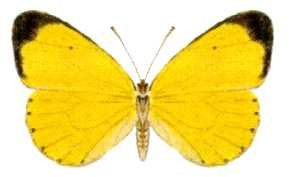 Small Grass-yellowEurema smilax
-
 Spotless Grass YellowEurema laeta
- Changeable Grass YellowEurema simulatrix
-
 Malagasy Grass YellowEurema floricola
Compare
Questions and answers
What is the scientific name of the Common Grass Yellow?
The scientific name of the Common Grass Yellow is Eurema hecabe. Written with its author, the full name is Eurema hecabe (Linnaeus, 1758).
Which family does the Common Grass Yellow belong to?
Eurema hecabe belongs to the family Pieridae, in the order Lepidoptera and the class Insecta.
Where is the Common Grass Yellow found?
Checklists and occurrence records place Eurema hecabe in 69 countries, including India, Australia, Japan, Indonesia, Hong Kong and South Africa.
What is the conservation status of the Common Grass Yellow?
The IUCN Red List category recorded for Eurema hecabe is Least Concern (LC).
What other names does the Common Grass Yellow have?
Eurema hecabe is also known in English as Common Grass-yellow, Grass Yellow, Large Grass Yellow, Large Grass-yellow and Pale Grass Yellow.
Sources
Passages the profile rests on
- Females have slightly broader black areas on both pairs of upper wing surfaces than males. Source passage: “the black areas on both forewings and hindwings slightly broader” — English Wikipedia
- Females possess a reduced patch of ultraviolet-reflecting scales on the upper forewing. Source passage: “Females also have a reduced patch of ultraviolet-reflecting scales located in the proximate region of the dorsal forewing.” — English Wikipedia
- The species occurs in open grass habitats. Source passage: “open grass and scrub habitats.” — English Wikipedia
- The species occurs in scrub habitats. Source passage: “open grass and scrub habitats.” — English Wikipedia
- Adults commonly fly close to the ground. Source passage: “They are found flying close to the ground” — English Wikipedia
- Males search visually for receptive females by patrolling around patches of larval host plants. Source passage: “males visually search for receptive females by patrolling in and around patches of the larval host plant.” — pmc.ncbi.nlm.nih.gov
- Males concentrate on finding newly emerged, immobile females during the early morning. Source passage: “Early in the morning, when most females eclose, males focus on locating freshly emerged, immobile females;” — pmc.ncbi.nlm.nih.gov
- Males invest more time courting older, flying females during late morning. Source passage: “later, they invest more time courting older, flying females” — pmc.ncbi.nlm.nih.gov
- Male butterflies continue searching for newly emerged females while courting mature females later in the morning. Source passage: “The males appear to continue the search for teneral matings alongside the courting of mature females in the late mornings” — pmc.ncbi.nlm.nih.gov
- Male mate-searching behaviour involves mobile patrolling rather than territorial defence. Source passage: “Males of E. hecabe, much like other Pierid butterflies (such as Colias eurytheme ; Kingsolver 1983), do not exhibit pupal or resource guarding and will instead invest almost all their time patrolling in search of receptive females” — pmc.ncbi.nlm.nih.gov
- Males adjust their courtship investment according to the likely availability of receptive females. Source passage: “E. hecabe males optimise their chances of copulation by allocating their mate search efforts according to the likely availability of receptive females.” — pmc.ncbi.nlm.nih.gov
- Females are sexually receptive immediately after emerging from the pupa. Source passage: “Females of this weakly polyandrous species are sexually receptive immediately upon eclosion” — pmc.ncbi.nlm.nih.gov
- Females may become sexually receptive once or possibly twice again during adulthood. Source passage: “and then once or possibly twice during adulthood.” — pmc.ncbi.nlm.nih.gov
- Freshly emerged females are generally immobile and can be mated shortly after emergence. Source passage: “newly eclosed, immobile female” — pmc.ncbi.nlm.nih.gov
- Females generally seek to lay eggs after they have mated. Source passage: “who are generally seeking to oviposit.” — pmc.ncbi.nlm.nih.gov
- Females lay eggs on Abrus precatorius. Source passage: “Eggs are laid on Abrus precatorius” — English Wikipedia
- Females lay eggs on Falcataria moluccana. Source passage: “Falcataria moluccana” — English Wikipedia
- Females lay eggs on Aeschynomene species. Source passage: “Aeschynomene species” — English Wikipedia
- The species also lays eggs on plants belonging to the Leguminosae, Euphorbiaceae and Cucurbitaceae families. Source passage: “numerous other Leguminosae, Euphorbiaceae and Cucurbitaceae sp.” — English Wikipedia
- Females can discriminate between colours when selecting plants for egg-laying. Source passage: “Studies suggest that the females can discriminate colours when choosing host plants for oviposition.” — English Wikipedia
- The larva is green, cylindrical or slightly flattened, rough-bodied and has a large head. Source passage: “Long, green, rough, cylindrical, or slightly depressed, with a large head.” — English Wikipedia
- The pupa is ordinarily solitary and green. Source passage: “Ordinarily the pupa is solitary and green” — English Wikipedia
- The pupa hangs by its tail and a moderately long supporting band. Source passage: “Suspended by the tail and by a moderately long band;” — English Wikipedia
- Pupae sometimes occur in large numbers on a twig. Source passage: “but sometimes on a twig in large numbers.” — English Wikipedia
- The species has been found parasitised by multiple strains of Wolbachia. Source passage: “This species has been found to be parasitised by multiple strains of Wolbachia.” — English Wikipedia
- Wolbachia bacteria can alter the sex ratios of the species. Source passage: “These bacteria can alter the sex ratios of the species.” — English Wikipedia
Data
- Catalogue of Life, 2026-10-16 XR cc by
- Global Biodiversity Information Facility CC BY 4.0
- Wikidata CC0
- GeoNames CC BY 4.0
- Wikimedia Commons per image; credit shown with each image
- Within the Catalogue of Life, this name comes from Global Butterfly Information System cc by
References
- Linnaeus, C. (1758) Systema naturae per regna tria naturae, secundum classes, ordines, genera, species, cum characteribus, differentiis, symonymis, locis. Vol. 1. Editio Decima, reformata. L. Salvius, Holmiae, iv + 823 + [1] pp. https://doi.org/10.5962/bhl.title.542 where the name was published
This species in other databases
Page built on 27 November 2026. See how the catalog is made and all sources and licences.
Cite this page
ScientificNames.org. (2026). Eurema hecabe (Common Grass Yellow). Retrieved November 27, 2026, from https://scientificnames.org/species/eurema-hecabe
“Eurema hecabe (Common Grass Yellow).” ScientificNames.org, 2026, scientificnames.org/species/eurema-hecabe. Accessed 27 Nov. 2026.
ScientificNames.org. “Eurema hecabe (Common Grass Yellow).” Accessed November 27, 2026. https://scientificnames.org/species/eurema-hecabe.
@misc{scientificnames_eurema_hecabe_common_grass_yellow,
  author = {{ScientificNames.org}},
  title = {Eurema hecabe (Common Grass Yellow)},
  year = {2026},
  url = {https://scientificnames.org/species/eurema-hecabe},
  note = {Accessed 2026-11-27}
}