Species · Insects
Mexican Yellow Eurema mexicana
The scientific name of the Mexican Yellow is Eurema mexicana. It is a species of insect in the family Pieridae (whites), order Lepidoptera. The name dates from 1836.
- Scientific name
- Eurema mexicana (Boisduval, 1836)
- Common name
- Mexican Yellow
- Genus
- Eurema
- Family
- Pieridae (Whites)
- Order
- Lepidoptera
- Class
- Insecta
- Recorded in
- 7 countries
- Name status
- accepted in the Catalogue of Life

Overview
Eurema mexicana occurs mainly in Mexico, occasionally in central and southwestern United States, and rarely reaches Canada. It has pale yellow upper wing surfaces, a black dog-face or wolf-face pattern on the forewings, and sharply pointed hindwings.
Written 26 November 2026 from the sources listed below. Each statement was checked against the passage it cites; statements that could not be supported were removed.
Appearance
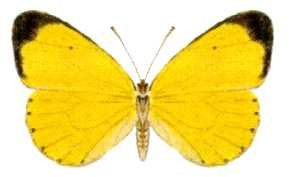
The upper surfaces of the wings are pale yellow. The forewings have a black submarginal border forming a dog-face or wolf-face pattern, while the hindwings have a small black border along their outer margins.[1][2]
Male individuals have a bright yellow patch along the leading edge of each hindwing. The hindwings have sharply pointed outer ends.[3][4]
Summer individuals have pale yellow undersides of the wings. Winter individuals have pale yellow undersides with reddish markings or entirely reddish-pink undersides.[5][6]
The wingspan ranges from 32 to 57 millimeters.[7]
The larva is green, with a creamy or yellow stripe along its mid-dorsal region and a yellow stripe along each side.[8][9]
Habitat
The species inhabits woodland edges, open woodlands, and desert grasslands.[10][11][12]
Diet
New Mexican locust (Robinia neomexicana) is recorded as a host plant of the species. Fern acacia (Acacia angustissima) and prairie acacia (Acacia angustissima var. hirta) are also recorded as host plants.[13][14][15]
Behaviour
Male individuals patrol throughout the day in search of females.[16]
Reproduction and life cycle
The species produces three to four broods annually.[17]
Similar species
Boisduval's yellow (Eurema boisduvaliana) and Salome yellow (Eurema salome) occur within the Mexican Yellow's range.[18][19]
Boisduval's yellow is smaller and brighter yellow than the Mexican Yellow. Its male individuals have a less pronounced dog-face pattern, and its female individuals have less black coloration on their upper wing surfaces.[20][21][22]
Boisduval's yellow has less sharply pointed hindwings than the Mexican Yellow.[23]
Salome yellow is brighter yellow and has less extensive black coloration on its upper wing surfaces than the Mexican Yellow. It has a round reddish spot near the trailing edge on the underside of its hindwing.[24][25]
Classification of the Mexican Yellow
| Kingdom | Animalia |
|---|---|
| Phylum | Arthropoda |
| Subphylum | Hexapoda |
| Class | Insecta (Insect) |
| Order | Lepidoptera |
| Superfamily | Papilionoidea |
| Family | Pieridae (Whites) |
| Genus | Eurema (Grass Yellows) |
| Species | Eurema mexicana (Boisduval, 1836) |
Where the Mexican Yellow is found
Checklists and occurrence records place Eurema mexicana in 7 countries across North America. GBIF holds 11,696 georeferenced records of it.
Countries
Regions and cities with the most records
- Michoacán, Mexico 2,465
- Arizona, United States 1,768
- Uruapan, Mexico 1,481
- Guerrero, Mexico 963
- Morelos, Mexico 953
- Oaxaca, Mexico 899
- Cuernavaca, Mexico 829
- Tres de Mayo, Mexico 826
- Jiutepec, Mexico 760
- Texas, United States 732
- Yautepec, Mexico 730
- Veracruz, Mexico 417
- Catalina Foothills, United States 408
- Casas Adobes, United States 397
- Flowing Wells, United States 391
- Oro Valley, United States 387
- Tucson, United States 376
- Emiliano Zapata, Mexico 343
- Chiapas, Mexico 275
- Temixco, Mexico 264
- Baja California Sur, Mexico 261
- Xochitepec, Mexico 258
- Paracho de Verduzco, Mexico 249
- Coatepec, Mexico 235
- Xalapa de Enríquez, Mexico 230
- Green Valley, United States 226
- Xico, Mexico 225
- New Mexico, United States 224
- Tanque Verde, United States 224
- Cuautla, Mexico 223
- Santa Rosa Treinta, Mexico 223
- Sierra Vista, United States 215
- Taxco de Alarcón, Mexico 206
- Hidalgo, Mexico 185
- Coyoacán, Mexico 177
- Magdalena Contreras, Mexico 177
2 more countries have a few records outside this range
These countries hold a few records of Eurema mexicana but lie outside the range the checklists give for it. Such records are often zoo or garden specimens, museum material or vagrants, so the species is not counted as occurring there.
A number beside a place is its count of GBIF occurrence records. A place without a number comes from a checklist alone. Records show where a species has been observed or collected, which can include escapes and vagrants.
Common names
English
- Mexican Yellow
Names in 1 other language
- Spanish
- Mariposa Amarilla mexicana
Synonyms
One other scientific name has been used for this species and is now treated as a synonym of Eurema mexicana.
- Terias bogotana Felder & Felder, 1861
Subspecies and varieties
- Eurema mexicana mexicana subspecies
Related species
-
 Common Grass YellowEurema hecabe
-
 Broad-bordered Grass YellowEurema brigitta
-
 Three Spot Grass YellowEurema blanda
- Barred SulphurEurema daira
-
 Small Grass-yellowEurema smilax
-
 Spotless Grass YellowEurema laeta
- Changeable Grass YellowEurema simulatrix
-
 Malagasy Grass YellowEurema floricola
Compare
Questions and answers
What is the scientific name of the Mexican Yellow?
The scientific name of the Mexican Yellow is Eurema mexicana. Written with its author, the full name is Eurema mexicana (Boisduval, 1836).
Which family does the Mexican Yellow belong to?
Eurema mexicana belongs to the family Pieridae, in the order Lepidoptera and the class Insecta.
Where is the Mexican Yellow found?
Checklists and occurrence records place Eurema mexicana in 7 countries, including Mexico, United States, Costa Rica, Guatemala, Honduras and Panama.
Sources
Passages the profile rests on
- The upper surfaces of the wings are pale yellow with a black submarginal border on the forewings that forms a dog-face or wolf-face pattern. Source passage: “The upperside of the wings is pale yellow with a black forewing submarginal border outlining a "dog" or "wolf-face" pattern.” — English Wikipedia
- The hindwings have a small black border along their outer margins. Source passage: “The hindwing has a small outer margin black border.” — English Wikipedia
- Male individuals have a bright yellow patch along the leading edge of each hindwing. Source passage: “The male has a bright yellow patch on the leading edge of the hindwing.” — English Wikipedia
- The hindwings have sharply pointed outer ends. Source passage: “The hindwing is sharply pointed.” — English Wikipedia
- Summer individuals have pale yellow undersides of the wings. Source passage: “The underside of the wings is pale yellow in summer individuals” — English Wikipedia
- Winter individuals have pale yellow undersides with reddish markings or entirely reddish-pink undersides. Source passage: “pale yellow with reddish markings or all reddish pink in winter individuals.” — English Wikipedia
- The wingspan ranges from 32 to 57 millimeters. Source passage: “The wingspan measures 1+1⁄4 to 2+1⁄4 inches (32–57 mm).” — English Wikipedia
- The larva is green and has a creamy or yellow stripe along its mid-dorsal region. Source passage: “The larva is green with a middorsal creamy or yellow stripe” — English Wikipedia
- The larva has a yellow stripe along each side. Source passage: “and a lateral yellow stripe.” — English Wikipedia
- The species inhabits woodland edges. Source passage: “The Mexican yellow lives in a variety of open habitats such as woodland edges, open woodlands, and desert grasslands.” — English Wikipedia
- The species inhabits open woodlands. Source passage: “The Mexican yellow lives in a variety of open habitats such as woodland edges, open woodlands, and desert grasslands.” — English Wikipedia
- The species inhabits desert grasslands. Source passage: “The Mexican yellow lives in a variety of open habitats such as woodland edges, open woodlands, and desert grasslands.” — English Wikipedia
- New Mexican locust (Robinia neomexicana) is recorded as a host plant of the species. Source passage: “New Mexican locust, Robinia neomexicana” — English Wikipedia
- Fern acacia (Acacia angustissima) is recorded as a host plant of the species. Source passage: “Fern acacia, Acacia angustissima” — English Wikipedia
- Prairie acacia (Acacia angustissima var. hirta) is recorded as a host plant of the species. Source passage: “Prairie acacia, Acacia angustissima var. hirta” — English Wikipedia
- Male individuals patrol throughout the day in search of females. Source passage: “Males will patrol all day looking for females.” — English Wikipedia
- The species produces three to four broods annually. Source passage: “The Mexican yellow has 3-4 broods per year.” — English Wikipedia
- Boisduval's yellow (Eurema boisduvaliana) occurs within the Mexican yellow's range. Source passage: “Similar species in the Mexican yellow's range include Boisduval's yellow (Eurema boisduvaliana)” — English Wikipedia
- Salome yellow (Eurema salome) occurs within the Mexican yellow's range. Source passage: “and the Salome yellow (Eurema salome).” — English Wikipedia
- Boisduval's yellow is smaller and brighter yellow than the Mexican yellow. Source passage: “Boisduval's yellow is smaller and brighter yellow” — English Wikipedia
- The male Boisduval's yellow has a less pronounced dog-face pattern than the Mexican yellow. Source passage: “the male has a weaker "dog face" pattern” — English Wikipedia
- Female Boisduval's yellow individuals have less black coloration on their upper wing surfaces. Source passage: “the female has reduced black on the upper side” — English Wikipedia
- Boisduval's yellow has less sharply pointed hindwings than the Mexican yellow. Source passage: “and the hindwing is less sharply pointed.” — English Wikipedia
- Salome yellow is brighter yellow and has less extensive black coloration on its upper wing surfaces than the Mexican yellow. Source passage: “The Salome yellow is brighter yellow, has more limited black on the upperside” — English Wikipedia
- Salome yellow has a round reddish spot near the trailing edge on the underside of its hindwing. Source passage: “and the underside of the hindwing has a round reddish spot near the trailing edge.” — English Wikipedia
Data
- Catalogue of Life, 2026-10-16 XR cc by
- Global Biodiversity Information Facility CC BY 4.0
- Wikidata CC0
- GeoNames CC BY 4.0
- Wikimedia Commons per image; credit shown with each image
- Within the Catalogue of Life, this name comes from Global Butterfly Information System cc by
This species in other databases
Page built on 29 November 2026. See how the catalog is made and all sources and licences.
Cite this page
ScientificNames.org. (2026). Eurema mexicana (Mexican Yellow). Retrieved November 29, 2026, from https://scientificnames.org/species/eurema-mexicana
“Eurema mexicana (Mexican Yellow).” ScientificNames.org, 2026, scientificnames.org/species/eurema-mexicana. Accessed 29 Nov. 2026.
ScientificNames.org. “Eurema mexicana (Mexican Yellow).” Accessed November 29, 2026. https://scientificnames.org/species/eurema-mexicana.
@misc{scientificnames_eurema_mexicana_mexican_yellow,
  author = {{ScientificNames.org}},
  title = {Eurema mexicana (Mexican Yellow)},
  year = {2026},
  url = {https://scientificnames.org/species/eurema-mexicana},
  note = {Accessed 2026-11-29}
}