Comparison

Comb-toed Jerboa vs Long-eared Jerboa

Comb-toed Jerboa (Paradipus ctenodactylus) and Long-eared Jerboa (Euchoreutes naso) both belong to the family Dipodidae (jerboa) and part ways below it.

Comb-toed Jerboa

Paradipus ctenodactylus
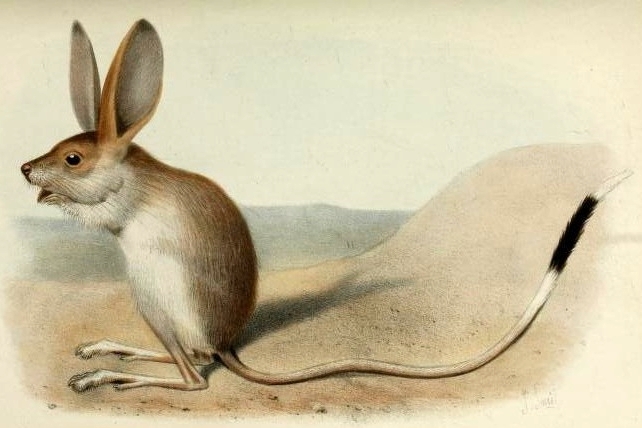
Long-eared Jerboa

Long-eared Jerboa

Euchoreutes naso

Joseph Smit (1836–1929), Public domain, via Wikimedia Commons

Side by side

Comb-toed JerboaLong-eared Jerboa
Scientific nameParadipus ctenodactylus (Vinogradov, 1929)Euchoreutes naso Sclater, 1891
English nameComb-toed JerboaLong-eared Jerboa
GroupMammalsMammals
ClassMammalia MammalMammalia Mammal
OrderRodentia RodentRodentia Rodent
FamilyDipodidae JerboaDipodidae Jerboa
GenusParadipus Comb-toed JerboasEuchoreutes
Named in19291891
Red List categoryLeast ConcernLeast Concern
Countries on record1 country2 countries
GBIF occurrence records3 records111 records

Rows where the two agree are shown in grey.

Where each is found

Only Comb-toed Jerboa (1)

Only Long-eared Jerboa (2)

From Catalogue of Life checklists and GBIF occurrence records. A country missing from a list means no record is held, which is not proof of absence.

Checked facts

Comb-toed JerboaLong-eared Jerboa
Appearance
  • The species has pinkish cinnamon to beige fur, white underparts, and a broad white zone around each eye. animaldiversity.org
  • The species has rusty-colored patches on its cheeks and chest and a large white tuft at the end of its tail. animaldiversity.org
  • Its three hind toes bear combs of stiff bristles, with the longest bristles on the medial toe and inner edges of the outer toes. animaldiversity.org
  • Its upper incisors are white and lack the medial groove found in some jerboas. animaldiversity.org
  • The species lacks premolars. animaldiversity.org
  • The long-eared jerboa has reddish-yellow to light russet upperparts and a white belly. animaldiversity.org
  • The long-eared jerboa has ears approximately one-third longer than its head. animaldiversity.org
  • The long-eared jerboa has a tail with short hairs and a terminal tuft of black and white hairs. animaldiversity.org
  • The long-eared jerboa has five digits on each hind foot, with shorter lateral digits than central digits. animaldiversity.org
  • The central metatarsals of the long-eared jerboa are fused over a short distance. animaldiversity.org
  • The long-eared jerboa has tufts of bristly hairs covering its feet. animaldiversity.org
  • The long-eared jerboa has thin, white incisors. animaldiversity.org
  • The long-eared jerboa has a small premolar on each side of its upper jaw. animaldiversity.org
  • Female long-eared jerboas have eight mammary glands. animaldiversity.org
Size
Habitat
  • The species inhabits sandy desert environments containing shrubs. English Wikipedia
  • It inhabits sandy areas of the Kyzyl Kum and Kara Kum deserts. animaldiversity.org
  • It is concentrated in desert areas containing sand acacia, calligonum, and tufts of three-awn vegetation. animaldiversity.org
  • Its daytime burrows are usually located at the base of the windward side of a barkhan dune. animaldiversity.org
  • Its burrows are generally 25–65 cm long and terminate in a nest chamber. animaldiversity.org
  • Long-eared jerboas have been collected in sandy valleys covered with low-growing bushes. animaldiversity.org
  • The long-eared jerboa inhabits arid desert and semi-desert environments in the Mengxin and Aerjin Mountain regions. animaldiversity.org
  • The long-eared jerboa also inhabits cold, high-elevation desert environments in the Qing-Zang Plateau region. animaldiversity.org
  • Haloxylon ammodendron has been documented at some long-eared jerboa capture sites. animaldiversity.org
Diet
Behaviour
  • Long-eared jerboas are presumed to be mainly nocturnal. animaldiversity.org
  • The long-eared jerboa locates flying insects using sound and captures them by leaping rapidly into the air. animaldiversity.org
  • The long-eared jerboa belongs to a species whose mating system has not been established. animaldiversity.org
  • The long-eared jerboa is gonochoric, with separate male and female sexes. animaldiversity.org
Reproduction
  • Female long-eared jerboas nurse and care for their offspring at least until weaning. animaldiversity.org
DistributionNo checked fact yet
  • The long-eared jerboa occurs from southernmost Mongolia into northwestern China. animaldiversity.org
ConservationNo checked fact yet
  • The long-eared jerboa was identified as one of the ten focal species of the EDGE project in 2007. English Wikipedia
  • Ongoing human disturbance is identified as a major threat to the long-eared jerboa. animaldiversity.org
  • The long-eared jerboa's population has experienced an observed or probable reduction of at least 80 percent over ten years. animaldiversity.org
Other
  • Its specialized hind limbs enable leaps of up to 3 m in length and 1 m in height. animaldiversity.org
  • Its comb-like hind-toe bristles are thought to assist movement across sandy habitats. animaldiversity.org
  • The long-eared jerboa is the only recognized member of its genus, Euchoreutes. English Wikipedia
  • The long-eared jerboa is also the only recognized member of its subfamily, Euchoreutinae. English Wikipedia

In brief

Comb-toed Jerboa

Paradipus ctenodactylus inhabits sandy desert areas of the Kyzyl Kum and Kara Kum deserts. It is distinguished by combs of stiff bristles on its three hind toes and a large white tuft at the end of its tail. Full profile

Long-eared Jerboa

Euchoreutes naso occurs from southernmost Mongolia into northwestern China and inhabits arid desert, semi-desert, and cold, high-elevation desert environments. It is distinguished by ears approximately one-third longer than its head and a tail ending in a tuft of black and white hairs. Full profile

Compare something else

Page built on 29 November 2026 from the data on the two species pages, where every source is listed.

Cite this page

ScientificNames.org. (2026). Comb-toed Jerboa vs Long-eared Jerboa. Retrieved November 29, 2026, from https://scientificnames.org/compare/comb-toed-jerboa-vs-long-eared-jerboa