Overview
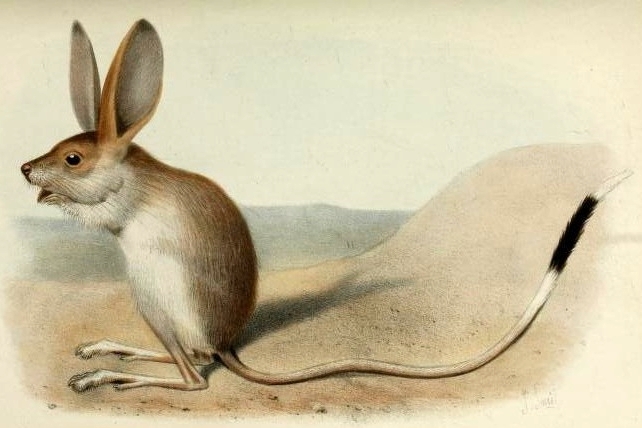
Paradipus ctenodactylus inhabits sandy desert areas of the Kyzyl Kum and Kara Kum deserts. It is distinguished by combs of stiff bristles on its three hind toes and a large white tuft at the end of its tail.
Written 26 November 2026 from the sources listed below. Each statement was checked against the passage it cites; statements that could not be supported were removed.
Appearance
The Comb-toed Jerboa has pinkish cinnamon to beige fur, white underparts, and a broad white zone around each eye. Rusty-colored patches occur on its cheeks and chest, and its tail ends in a large white tuft.[1][2]
Its three hind toes bear combs of stiff bristles, with the longest bristles on the medial toe and inner edges of the outer toes. Its upper incisors are white and lack the medial groove found in some jerboas, and it lacks premolars.[3][4][5]
Its head and body measure 110–155 mm in length, and its average body weight is 140 g. Its tail measures approximately 206–221 mm and is not prehensile.[6][7][8]
Its hind feet measure 73–82 mm, and its ears measure 33–38 mm. Its forelimb claws are approximately 7 mm long.[9][10][11]
Habitat
The Comb-toed Jerboa inhabits sandy desert environments containing shrubs. It occurs in sandy areas of the Kyzyl Kum and Kara Kum deserts.[12][13]
It is concentrated in desert areas containing sand acacia, calligonum, and tufts of three-awn vegetation.[14]
Its daytime burrows are usually located at the base of the windward side of a barkhan dune. The burrows are generally 25–65 cm long and terminate in a nest chamber.[15][16]
Diet
The Comb-toed Jerboa is completely herbivorous and eats desert shrubs. Its diet includes white saxaul tree vegetation.[17][18]
Behaviour
The Comb-toed Jerboa is nocturnal. It hibernates from December through February, with hibernation beginning when ground temperature falls to 16–18 degrees Celsius.[19][20][21]
It does not normally dig an emergency exit or seal its burrow, instead maintaining a single exit. When threatened inside its burrow, it digs new exits to escape.[22][23]
It travels approximately 7–11 km per night while making rounds of its territory. Individual territories have radii of approximately 1.5–2 km and overlap considerably with those of other individuals.[24][25][26]
The species produces distinctive tracks with alternating symmetrical bipedal patterns. It appears to roll and play in sand, leaving body marks and broad trampled areas.[27][28]
Its specialized hind limbs enable leaps of up to 3 m in length and 1 m in height. Its comb-like hind-toe bristles are thought to assist movement across sandy habitats.[29][30]
Reproduction and life cycle
The reproductive habits of the Comb-toed Jerboa are poorly documented. The species is gonochoric, with separate sexes.[31][32]
Its breeding season is reported to include April–May and July periods. Females are reported to care for and nourish their young at least until weaning.[33][34]
Classification of the Comb-toed Jerboa
| Kingdom | Animalia |
|---|---|
| Phylum | Chordata |
| Subphylum | Vertebrata |
| Infraphylum | Gnathostomata |
| Parvphylum | Osteichthyes |
| Megaclass | Tetrapoda |
| Class | Mammalia (Mammal) |
| Subclass | Theria |
| Infraclass | Eutheria |
| Order | Rodentia (Rodent) |
| Suborder | Myomorpha (Mice) |
| Superfamily | Dipodoidea |
| Family | Dipodidae (Jerboa) |
| Subfamily | Dipodinae |
| Genus | Paradipus (Comb-toed Jerboas) |
| Species | Paradipus ctenodactylus (Vinogradov, 1929) |
Where the Comb-toed Jerboa is found
Checklists and occurrence records place Paradipus ctenodactylus in 1 country. GBIF holds 3 georeferenced records of it.
Countries
Range as the checklists state it
Europe & Northern Asia (excluding China)
A number beside a place is its count of GBIF occurrence records. A place without a number comes from a checklist alone. Records show where a species has been observed or collected, which can include escapes and vagrants.
Common names
English
- Comb-toed Jerboa
Names in 9 other languages
- Czech
- frčík hřebenatý
- Dutch
- Kamteenspringmuis
- Finnish
- kampavarvasjerbo
- German
- Kammzehenspringmaus
- Japanese
- ケアシトビネズミ
- Kazakh
- Тарақжүндес косаяқ
- Norwegian Bokmål
- Kamspringmus
- Polish
- Skoczek grzebykopalcy, stoposkoczek grzebykopalcy
- Russian
- Grebnepalyi Tushkanchik, Гребнепалый тушканчик
Related species
-
 Baluchistan Pygmy JerboaSalpingotulus michaelis
-
 Long-eared JerboaEuchoreutes naso
-
 Lesser Egyptian JerboaJaculus jaculus
-
 Meadow Jumping MouseZapus hudsonius
-
 Woodland Jumping MouseNapaeozapus insignis
-
 Greater Egyptian JerboaJaculus orientalis
-
 Northern Birch MouseSicista betulina
-
 Five-toed Pygmy JerboaCardiocranius paradoxus
Compare
Questions and answers
What is the scientific name of the Comb-toed Jerboa?
The scientific name of the Comb-toed Jerboa is Paradipus ctenodactylus. Written with its author, the full name is Paradipus ctenodactylus (Vinogradov, 1929).
Which family does the Comb-toed Jerboa belong to?
Paradipus ctenodactylus belongs to the family Dipodidae, in the order Rodentia and the class Mammalia.
Where is the Comb-toed Jerboa found?
Checklists and occurrence records place Paradipus ctenodactylus in 1 country: Turkmenistan.
What is the conservation status of the Comb-toed Jerboa?
The IUCN Red List category recorded for Paradipus ctenodactylus is Least Concern (LC).
What is a jerboas habitat?
The Comb-toed Jerboa inhabits sandy desert environments containing shrubs, particularly sandy areas of the Kyzyl Kum and Kara Kum deserts. It is concentrated in areas containing sand acacia, calligonum, and tufts of three-awn vegetation.[12][13][14]
What do jerboas like to eat?
The Comb-toed Jerboa eats desert shrubs, including white saxaul tree vegetation.[17][18]
Are jerboa omnivores?
No. The Comb-toed Jerboa is completely herbivorous.[17]
Is jerboa an herbivore?
Yes. The Comb-toed Jerboa is completely herbivorous and eats desert shrubs.[17]
Sources
Passages the profile rests on
- The species has pinkish cinnamon to beige fur, white underparts, and a broad white zone around each eye. Source passage: “The fur is a pinkish cinnamon to beige with white underparts and a broad white zone around each eye” — animaldiversity.org
- The species has rusty-colored patches on its cheeks and chest and a large white tuft at the end of its tail. Source passage: “There are rusty colored patches on the cheeks and chest and the tail has a large white tuft at the end” — animaldiversity.org
- Its three hind toes bear combs of stiff bristles, with the longest bristles on the medial toe and inner edges of the outer toes. Source passage: “The three toes of the hind feet have a comb of stiff bristles with the longest bristles located on the medial toe and internal edges of the outer toes.” — animaldiversity.org
- Its upper incisors are white and lack the medial groove found in some jerboas. Source passage: “Paradipus ctendactylus has white upper incisors, without the medial groove that is present in some jerboas.” — animaldiversity.org
- The species lacks premolars. Source passage: “Premolars are absent (Ognev, 1963).” — animaldiversity.org
- Its head and body measure 110–155 mm in length. Source passage: “The length of the head and body is 110 to 155 mm” — animaldiversity.org
- Its average body weight is 140 g. Source passage: “average weight is 140 g.” — animaldiversity.org
- Its tail measures approximately 206–221 mm and is not prehensile. Source passage: “The tail is not prehensile and is very long, approximately 206 to 221 mm” — animaldiversity.org
- Its hind feet measure 73–82 mm in length. Source passage: “the hind feet are very long at 73 to 82 mm” — animaldiversity.org
- Its ears measure 33–38 mm in length. Source passage: “The ears are longer than those of most other jerboas, at 33 to 38 mm” — animaldiversity.org
- Its forelimb claws are approximately 7 mm long. Source passage: “they are used for burrowing and have prominent claws, around 7 mm in length” — animaldiversity.org
- The species inhabits sandy desert environments containing shrubs. Source passage: “It prefers sandy desert habitats where shrubs grow.” — English Wikipedia
- It inhabits sandy areas of the Kyzyl Kum and Kara Kum deserts. Source passage: “Paradipus ctenodactylus is a psammophile found in the sandy Kyzyl Kum and Kara Kum deserts” — animaldiversity.org
- It is concentrated in desert areas containing sand acacia, calligonum, and tufts of three-awn vegetation. Source passage: “It is found concentrated in regions of these deserts with bushy vegetation such as sand acacia, calligonum, and tufts of three-awn.” — animaldiversity.org
- Its daytime burrows are usually located at the base of the windward side of a barkhan dune. Source passage: “Days are spent in their burrows, usually dug at the base of the windward side of a barkhan dune.” — animaldiversity.org
- Its burrows are generally 25–65 cm long and terminate in a nest chamber. Source passage: “The burrow is generally 25 to 65 cm in length and ends in a nest chamber.” — animaldiversity.org
- The species is completely herbivorous and eats desert shrubs. Source passage: “Comb-toed jerboas are completely herbivorous, eating only desert shrubs.” — animaldiversity.org
- Its diet includes white saxaul tree vegetation. Source passage: “the growing of the shoots of the white saxaul tree, which they feed on” — animaldiversity.org
- The species is nocturnal. Source passage: “Comb-toed jerboas are nocturnal.” — animaldiversity.org
- It hibernates from December through February. Source passage: “From December to February, comb-toed jerboas hibernate.” — animaldiversity.org
- Hibernation begins when ground temperature falls to 16–18 degrees Celsius. Source passage: “When the ground temperature drops to 16-18 degrees Celsius, hibernation begins.” — animaldiversity.org
- It does not normally dig an emergency exit or seal its burrow, instead maintaining a single exit. Source passage: “While most jerboas dig an emergency exit and seal their burrows off, P. ctenodactylus does not. Only one exit is present.” — animaldiversity.org
- When threatened inside its burrow, the species digs new exits to escape. Source passage: “When threatened in the burrow comb-toed jerboas dig new exits to escape” — animaldiversity.org
- It travels approximately 7–11 km per night while making rounds of its territory. Source passage: “This results in them traveling 7 to 11 km per night, sometimes even more” — animaldiversity.org
- Individual territories have radii of approximately 1.5–2 km. Source passage: “Individuals make nightly rounds of their territories, which are 1.5 to 2 km in radius.” — animaldiversity.org
- Its territories overlap considerably with those of other individuals. Source passage: “Territories for individuals overlap considerably” — animaldiversity.org
- The species produces distinctive tracks with alternating symmetrical bipedal patterns. Source passage: “Their tracks also tend to lie alternatively in a symmetric bipedal pattern, rather than in twos like some jerboas.” — animaldiversity.org
- It appears to roll and play in sand, leaving body marks and broad trampled areas. Source passage: “Paradipus ctenodactylus appears to "play" in the sand, leaving rolling body marks as well as broad trampled stretches” — animaldiversity.org
- Its specialized hind limbs enable leaps of up to 3 m in length and 1 m in height. Source passage: “These highly specialized hind limbs allow leaps of up to 3 m in length and 1 m in height” — animaldiversity.org
- Its comb-like hind-toe bristles are thought to assist movement across sandy habitats. Source passage: “These combed toes, from which the species' common name comes, are thought to assist in moving about the sandy habitat.” — animaldiversity.org
- The reproductive habits of this species are poorly documented. Source passage: “Little is known about the reproductive habits of Paradipus ctenodactylus .” — animaldiversity.org
- The species is gonochoric, with separate sexes. Source passage: “gonochoric/gonochoristic/dioecious (sexes separate)” — animaldiversity.org
- Its breeding season is reported to include April–May and July periods. Source passage: “the April-May period of breeding in both P. ctenodactylus and D. sagitta may include mostly older females, while the July period may also include yearling females” — animaldiversity.org
- Females are reported to care for and nourish their young at least until weaning. Source passage: “females care for and nourish their young at least through the age of weaning.” — animaldiversity.org
Data
- Catalogue of Life, 2026-10-16 XR cc by
- Global Biodiversity Information Facility CC BY 4.0
- Wikidata CC0
- GeoNames CC BY 4.0
- Within the Catalogue of Life, this name comes from The Integrated Taxonomic Information System cc0
References
- Doklady Akad. Nauk S.S.S.R., Leningrad vol.1929 p.248 where the name was published
- Wilson, Don E., and DeeAnn M. Reeder, eds. (1993). Mammal Species of the World: A Taxonomic and Geographic Reference, 2nd Ed., 3rd Printing.
- Wilson, Don E., and F. Russell Cole. (2000). Common Names of Mammals of the World.
- Holden, Mary Ellen, and Guy G. Musser / Wilson, Don E., and DeeAnn M. Reeder, eds. (2005). Family Dipodidae. Mammal Species of the World: A Taxonomic and Geographic Reference, 3rd Ed., Vol. 2.
- Shenbrot, G. I., V. E. Sokolov, V. G. Heptner, and Yu. M. Koval’skaya. (2008). Jerboas.
This species in other databases
Page built on 28 November 2026. See how the catalog is made and all sources and licences.
Cite this page
ScientificNames.org. (2026). Paradipus ctenodactylus (Comb-toed Jerboa). Retrieved November 28, 2026, from https://scientificnames.org/species/paradipus-ctenodactylus
“Paradipus ctenodactylus (Comb-toed Jerboa).” ScientificNames.org, 2026, scientificnames.org/species/paradipus-ctenodactylus. Accessed 28 Nov. 2026.
ScientificNames.org. “Paradipus ctenodactylus (Comb-toed Jerboa).” Accessed November 28, 2026. https://scientificnames.org/species/paradipus-ctenodactylus.
@misc{scientificnames_paradipus_ctenodactylus_comb_toed_jerboa,
  author = {{ScientificNames.org}},
  title = {Paradipus ctenodactylus (Comb-toed Jerboa)},
  year = {2026},
  url = {https://scientificnames.org/species/paradipus-ctenodactylus},
  note = {Accessed 2026-11-28}
}