Comparison
Rose-of-Jericho vs African Clubmoss
Rose-of-Jericho (Selaginella lepidophylla) and African Clubmoss (Selaginella kraussiana) both belong to the genus Selaginella (spikemoss) and part ways below it. Both are recorded in 1 country.


How they differ
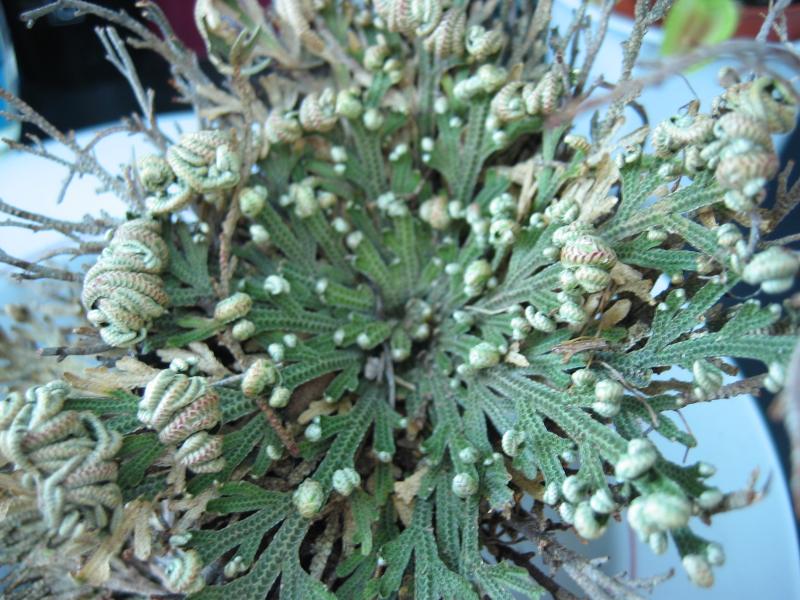
The rose-of-Jericho (Selaginella lepidophylla) forms a tight ball as its stems curl during dehydration, whereas the mat spike-moss (Selaginella kraussiana) is a low-growing, mat-forming evergreen perennial. The rose-of-Jericho (Selaginella lepidophylla) is native to the Chihuahuan Desert of the United States and Mexico, whereas the mat spike-moss (Selaginella kraussiana) is native to Macaronesia and parts of southern and eastern Africa. The rose-of-Jericho (Selaginella lepidophylla) reproduces through spores rather than flowers or seeds, whereas the mat spike-moss (Selaginella kraussiana) spreads through stems that root as they grow.
| Rose-of-Jericho | African Clubmoss | |
|---|---|---|
| Appearance | When dehydrated, the rose-of-Jericho (Selaginella lepidophylla) develops brown leaves that fold inward to form a ball. | The mat spike-moss (Selaginella kraussiana) has primitive fern-like leaves and a lacy leaf structure. |
| Growth form | The rose-of-Jericho (Selaginella lepidophylla) has outer stems that bend into circular rings and inner stems that curl into spirals as it loses water. | The mat spike-moss (Selaginella kraussiana) is a low-growing, mat-forming vascular plant. |
| Drought response | The rose-of-Jericho (Selaginella lepidophylla) can survive losing up to 95% of its moisture without sustaining damage. | The mat spike-moss (Selaginella kraussiana) requires potting media that retains humidity, drains quickly, and does not remain excessively wet. |
| Distribution | The rose-of-Jericho (Selaginella lepidophylla) occurs in deserts of the southwestern United States and northern Mexico. | The mat spike-moss (Selaginella kraussiana) is common in many parts of New Zealand and Australia. |
| Cultivation | The rose-of-Jericho (Selaginella lepidophylla) is commercially sold as a dried, bare-root novelty item that can be revived with a small amount of water. | The mat spike-moss (Selaginella kraussiana) is cultivated for ornamental purposes. |
| Conservation | The rose-of-Jericho (Selaginella lepidophylla) is not listed as a threatened or endangered species. | The mat spike-moss (Selaginella kraussiana) is listed on the New Zealand National Pest Plant Accord as an invasive species. |
Written from the checked facts listed further down. Statements that the sources did not support were removed.
Side by side
| Rose-of-Jericho | African Clubmoss | |
|---|---|---|
| Scientific name | Selaginella lepidophylla (Hook. & Grev.) Spring | Selaginella kraussiana (Kunze) A.Braun |
| English name | Rose-of-Jericho | African Clubmoss |
| Group | Ferns and allies | Ferns and allies |
| Class | Lycopodiopsida | Lycopodiopsida |
| Order | Selaginellales | Selaginellales |
| Family | Selaginellaceae Spikemoss Family | Selaginellaceae Spikemoss Family |
| Genus | Selaginella Spikemoss | Selaginella Spikemoss |
| Countries on record | 5 countries | 49 countries |
| GBIF occurrence records | 2,342 records | 12,813 records |
Rows where the two agree are shown in grey.
Where each is found
Both recorded in 1 country
Only Rose-of-Jericho (4)
Only African Clubmoss (48)
- Angola
- Australia
- Austria
- Belgium
- Botswana
- Brazil
- Burundi
- Cameroon
- China
- Croatia
- Democratic Republic of the Congo
- Equatorial Guinea
- Eswatini
- Ethiopia
- France
- Gabon
- Germany
- Gibraltar
- Guernsey
- India
- Ireland
- Isle of Man
- Italy
- Jamaica
- Kenya
- Madagascar
- Malawi
- Mozambique
- New Zealand
- Panama
- Portugal
- Rwanda
- Senegal
- Sierra Leone
- Slovenia
- South Africa
- Spain
- Sudan
- Sweden
- Switzerland
- Tanzania
- Thailand
- The Netherlands
- Uganda
- Ukraine
- United Kingdom
- Venezuela
- Zimbabwe
From Catalogue of Life checklists and GBIF occurrence records. A country missing from a list means no record is held, which is not proof of absence.
Checked facts
| Rose-of-Jericho | African Clubmoss | |
|---|---|---|
| Appearance |
|
|
| Size | No checked fact yet |
|
| Habitat |
|
|
| Behaviour |
| No checked fact yet |
| Reproduction |
| No checked fact yet |
| Distribution |
|
|
| Conservation |
|
|
| Uses |
|
|
| Similar species |
| No checked fact yet |
| Other | No checked fact yet |
|
In brief
Rose-of-Jericho
Selaginella lepidophylla inhabits desert environments in the southwestern United States and northern Mexico. Its stems curl into a tight ball during dry weather and uncurl when exposed to moisture. Full profile
African Clubmoss
African Clubmoss is a low-growing, mat-forming evergreen perennial belonging to the ancient clubmoss lineage rather than the true ferns. It is native to Macaronesia and parts of southern and eastern Africa and is common in many parts of New Zealand and Australia. It has primitive fern-like leaves and spreads through stems that root as they grow. Full profile
Compare something else
Page built on 24 November 2026 from the data on the two species pages, where every source is listed.
Cite this page
ScientificNames.org. (2026). Rose-of-Jericho vs African Clubmoss. Retrieved November 24, 2026, from https://scientificnames.org/compare/rose-of-jericho-vs-african-clubmoss
“Rose-of-Jericho vs African Clubmoss.” ScientificNames.org, 2026, scientificnames.org/compare/rose-of-jericho-vs-african-clubmoss. Accessed 24 Nov. 2026.
ScientificNames.org. “Rose-of-Jericho vs African Clubmoss.” Accessed November 24, 2026. https://scientificnames.org/compare/rose-of-jericho-vs-african-clubmoss.
@misc{scientificnames_rose_of_jericho_vs_african_clubmoss,
  author = {{ScientificNames.org}},
  title = {Rose-of-Jericho vs African Clubmoss},
  year = {2026},
  url = {https://scientificnames.org/compare/rose-of-jericho-vs-african-clubmoss},
  note = {Accessed 2026-11-24}
}