Species · Ferns and allies
Rose-of-Jericho Selaginella lepidophylla
The scientific name of the Rose-of-Jericho is Selaginella lepidophylla. It is a species of fern or lycophyte in the family Selaginellaceae (spikemoss family), order Selaginellales.
- Scientific name
- Selaginella lepidophylla (Hook. & Grev.) Spring
- Common name
- Rose-of-Jericho
- Genus
- Selaginella
- Family
- Selaginellaceae (Spikemoss Family)
- Order
- Selaginellales
- Class
- Lycopodiopsida
- Recorded in
- 5 countries
- Name status
- accepted in the Catalogue of Life
Overview
Selaginella lepidophylla inhabits desert environments in the southwestern United States and northern Mexico. Its stems curl into a tight ball during dry weather and uncurl when exposed to moisture.
Written 24 November 2026 from the sources listed below. Each statement was checked against the passage it cites; statements that could not be supported were removed.
Appearance
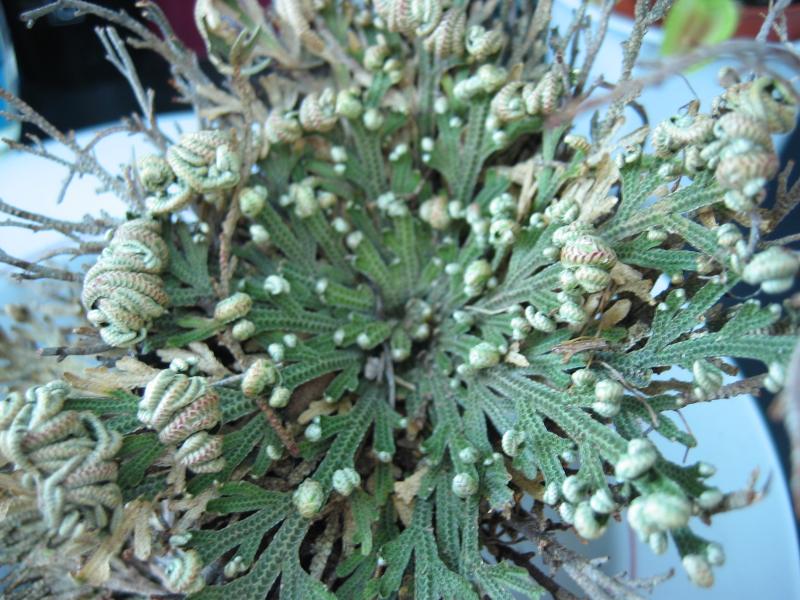
When dehydrated, its leaves become brown and fold inward to form a ball. The rooted leaves develop leathery bases that become dark brown or reddish brown during desiccation.[1][2]
The outer stems bend into circular rings after a short period without water. The inner stems gradually curl into spirals as the plant loses water.[3][4]
Habitat
The rose-of-Jericho grows in dry, sandy soils exposed to full sunlight. It inhabits desert environments in the southwestern United States and northern Mexico.[5][6]
The species is native to the Chihuahuan Desert of the United States and Mexico and occurs in deserts of the southwestern United States and northern Mexico.[7][8]
Behaviour
During dry weather in its native habitat, the plant's stems curl into a tight ball and uncurl when exposed to moisture. It can survive losing up to 95% of its moisture without sustaining damage.[9][10]
During drought, the rose-of-Jericho can remain alive for several years without water. During dormancy, it reduces its metabolic functions to a minimum.[11][12]
After drying out, the plant can retain only 3% of its original mass. It can lose 97% of its internal moisture while sustaining little permanent damage to its leaf cells.[13][14]
After being soaked by rain, the plant can begin recovering its green coloration almost immediately. It resumes respiration and uses stored food reserves to rebuild its chloroplasts and photosynthetic enzymes.[15][16]
The plant can resume producing food through photosynthesis within a few hours after rehydration. Extreme heat can dry it again, returning it to inactivity.[17][18]
The rose-of-Jericho can remain inactive for months or years while waiting for another rainfall event. During dehydration, it produces trehalose to protect its tissues from damage caused by concentrated salts and also uses betaines for tissue protection.[19][20][21]
After prolonged drought, the plant's roots may detach, allowing wind to transport it. If it encounters moisture after transport, it may rehydrate and establish roots in a new location.[22][23]
Repeated cycles of dehydration and regrowth can eventually reduce the plant's ability to recover and lead to its death.[24]
Reproduction and life cycle
The rose-of-Jericho reproduces through spores rather than flowers or seeds. It can be propagated from spores or cuttings.[25][26]
Conservation
Selaginella lepidophylla is not listed as a threatened or endangered species.[27]
Uses
The rose-of-Jericho is commercially sold as a novelty item in dried, bare-root form that can be revived with a small amount of water.[28]
The plant has been used as an herbal remedy for colds and sore throats in the form of an infusion. In Mexico, it is sold as a diuretic.[29][30]
Women in Mexico drink water in which the plant has been soaked to facilitate childbirth.[31]
The plant is used in voodoo and Cuban santería rituals intended to invoke love and fortune. It has also traditionally been regarded as a lucky charm and passed down through families.[32][33]
Similar species
Selaginella lepidophylla is distinct from Anastatica hierochuntica, the flowering plant known as the true Rose of Jericho.[34]
Classification of the Rose-of-Jericho
| Kingdom | Plantae |
|---|---|
| Subkingdom | Pteridobiotina |
| Phylum | Tracheophyta |
| Class | Lycopodiopsida |
| Order | Selaginellales |
| Family | Selaginellaceae (Spikemoss Family) |
| Genus | Selaginella (Spikemoss) |
| Species | Selaginella lepidophylla (Hook. & Grev.) Spring |
Where the Rose-of-Jericho is found
Checklists and occurrence records place Selaginella lepidophylla in 5 countries across North America. GBIF holds 2,342 georeferenced records of it.
Countries
Regions and cities with the most records
- Texas, United States 745
- Coahuila, Mexico 112
- Baja California Sur, Mexico 101
- Nuevo León, Mexico 91
- Chihuahua, Mexico 88
- Oaxaca, Mexico 84
- Querétaro, Mexico 78
- Guanajuato, Mexico 75
- Puebla, Mexico 67
- Durango, Mexico 52
- Jalisco, Mexico 47
- Benito Juarez, Mexico 33
- Coyoacán, Mexico 33
- Tlalpan, Mexico 33
- Xochimilco, Mexico 33
- Iztapalapa, Mexico 32
- Iztacalco, Mexico 31
- Morelos, Mexico 31
- Magdalena Contreras, Mexico 30
- Mexico City, Mexico 29
- Santa Catarina, Mexico 29
- Miguel Hidalgo, Mexico 28
- San Pedro Garza García, Mexico 28
- Delegación Cuajimalpa de Morelos, Mexico 27
- Cuauhtémoc, Mexico 25
- Huixquilucan, Mexico 24
- Tehuacán, Mexico 24
- Monterrey, Mexico 23
- México, Mexico 23
- Zacatecas, Mexico 21
- Guerrero, Mexico 20
- Hidalgo, Mexico 20
- Tamaulipas, Mexico 20
- Azcapotzalco, Mexico 18
- Naucalpan de Juárez, Mexico 17
- El Pueblito, Mexico 16
6 more countries have a few records outside this range
These countries hold a few records of Selaginella lepidophylla but lie outside the range the checklists give for it. Such records are often zoo or garden specimens, museum material or vagrants, so the species is not counted as occurring there.
Range as the checklists state it
USA (W-Texas, S-New Mexico); Mexico (Aguascalientes, Baja California Norte, Baja California Sur, Chiapas, Chihuahua, Coahuila, Colima, Ciudad de Mexico, Durango, Guanajuato, Guerrero, Hidalgo, Jalisco, México State, Michoacán, Morelos, Nayarit, Nuevo León, Oaxaca, Puebla, Queretaro, San Luis Potosí, Sinaloa, Sonora, Tamaulipas, Tlaxcala, Veracruz, Zacatecas); El Salvador; Costa Rica
A number beside a place is its count of GBIF occurrence records. A place without a number comes from a checklist alone. Records show where a species has been observed or collected, which can include escapes and vagrants.
Common names
English
- Rose-of-Jericho
- Dinosaur Plant
- False Rose of Jericho
- Resurrection Moss
- Resurrection-plant
Names in 7 other languages
- German
- Unechte Rose von Jericho
- Italian
- Falsa rosa di Gerico, Pianta della resurrezione
- Lithuanian
- Žvynuotoji selaginelė
- Russian
- Плаунок чешуелистный
- Slovak
- plavúnka schúlivá
- Spanish
- Doradilla, Flor de peña, Yamanquitexochitl
- Swedish
- falsk jerikoros
Synonyms
6 other scientific names have been used for this species and are now treated as synonyms of Selaginella lepidophylla.
- Lepidoselaginella lepidophylla (Hook. & Grev.) Li Bing Zhang & X.M.Zhou
- Lycopodioides lepidophylla (Hook.) Kuntze
- Lycopodium lepidophyllum Hook. & Grev.
- Selaginella rediviva Forrer ex Wittr.
- Selaginella thoytsiana Curd.
- Lycopodium nidiforme Herb. ex Spring ambiguous synonym
Related species
-
 African ClubmossSelaginella kraussiana
-
 Rainbow-fernSelaginella uncinata
-
 Peacock-fernSelaginella willdenowii
-
 Little-club-mossSelaginella tamariscina
-
 Low SpikemossSelaginella selaginoides
-
 Gemmiferous SpikemossSelaginella moellendorffii
-
 Toothed-leaved ClubmossSelaginella denticulata
-
 Festoon-pineSelaginella rupestris
Compare
Questions and answers
What is the scientific name of the Rose-of-Jericho?
The scientific name of the Rose-of-Jericho is Selaginella lepidophylla. Written with its author, the full name is Selaginella lepidophylla (Hook. & Grev.) Spring.
Which family does the Rose-of-Jericho belong to?
Selaginella lepidophylla belongs to the family Selaginellaceae, in the order Selaginellales and the class Lycopodiopsida.
Where is the Rose-of-Jericho found?
Checklists and occurrence records place Selaginella lepidophylla in 5 countries: Mexico, United States, El Salvador, Nicaragua and Costa Rica.
What other names does the Rose-of-Jericho have?
Selaginella lepidophylla is also known in English as Dinosaur Plant, False Rose of Jericho, Resurrection Moss and Resurrection-plant.
How long will a Rose of Jericho live?
During drought, the rose-of-Jericho can remain alive for several years without water. Repeated cycles of dehydration and regrowth can eventually reduce its ability to recover and lead to its death.[11][24]
Does the Rose of Jericho need sunlight?
The rose-of-Jericho grows in dry, sandy soils exposed to full sunlight.[5]
Sources
Passages the profile rests on
- When dehydrated, the plant's leaves become brown and fold inward, forming a ball. Source passage: “Its leaves turn brown and fold in, giving the plant the appearance of a ball.” — English Wikipedia
- The rooted leaves develop leathery bases that become dark brown or reddish brown during desiccation. Source passage: “When desiccated, its rooted leaves become leathery at the base, appearing dark brown or light to reddish brown.” — English Wikipedia
- The plant's outer stems bend into circular rings after a short period without water. Source passage: “The outer stems of the plant bend into circular rings after a relatively short period without water.” — English Wikipedia
- The inner stems curl gradually into spirals as the plant loses water. Source passage: “The inner stems instead curl slowly into spirals in response to desiccation, due to the action of the strain gradient along their length.” — English Wikipedia
- The species grows in dry, sandy soils exposed to full sunlight. Source passage: “Selaginella lepidophylla grows in dry, sandy soils in full sun.” — English Wikipedia
- Selaginella lepidophylla inhabits desert environments in the southwestern United States and northern Mexico. Source passage: “Resurrection plant or desert scale-leaf spikemoss (Selaginella lepidophylla) is a spore-bearing vascular plant from the deserts of the southwestern US and northern Mexico” — sbs.wsu.edu
- The species is native to the Chihuahuan Desert of the United States and Mexico. Source passage: “It is native to the Chihuahuan Desert of the United States and Mexico.” — English Wikipedia
- The species occurs in deserts of the southwestern United States and northern Mexico. Source passage: “Resurrection plant or desert scale-leaf spikemoss (Selaginella lepidophylla) is a spore-bearing vascular plant from the deserts of the southwestern US and northern Mexico” — sbs.wsu.edu
- During dry weather in its native habitat, the plant's stems curl into a tight ball and uncurl when exposed to moisture. Source passage: “During dry weather in its native habitat, its stems curl into a tight ball, uncurling only when exposed to moisture.” — English Wikipedia
- The plant can survive losing up to 95% of its moisture without sustaining damage. Source passage: “can survive for up to several years, and lose up to 95% of its moisture content, without suffering damage.” — English Wikipedia
- During drought, Selaginella lepidophylla can remain alive for several years without water. Source passage: “Selaginella lepidophylla can survive without water for several years” — English Wikipedia
- During dormancy, the plant reduces its metabolic functions to a minimum. Source passage: “In dormancy, all of its metabolic functions are reduced to a minimum.” — English Wikipedia
- The plant can retain only 3% of its original mass after drying out. Source passage: “drying up until it retains only 3% of its mass.” — English Wikipedia
- The plant can lose 97% of its internal moisture while sustaining little permanent damage to its leaf cells. Source passage: “Although they may have lost 97% of their internal moisture, Selaginella leaf cells suffer little permanent damage during their prolonged period of dormancy.” — sbs.wsu.edu
- The plant can begin recovering its green coloration almost immediately after being soaked by rain. Source passage: “Once soaked by rain, this species begins to green up almost immediately.” — sbs.wsu.edu
- After rehydration, the plant resumes respiration and uses stored food reserves to rebuild its chloroplasts and photosynthetic enzymes. Source passage: “First, the plants begin respiring and using stored food reserves to rebuild their chloroplasts and the enzymes needed for photosynthesis.” — sbs.wsu.edu
- After rehydration, the plant can resume producing food through photosynthesis within a few hours. Source passage: “Then within a few hours, they are able to once again create their own food from sunshine, carbon dioxide, and water” — sbs.wsu.edu
- Extreme heat can dry the rehydrated plant again, returning it to inactivity. Source passage: “But they must do this quickly, as extreme heat dries them out again, and the plants return to their previous state of inactivity.” — sbs.wsu.edu
- The plant can remain inactive for months or years while waiting for another rainfall event. Source passage: “Resurrection plants must then wait for the next rainfall event, which may be months or years in the future.” — sbs.wsu.edu
- The plant produces trehalose during dehydration to protect its tissues from damage caused by concentrated salts. Source passage: “The trehalose produced by the plant acts in place of the evaporating water, so preventing the salts from causing damage and protecting against death due to an excess of salinity.” — English Wikipedia
- Selaginella lepidophylla also uses betaines to protect its tissues during dehydration. Source passage: “S. lepidophylla also uses betaines, substances which have the same function as trehalose.” — English Wikipedia
- After prolonged drought, the plant's roots may detach, allowing wind to transport it. Source passage: “Where drought persists, the roots may detach, allowing the plant to be carried by the wind.” — English Wikipedia
- After wind transport, the plant may rehydrate and establish roots in a new location if it encounters moisture. Source passage: “If it encounters moisture, Selaginella lepidophylla may rehydrate and take root in the new location.” — English Wikipedia
- Repeated cycles of dehydration and regrowth can eventually reduce the plant's ability to recover and lead to its death. Source passage: “Likewise, the ability to dry up and rehydrate may diminish, in which case, after dozens of cycles of alternate desiccation and regrowth, the plant dies.” — English Wikipedia
- Selaginella lepidophylla reproduces through spores rather than flowers or seeds. Source passage: “As a sporophyte, S. lepidophylla does not produce flowers or seeds but reproduces through spores.” — English Wikipedia
- The species can be propagated from spores or cuttings. Source passage: “Selaginella lepidophylla can be grown from spores or cuttings.” — English Wikipedia
- Selaginella lepidophylla is not listed as a threatened or endangered species. Source passage: “Selaginella lepidophylla is not listed as a threatened or endangered species.” — English Wikipedia
- The plant is commercially sold as a novelty item in a dried, bare-root form that can be revived with a small amount of water. Source passage: “Selaginella lepidophylla is sold as a novelty item, as bare root stock in its dry state, in which it may be revived with only a little water.” — English Wikipedia
- The plant has been used as an herbal remedy for colds and sore throats in the form of an infusion. Source passage: “An infusion is made by steeping a tablespoon of dried material in hot water, and the resulting tea is used to treat colds and sore throat.” — English Wikipedia
- In Mexico, the plant is sold as a diuretic. Source passage: “In Mexico, S. lepidophylla is sold as a diuretic.” — English Wikipedia
- Women in Mexico drink water in which the plant has been soaked to facilitate childbirth. Source passage: “Women drink the water in which the plant is soaked to facilitate childbirth.” — English Wikipedia
- The plant is used in voodoo and Cuban santería rituals intended to invoke love and fortune. Source passage: “The plant is also used in the rites of voodoo and Cuban santería to invoke love and fortune.” — English Wikipedia
- The plant has traditionally been regarded as a lucky charm and passed down through families. Source passage: “Because of its properties, the plant was considered a lucky charm, and was passed on in families from generation to generation.” — English Wikipedia
- Selaginella lepidophylla is distinct from Anastatica hierochuntica, the flowering plant known as the true Rose of Jericho. Source passage: “Selaginella lepidophylla is not to be confused with Anastatica hierochuntica a flowering plant in the mustard family, Brassicaceae, known as the true Rose of Jericho.” — English Wikipedia
Data
- Catalogue of Life, 2026-10-16 XR cc by
- Global Biodiversity Information Facility CC BY 4.0
- Wikidata CC0
- GeoNames CC BY 4.0
- Wikimedia Commons per image; credit shown with each image
- Within the Catalogue of Life, this name comes from Checklist of Ferns and Lycophytes of the World cc by
References
- Spring. (1840). Fl. Bras. [Martius] 1(2): 126 (1840). where the name was published
This species in other databases
- Catalogue of Life 4WBYV
- Wikidata Q1756483
- iNaturalist 168764
- World Flora Online wfo-0001109651
- GRIN 407061
Page built on 24 November 2026. See how the catalog is made and all sources and licences.
Cite this page
ScientificNames.org. (2026). Selaginella lepidophylla (Rose-of-Jericho). Retrieved November 24, 2026, from https://scientificnames.org/species/selaginella-lepidophylla
“Selaginella lepidophylla (Rose-of-Jericho).” ScientificNames.org, 2026, scientificnames.org/species/selaginella-lepidophylla. Accessed 24 Nov. 2026.
ScientificNames.org. “Selaginella lepidophylla (Rose-of-Jericho).” Accessed November 24, 2026. https://scientificnames.org/species/selaginella-lepidophylla.
@misc{scientificnames_selaginella_lepidophylla_rose_of_jericho,
  author = {{ScientificNames.org}},
  title = {Selaginella lepidophylla (Rose-of-Jericho)},
  year = {2026},
  url = {https://scientificnames.org/species/selaginella-lepidophylla},
  note = {Accessed 2026-11-24}
}