Species · Ferns and allies
African Clubmoss Selaginella kraussiana
The scientific name of the African Clubmoss is Selaginella kraussiana. It is a species of fern or lycophyte in the family Selaginellaceae (spikemoss family), order Selaginellales.
- Scientific name
- Selaginella kraussiana (Kunze) A.Braun
- Common name
- African Clubmoss
- Genus
- Selaginella
- Family
- Selaginellaceae (Spikemoss Family)
- Order
- Selaginellales
- Class
- Lycopodiopsida
- Recorded in
- 49 countries
- Name status
- accepted in the Catalogue of Life

Overview
African Clubmoss is a low-growing, mat-forming evergreen perennial belonging to the ancient clubmoss lineage rather than the true ferns. It is native to Macaronesia and parts of southern and eastern Africa and is common in many parts of New Zealand and Australia. It has primitive fern-like leaves and spreads through stems that root as they grow.
Written 24 November 2026 from the sources listed below. Each statement was checked against the passage it cites; statements that could not be supported were removed.
Appearance
African Clubmoss is a low-growing, mat-forming vascular plant with primitive fern-like leaves. It grows to a height of approximately 5 cm.[1][2][3]
Its stems spread and root as they grow. Its lacy leaf structure has contributed to its occasional misidentification as a peacock fern.[4][5]
Habitat
African Clubmoss forms dense mats in shaded areas in New Zealand and Australia. It prefers sheltered locations receiving full or partial shade.[6][7]
In temperate regions, it is grown under glass as a houseplant. It requires a minimum temperature of 5 °C.[8][9]
It requires potting media that retains humidity, drains quickly and does not remain excessively wet. It prefers acidic to neutral growing media with a pH of 6.0–7.0.[10][11]
Conservation
African Clubmoss is listed on the New Zealand National Pest Plant Accord as an invasive species.[12]
Uses
African Clubmoss is cultivated for ornamental purposes.[13]
African Clubmoss and its cultivar 'Brownii' have received the Royal Horticultural Society's Award of Garden Merit. Other cultivated varieties include 'Aurea' and 'Gold Tips'.[14][15]
Classification of the African Clubmoss
| Kingdom | Plantae |
|---|---|
| Subkingdom | Pteridobiotina |
| Phylum | Tracheophyta |
| Class | Lycopodiopsida |
| Order | Selaginellales |
| Family | Selaginellaceae (Spikemoss Family) |
| Genus | Selaginella (Spikemoss) |
| Species | Selaginella kraussiana (Kunze) A.Braun |
Where the African Clubmoss is found
Checklists and occurrence records place Selaginella kraussiana in 49 countries across Africa, Asia, Europe, North America, Oceania and South America. GBIF holds 12,813 georeferenced records of it.
Countries where it is native or its origin is not stated
- Angola 5
- Austria 3
- Botswana
- Burundi 48
- Cameroon 14
- Croatia 3
- Democratic Republic of the Congo 100
- Equatorial Guinea 12
- Eswatini 16
- Ethiopia 47
- Gabon 9
- Guernsey 3
- Isle of Man 28
- Kenya 124
- Madagascar 9
- Malawi 28
- Mozambique 19
- Rwanda 42
- Senegal 10
- Sierra Leone 2
- Slovenia 3
- South Africa 503
- Sudan 3
- Sweden 4
- Switzerland 5
- Tanzania 154
- The Netherlands 41
- Uganda 53
- Zimbabwe 41
Countries where it has been introduced
- Australia 920
- Belgium 124
- Brazil 106
- China 26
- France 214
- Germany 60
- Gibraltar
- India 7
- Ireland 27
- Italy 23
- Jamaica 40
- New Zealand 2,278
- Panama 9
- Portugal 5,747
- Spain 171
- Thailand
- Ukraine 1
- United Kingdom 1,172
- United States 557
- Venezuela 2
Regions and cities with the most records
- Azores, Portugal 4,871
- England, United Kingdom 807
- Victoria, Australia 617
- Wellington Region, New Zealand 580
- Lower Hutt, New Zealand 493
- Wellington, New Zealand 484
- Porirua, New Zealand 456
- Madeira, Portugal 431
- Auckland, New Zealand 429
- Funchal, Portugal 357
- California, United States 283
- Auckland, New Zealand 282
- Taranaki Region, New Zealand 273
- New South Wales, Australia 239
- Waikato Region, New Zealand 235
- New Plymouth, New Zealand 195
- Upper Hutt, New Zealand 194
- KwaZulu-Natal, South Africa 181
- Northland, New Zealand 159
- Papatoetoe, New Zealand 155
- Bay of Plenty, New Zealand 117
- West Coast, New Zealand 115
- Sydney, Australia 108
- Hawaii, United States 105
- Wales, United Kingdom 95
- Manukau City, New Zealand 94
- Manawatu-Wanganui, New Zealand 86
- Scotland, United Kingdom 75
- Eastern Cape, South Africa 67
- Ntuzuma, South Africa 66
- Pinetown, South Africa 64
- Rotorua, New Zealand 62
- Mpumalanga, South Africa 59
- Limpopo, South Africa 57
- Basque Country, Spain 55
- Canterbury, New Zealand 55
7 more countries have a few records outside this range
These countries hold a few records of Selaginella kraussiana but lie outside the range the checklists give for it. Such records are often zoo or garden specimens, museum material or vagrants, so the species is not counted as occurring there.
Range as the checklists state it
England [I] (England [I], Scotland [I], Wales [I]); Ireland [I] (Ireland [I], Northern Ireland [I]); Belgium [I]; Germany [I]; Portugal [I]; Spain [I]; Gibraltar [I]; France [I]; Channel Isl. [I]; Corsica [I]; Italy [I]; Sicily [I]; Ukraine [I]; Azores (Santa Maria Isl., Sao Miguel Isl., Terceira, Graciosa, Sao Jorge, Pico, Faial, Flores Isl., Corvo Isl.); Madeira (Madeira Isl.); Canary Isl. (Gran Canaria, Tenerife, Hierro); Sierra Leone; Cameroon; Bioko Isl. [Fernando Poo]; Equatorial Guinea (Rio Muni); Congo [Brazzaville]; D. R. Congo [Zaire]; Rwanda; Burundi; Sudan; Ethiopia; Uganda; Kenya; Tanzania; Angola; Malawi; E-Zimbabwe; Mozambique; Botswana; South Africa (North West, Limpopo, Mpulamanga, KwaZulu-Natal, E-Cape Prov., W-Cape Prov.); Eswatini [Swaziland]; China [I] (Guangdong [I], Guizhou [I]); India [I]; Thailand [I]; Australia [I] (Australian Capital Territory [I], South Australia [I], Victoria [I], New South Wales [I]); Norfolk Isl. [I]; New Zealand [I] (North Isl. [I], South Isl. [I]); Chatham Isl. [I]; Hawaii [I] (Oahu [I], Maui [I], Hawaii Isl. [I]); USA [I] (Alabama [I], California [I], Georgia [I], North Carolina [I], South Carolina [I], Virginia [I]); Panama [I]; Jamaica [I]; Venezuela [I]; Brazil [I]
A number beside a place is its count of GBIF occurrence records. A place without a number comes from a checklist alone. Records show where a species has been observed or collected, which can include escapes and vagrants.
Common names
English
- African Clubmoss
- Forest Selaginella
- Kraus's Clubmoss
- Krauss Spikemoss
- Krauss' Spike Moss
- Krauss's Clubmoss
- Krauss's Spike-moss
- Krauss's Spikemoss
- Krauss's-club-moss
- Mat Spikemoss
- Spreading Spike Moss
- Garden Selaginella
- Mat Spike-moss
- Spreading Selaginella
- Spreading-club-moss
- Trailing Spike-moss
Names in 13 other languages
- Afrikaans
- woud aarmos
- Chinese
- 地柏, 小翠云
- Danish
- Dværgulvefod
- Dutch
- Afrikaans mosvarentje, Gazonmosvarentje, Krauss' Mosvarentje
- Finnish
- pikkumähkä
- French
- Sélaginelle de Krauss, Sélaginelle des Açores, Sélaginelle des jardiniers
- German
- Feingliedriger Moosfarn
- Lithuanian
- Draikioji selaginelė
- Polish
- Widliczka Kraussa
- Russian
- Плаунок Краузе
- Slovak
- plavúnka Kraussova
- Swedish
- glansmosslummer
- Welsh
- Cnwp-Fwsogl Krauss, Cnwpfwsogl Kraus
Synonyms
20 other scientific names have been used for this species and are now treated as synonyms of Selaginella kraussiana.
- Didiclis kraussiana (Kunze) Rothm.
- Didiclis poulteri (Laurentius) Rothm.
- Gymnogynum kraussianum (Kunze) Weakley
- Lycopodioides azorica (Baker) Kuntze
- Lycopodioides canescens (Fée) Kuntze
- Lycopodioides kraussiana (Kunze) Kuntze
- Lycopodioides poulteri (Laurentius) Kuntze
- Lycopodium kraussianum Kunze
- Selaginella azorica Baker
- Selaginella azorica G.Nicholson
- Selaginella brownii W.Bull
- Selaginella canescens Fée
- Selaginella hortensis Mett.
- Selaginella kraussiana var. aurea W.Bull
- Selaginella kraussiana var. brownii (Stansf.) G.Nicholson
- Selaginella kraussiana var. poulteri (Laurentius) A.Braun
- Selaginella kraussiana var. stansfieldii C. K. Schneid., nom. nud.
- Selaginella kraussiana var. variegata B.S.Williams
- Selaginella poulteri Laurentius
- Selaginella poulteri G.Nicholson
Related species
-
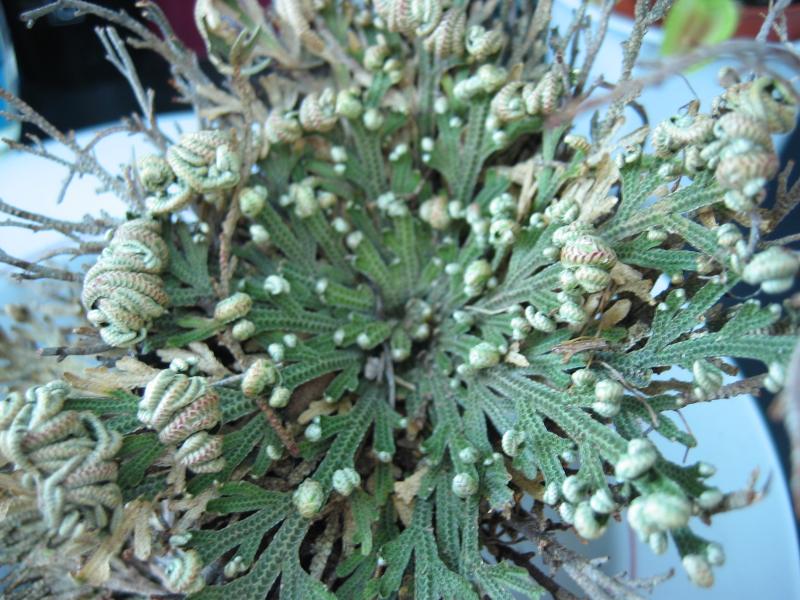 Rose-of-JerichoSelaginella lepidophylla
-
 Rainbow-fernSelaginella uncinata
-
 Peacock-fernSelaginella willdenowii
-
 Little-club-mossSelaginella tamariscina
-
 Low SpikemossSelaginella selaginoides
-
 Gemmiferous SpikemossSelaginella moellendorffii
-
 Toothed-leaved ClubmossSelaginella denticulata
-
 Festoon-pineSelaginella rupestris
Compare
Questions and answers
What is the scientific name of the African Clubmoss?
The scientific name of the African Clubmoss is Selaginella kraussiana. Written with its author, the full name is Selaginella kraussiana (Kunze) A.Braun.
Which family does the African Clubmoss belong to?
Selaginella kraussiana belongs to the family Selaginellaceae, in the order Selaginellales and the class Lycopodiopsida.
Where is the African Clubmoss found?
Checklists and occurrence records place Selaginella kraussiana in 49 countries, including South Africa, Tanzania, Kenya, Democratic Republic of the Congo, Uganda and Burundi.
What other names does the African Clubmoss have?
Selaginella kraussiana is also known in English as Forest Selaginella, Kraus's Clubmoss, Krauss Spikemoss, Krauss' Spike Moss, Krauss's Clubmoss and Krauss's Spike-moss.
What is Selaginella used for?
African Clubmoss is cultivated for ornamental purposes.[13]
What are the defining characteristics of Selaginella plants?
African Clubmoss is a low-growing, mat-forming vascular plant with primitive fern-like leaves. Its stems spread and root as they grow.[1][4][3]
Is Selaginella hard to care for?
African Clubmoss requires a minimum temperature of 5 °C, sheltered locations with full or partial shade, and potting media that retains humidity, drains quickly and does not remain excessively wet. It prefers acidic to neutral growing media with a pH of 6.0–7.0.[8][7][10][11]
Sources
Passages the profile rests on
- Selaginella kraussiana has primitive fern-like leaves. Source passage: “primitive fern-like leaves” — English Wikipedia
- Selaginella kraussiana grows to a height of approximately 5 cm. Source passage: “Growing to just 5 cm (2.0 in) high” — English Wikipedia
- Selaginella kraussiana is a low-growing, mat-forming vascular plant. Source passage: “a low-growing, mat-forming vascular plant.” — plants.ces.ncsu.edu
- Selaginella kraussiana spreads through stems that root as they grow. Source passage: “that spreads via rooting stems.” — English Wikipedia
- Selaginella kraussiana has a lacy leaf structure that has contributed to its occasional misidentification as a peacock fern. Source passage: “It is sometimes given the misnomer of "peacock fern", due to its lacy leaf structure” — English Wikipedia
- Selaginella kraussiana forms dense mats in shaded areas in New Zealand and Australia. Source passage: “where it forms dense mats in shaded areas.” — English Wikipedia
- Selaginella kraussiana prefers sheltered locations receiving full or partial shade. Source passage: “They prefer a sheltered spot, in full or partial shade.” — English Wikipedia
- Selaginella kraussiana requires a minimum temperature of 5 °C. Source passage: “It requires a minimum temperature of 5 °C (41 °F)” — English Wikipedia
- In temperate regions, Selaginella kraussiana is grown under glass as a houseplant. Source passage: “in temperate regions is grown under glass as a houseplant.” — English Wikipedia
- Selaginella kraussiana requires potting media that retains humidity, drains quickly, and does not remain excessively wet. Source passage: “They require potting media that retains humidity while not staying overly wet, and drains quickly.” — English Wikipedia
- Selaginella kraussiana prefers acidic to neutral growing media with a pH of 6.0–7.0. Source passage: “An acidic to neutral pH (6.0–7.0) is preferable.” — English Wikipedia
- Selaginella kraussiana is listed on the New Zealand National Pest Plant Accord as an invasive species. Source passage: “Selaginella kraussiana is listed on the New Zealand National Pest Plant Accord since it is an invasive species.” — English Wikipedia
- Selaginella kraussiana is cultivated for ornamental purposes. Source passage: “Selaginella kraussiana is cultivated for ornamental purposes.” — English Wikipedia
- Selaginella kraussiana and its cultivar 'Brownii' have received the Royal Horticultural Society's Award of Garden Merit. Source passage: “The species and the cultivar 'Brownii' have both gained the Royal Horticultural Society's Award of Garden Merit.” — English Wikipedia
- Other cultivated varieties of Selaginella kraussiana include 'Aurea' and 'Gold Tips'. Source passage: “Other cultivars include 'Aurea' and 'Gold Tips'.” — English Wikipedia
Data
- Catalogue of Life, 2026-10-16 XR cc by
- Global Biodiversity Information Facility CC BY 4.0
- Wikidata CC0
- GeoNames CC BY 4.0
- Wikimedia Commons per image; credit shown with each image
- Within the Catalogue of Life, this name comes from Checklist of Ferns and Lycophytes of the World cc by
References
- Braun, A. Index Sem. (Berlin) App., 22 (1860). where the name was published
This species in other databases
- Catalogue of Life 4WBXR
- Wikidata Q7447419
- iNaturalist 168763
- World Flora Online wfo-0001109648
- GRIN 407059
Page built on 24 November 2026. See how the catalog is made and all sources and licences.
Cite this page
ScientificNames.org. (2026). Selaginella kraussiana (African Clubmoss). Retrieved November 24, 2026, from https://scientificnames.org/species/selaginella-kraussiana
“Selaginella kraussiana (African Clubmoss).” ScientificNames.org, 2026, scientificnames.org/species/selaginella-kraussiana. Accessed 24 Nov. 2026.
ScientificNames.org. “Selaginella kraussiana (African Clubmoss).” Accessed November 24, 2026. https://scientificnames.org/species/selaginella-kraussiana.
@misc{scientificnames_selaginella_kraussiana_african_clubmoss,
  author = {{ScientificNames.org}},
  title = {Selaginella kraussiana (African Clubmoss)},
  year = {2026},
  url = {https://scientificnames.org/species/selaginella-kraussiana},
  note = {Accessed 2026-11-24}
}