Comparison

Small Grass-yellow vs Mexican Yellow

Small Grass-yellow (Eurema smilax) and Mexican Yellow (Eurema mexicana) both belong to the genus Eurema (grass yellows) and part ways below it.
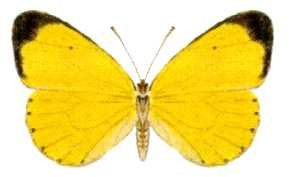
Small Grass-yellow

Small Grass-yellow

Eurema smilax

Commonwealth Scientific and Industrial Research Organisation (CSIRO), Public domain, via Wikimedia Commons

Mexican Yellow

Mexican Yellow

Eurema mexicana

Meganmccarty, Public domain, via Wikimedia Commons

Side by side

Small Grass-yellowMexican Yellow
Scientific nameEurema smilax (Donovan, 1805)Eurema mexicana (Boisduval, 1836)
English nameSmall Grass-yellowMexican Yellow
GroupInsectsInsects
ClassInsecta InsectInsecta Insect
OrderLepidopteraLepidoptera
FamilyPieridae WhitesPieridae Whites
GenusEurema Grass YellowsEurema Grass Yellows
Named in18051836
Countries on record2 countries7 countries
GBIF occurrence records3,282 records11,696 records

Rows where the two agree are shown in grey.

Where each is found

Only Small Grass-yellow (2)

Only Mexican Yellow (7)

From Catalogue of Life checklists and GBIF occurrence records. A country missing from a list means no record is held, which is not proof of absence.

Checked facts

Small Grass-yellowMexican Yellow
Appearance
  • Adult butterflies are yellow and have black tips on the upper surfaces of their forewings. English Wikipedia
  • Summer-form adults in southern Australia are usually pale yellow and have few or no brown markings on the undersides of their wings. English Wikipedia
  • Winter-form adults in southern Australia are brighter yellow and have pronounced brown markings on the undersides of their wings. English Wikipedia
  • Male adults are generally brighter yellow than female adults. English Wikipedia
  • Young caterpillars are initially pale yellow before becoming greenish. English Wikipedia
  • Third- and fourth-instar caterpillars develop a darker dorsal line and a yellow lateral line. English Wikipedia
  • All larval stages possess specialised hairs that secrete poison, which appears as clear droplets at the hair tips. English Wikipedia
  • The upper surfaces of the wings are pale yellow with a black submarginal border on the forewings that forms a dog-face or wolf-face pattern. English Wikipedia
  • The hindwings have a small black border along their outer margins. English Wikipedia
  • Male individuals have a bright yellow patch along the leading edge of each hindwing. English Wikipedia
  • Summer individuals have pale yellow undersides of the wings. English Wikipedia
  • Winter individuals have pale yellow undersides with reddish markings or entirely reddish-pink undersides. English Wikipedia
  • The hindwings have sharply pointed outer ends. English Wikipedia
  • The larva is green and has a creamy or yellow stripe along its mid-dorsal region. English Wikipedia
  • The larva has a yellow stripe along each side. English Wikipedia
Size
Habitat
  • Females appear to prefer laying eggs on small plants growing in full sunlight. English Wikipedia
Diet
  • The larvae mainly feed on plants belonging to the genera Senna and Neptunia. English Wikipedia
  • Recorded larval host plants include Senna acclinis, Senna coronilloides and Senna gaudichaudii. English Wikipedia
  • Recorded larval host plants include Senna artemisioides, Senna odorata and Senna petiolaris. English Wikipedia
  • Recorded larval host plants include Senna surattensis, Senna alata and Senna auriculata. English Wikipedia
  • Neptunia gracilis and Neptunia monosperma are recorded larval host plants. English Wikipedia
  • Paraserianthes lophantha is a recorded larval host plant. English Wikipedia
  • New Mexican locust (Robinia neomexicana) is recorded as a host plant of the species. English Wikipedia
  • Fern acacia (Acacia angustissima) is recorded as a host plant of the species. English Wikipedia
  • Prairie acacia (Acacia angustissima var. hirta) is recorded as a host plant of the species. English Wikipedia
Behaviour
  • The species exhibits both migratory and vagrant movement patterns. English Wikipedia
  • In South Australia, adults migrate south from northern breeding grounds during spring. English Wikipedia
  • Hot northerly winds assist the species during its southward spring migrations in South Australia. English Wikipedia
  • Migrating adults fly steadily and directly below head height. English Wikipedia
  • Females undertaking migration are gravid and fertile. English Wikipedia
Reproduction
Distribution
  • The species occurs throughout mainland Australia. English Wikipedia
  • Occasional records of the species exist from Kangaroo Island, Lord Howe Island and Tasmania. English Wikipedia
Similar species
  • Terias parvula Herrich-Schäffer, 1869 is listed as a synonym of this species. bie.ala.org.au
  • Boisduval's yellow (Eurema boisduvaliana) occurs within the Mexican yellow's range. English Wikipedia
  • Salome yellow (Eurema salome) occurs within the Mexican yellow's range. English Wikipedia
  • Boisduval's yellow is smaller and brighter yellow than the Mexican yellow. English Wikipedia
  • The male Boisduval's yellow has a less pronounced dog-face pattern than the Mexican yellow. English Wikipedia
  • Female Boisduval's yellow individuals have less black coloration on their upper wing surfaces. English Wikipedia
  • Boisduval's yellow has less sharply pointed hindwings than the Mexican yellow. English Wikipedia
  • Salome yellow is brighter yellow and has less extensive black coloration on its upper wing surfaces than the Mexican yellow. English Wikipedia
  • Salome yellow has a round reddish spot near the trailing edge on the underside of its hindwing. English Wikipedia

In brief

Small Grass-yellow

Eurema smilax occurs throughout mainland Australia, with occasional records from Kangaroo Island, Lord Howe Island and Tasmania. Adult butterflies are yellow and have black tips on the upper surfaces of their forewings. Full profile

Mexican Yellow

Eurema mexicana occurs mainly in Mexico, occasionally in central and southwestern United States, and rarely reaches Canada. It has pale yellow upper wing surfaces, a black dog-face or wolf-face pattern on the forewings, and sharply pointed hindwings. Full profile

Compare something else

Page built on 28 November 2026 from the data on the two species pages, where every source is listed.

Cite this page

ScientificNames.org. (2026). Small Grass-yellow vs Mexican Yellow. Retrieved November 28, 2026, from https://scientificnames.org/compare/small-grass-yellow-vs-mexican-yellow