Comparison
Solitary Eagle vs Common Black Hawk
Solitary Eagle (Buteogallus solitarius) and Common Black Hawk (Buteogallus anthracinus) both belong to the genus Buteogallus (black-hawks) and part ways below it. Both are recorded in 11 countries.
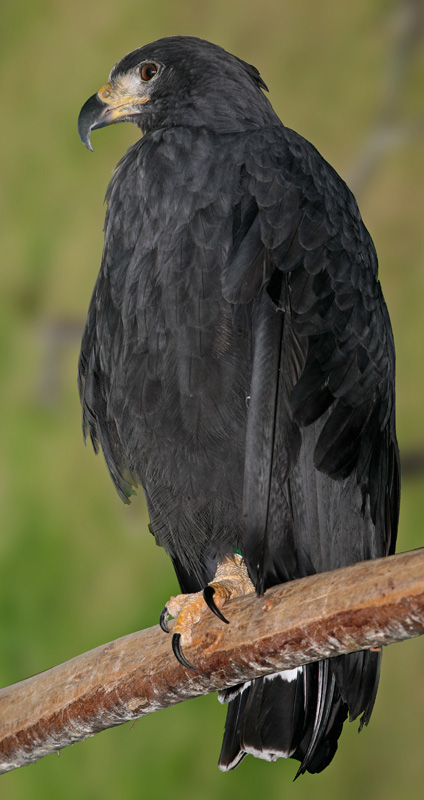


Common Black Hawk
Buteogallus anthracinus
Fernando Flores from Caracas, Venezuela, CC BY-SA 4.0, via Wikimedia Commons

Side by side
| Solitary Eagle | Common Black Hawk | |
|---|---|---|
| Scientific name | Buteogallus solitarius (Tschudi, 1844) | Buteogallus anthracinus (Deppe, 1830) |
| English name | Solitary Eagle | Common Black Hawk |
| Group | Birds | Birds |
| Class | Aves Bird | Aves Bird |
| Order | Accipitriformes Hawks | Accipitriformes Hawks |
| Family | Accipitridae Hawks | Accipitridae Hawks |
| Genus | Buteogallus Black-Hawks | Buteogallus Black-Hawks |
| Named in | 1844 | 1830 |
| Red List category | Near Threatened | Least Concern |
| Environment | terrestrial | terrestrial |
| Countries on record | 14 countries | 20 countries |
| GBIF occurrence records | 2,504 records | 156,927 records |
Rows where the two agree are shown in grey.
Where each is found
Both recorded in 11 countries
Only Solitary Eagle (3)
Only Common Black Hawk (9)
- Cuba
- El Salvador
- Guyana
- Honduras
- Saint Lucia
- Saint Vincent and the Grenadines
- Suriname
- Trinidad and Tobago
- United States
From Catalogue of Life checklists and GBIF occurrence records. A country missing from a list means no record is held, which is not proof of absence.
Checked facts
| Solitary Eagle | Common Black Hawk | |
|---|---|---|
| Appearance |
|
|
| Size |
|
|
| Habitat |
|
|
| Diet |
|
|
| Behaviour | No checked fact yet |
|
| Reproduction | No checked fact yet |
|
| Distribution | No checked fact yet |
|
| Conservation |
|
|
| Similar species | No checked fact yet |
|
| Other |
|
|
In brief
Solitary Eagle
Buteogallus solitarius inhabits mountainous or hilly forests at elevations between 600 and 2,200 m. It has uniformly dark gray adult plumage, exceptionally broad wings and a thickset body. Full profile
Common Black Hawk
Buteogallus anthracinus inhabits mangrove swamps, estuaries, nearby dry open woodland, and other coastal habitats, with inland populations also occurring. Adults are predominantly black or dark gray, with very broad wings and a short black tail marked by a broad white band and white tip. Full profile
Compare something else
Page built on 29 November 2026 from the data on the two species pages, where every source is listed.
Cite this page
ScientificNames.org. (2026). Solitary Eagle vs Common Black Hawk. Retrieved November 29, 2026, from https://scientificnames.org/compare/solitary-eagle-vs-common-black-hawk
“Solitary Eagle vs Common Black Hawk.” ScientificNames.org, 2026, scientificnames.org/compare/solitary-eagle-vs-common-black-hawk. Accessed 29 Nov. 2026.
ScientificNames.org. “Solitary Eagle vs Common Black Hawk.” Accessed November 29, 2026. https://scientificnames.org/compare/solitary-eagle-vs-common-black-hawk.
@misc{scientificnames_solitary_eagle_vs_common_black_hawk,
  author = {{ScientificNames.org}},
  title = {Solitary Eagle vs Common Black Hawk},
  year = {2026},
  url = {https://scientificnames.org/compare/solitary-eagle-vs-common-black-hawk},
  note = {Accessed 2026-11-29}
}