Comparison
Spring Peeper vs Cuban Tree Frog
Spring Peeper (Pseudacris crucifer) and Cuban Tree Frog (Osteopilus septentrionalis) both belong to the family Hylidae (hylids) and part ways below it. Both are recorded in 2 countries.


How they differ
The spring peeper generally remains concealed during daylight and becomes active around dusk, while the Cuban tree frog is generally nocturnal and most active between dusk and dawn. The spring peeper commonly inhabits forests and regenerating woodlands near temporary or semipermanent wetlands, while the Cuban tree frog occupies forest, mountain, coastal, urban, and suburban habitats. The spring peeper typically lays approximately 900 eggs per clutch, while the Cuban tree frog has multiple mating partners and males attract females through large chorus mating calls.
| Spring Peeper | Cuban Tree Frog | |
|---|---|---|
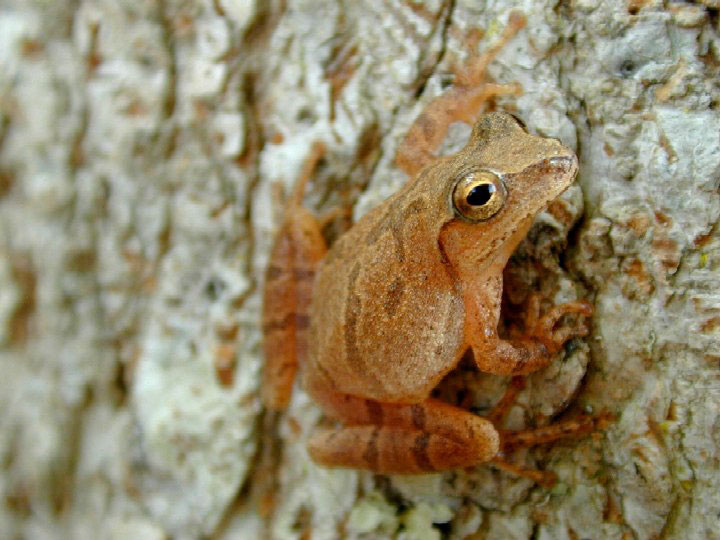
| Appearance | The spring peeper typically has pink, tan, light brown, or gray skin with an X-shaped marking on its back. | The Cuban tree frog has rough, warty skin with blotchy or mottled patterns and can change its coloration and patterns for camouflage. |
| Adhesive pads | The spring peeper has adhesive pads on its fingertips and toe tips. | The Cuban tree frog has adhesive pads on its toes that facilitate climbing in trees. |
| Calling | Male spring peepers produce clear, high-pitched calls that rise slightly in pitch at the end and repeat approximately once per second. | Male Cuban tree frogs attract females through large chorus mating calls. |
| Migration | Spring peepers generally migrate at night. | Cuban tree frogs migrate collectively to breeding sites after heavy rainstorms. |
| Diet | Adult spring peepers eat small insects and spiders, including ants, beetles, and flies. | Cuban tree frogs are generalist feeders whose diet consists primarily of invertebrates, including beetles and cockroaches. |
| Tadpole diet | Spring peeper tadpoles feed on algae, detritus, and microorganisms. | Cuban tree frog tadpoles primarily feed on algae and may also consume other tadpoles. |
| Conservation | Spring peepers are listed as protected in New Jersey and threatened in Kansas. | Cuban tree frogs are considered invasive in Florida and Puerto Rico. |
Written from the checked facts listed further down. Statements that the sources did not support were removed.
Side by side
| Spring Peeper | Cuban Tree Frog | |
|---|---|---|
| Scientific name | Pseudacris crucifer (Wied-Neuwied, 1838) | Osteopilus septentrionalis (Duméril & Bibron, 1841) |
| English name | Spring Peeper | Cuban Tree Frog |
| Group | Amphibians | Amphibians |
| Class | Amphibia Amphibians | Amphibia Amphibians |
| Order | Anura Frogs | Anura Frogs |
| Family | Hylidae Hylids | Hylidae Hylids |
| Genus | Pseudacris Chorus Frog | Osteopilus West Indian Treefrogs |
| Named in | 1838 | 1841 |
| Red List category | Least Concern | Least Concern |
| Environment | freshwater, terrestrial | Not recorded |
| Countries on record | 2 countries | 21 countries |
| GBIF occurrence records | 81,811 records | 31,787 records |
Rows where the two agree are shown in grey.
Where each is found
Both recorded in 2 countries
Only Cuban Tree Frog (19)
- Anguilla
- Antigua and Barbuda
- Bahamas
- Bonaire, Saint Eustatius and Saba
- British Virgin Islands
- Cayman Islands
- Cuba
- Curacao
- Dominica
- Dominican Republic
- Haiti
- Jamaica
- Puerto Rico
- Saint Barthelemy
- Saint Kitts and Nevis
- Saint Martin
- Sint Maarten
- Turks and Caicos Islands
- U.S. Virgin Islands
From Catalogue of Life checklists and GBIF occurrence records. A country missing from a list means no record is held, which is not proof of absence.
Checked facts
| Spring Peeper | Cuban Tree Frog | |
|---|---|---|
| Appearance |
|
|
| Size |
|
|
| Habitat |
|
|
| Diet |
|
|
| Behaviour |
|
|
| Reproduction |
|
|
| Conservation |
|
|
| Uses |
|
|
| Similar species |
| No checked fact yet |
In brief
Spring Peeper
Pseudacris crucifer inhabits forests, woodlands, marshy lowlands, and areas near ponds, swamps, and temporary wetlands. It typically has an X-shaped marking on its back, adhesive pads on its fingertips and toe tips, and skin that can change color in response to temperature and light. Full profile
Cuban Tree Frog
Osteopilus septentrionalis has rough, warty skin, bulging eyes, bright yellow inner thighs, and adhesive toe pads. Full profile
Compare something else
Page built on 24 November 2026 from the data on the two species pages, where every source is listed.
Cite this page
ScientificNames.org. (2026). Spring Peeper vs Cuban Tree Frog. Retrieved November 24, 2026, from https://scientificnames.org/compare/spring-peeper-vs-cuban-tree-frog
“Spring Peeper vs Cuban Tree Frog.” ScientificNames.org, 2026, scientificnames.org/compare/spring-peeper-vs-cuban-tree-frog. Accessed 24 Nov. 2026.
ScientificNames.org. “Spring Peeper vs Cuban Tree Frog.” Accessed November 24, 2026. https://scientificnames.org/compare/spring-peeper-vs-cuban-tree-frog.
@misc{scientificnames_spring_peeper_vs_cuban_tree_frog,
  author = {{ScientificNames.org}},
  title = {Spring Peeper vs Cuban Tree Frog},
  year = {2026},
  url = {https://scientificnames.org/compare/spring-peeper-vs-cuban-tree-frog},
  note = {Accessed 2026-11-24}
}