Species · Amphibians
Cuban Tree Frog Osteopilus septentrionalis
The scientific name of the Cuban Tree Frog is Osteopilus septentrionalis. It is a species of amphibian in the family Hylidae (hylids), order Anura. The name dates from 1841.
- Scientific name
- Osteopilus septentrionalis (Duméril & Bibron, 1841)
- Common name
- Cuban Tree Frog
- Genus
- Osteopilus
- Family
- Hylidae (Hylids)
- Order
- Anura
- Class
- Amphibia
- Red List category
- LC Least Concern
- Recorded in
- 21 countries
- Name status
- accepted in the Catalogue of Life

Overview
Osteopilus septentrionalis has rough, warty skin, bulging eyes, bright yellow inner thighs, and adhesive toe pads.
Written 24 November 2026 from the sources listed below. Each statement was checked against the passage it cites; statements that could not be supported were removed.
Appearance
Adults are generally gray, brown, or green, while juveniles tend to have greener coloration. The species can change its coloration and patterns for camouflage.[1][2]
Its skin has a rough, warty texture and blotchy or mottled patterns. Its coloration ranges from white and light brown to green and dark brown, and its abdomen is coarse and white.[3][4]
The inner thighs are bright yellow, and the eyes are bulging. Its toes have adhesive pads that facilitate climbing in trees.[5][6][7]
The species averages 2.5 to 12 cm in body length and 57 g in body mass. Females can grow to almost twice the size of males.[8][9][10]
Habitat
The Cuban Tree Frog occupies freshwater, tropical, and terrestrial habitats. Its habitats include mountain, forest, and coastal biomes, as well as urban and suburban environments.[11][12]
The species typically inhabits xeric environments, and its recorded maximum habitat elevation is 1,110 m.[13][14]
In southern Florida, individuals are frequently found around buildings and disturbed suburban areas, including inside houses.[15]
Diet
The Cuban Tree Frog is a generalist feeder whose diet consists primarily of invertebrates. Recorded invertebrate prey include beetles and cockroaches.[16][17]
Vertebrate prey include southern leopard frogs, eastern narrow-mouthed toads, brown anoles, tropical house geckos, and Florida brown snakes.[18][19]
Tadpoles primarily feed on algae and may also consume other tadpoles.[20]
Behaviour
The species is generally nocturnal and most active between dusk and dawn. When temperatures fall below 9.5°C, individuals enter a state of torpor.[21][22]
Individuals migrate collectively to breeding sites after heavy rainstorms. The species uses ambush predation to capture prey.[23][24]
When captured by a predator, the frog inflates its body and releases defensive compounds. The species does not appear to be territorial.[25][26]
Reproduction and life cycle
Males and females have multiple mating partners. Males attract females through large chorus mating calls.[27][28]
Males reach sexual maturity at an average age of 120 days, while females reach sexual maturity at an average age of 255 days.[29][30]
Breeding in aquatic environments occurs throughout the year in Cuba and Florida, with activity peaking between May and October. The species reproduces by laying eggs that are fertilized externally.[31][32]
Females can lay more than 3,000 eggs in batches of 75 to 1,000. Eggs float on the water surface and require ambient temperatures above 27°C to survive.[33][34]
Eggs hatch within approximately 24 to 32 hours. At water temperatures above 35°C, tadpoles can complete metamorphosis in approximately three weeks.[35][36]
At temperatures below 29°C, tadpole metamorphosis typically takes approximately one month. The species provides no parental care, and offspring become independent immediately.[37][38]
Conservation
The Cuban Tree Frog is considered invasive in Florida and Puerto Rico. Its predation on native amphibians can contribute to declines in native tree frog populations.[39][40]
Its removal has been associated with increases in native tree frog abundance.[41]
Uses
The Cuban Tree Frog is commonly available in the pet trade in the United States.[42]
Classification of the Cuban Tree Frog
| Kingdom | Animalia |
|---|---|
| Phylum | Chordata |
| Subphylum | Vertebrata |
| Infraphylum | Gnathostomata |
| Parvphylum | Osteichthyes |
| Megaclass | Tetrapoda |
| Class | Amphibia (Amphibians) |
| Order | Anura (Frogs) |
| Family | Hylidae (Hylids) |
| Genus | Osteopilus (West Indian Treefrogs) |
| Species | Osteopilus septentrionalis (Duméril & Bibron, 1841) |
Where the Cuban Tree Frog is found
Checklists and occurrence records place Osteopilus septentrionalis in 21 countries across North America and Oceania. GBIF holds 31,787 georeferenced records of it.
Countries
- Anguilla 19
- Antigua and Barbuda 16
- Bahamas 1,584
- Bonaire, Saint Eustatius and Saba 103
- British Virgin Islands 100
- Canada 10
- Cayman Islands 596
- Cuba 1,795
- Curacao 73
- Dominica 5
- Dominican Republic 3
- Haiti 10
- Jamaica 21
- Puerto Rico 897
- Saint Barthelemy 28
- Saint Kitts and Nevis 9
- Saint Martin 16
- Sint Maarten 41
- Turks and Caicos Islands 25
- U.S. Virgin Islands 221
- United States 26,215
Regions and cities with the most records
- Florida, United States 23,638
- Homestead, United States 2,629
- Orlando, United States 1,345
- Gainesville, United States 1,321
- Alafaya, United States 1,319
- Kendall, United States 1,116
- Flagami, United States 1,109
- Coral Gables, United States 1,097
- Tampa, United States 1,076
- Fountainebleau, United States 1,031
- Town 'n' Country, United States 1,030
- Kendale Lakes, United States 1,022
- Tamiami, United States 968
- Little Havana, United States 962
- Brandon, United States 951
- Pine Hills, United States 943
- Cutler Bay, United States 938
- Allapattah, United States 917
- The Hammocks, United States 909
- Doral, United States 886
- Hialeah, United States 866
- Lauderhill, United States 862
- Plantation, United States 861
- Miami, United States 848
- Kissimmee, United States 845
- Tamarac, United States 817
- Fort Lauderdale, United States 770
- Carol City, United States 768
- Miami Gardens, United States 766
- Pembroke Pines, United States 754
- Fort Myers, United States 737
- Bonita Springs, United States 735
- Pinellas Park, United States 735
- Margate, United States 732
- Sarasota, United States 726
- Miramar, United States 725
Range as the checklists state it
North America
Caribbean
Oceania
A number beside a place is its count of GBIF occurrence records. A place without a number comes from a checklist alone. Records show where a species has been observed or collected, which can include escapes and vagrants.
Common names
English
- Cuban Tree Frog
- Cuban Treefrog
- Giant Tree-frog
Names in 10 other languages
- Czech
- rosnička kubánská
- Dutch
- Cubaanse boomkikker
- French
- Rainette de Cuba, Rainette de Cuba (La)
- German
- Kuba-Laubfrosch, Kubalaubfrosch
- Italian
- Raganella cubana
- Japanese
- キューバズツキガエル
- Korean
- 쿠바청개구리
- Portuguese
- Perereca-cubana
- Russian
- Исполинская квакша, Кубинская квакша
- Spanish
- Hila platanera, Rana Arborícola Cubana, Rana Platanera
Synonyms
15 other scientific names have been used for this species and are now treated as synonyms of Osteopilus septentrionalis.
- Dendrohyas septentrionalis Tschudi, 1838
- Hyla dominicensis insulsa (Cope, 1863)
- Hyla dominicensis insulsa Mittleman, 1950
- Hyla dominicensis septentrionalis Duméril & Bibron, 1841
- Hyla dominicensis septentrionalis Mertens, 1938
- Hyla insulsa (Cope, 1863)
- Hyla microterodisca Werner, 1921
- Hyla schebestana Werner, 1917
- Hyla septentrionalis Duméril & Bibron, 1841
- Hyla septentrionalis septentrionalis Duméril & Bibron, 1841
- Trachycephalus insulsus Cope, 1863
- Trachycephalus marmoratus Duméril & Bibron, 1841
- Trachycephalus septentrionalis (Duméril & Bibron, 1841)
- Trachycephalus wrightii Cope, 1863
- Osteopilus gratiosa misapplied
Related species
-
 Jamaican Laughing FrogOsteopilus ocellatus
-
 Hispaniolan Common Tree FrogOsteopilus dominicensis
-
 Jamaican Snoring FrogOsteopilus crucialis
- Hispaniolan Giant Tree FrogOsteopilus vastus
- Hispaniolan Yellow Tree FrogOsteopilus pulchrilineatus
- Yellow Bromeliad FrogOsteopilus marianae
- Green Bromeliad FrogOsteopilus wilderi
-
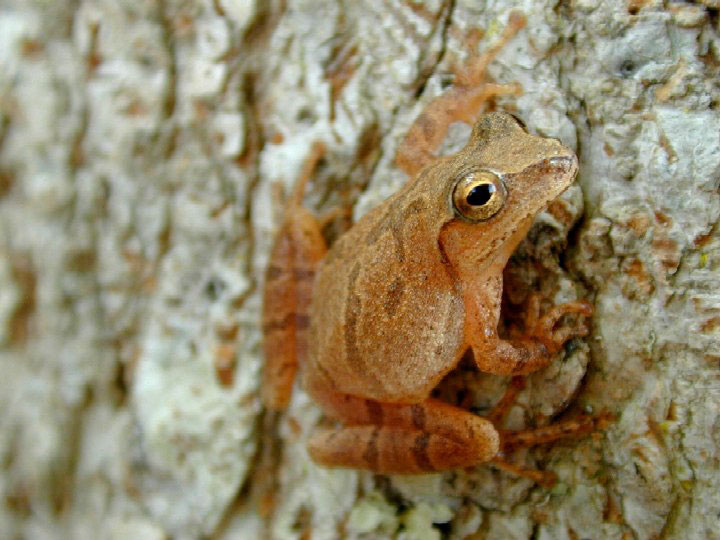 Spring PeeperPseudacris crucifer
Compare
Questions and answers
What is the scientific name of the Cuban Tree Frog?
The scientific name of the Cuban Tree Frog is Osteopilus septentrionalis. Written with its author, the full name is Osteopilus septentrionalis (Duméril & Bibron, 1841).
Which family does the Cuban Tree Frog belong to?
Osteopilus septentrionalis belongs to the family Hylidae, in the order Anura and the class Amphibia.
Where is the Cuban Tree Frog found?
Checklists and occurrence records place Osteopilus septentrionalis in 21 countries, including United States, Cuba, Bahamas, Puerto Rico, Cayman Islands and U.S. Virgin Islands.
What is the conservation status of the Cuban Tree Frog?
The IUCN Red List category recorded for Osteopilus septentrionalis is Least Concern (LC).
What other names does the Cuban Tree Frog have?
Osteopilus septentrionalis is also known in English as Cuban Treefrog and Giant Tree-frog.
Is it safe to touch a Cuban treefrog?
The species can secrete toxic mucus through its skin that causes a burning sensation upon contact with human eyes.[43]
Can I keep a Cuban treefrog as a pet?
The Cuban Tree Frog is commonly available in the pet trade in the United States.[42]
Why are Cuban treefrogs considered invasive?
The species is considered invasive in Florida and Puerto Rico. Its predation on native amphibians can contribute to declines in native tree frog populations, and its removal has been associated with increases in native tree frog abundance.[39][40][41]
What do Cuban treefrogs eat?
The Cuban Tree Frog is a generalist feeder whose diet consists primarily of invertebrates, including beetles and cockroaches. It also consumes southern leopard frogs, eastern narrow-mouthed toads, brown anoles, tropical house geckos, and Florida brown snakes.[16][17][18][19]
What kind of environment do Cuban treefrogs live in?
The species occupies freshwater, tropical, and terrestrial habitats, including mountain, forest, and coastal biomes, as well as urban and suburban environments. It typically inhabits xeric environments.[11][12][13]
Sources
Passages the profile rests on
- Adults are generally gray, brown, or green, while juveniles tend to have greener coloration. Source passage: “Cuban tree frogs are mostly gray, brown, or green, with young frogs having more green coloration than adults.” — English Wikipedia
- The species can change its coloration and patterns for camouflage. Source passage: “Cuban tree frogs have the ability to change their color and pattern to camouflage themselves.” — English Wikipedia
- The skin has a rough, warty texture and blotchy or mottled patterns. Source passage: “These frogs have rough, warty skin with blotchy or mottled patterning.” — English Wikipedia
- Its coloration ranges from white and light brown to green and dark brown, and its abdomen is coarse and white. Source passage: “Most tend to be white to light brown, but can include green to dark brown, with a white, coarse abdomen.” — animaldiversity.org
- The inner thighs are bright yellow. Source passage: “The inner thighs of these frogs are bright yellow” — English Wikipedia
- Its toes have adhesive pads that facilitate climbing in trees. Source passage: “The toes have sticky pads that are useful in their arboreal life.” — English Wikipedia
- The species has bulging eyes. Source passage: “The Cuban treefrog has bulging eyes.” — animaldiversity.org
- The species averages 2.5 to 12 cm in body length. Source passage: “On average, Osteopilus septentrionalis is 2.5 to 12 cm long.” — animaldiversity.org
- Females can grow to almost twice the size of males. Source passage: “The female can be almost twice as large as the male.” — animaldiversity.org
- The species averages 57 g in body mass. Source passage: “Osteopilus septentrionalis weighs 57 g, on average.” — animaldiversity.org
- The species occupies freshwater, tropical, and terrestrial habitats. Source passage: “The Cuban treefrog inhabits freshwater, tropical, and terrestrial habitats.” — animaldiversity.org
- Its habitats include mountain, forest, and coastal biomes, as well as urban and suburban environments. Source passage: “This species can be found in mountain, forest, and coastal biomes, as well as urban and suburban areas.” — animaldiversity.org
- The species typically inhabits xeric environments. Source passage: “The Cuban treefrog typically inhabits xeric habitats.” — animaldiversity.org
- Its recorded maximum habitat elevation is 1,110 m. Source passage: “The maximum elevation the Cuban treefrog inhabits is 1110 m.” — animaldiversity.org
- In southern Florida, individuals are frequently found around buildings and disturbed suburban areas, including inside houses. Source passage: “This frog is often found around buildings and disturbed areas in suburban southern Florida, including in houses.” — animaldiversity.org
- The species is a generalist feeder whose diet consists primarily of invertebrates. Source passage: “The Cuban treefrog is a generalist feeder, with invertebrates making up the majority of prey consumed.” — animaldiversity.org
- Recorded invertebrate prey include beetles and cockroaches. Source passage: “Prey include beetles and roaches” — animaldiversity.org
- Vertebrate prey include southern leopard frogs and eastern narrow-mouthed toads. Source passage: “vertebrates, such as other frogs: southern leopard frogs ( Lithobates sphenocephalus ) and eastern narrow-mouthed toads ( Gastrophryne carolinensis )” — animaldiversity.org
- The species also consumes brown anoles, tropical house geckos, and Florida brown snakes. Source passage: “lizards: brown anoles ( Anolis sagrei ). Osteopilus septentrionalis is known to feed on tropical house geckos ( Hemidactylus mabouia ) and Florida brown snakes ( Storeria victa ).” — animaldiversity.org
- Tadpoles primarily feed on algae and may also consume other tadpoles. Source passage: “As a tadpole, it primarily feeds on algae, but is known to engage in cannibalism.” — animaldiversity.org
- The species is generally nocturnal and most active between dusk and dawn. Source passage: “The Cuban treefrog is generally nocturnal, being most active from dusk to dawn.” — animaldiversity.org
- When temperatures fall below 9.5°C, individuals enter a state of torpor. Source passage: “When temperatures are below 9.5° Celsius, the Cuban treefrog goes into a state of torpor.” — animaldiversity.org
- The species migrates collectively to breeding sites after heavy rainstorms. Source passage: “The Cuban treefrog is generally a terrestrial species, but migrates en masse to breeding sites following heavy rainstorms.” — animaldiversity.org
- It uses ambush predation to capture prey. Source passage: “The Cuban treefrog is an ambush predator.” — animaldiversity.org
- When captured by a predator, the frog inflates its body and releases defensive compounds. Source passage: “When captured by a predator, the Cuban treefrog will inflate its body and release defensive compounds that are toxic to humans and other mammalian predators.” — animaldiversity.org
- The species does not appear to be territorial. Source passage: “They do not appear to be territorial.” — animaldiversity.org
- Males and females have multiple mating partners. Source passage: “Males and females are polygynandrous which means males and females have multiple mates.” — animaldiversity.org
- Males attract females through large chorus mating calls. Source passage: “The male Cuban treefrog attracts the female through large chorus mating calls.” — animaldiversity.org
- Males reach sexual maturity at an average age of 120 days. Source passage: “The male Cuban treefrog reaches sexual maturity at 120 days, on average.” — animaldiversity.org
- Females reach sexual maturity at an average age of 255 days. Source passage: “The female treefrog reaches sexual maturity at 255 days, on average.” — animaldiversity.org
- Breeding in aquatic environments occurs throughout the year in Cuba and Florida, with activity peaking between May and October. Source passage: “In the Cuban treefrog's native habitat of Cuba and in Florida, breeding in aquatic environments occurs throughout the year, with peaks during the wet season from May to October.” — animaldiversity.org
- The species reproduces by laying eggs that are fertilized externally. Source passage: “This frog is oviparous with external fertilization by the male.” — animaldiversity.org
- Females can lay more than 3,000 eggs in batches of 75 to 1,000. Source passage: “The female Cuban treefrog lays over 3,000 eggs, laying them 75 to 1,000 at a time.” — animaldiversity.org
- Eggs float on the water surface and require ambient temperatures above 27°C to survive. Source passage: “The eggs float on the surface of the water and will only survive in the presence of adequate ambient temperatures above 27° Celsius.” — animaldiversity.org
- Eggs hatch within approximately 24 to 32 hours. Source passage: “The eggs hatch quickly, within 24 to 32 hours.” — animaldiversity.org
- At water temperatures above 35°C, tadpoles can complete metamorphosis in approximately three weeks. Source passage: “In water temperatures above 35° Celsius, tadpoles will undergo metamorphosis relatively quickly, in 3 weeks.” — animaldiversity.org
- At temperatures below 29°C, tadpole metamorphosis typically takes approximately one month. Source passage: “However with temperatures below 29° Celsius, metamorphosis typically takes a month.” — animaldiversity.org
- The species provides no parental care, and offspring become independent immediately. Source passage: “There is no parental care and this treefrog is immediately independent.” — animaldiversity.org
- The species is considered invasive in Florida and Puerto Rico. Source passage: “The Cuban treefrog was introduced to the coast of Florida, just south of Tampa and from Orlando to Miami, as well as parts of Puerto Rico and is now considered an invasive species in those places.” — animaldiversity.org
- Its predation on native amphibians can contribute to declines in native tree frog populations. Source passage: “This large frog directly impacts native ecosystems by eating native frogs, lizards, and snakes, and poses a threat to the biodiversity of the areas into which it spreads by causing native tree frog populations to decline.” — English Wikipedia
- Its removal has been associated with increases in native tree frog abundance. Source passage: “their removal has shown to result in an increase in the amount of native tree frogs in an area.” — English Wikipedia
- The species is commonly available in the pet trade in the United States. Source passage: “Cuban tree frogs are commonly available in the pet trade within the United States.” — English Wikipedia
- The species can secrete toxic mucus through its skin that causes a burning sensation upon contact with human eyes. Source passage: “Cuban tree frogs are able to secrete a toxic mucus from their skin which can cause a fiery sensation if it makes contact with a person's eyes.” — English Wikipedia
Data
- Catalogue of Life, 2026-10-16 XR cc by
- Global Biodiversity Information Facility CC BY 4.0
- Wikidata CC0
- GeoNames CC BY 4.0
- Wikimedia Commons per image; credit shown with each image
- Within the Catalogue of Life, this name comes from The Integrated Taxonomic Information System cc0
References
- Frost, Darrel R. (1997). Amphibian Species of the World, A Taxonomic and Geographic Reference. Second Edition.
- Crother, Brian I., Jeff Boundy, Jonathan A. Campbell, et al. / Moriarty, John J., ed. (2000). Scientific and Standard English Names of Amphibians and Reptiles of North America North of Mexico, with Comments Regarding Confidence in Our Understanding. Herpetological Circular, No. 29.
- Crother, Brian I., Jeff Boundy, Frank T. Burbrink, et al. / Moriarty, John J., ed. (2008). Scientific and Standard English Names of Amphibians and Reptiles of North America North of Mexico, With Comments Regarding Confidence in Our Understanding, Sixth Ed. Herpetological Circular No. 37.
This species in other databases
Page built on 24 November 2026. See how the catalog is made and all sources and licences.
Cite this page
ScientificNames.org. (2026). Osteopilus septentrionalis (Cuban Tree Frog). Retrieved November 24, 2026, from https://scientificnames.org/species/osteopilus-septentrionalis
“Osteopilus septentrionalis (Cuban Tree Frog).” ScientificNames.org, 2026, scientificnames.org/species/osteopilus-septentrionalis. Accessed 24 Nov. 2026.
ScientificNames.org. “Osteopilus septentrionalis (Cuban Tree Frog).” Accessed November 24, 2026. https://scientificnames.org/species/osteopilus-septentrionalis.
@misc{scientificnames_osteopilus_septentrionalis_cuban_tree_frog,
  author = {{ScientificNames.org}},
  title = {Osteopilus septentrionalis (Cuban Tree Frog)},
  year = {2026},
  url = {https://scientificnames.org/species/osteopilus-septentrionalis},
  note = {Accessed 2026-11-24}
}