Comparison

Wolf vs Coyote

Wolf (Canis lupus) and Coyote (Canis latrans) both belong to the genus Canis (dogs) and part ways below it. Both are recorded in 3 countries.

Wolf

Wolf

Canis lupus

User:Mas3cf, CC BY-SA 4.0, via Wikimedia Commons

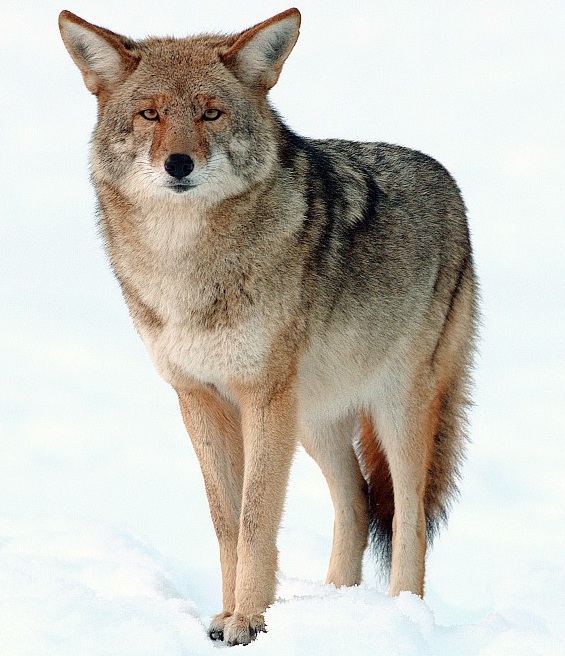
Coyote

Coyote

Canis latrans

Yathin S Krishnappa, CC BY-SA 3.0, via Wikimedia Commons

How they differ

The Wolf (Canis lupus) has small, pointed ears and small eyes positioned relatively far apart, while the Coyote (Canis latrans) has longer ears, a narrow muzzle, and a bushy tail with a black tip. The Wolf generally lives in social packs, while the Coyote can live in family units or loosely organized packs of unrelated individuals and can also hunt individually. The Wolf generally maintains territories used almost exclusively by pack members, while the Coyote may defend territories or survive as a nonterritorial transient individual.

WolfCoyote
AppearanceThe Wolf has a coat ranging from white and gray to brown and black.The Coyote typically has a coat combining light gray, reddish or fulvous, black, and white coloration.
Winter coatThe Wolf develops a thick, fluffy winter coat with longer guard hairs and a dense undercoat.The Coyote generally has a grey-brown coat with black-tipped hairs along its back.
Social groupsA typical Wolf pack in the northern United States Rocky Mountains contains five to ten animals.Coyotes may form groups of five to six adults under favorable conditions.
VocalizationThe Wolf uses howling to communicate and maintain contact with pack members.The Coyote characteristically produces howls that rapidly change in tone and pitch.
ConservationThe gray Wolf has been assessed as Least Concern by the IUCN.The Coyote is classified as Least Concern by the International Union for Conservation of Nature.

Written from the checked facts listed further down. Statements that the sources did not support were removed.

Side by side

WolfCoyote
Scientific nameCanis lupus Linnaeus, 1758Canis latrans Say, 1823
English nameWolfCoyote
GroupMammalsMammals
ClassMammalia MammalMammalia Mammal
OrderCarnivora CarnivoresCarnivora Carnivores
FamilyCanidae DogsCanidae Dogs
GenusCanis DogsCanis Dogs
Named in17581823
Red List categoryLeast ConcernLeast Concern
Environmentterrestrialterrestrial
Countries on record73 countries10 countries
GBIF occurrence records119,810 records120,320 records

Rows where the two agree are shown in grey.

Where each is found

Both recorded in 3 countries

Only Wolf (70)

Only Coyote (7)

From Catalogue of Life checklists and GBIF occurrence records. A country missing from a list means no record is held, which is not proof of absence.

Checked facts

WolfCoyote
Appearance
  • The gray wolf has a coat that can range from white and gray to brown and black. English Wikipedia
  • The wolf has small, pointed ears and small eyes positioned relatively far apart. English Wikipedia
  • The wolf develops a thick, fluffy winter coat with longer guard hairs and a dense undercoat. English Wikipedia
  • The wolf sheds most of its undercoat in spring and regrows its coat in autumn. English Wikipedia
  • The wolf's legs are generally longer than those of other canids, helping it move through deep snow. English Wikipedia
  • Female wolves generally have slimmer bodies and shorter legs than males. English Wikipedia
  • The coyote typically has a coat combining light gray, reddish or fulvous, black, and white coloration. English Wikipedia
  • Coyotes have pointed ears, a narrow muzzle, and a bushy tail with a black tip. nps.gov
  • Coyotes generally have a grey-brown coat with black-tipped hairs along their backs. nps.gov
  • The coyote has longer ears and a relatively larger braincase than the gray wolf. English Wikipedia
  • Coyotes carry their tails downward when walking or running. English Wikipedia
Size
  • Male coyotes typically weigh between 8 and 20 kg. English Wikipedia
  • Female coyotes typically weigh between 7 and 18 kg. English Wikipedia
  • Adult coyotes have an average total body length, including the tail, of 1.0 to 1.35 m. English Wikipedia
  • The coyote's tail measures approximately 40 cm in length. English Wikipedia
  • The average shoulder height of coyotes ranges from 18 to 23 inches. nps.gov
  • Coyotes average approximately 20 to 35 pounds in weight according to the Jewel Cave National Monument account. nps.gov
  • Northern coyote subspecies average approximately 18 kg, compared with 11.5 kg for southern Mexican subspecies. English Wikipedia
Habitat
  • Wolves inhabit forests, wetlands, shrublands, grasslands, Arctic tundra, pastures, deserts, and rocky mountain peaks. English Wikipedia
  • Wolves can inhabit both wilderness areas and landscapes modified by humans. English Wikipedia
Diet
  • Wolves primarily consume large wild hoofed mammals and also eat smaller animals, livestock, carrion, and garbage. English Wikipedia
  • Important prey species for North American wolves include elk, moose, caribou, white-tailed deer, and mule deer. English Wikipedia
  • European wolves prey on wild boar, chamois, roe deer, red deer, and moose. English Wikipedia
  • Alaskan wolves commonly supplement their diet with Dall sheep, squirrels, snowshoe hares, beavers, birds, and fish. adfg.alaska.gov
  • Moose and caribou are the primary food sources for wolves across much of mainland Alaska. adfg.alaska.gov
  • Salmon are an important seasonal food for coastal wolves in southeastern Alaska, particularly young individuals. adfg.alaska.gov
  • Wolves in southeastern Alaska primarily feed on Sitka black-tailed deer, mountain goats, and beavers. adfg.alaska.gov
  • Coyotes preferentially prey on Dall's sheep, white-tailed deer, eastern cottontail rabbits, and California voles. pmc.ncbi.nlm.nih.gov
  • Coyotes avoid preying on small mammals, including carnivorans and arboreal species. pmc.ncbi.nlm.nih.gov
  • Coyotes consume deer, rabbits, hares, rodents, birds, reptiles, amphibians, fish, and invertebrates. English Wikipedia
  • Coyotes occasionally consume fruits and vegetables. English Wikipedia
  • Coyotes in the southern United States may consume more frogs than coyotes in other regions. nps.gov
  • Coyotes in the Yukon may consume more berries. nps.gov
  • Vegetation consumption by coyotes is greatest during summer and autumn. research.fs.usda.gov
Behaviour
  • Wolves are highly social animals that generally live in packs. wdfw.wa.gov
  • Wolf packs commonly consist of a breeding pair, their previous-year offspring, and new pups. wdfw.wa.gov
  • A typical wolf pack in the northern United States Rocky Mountains contains five to ten animals. wdfw.wa.gov
  • Alaskan wolf packs average six or seven individuals. adfg.alaska.gov
  • Some Alaskan wolf packs contain 20–30 individuals. adfg.alaska.gov
  • Wolf packs generally maintain territories used almost exclusively by their own members. adfg.alaska.gov
  • Wolves use howling to communicate and maintain contact with pack members. wdfw.wa.gov
  • Wolf howls can be heard from distances of up to five miles. wdfw.wa.gov
  • Wolves typically avoid contact with humans. wdfw.wa.gov
  • Wolves generally target young, old, or debilitated prey rather than healthy middle-aged animals. adfg.alaska.gov
  • Coyotes can live either in family units or in loosely organized packs of unrelated individuals. English Wikipedia
  • Coyotes can hunt either individually or in groups. pmc.ncbi.nlm.nih.gov
  • Coyotes may form groups of five to six adults under favorable conditions. nps.gov
  • Coyote packs containing more than ten animals have been observed. nps.gov
  • Coyotes may establish and defend territories or survive as nonterritorial transient individuals. pmc.ncbi.nlm.nih.gov
  • Coyotes characteristically produce howls that rapidly change in tone and pitch. English Wikipedia
Reproduction
  • Most wolf packs produce one litter annually, typically containing four to six pups. wdfw.wa.gov
  • A female wolf in an Alaskan pack typically gives birth to approximately seven pups each year. adfg.alaska.gov
  • Wolf dens may be located in underground burrows, abandoned beaver lodges, hollow trees, or shallow rock caves. wdfw.wa.gov
Lifespan
  • Few wild wolves live longer than five years, although some individuals reach 15 years. wdfw.wa.gov
No checked fact yet
Distribution
  • Coyotes are native to North America. English Wikipedia
  • Coyotes occur throughout North and Central America. animaldiversity.org
  • Coyotes have expanded their geographic range by approximately 40 percent over the past 120 years. research.fs.usda.gov
  • Coyotes currently occur in every US state except Hawaii and extend as far north as the Arctic. nps.gov
  • Coyotes were first sighted in eastern Panama in 2013. English Wikipedia
Conservation
  • The global wild gray wolf population is estimated at approximately 300,000 individuals. English Wikipedia
  • The gray wolf has been assessed as Least Concern by the IUCN. English Wikipedia
  • Alaska has an estimated wolf population of 7,000–11,000 individuals. adfg.alaska.gov
  • Wolves have not been classified as threatened or endangered in Alaska. adfg.alaska.gov
  • Gray wolves are federally listed as endangered in the western two-thirds of Washington. wdfw.wa.gov
  • Human activities have caused wolves to disappear from much of their historical range. English Wikipedia
  • Human-caused mortality is the leading source of wolf deaths in the northern Rocky Mountain states. wdfw.wa.gov
  • The coyote is classified as Least Concern by the International Union for Conservation of Nature. English Wikipedia
  • Human persecution is a major cause of coyote mortality. nps.gov
  • Trapping for their pelts is one of the major causes of coyote mortality throughout their range. nps.gov
  • Coyotes have expanded their range despite substantial persecution related to actual or perceived livestock predation. pmc.ncbi.nlm.nih.gov
Name origin
  • The scientific genus name Canis is derived from the Latin word meaning dog. English Wikipedia

In brief

Wolf

The Gray Wolf occurs naturally across Eurasia and North America. The Gray Wolf has a coat ranging from white and gray to brown and black and generally lives in social packs. Full profile

Coyote

Coyotes are native to North America and inhabit environments ranging from dry tropical deciduous forests and prairies to woodlands, mountains, and urban areas. The Coyote has pointed ears, a narrow muzzle, a bushy black-tipped tail, and a coat combining gray, reddish, black, and white coloration. Full profile

Compare something else

Page built on 24 November 2026 from the data on the two species pages, where every source is listed.

Cite this page

ScientificNames.org. (2026). Wolf vs Coyote. Retrieved November 24, 2026, from https://scientificnames.org/compare/wolf-vs-coyote