Comparison

Wolverine vs Honey Badger

Wolverine (Gulo gulo) and Honey Badger (Mellivora capensis) both belong to the family Mustelidae (mustelids) and part ways below it.

Wolverine

Wolverine

Gulo gulo

Zefram, CC BY 2.5, via Wikimedia Commons

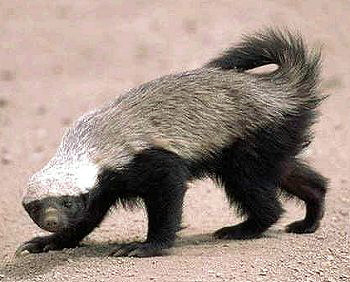
Honey Badger

Honey Badger

Mellivora capensis

en:User:Jaganath, CC BY-SA 3.0, via Wikimedia Commons

How they differ

The Wolverine (Gulo gulo) has dense dark brown to black fur with creamy white to golden stripes along its flanks, whereas the Honey badger (Mellivora capensis) generally has a black lower body and a white or grey upper mantle. The Wolverine inhabits northern Eurasia and North America within the boreal zone of the Northern Hemisphere, whereas the Honey badger occurs across most of sub-Saharan Africa and extends through Arabia, Iran, Western Asia, Turkmenistan, and the Indian Peninsula. The Wolverine has a breeding season extending from May through August, whereas the Honey badger can breed throughout the year.

WolverineHoney Badger
AppearanceThe Wolverine has dense fur that is generally dark brown to black, with creamy white to golden stripes extending from its shoulders along its flanks.The Honey badger generally has a black lower body and a white or grey upper mantle extending to the base of the tail.
ActivityThe Wolverine is active throughout the year and can be active at any time of day.The Honey badger may be active at any time of day depending on its location.
Social behaviourThe Wolverine is generally solitary outside the breeding period.The Honey badger is predominantly solitary.
Territorial markingThe Wolverine marks its territory using secretions from its anal scent glands and urine.The Honey badger scent-marks its territory using anal gland secretions, feces, and urine.
HabitatThe Wolverine inhabits alpine forests, tundra, open grasslands, and boreal shrub transition zones at or above the tree line.The Honey badger inhabits tropical and subtropical green forests, thorn forests, open woodlands, riparian forests, grasslands, arid steppes, rocky hills, and deserts.
DietThe Wolverine primarily scavenges carrion, particularly during winter and early spring.The Honey badger consumes insects, frogs, tortoises, turtles, lizards, rodents, snakes, birds, and eggs.
ConservationThe Wolverine is classified as Least Concern by the IUCN.The Honey badger is classified as Least Concern on the IUCN Red List.
ReproductionFemale Wolverines experience delayed implantation, with embryos remaining in the blastocyst stage until late autumn or early winter.The gestation period of the Honey badger is approximately 50–70 days.

Written from the checked facts listed further down. Statements that the sources did not support were removed.

Side by side

WolverineHoney Badger
Scientific nameGulo gulo (Linnaeus, 1758)Mellivora capensis (Schreber, 1776)
English nameWolverineHoney Badger
GroupMammalsMammals
ClassMammalia MammalMammalia Mammal
OrderCarnivora CarnivoresCarnivora Carnivores
FamilyMustelidae MustelidsMustelidae Mustelids
GenusGulo WolverinesMellivora Ratels
Named in17581776
Red List categoryLeast ConcernLeast Concern
EnvironmentterrestrialNot recorded
Countries on record12 countries37 countries
GBIF occurrence records36,845 records2,204 records

Rows where the two agree are shown in grey.

Where each is found

Only Wolverine (12)

Only Honey Badger (37)

From Catalogue of Life checklists and GBIF occurrence records. A country missing from a list means no record is held, which is not proof of absence.

Checked facts

WolverineHoney Badger
Appearance
  • The wolverine's dense fur is generally dark brown to black, with creamy white to golden stripes extending from its shoulders along its flanks. adfg.alaska.gov
  • The wolverine walks using a semiplantigrade posture, placing weight on the soles of its feet. adfg.alaska.gov
  • The honey badger has short, sturdy legs and five toes on each foot. English Wikipedia
  • Its forelimbs have remarkably long claws, whereas its hind-leg claws are short. English Wikipedia
  • Its coat generally has a black lower body and a white or grey upper mantle extending to the base of the tail. animaldiversity.org
  • Individuals belonging to the cottoni subspecies have an entirely black coat. English Wikipedia
Size
  • Adult wolverines measure approximately 65–109 cm in body length. English Wikipedia
  • Adult wolverines stand approximately 36–45 cm tall at the shoulder. English Wikipedia
  • Adult wolverines have tails measuring approximately 17–26 cm long. English Wikipedia
  • Male wolverines typically weigh 11–18 kg, while females typically weigh 8–12 kg. English Wikipedia
  • Male wolverines are generally 30–40% heavier than females. English Wikipedia
Habitat
  • Wolverines inhabit alpine forests, tundra, open grasslands, and boreal shrub transition zones at or above the tree line. animaldiversity.org
  • Wolverines generally require large, undisturbed habitats with low levels of human development. animaldiversity.org
  • Wolverines are associated with cold climates, where low temperatures help preserve cached animal food. animaldiversity.org
  • Female wolverines use persistent snow cover for constructing winter dens. adfg.alaska.gov
  • Honey badgers inhabit tropical and subtropical green forests, thorn forests, open woodlands, riparian forests, grasslands, arid steppes, rocky hills, and deserts. animaldiversity.org
  • Honey badgers occupy elevations from sea level to approximately 4,050 m. animaldiversity.org
  • Honey badgers require sheltering places such as burrows or rock crevices. animaldiversity.org
  • Honey badgers are not historically found in the extremely dry parts of the Sahara Desert or along the Mediterranean coast. animaldiversity.org
Diet
  • Wolverines primarily scavenge carrion, particularly during winter and early spring. English Wikipedia
  • Wolverines commonly consume the remains of moose and caribou killed by wolves or hunters during winter. adfg.alaska.gov
  • Wolverines feed on voles, squirrels, snowshoe hares, and birds throughout the year. adfg.alaska.gov
  • Wolverines occasionally kill moose, Dall sheep, and caribou. adfg.alaska.gov
  • Wolverines sometimes prey on young Dall sheep during spring. adfg.alaska.gov
  • Wolverines possess powerful jaws and large neck muscles that enable them to crush and consume bones and frozen flesh. adfg.alaska.gov
  • Honey badgers consume insects, frogs, tortoises, turtles, lizards, rodents, snakes, birds, and eggs. English Wikipedia
  • Honey badgers also eat berries, roots, and bulbs. English Wikipedia
  • Honey badgers raid beehives to obtain bee larvae and honey. English Wikipedia
  • Honey badgers consume all parts of their prey, including bones, feathers, hair, and skin. English Wikipedia
Behaviour
  • Wolverines are generally solitary animals outside the breeding period. adfg.alaska.gov
  • Wolverines are active throughout the year and can be active at any time of day. adfg.alaska.gov
  • Wolverines can travel up to 40 miles in a single day. adfg.alaska.gov
  • Wolverines defend their food sources and territories against other wolverines and smaller predators. adfg.alaska.gov
  • Wolverines cache food when supplies are abundant, particularly to support lactating females during winter and early spring. English Wikipedia
  • Wolverines mark their territories using secretions from their anal scent glands and urine. animaldiversity.org
  • Wolverines can climb trees readily. adfg.alaska.gov
  • Wolverines avoid encounters with wolves and bears because these predators can kill them. adfg.alaska.gov
  • Honey badgers are predominantly solitary animals. English Wikipedia
  • Honey badgers may be active at any time of day depending on their location. English Wikipedia
  • Honey badgers in the Serengeti are mostly nocturnal during the dry season and active throughout the day during the wet season. English Wikipedia
  • Honey badgers are skilled diggers capable of excavating tunnels in hard ground within ten minutes. English Wikipedia
  • Honey badger burrows are generally 1–3 m long and have a single entrance and an unlined nesting chamber. English Wikipedia
  • Adult male honey badgers have an average home range of 548 km², compared with 138 km² for females. English Wikipedia
  • Honey badgers scent-mark their territories using anal gland secretions, feces, and urine. English Wikipedia
  • Honey badgers can repel larger predators by releasing a pungent yellow liquid from their anal glands. English Wikipedia
  • Honey badgers sometimes hunt in pairs in Africa. English Wikipedia
Reproduction
  • Wolverines have a breeding season extending from May through August. adfg.alaska.gov
  • Female wolverines experience delayed implantation, with embryos remaining in the blastocyst stage until late autumn or early winter. adfg.alaska.gov
  • Newborn wolverine kits are blind and weigh less than 0.4 kg. adfg.alaska.gov
  • Wolverine kits are weaned at approximately nine to ten weeks of age. adfg.alaska.gov
  • Wolverines generally reach sexual maturity during their second year. adfg.alaska.gov
  • Honey badgers can breed throughout the year rather than during a fixed mating season. English Wikipedia
  • Female honey badgers have an estimated oestrus period of approximately 14 days. English Wikipedia
  • The gestation period of honey badgers is approximately 50–70 days. animaldiversity.org
  • Female honey badgers move their cubs between dens during the first three months after birth. animaldiversity.org
  • Honey badger cubs begin accompanying their mothers while foraging at approximately three months of age. animaldiversity.org
  • Female honey badgers care for their offspring for approximately 12–16 months. animaldiversity.org
  • Male honey badgers generally reach sexual maturity at two to three years of age. animaldiversity.org
Distribution
  • Wolverines inhabit northern Eurasia and North America within the boreal zone of the Northern Hemisphere. animaldiversity.org
  • Honey badgers occur across most of sub-Saharan Africa, from South Africa's Western Cape to southern Morocco and southwestern Algeria. English Wikipedia
  • The species' range extends beyond Africa through Arabia, Iran, Western Asia, Turkmenistan, and the Indian Peninsula. English Wikipedia
Conservation
  • The IUCN classifies the wolverine as Least Concern. English Wikipedia
  • Historical wolverine populations in southern Europe and North America were extirpated mainly through hunting, forest clearing, and other human activities. animaldiversity.org
  • Wolverines are vulnerable to excessive harvesting because of their limited reproductive capacity. adfg.alaska.gov
  • Protecting large wilderness areas and preventing excessive harvesting are important for maintaining healthy wolverine populations in Alaska. adfg.alaska.gov
  • The honey badger is classified as Least Concern on the IUCN Red List. English Wikipedia
  • Honey badgers are threatened by killings associated with beekeeping and farming, including poisoning and trapping. English Wikipedia
UsesNo checked fact yet
  • Honey badgers are used in traditional medicine and consumed as bushmeat. English Wikipedia
OtherNo checked fact yet
  • The honey badger is the only living species in the genus Mellivora. English Wikipedia
  • The honey badger is the sole living representative of the subfamily Mellivorinae. English Wikipedia

In brief

Wolverine

Wolverines inhabit northern Eurasia and North America within the boreal zone of the Northern Hemisphere. Wolverines have dense dark fur with creamy white to golden stripes extending from their shoulders along their flanks. Full profile

Honey Badger

Mellivora capensis occurs across most of sub-Saharan Africa and extends through Arabia, Iran, Western Asia, Turkmenistan, and the Indian Peninsula. It is the only living species in the genus Mellivora and the sole living representative of the subfamily Mellivorinae. Full profile

Compare something else

Page built on 24 November 2026 from the data on the two species pages, where every source is listed.

Cite this page

ScientificNames.org. (2026). Wolverine vs Honey Badger. Retrieved November 24, 2026, from https://scientificnames.org/compare/wolverine-vs-honey-badger