Species · Mammals
Wolverine Gulo gulo
The scientific name of the Wolverine is Gulo gulo. It is a species of mammal in the family Mustelidae (mustelids), order Carnivora. The name dates from 1758.
- Scientific name
- Gulo gulo (Linnaeus, 1758)
- Common name
- Wolverine
- Genus
- Gulo
- Family
- Mustelidae (Mustelids)
- Order
- Carnivora
- Class
- Mammalia
- Red List category
- LC Least Concern
- Environment
- terrestrial
- Recorded in
- 12 countries
- Name status
- accepted in the Catalogue of Life

Overview
Wolverines inhabit northern Eurasia and North America within the boreal zone of the Northern Hemisphere. Wolverines have dense dark fur with creamy white to golden stripes extending from their shoulders along their flanks.
Written 24 November 2026 from the sources listed below. Each statement was checked against the passage it cites; statements that could not be supported were removed.
Appearance
The wolverine walks using a semiplantigrade posture, placing weight on the soles of its feet. Adults measure approximately 65–109 cm in body length and stand approximately 36–45 cm tall at the shoulder.[1][2][3]
Adult wolverines have tails measuring approximately 17–26 cm long. Males typically weigh 11–18 kg, while females typically weigh 8–12 kg; males are generally 30–40% heavier than females.[4][5][6]
Habitat
Wolverines inhabit alpine forests, tundra, open grasslands, and boreal shrub transition zones at or above the tree line. They generally require large, undisturbed habitats with low levels of human development.[7][8]
Wolverines are associated with cold climates, where low temperatures help preserve cached animal food. Female wolverines use persistent snow cover for constructing winter dens.[9][10]
Diet
Wolverines primarily scavenge carrion, particularly during winter and early spring. They commonly consume the remains of moose and caribou killed by wolves or hunters during winter.[11][12]
Wolverines feed on voles, squirrels, snowshoe hares, and birds throughout the year. They occasionally kill moose, Dall sheep, and caribou, and sometimes prey on young Dall sheep during spring.[13][14][15]
Wolverines possess powerful jaws and large neck muscles that enable them to crush and consume bones and frozen flesh.[16]
Behaviour
Wolverines are generally solitary animals outside the breeding period. They are active throughout the year and can be active at any time of day.[17][18]
Wolverines can travel up to 40 miles in a single day. They defend their food sources and territories against other wolverines and smaller predators.[19][20]
Wolverines cache food when supplies are abundant, particularly to support lactating females during winter and early spring. They mark their territories using secretions from their anal scent glands and urine.[21][22]
Wolverines can climb trees readily. They avoid encounters with wolves and bears because these predators can kill them.[23][24]
Reproduction and life cycle
Wolverines have a breeding season extending from May through August. Female wolverines experience delayed implantation, with embryos remaining in the blastocyst stage until late autumn or early winter.[25][26]
Newborn wolverine kits are blind and weigh less than 0.4 kg. They are weaned at approximately nine to ten weeks of age.[27][28]
Wolverines generally reach sexual maturity during their second year.[29]
Conservation
The IUCN classifies the wolverine as Least Concern. Historical wolverine populations in southern Europe and North America were extirpated mainly through hunting, forest clearing, and other human activities.[30][31]
Wolverines are vulnerable to excessive harvesting because of their limited reproductive capacity. Protecting large wilderness areas and preventing excessive harvesting are important for maintaining healthy wolverine populations in Alaska.[32][33]
Classification of the Wolverine
| Kingdom | Animalia |
|---|---|
| Phylum | Chordata |
| Subphylum | Vertebrata |
| Infraphylum | Gnathostomata |
| Parvphylum | Osteichthyes |
| Megaclass | Tetrapoda |
| Class | Mammalia (Mammal) |
| Subclass | Theria |
| Infraclass | Eutheria |
| Order | Carnivora (Carnivores) |
| Suborder | Caniformia (Dog-like Carnivores) |
| Family | Mustelidae (Mustelids) |
| Subfamily | Guloninae (Fishers) |
| Genus | Gulo (Wolverines) |
| Species | Gulo gulo (Linnaeus, 1758) |
Where the Wolverine is found
Checklists and occurrence records place Gulo gulo in 12 countries across Asia and North America. GBIF holds 36,845 georeferenced records of it.
Countries
- Canada 2,299
- Estonia 15
- Finland 800
- Germany 24
- Kazakhstan 6
- Mongolia 8
- Norway 27,814
- Poland 18
- Romania 5
- Russia 541
- Sweden 2,267
- United States 3,048
Regions and cities with the most records
- Nordland, Norway 3,869
- Finnmark, Norway 3,319
- Møre og Romsdal, Norway 2,315
- Troms, Norway 2,199
- Alaska, United States 1,207
- Norrbotten, Sweden 1,166
- Northwest Territories, Canada 1,006
- Jämtland, Sweden 949
- Yukon, Canada 498
- Karelia, Russia 210
- Nunavut, Canada 166
- Lapland, Finland 134
- Rogaland, Norway 126
- Västerbotten, Sweden 124
- British Columbia, Canada 107
- Buskerud, Norway 107
- Murmansk, Russia 80
- Nenets, Russia 65
- Arkhangel’sk, Russia 64
- Murmansk, Russia 64
- Severomorsk, Russia 64
- Komi, Russia 63
- Västernorrland, Sweden 56
- Alberta, Canada 49
- Ontario, Canada 42
- Washington, United States 37
- Montana, United States 32
- Trondheim, Norway 28
- Gävleborg, Sweden 25
- Telemark, Norway 25
- California, United States 16
- Chukotka, Russia 16
- Anchorage, United States 14
- Akershus, Norway 12
- Dalarna, Sweden 7
- Idaho, United States 7
Range as the checklists state it
Europe & Northern Asia (excluding China)
North America
Southern Asia
A number beside a place is its count of GBIF occurrence records. A place without a number comes from a checklist alone. Records show where a species has been observed or collected, which can include escapes and vagrants.
Common names
English
- Wolverine
Names in 7 other languages
- Finnish
- ahma
- French
- Glouton, carcajou
- German
- Vielfraß
- Northern Sami
- geatki
- Norwegian Bokmål
- jerv
- Spanish
- Glotón
- Swedish
- järv
Synonyms
3 other scientific names have been used for this species and are now treated as synonyms of Gulo gulo.
- Gulo gulo luscus Trouessart, 1910
- Gulo vulgaris Oken, 1816
- Mustela gulo Linnaeus, 1758
Subspecies and varieties
- Gulo gulo gulo (Old World Badger) subspecies
- Gulo gulo luscus subspecies
Related species
-
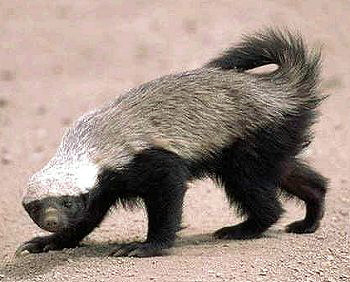 Honey BadgerMellivora capensis
-
 StoatMustela erminea
-
 Sea OtterEnhydra lutris
- SableMartes zibellina
-
 European Pine MartenMartes martes
-
 Least WeaselMustela nivalis
-
 European BadgerMeles meles
-
 Giant OtterPteronura brasiliensis
Compare
Questions and answers
What is the scientific name of the Wolverine?
The scientific name of the Wolverine is Gulo gulo. Written with its author, the full name is Gulo gulo (Linnaeus, 1758).
Which family does the Wolverine belong to?
Gulo gulo belongs to the family Mustelidae, in the order Carnivora and the class Mammalia.
Where is the Wolverine found?
Checklists and occurrence records place Gulo gulo in 12 countries, including Norway, United States, Canada, Sweden, Finland and Russia.
What is the conservation status of the Wolverine?
The IUCN Red List category recorded for Gulo gulo is Least Concern (LC).
Sources
Passages the profile rests on
- The wolverine walks using a semiplantigrade posture, placing weight on the soles of its feet. Source passage: “Like humans and bears, wolverines walk on the soles of their feet, called semiplantigrade posture.” — adfg.alaska.gov
- Adult wolverines measure approximately 65–109 cm in body length. Source passage: “body length ranging from 65–109 cm (26–43 in)” — English Wikipedia
- Adult wolverines stand approximately 36–45 cm tall at the shoulder. Source passage: “standing 36–45 cm (14–18 in) at the shoulder” — English Wikipedia
- Adult wolverines have tails measuring approximately 17–26 cm long. Source passage: “a tail length of 17–26 cm (6+1⁄2–10 in).” — English Wikipedia
- Male wolverines typically weigh 11–18 kg, while females typically weigh 8–12 kg. Source passage: “Weight is usually 11–18 kg (24–40 lb) in males, and in females 8–12 kg (18–26 lb).” — English Wikipedia
- Male wolverines are generally 30–40% heavier than females. Source passage: “can be 30–40% greater in weight.” — English Wikipedia
- Wolverines inhabit alpine forests, tundra, open grasslands, and boreal shrub transition zones at or above the tree line. Source passage: “Wolverines are found in alpine forests, tundra, open grasslands, and boreal shrub transition zones at or above timberline.” — animaldiversity.org
- Wolverines generally require large, undisturbed habitats with low levels of human development. Source passage: “Generally they live in areas with low human development and need large, undisturbed ranges in order to survive.” — animaldiversity.org
- Wolverines are associated with cold climates, where low temperatures help preserve cached animal food. Source passage: “Cold weather helps preserve the meat for later use.” — animaldiversity.org
- Female wolverines use persistent snow cover for constructing winter dens. Source passage: “home range size and use patterns are thought to be a response to the availability of resources being food or for adult females the presence of persistent snow cover for denning.” — adfg.alaska.gov
- Wolverines primarily scavenge carrion, particularly during winter and early spring. Source passage: “Most of their food is carrion, especially in winter and early spring.” — English Wikipedia
- Wolverines commonly consume the remains of moose and caribou killed by wolves or hunters during winter. Source passage: “In the winter wolverines primarily rely on carrion, remains of moose and caribou killed by wolves and hunters or animals that have died of natural causes.” — adfg.alaska.gov
- Wolverines feed on voles, squirrels, snowshoe hares, and birds throughout the year. Source passage: “Throughout the year, wolverines feed on small and medium-sized animals such as voles, squirrels, snowshoe hares, and birds.” — adfg.alaska.gov
- Wolverines occasionally kill moose, Dall sheep, and caribou. Source passage: “In the right situations, wolverines can kill moose, Dall sheep or caribou, but these occurrences are rare.” — adfg.alaska.gov
- Wolverines sometimes prey on young Dall sheep during spring. Source passage: “They have been known to take the young Dall sheep in the spring when they are most vulnerable.” — adfg.alaska.gov
- Wolverines possess powerful jaws and large neck muscles that enable them to crush and consume bones and frozen flesh. Source passage: “The wolverine has a powerful jaw and large neck muscles allowing it to crush and utilize bones and frozen flesh.” — adfg.alaska.gov
- Wolverines are generally solitary animals outside the breeding period. Source passage: “They are primarily solitary creatures throughout most of the year.” — adfg.alaska.gov
- Wolverines are active throughout the year and can be active at any time of day. Source passage: “Wolverines are active at any time of day, year round.” — adfg.alaska.gov
- Wolverines can travel up to 40 miles in a single day. Source passage: “Movements of 40 miles in a day have been documented.” — adfg.alaska.gov
- Wolverines defend their food sources and territories against other wolverines and smaller predators. Source passage: “Wolverines will defend a food source or its territory against other wolverines or smaller predators.” — adfg.alaska.gov
- Wolverines cache food when supplies are abundant, particularly to support lactating females during winter and early spring. Source passage: “Wolverines often cache their food during times of plenty. This is of particular importance to lactating females in the winter and early spring, a time when food is scarce.” — English Wikipedia
- Wolverines mark their territories using secretions from their anal scent glands and urine. Source passage: “Territories are marked with secretions from anal scent glands and urine.” — animaldiversity.org
- Wolverines can climb trees readily. Source passage: “They have curved, semi-retractile claws and can climb trees readily.” — adfg.alaska.gov
- Wolverines avoid encounters with wolves and bears because these predators can kill them. Source passage: “Instead, they avoid these animals as encounters with either of these predators may be fatal to the wolverine.” — adfg.alaska.gov
- Wolverines have a breeding season extending from May through August. Source passage: “The breeding season extends from May through August.” — adfg.alaska.gov
- Female wolverines experience delayed implantation, with embryos remaining in the blastocyst stage until late autumn or early winter. Source passage: “After mating, the fertilized eggs remain in the blastocyst stage until implantation occurs during until late fall or early winter.” — adfg.alaska.gov
- Newborn wolverine kits are blind and weigh less than 0.4 kg. Source passage: “Wolverine kits are born blind and weigh less than 1 pound (0.4 kg).” — adfg.alaska.gov
- Wolverine kits are weaned at approximately nine to ten weeks of age. Source passage: “They develop rapidly and are weaned at about 9-10 weeks of age.” — adfg.alaska.gov
- Wolverines generally reach sexual maturity during their second year. Source passage: “Both male and female wolverines become sexually mature in their second year” — adfg.alaska.gov
- The IUCN classifies the wolverine as Least Concern. Source passage: “The wolverine is listed by the IUCN as Least Concern” — English Wikipedia
- Historical wolverine populations in southern Europe and North America were extirpated mainly through hunting, forest clearing, and other human activities. Source passage: “Historically, wolverines were found in more southerly areas of Europe and North America, but these populations were extirpated mainly due to hunting, clearing of forests, and other human activities.” — animaldiversity.org
- Wolverines are vulnerable to excessive harvesting because of their limited reproductive capacity. Source passage: “Wolverines are vulnerable to harvest and because of their limited reproductive capability can be sensitive to overharvest.” — adfg.alaska.gov
- Protecting large wilderness areas and preventing excessive harvesting are important for maintaining healthy wolverine populations in Alaska. Source passage: “The continued health of wolverine populations in Alaska is best assured by both protecting large expanses of wilderness and preventing overharvest.” — adfg.alaska.gov
Data
- Catalogue of Life, 2026-10-16 XR cc by
- Global Biodiversity Information Facility CC BY 4.0
- Wikidata CC0
- GeoNames CC BY 4.0
- Wikimedia Commons per image; credit shown with each image
- Within the Catalogue of Life, this name comes from The Integrated Taxonomic Information System cc0
References
- Syst. Nat., 10th ed. vol.1 p.45 where the name was published
- Wilson, Don E., and DeeAnn M. Reeder, eds. (1993). Mammal Species of the World: A Taxonomic and Geographic Reference, 2nd Ed., 3rd Printing.
- Wilson, Don E., and F. Russell Cole. (2000). Common Names of Mammals of the World.
- Wilson, Don E., and DeeAnn M. Reeder, eds. (2005). Mammal Species of the World: A Taxonomic and Geographic Reference, 3rd Ed., Vols. 1 & 2.
- Tomasik, Eric, and Joseph A. Cook. (2005). Mitochondrial phylogeography and conservation genetics of wolverine (Gulo gulo) of northwestern North America. Journal of Mammalogy, Vol. 86, No. 2.
- Larivière, S., and A. P. Jennings / Don E. Wilson and Russell A. Mittermeier, eds. (2009). Family Mustelidae (Weasels and relatives). Handbook of the Mammals of the World. Vol. 1: Carnivores.
- Burgin, Connor J., Don E. Wilson, Russell A. Mittermeier, Anthony B. Rylands, et al. (2020). Illustrated Checklist of the Mammals of the World. Vol. 1. Monotremata to Rodentia.
- Hessels, Evan W., Eric C. Lofroth, Richard D. Weir, and Jamieson C. Gorrell. (2021). Characterizing the elusive Vancouver Island wolverine, Gulo gulo vancouverensis, using historical DNA. Journal of Mammalogy, Vol. 102, No. 2.
This species in other databases
Page built on 24 November 2026. See how the catalog is made and all sources and licences.
Cite this page
ScientificNames.org. (2026). Gulo gulo (Wolverine). Retrieved November 24, 2026, from https://scientificnames.org/species/gulo-gulo
“Gulo gulo (Wolverine).” ScientificNames.org, 2026, scientificnames.org/species/gulo-gulo. Accessed 24 Nov. 2026.
ScientificNames.org. “Gulo gulo (Wolverine).” Accessed November 24, 2026. https://scientificnames.org/species/gulo-gulo.
@misc{scientificnames_gulo_gulo_wolverine,
  author = {{ScientificNames.org}},
  title = {Gulo gulo (Wolverine)},
  year = {2026},
  url = {https://scientificnames.org/species/gulo-gulo},
  note = {Accessed 2026-11-24}
}