Comparison
Zebra Mussel vs Quagga Mussel
Zebra Mussel (Dreissena polymorpha) and Quagga Mussel (Dreissena bugensis) both belong to the genus Dreissena (dreissena mussels) and part ways below it. Both are recorded in 21 countries.
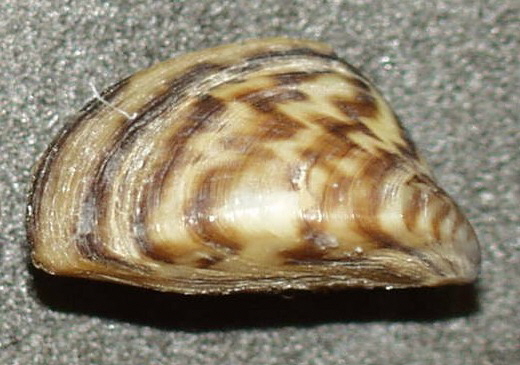


How they differ
The Zebra mussel attaches to substrates using strong byssal fibres emerging from the umbo on the dorsal side of its shell, while the Quagga mussel has a rounded carina and a convex ventral side. The Zebra mussel can reach a maximum shell length of approximately 50 mm, while the Quagga mussel is distinguished by a shell that is paler near the end of the hinge than the Zebra mussel shell. The Zebra mussel's adult female can produce between 30,000 and 40,000 eggs during each reproductive cycle, while the Quagga mussel's fully mature female can produce up to one million eggs annually.
| Zebra Mussel | Quagga Mussel | |
|---|---|---|
| Attachment | The Zebra mussel attaches to substrates using strong byssal fibres emerging from the umbo on the dorsal side of the shell. | The Quagga mussel's settling juveniles secure themselves using byssal threads. |
| Diet | The Zebra mussel obtains food by filtering particles from the water column. | The Quagga mussel filters particulate matter from water, including phytoplankton, zooplankton, algae, and its own veligers. |
| Filtration | Individual Zebra mussels can process up to one litre of water daily. | An adult Quagga mussel can filter at least one litre of water per day. |
| Habitat | The Zebra mussel inhabits freshwater environments and cannot survive in ocean water. | The Quagga mussel inhabits freshwater environments. |
| Reproduction | Female Zebra mussels can begin reproducing six to seven weeks after settling. | Quagga mussels have separate male and female individuals, and fertilization occurs externally. |
| Larvae | Zebra mussel larvae are microscopic, free-swimming veligers that drift in the water for several weeks before settling on hard surfaces. | Quagga mussel veligers drift with currents for three to four weeks and use hair-like cilia to feed while searching for suitable settlement surfaces. |
| Water clarity | The introduction of Zebra mussels into Lake Erie has increased water clarity in some areas from 15 centimetres to as much as one metre. | Quagga mussel filtration activity can increase water transparency and reduce mean chlorophyll concentrations. |
| Water infrastructure | Zebra mussel infestations have caused damage to harbours, waterways, vessels, water-treatment plants and power plants. | Quagga mussel colonization of water-intake structures can reduce pumping capabilities at power and water-treatment plants. |
Written from the checked facts listed further down. Statements that the sources did not support were removed.
Side by side
| Zebra Mussel | Quagga Mussel | |
|---|---|---|
| Scientific name | Dreissena polymorpha (Pallas, 1771) | Dreissena bugensis Andrusov, 1897 |
| English name | Zebra Mussel | Quagga Mussel |
| Group | Molluscs | Molluscs |
| Class | Bivalvia | Bivalvia |
| Family | Dreissenidae | Dreissenidae |
| Genus | Dreissena Dreissena Mussels | Dreissena Dreissena Mussels |
| Named in | 1771 | 1897 |
| Red List category | Least Concern | Least Concern |
| Environment | brackish, freshwater | brackish, freshwater |
| Countries on record | 36 countries | 21 countries |
| GBIF occurrence records | 43,629 records | 9,777 records |
Rows where the two agree are shown in grey.
Where each is found
Both recorded in 21 countries
- Austria
- Belgium
- Bulgaria
- Canada
- Denmark
- France
- Germany
- Hungary
- Ireland
- Italy
- Luxembourg
- Poland
- Romania
- Russia
- Serbia
- Slovakia
- Switzerland
- The Netherlands
- Ukraine
- United Kingdom
- United States
Only Zebra Mussel (15)
- Albania
- Belarus
- Croatia
- Czechia
- Estonia
- Finland
- Greece
- Latvia
- Lithuania
- Moldova
- Montenegro
- North Macedonia
- Slovenia
- Spain
- Sweden
From Catalogue of Life checklists and GBIF occurrence records. A country missing from a list means no record is held, which is not proof of absence.
Checked facts
| Zebra Mussel | Quagga Mussel | |
|---|---|---|
| Appearance | No checked fact yet |
|
| Size |
| No checked fact yet |
| Habitat |
|
|
| Diet |
|
|
| Behaviour |
|
|
| Reproduction |
|
|
| Distribution | No checked fact yet |
|
| Conservation |
|
|
| Uses |
| No checked fact yet |
| Similar species | No checked fact yet |
|
| Name origin | No checked fact yet |
|
| Other | No checked fact yet |
|
In brief
Zebra Mussel
Dreissena polymorpha inhabits freshwater environments and cannot survive in ocean water. Full profile
Quagga Mussel
Dreissena bugensis inhabits freshwater environments and is indigenous to the Dnipro River drainage in Ukraine, with populations in Europe and North America. It has a rounded carina, a convex ventral side, and a shell that is generally black, yellow, or zigzag-patterned. Full profile
Compare something else
Page built on 24 November 2026 from the data on the two species pages, where every source is listed.
Cite this page
ScientificNames.org. (2026). Zebra Mussel vs Quagga Mussel. Retrieved November 24, 2026, from https://scientificnames.org/compare/zebra-mussel-vs-quagga-mussel
“Zebra Mussel vs Quagga Mussel.” ScientificNames.org, 2026, scientificnames.org/compare/zebra-mussel-vs-quagga-mussel. Accessed 24 Nov. 2026.
ScientificNames.org. “Zebra Mussel vs Quagga Mussel.” Accessed November 24, 2026. https://scientificnames.org/compare/zebra-mussel-vs-quagga-mussel.
@misc{scientificnames_zebra_mussel_vs_quagga_mussel,
  author = {{ScientificNames.org}},
  title = {Zebra Mussel vs Quagga Mussel},
  year = {2026},
  url = {https://scientificnames.org/compare/zebra-mussel-vs-quagga-mussel},
  note = {Accessed 2026-11-24}
}