Species · Molluscs
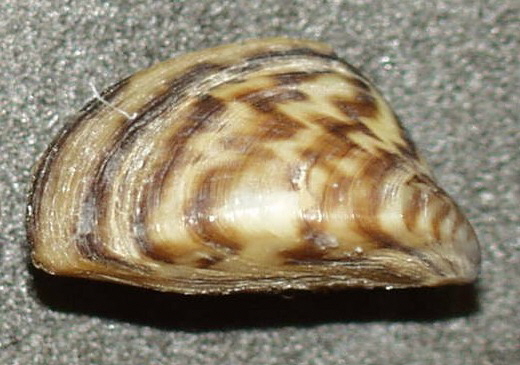
Zebra Mussel Dreissena polymorpha
The scientific name of the Zebra Mussel is Dreissena polymorpha. It is a species of mollusc in the family Dreissenidae. The name dates from 1771.
- Scientific name
- Dreissena polymorpha (Pallas, 1771)
- Common name
- Zebra Mussel
- Genus
- Dreissena
- Family
- Dreissenidae
- Class
- Bivalvia
- Red List category
- LC Least Concern
- Environment
- brackish, freshwater
- Recorded in
- 36 countries
- Name status
- accepted in the Catalogue of Life
Overview
Dreissena polymorpha inhabits freshwater environments and cannot survive in ocean water.
Written 24 November 2026 from the sources listed below. Each statement was checked against the passage it cites; statements that could not be supported were removed.
Appearance
Adults commonly reach approximately the size of a fingernail. The maximum shell length is approximately 50 mm.[1][2]
Habitat
The Zebra Mussel inhabits freshwater environments and cannot survive in ocean water. It attaches to substrates including sand, silt and harder surfaces.[3][4]
Juvenile Zebra Mussels generally prefer harder, rockier surfaces for attachment.[5]
Diet
The Zebra Mussel obtains food by filtering particles from the water column. An individual can process up to one litre of water daily.[6][7]
Behaviour
The Zebra Mussel attaches to substrates using strong byssal fibres emerging from the umbo on the dorsal side of its shell.[8]
Zebra Mussels form colonies on native unionid clams, reducing their ability to move, feed and reproduce.[9]
Adult Zebra Mussels can survive outside water for approximately seven days.[10]
Reproduction and life cycle
Female Zebra Mussels can begin reproducing six to seven weeks after settling. An adult female produces between 30,000 and 40,000 eggs during each reproductive cycle.[11][12]
The larvae are microscopic, free-swimming veligers that drift in the water for several weeks before settling on hard surfaces.[13]
Conservation
Zebra Mussels can clog underwater pipes by attaching to their surfaces. Infestations have also damaged harbours, waterways, vessels, water-treatment plants and power plants.[14][15]
The introduction of Zebra Mussels into Lake Erie has increased water clarity in some areas from 15 centimetres to as much as one metre.[16]
Wintering waterbirds at Lake Constance can reduce Zebra Mussel biomass in shallow areas by more than 90% annually. Adult crayfish have been reported to consume approximately 105 Zebra Mussels per day.[17][18]
Uses
The Zebra Mussel can be used as an indicator of environmental pollution.[19]
Classification of the Zebra Mussel
| Kingdom | Animalia |
|---|---|
| Phylum | Mollusca |
| Class | Bivalvia |
| Subclass | Autobranchia |
| Infraclass | Heteroconchia |
| Subterclass | Euheterodonta |
| Superorder | Imparidentia |
| Superfamily | Dreissenoidea |
| Family | Dreissenidae |
| Subfamily | Dreisseninae |
| Genus | Dreissena (Dreissena Mussels) |
| Species | Dreissena polymorpha (Pallas, 1771) |
Where the Zebra Mussel is found
Checklists and occurrence records place Dreissena polymorpha in 36 countries. GBIF holds 43,629 georeferenced records of it.
Countries
- Albania 7
- Austria 1,063
- Belarus 71
- Belgium 1,247
- Bulgaria 30
- Canada 4,252
- Croatia 14
- Czechia 51
- Denmark 142
- Estonia 1,623
- Finland 1,967
- France 2,202
- Germany 2,826
- Greece 10
- Hungary 123
- Ireland 837
- Italy 156
- Latvia 34
- Lithuania 367
- Luxembourg 35
- Moldova 27
- Montenegro 9
- North Macedonia 9
- Poland 501
- Romania 32
- Russia 796
- Serbia 21
- Slovakia 37
- Slovenia 4
- Spain 340
- Sweden 670
- Switzerland 4,557
- The Netherlands 5,468
- Ukraine 508
- United Kingdom 5,169
- United States 8,424
Regions and cities with the most records
- England, United Kingdom 4,667
- Ontario, Canada 3,217
- New York, United States 1,735
- Baden-Wurttemberg, Germany 1,417
- Konstanz, Germany 1,229
- Michigan, United States 1,089
- Wisconsin, United States 1,044
- Minnesota, United States 1,015
- Zurich, Switzerland 962
- Singen, Germany 870
- Spijkenisse, The Netherlands 811
- Friedrichshafen, Germany 804
- Vlaardingen, The Netherlands 704
- Thurgau, Switzerland 669
- Amsterdam, The Netherlands 667
- Ohio, United States 650
- Amstelveen, The Netherlands 647
- Schiedam, The Netherlands 617
- Illinois, United States 548
- Winterthur, Switzerland 537
- Zaandam, The Netherlands 532
- Overijssel, The Netherlands 529
- Zürich, Switzerland 522
- Delft, The Netherlands 521
- Auvergne-Rhône-Alpes, France 493
- Hilversum, The Netherlands 479
- Rijswijk, The Netherlands 472
- Zaanstad, The Netherlands 472
- Purmerend, The Netherlands 471
- Rotterdam, The Netherlands 467
- Dornbirn, Austria 461
- Kotka, Finland 460
- Texas, United States 451
- Hoofddorp, The Netherlands 447
- Zoetermeer, The Netherlands 434
- Gelderland, The Netherlands 431
4 more countries have a few records outside this range
These countries hold a few records of Dreissena polymorpha but lie outside the range the checklists give for it. Such records are often zoo or garden specimens, museum material or vagrants, so the species is not counted as occurring there.
A number beside a place is its count of GBIF occurrence records. A place without a number comes from a checklist alone. Records show where a species has been observed or collected, which can include escapes and vagrants.
Common names
English
- Zebra Mussel
- Wandering Mussel
- Many-shaped Dreissena
Names in 23 other languages
- Arabic
- بلح البحر المخطط
- Asturian
- muxón cebra
- Catalan
- Musclo zebrat
- Czech
- slávička mnohotvárná
- Danish
- vandremusling
- Dutch
- Driehoeksmossel, gewone driehoeksmossel
- Estonian
- Rändkarp
- Finnish
- vaeltajasimpukka
- French
- Moule zébrée
- German
- Dreiecksmuschel, Dreikantmuschel, Wandermuschel
- Greek
- Μύδι ζέβρα
- Hungarian
- vándorkagyló
- Italian
- Cozza zebra, Cozza zebrata
- Latvian
- Daudzveidīgā sēdgliemene
- Lithuanian
- Paprastoji dreisena
- Norwegian Bokmål
- sebramusling
- Polish
- Racicznica zmienna
- Portuguese
- Mexilhão-zebra
- Russian
- Речная дрейссена
- Slovak
- kopýtko prirastené
- Spanish
- Mejillón cebra
- Swedish
- vandrarmussla
- Ukrainian
- Дрейсена річкова
Synonyms
102 other scientific names have been used for this species and are now treated as synonyms of Dreissena polymorpha.
- Congeria polymorpha (Pallas, 1771)
- Deissena polymorpha (Pallas, 1771)
- Dreissena (Dreissena) caspia pallasi (Andrusov, 1897)
- Dreissena (Dreissena) polymorpha (Pallas, 1771)
- Dreissena (Dreissena) polymorpha andrusovi (Brusina, 1897)
- Dreissena (Dreissena) polymorpha aralensis (Andrusov, 1897)
- Dreissena (Dreissena) polymorpha obtusecarinata (Andrusov, 1897)
- Dreissena andrusovi Andrusov, 1897
- Dreissena angustiformis V. P. Kolesnikov, 1950
- Dreissena aralensis Andrusov, 1897
- Dreissena arnouldi Bourguignat, 1893
- Dreissena bedoti Locard, 1893
- Dreissena belgrandi Locard, 1893
- Dreissena caspia pallasi
- Dreissena caspia pallasi (Andrusov, 1897)
- Dreissena complanata Locard, 1893
- Dreissena curta Locard, 1893
- Dreissena eximia Locard, 1893
- Dreissena fluviatilis (Pallas, 1771)
- Dreissena kuesteri Dunker, 1855
- Dreissena küsteri Dunker, 1855
- Dreissena latro Andrusov, 1897
- Dreissena locardi Locard, 1893
- Dreissena lunata A. A. Ali-Zade, 1961
- Dreissena lutetiana Locard, 1893
- Dreissena magnifica Locard, 1893
- Dreissena obtusecarinata Andrusov, 1897
- Dreissena occidentalis Locard, 1893
- Dreissena pallasi Andrusov, 1897
- Dreissena paradoxa Bourguignat, 1893
- Dreissena paradoxa Locard, 1893
- Dreissena polymorpha arnouldi "Andrusov, 1897"
- Dreissena polymorpha var. lacustrina C. R. Boettger, 1913
- Dreissena polymorpha var. tschapurica Karpevich, 1955
- Dreissena recta Bourguignat in Locard, 1893
- Dreissena servaini Locard, 1893
- Dreissena sulcata Locard, 1893
- Dreissena tumida Locard, 1893
- Dreissena ventrosa Locard, 1893
- Dreissena westerlundi Locard, 1893
Showing 40 of 102.
Subspecies and varieties
- Dreissena polymorpha levis subspecies
- Dreissena polymorpha polymorpha (Zebra Mussel) subspecies
- Dreissena polymorpha sumbarica subspecies
- Dreissena polymorpha weberi subspecies
Related species
-
 Quagga MusselDreissena bugensis
- Dreissena carinata
- Dreissena anatolica
- Dreissena caputlacus
- Dreissena elata
- Dreissena gallandi
- Dreissena siouffi
- Dreissena abchasica
Compare
Questions and answers
What is the scientific name of the Zebra Mussel?
The scientific name of the Zebra Mussel is Dreissena polymorpha. Written with its author, the full name is Dreissena polymorpha (Pallas, 1771).
Which family does the Zebra Mussel belong to?
Dreissena polymorpha belongs to the family Dreissenidae and the class Bivalvia.
Where is the Zebra Mussel found?
Checklists and occurrence records place Dreissena polymorpha in 36 countries, including United States, The Netherlands, United Kingdom, Switzerland, Canada and Germany.
What is the conservation status of the Zebra Mussel?
The IUCN Red List category recorded for Dreissena polymorpha is Least Concern (LC).
What other names does the Zebra Mussel have?
Dreissena polymorpha is also known in English as Wandering Mussel and Many-shaped Dreissena.
What habitat do zebra mussels live in?
Zebra Mussels inhabit freshwater environments and cannot survive in ocean water. They attach to substrates including sand, silt and harder surfaces, while juveniles generally prefer harder, rockier surfaces.[3][4][5]
Sources
Passages the profile rests on
- Adult zebra mussels commonly reach approximately the size of a fingernail. Source passage: “They are usually about the size of a fingernail” — English Wikipedia
- The zebra mussel can reach a maximum shell length of approximately 50 mm. Source passage: “but can grow to a maximum length around 50 mm (2 in).” — English Wikipedia
- The zebra mussel inhabits freshwater environments and cannot survive in ocean water. Source passage: “The zebra mussel is a freshwater species and cannot survive in the ocean.” — English Wikipedia
- Zebra mussels attach to substrates including sand, silt and harder surfaces. Source passage: “Zebra mussels attach to most substrates, including sand, silt, and harder substrates” — English Wikipedia
- Juvenile zebra mussels generally prefer harder, rockier surfaces for attachment. Source passage: “usually juveniles prefer harder, rockier substrates on which to attach.” — English Wikipedia
- Zebra mussels obtain food by filtering particles from the water column. Source passage: “Zebra mussels and the closely related and ecologically similar quagga mussels are filter-feeding organisms; they remove particles from the water column.” — English Wikipedia
- Individual zebra mussels can process up to one litre of water daily. Source passage: “Zebra mussels process up to 1 litre (0.26 US gal; 34 US fl oz) of water per day, per mussel.” — English Wikipedia
- Zebra mussels attach to substrates using strong byssal fibres emerging from the umbo on the dorsal side of the shell. Source passage: “attached to the substrate with strong byssal fibres, which come out of their umbo on the dorsal (hinged) side.” — English Wikipedia
- Zebra mussels form colonies on native unionid clams and can reduce their ability to move, feed and reproduce. Source passage: “They build colonies on native unionid clams, reducing their ability to move, feed, and breed” — English Wikipedia
- Adult zebra mussels can survive outside water for approximately seven days. Source passage: “adults can even survive out of water for about seven days.” — English Wikipedia
- Female zebra mussels can begin reproducing six to seven weeks after settling. Source passage: “A female zebra mussel begins to reproduce within 6–7 weeks of settling.” — English Wikipedia
- An adult female can produce between 30,000 and 40,000 eggs during each reproductive cycle. Source passage: “An adult female zebra mussel can produce 30,000 to 40,000 eggs in each reproductive cycle” — English Wikipedia
- The larvae are microscopic, free-swimming veligers that drift in the water for several weeks before settling on hard surfaces. Source passage: “Free-swimming microscopic larvae, called veligers, drift in the water for several weeks and then settle onto any hard surface they can find.” — English Wikipedia
- Zebra mussels can clog underwater pipes by attaching to their surfaces. Source passage: “Zebra mussels also cling to pipes under the water and clog them.” — English Wikipedia
- Zebra mussel infestations have caused damage to harbours, waterways, vessels, water-treatment plants and power plants. Source passage: “They disrupt ecosystems through monotypic colonisation and damage harbours and waterways, ships and boats, and water-treatment and power plants.” — English Wikipedia
- The introduction of zebra mussels into Lake Erie has increased water clarity in some areas from 15 centimetres to as much as one metre. Source passage: “Since the zebra mussel has become established in Lake Erie, water clarity has increased from 15 cm (6 in) to up to 1 m (3 ft) in some areas.” — English Wikipedia
- Wintering waterbirds at Lake Constance can reduce zebra mussel biomass in shallow areas by more than 90% annually. Source passage: “Annually, the wintering waterbirds at Lake Constance decrease zebra mussel biomass in shallow areas by >90%.” — English Wikipedia
- Crayfish have been reported to consume approximately 105 zebra mussels per day as adults. Source passage: “An adult crayfish consumes around 105 zebra mussels every day” — English Wikipedia
- Zebra mussels can be used as indicators of environmental pollution. Source passage: “Zebra mussels can be used to detect risks to humans from environmental hazards and are considered effective indicators of environmental pollution.” — English Wikipedia
Data
- Catalogue of Life, 2026-10-16 XR cc by
- Global Biodiversity Information Facility CC BY 4.0
- Wikidata CC0
- GeoNames CC BY 4.0
- Wikimedia Commons per image; credit shown with each image
- Within the Catalogue of Life, this name comes from World Register of Marine Species cc by
References
- Pallas, P. S. (1771) Reise durch verschiedene Provinzen des Russischen Reichs. Vol. 3. St. Petersburg Kayserliche Akademie der Wissenschaften, St. Petersburg, 478 pp. where the name was published
This species in other databases
Page built on 24 November 2026. See how the catalog is made and all sources and licences.
Cite this page
ScientificNames.org. (2026). Dreissena polymorpha (Zebra Mussel). Retrieved November 24, 2026, from https://scientificnames.org/species/dreissena-polymorpha
“Dreissena polymorpha (Zebra Mussel).” ScientificNames.org, 2026, scientificnames.org/species/dreissena-polymorpha. Accessed 24 Nov. 2026.
ScientificNames.org. “Dreissena polymorpha (Zebra Mussel).” Accessed November 24, 2026. https://scientificnames.org/species/dreissena-polymorpha.
@misc{scientificnames_dreissena_polymorpha_zebra_mussel,
  author = {{ScientificNames.org}},
  title = {Dreissena polymorpha (Zebra Mussel)},
  year = {2026},
  url = {https://scientificnames.org/species/dreissena-polymorpha},
  note = {Accessed 2026-11-24}
}