Species · Molluscs
Quagga Mussel Dreissena bugensis
The scientific name of the Quagga Mussel is Dreissena bugensis. It is a species of mollusc in the family Dreissenidae. The name dates from 1897.
- Scientific name
- Dreissena bugensis Andrusov, 1897
- Common name
- Quagga Mussel
- Genus
- Dreissena
- Family
- Dreissenidae
- Class
- Bivalvia
- Red List category
- LC Least Concern
- Environment
- brackish, freshwater
- Recorded in
- 21 countries
- Name status
- accepted in the Catalogue of Life

Overview
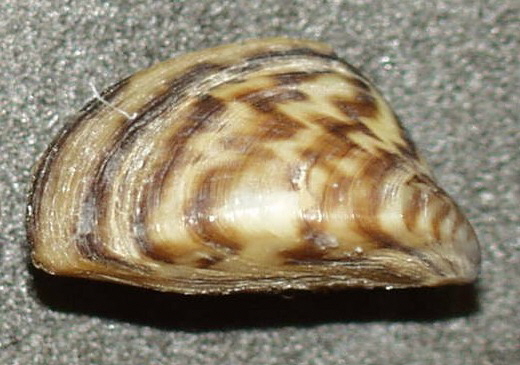
Dreissena bugensis inhabits freshwater environments and is indigenous to the Dnipro River drainage in Ukraine, with populations in Europe and North America. It has a rounded carina, a convex ventral side, and a shell that is generally black, yellow, or zigzag-patterned.
Written 24 November 2026 from the sources listed below. Each statement was checked against the passage it cites; statements that could not be supported were removed.
Appearance
The shell is generally black, yellow, or zigzag-patterned. Some individuals in Lake Erie have pale or completely white shells.[1][2]
The shell has a rounded carina and a convex ventral side. It is paler near the end of the hinge than the zebra mussel shell.[3][4]
Diet
The Quagga Mussel obtains food by filtering particulate matter from water. Its filtered food includes phytoplankton, zooplankton, algae, and its own veligers.[5][6]
An adult can filter at least one litre of water per day.[7]
Behaviour
The Quagga Mussel expels undesirable filtered particles as mucus-bound pseudofaeces.[8]
Reproduction and life cycle
The species has separate male and female individuals, and fertilization occurs externally. A fully mature female can produce up to one million eggs annually.[9][10][11]
Microscopic pelagic larvae develop within a few days after fertilization. Free-swimming veligers drift with currents for three to four weeks and use hair-like cilia to feed while searching for suitable settlement surfaces.[12][13][14]
Settling juveniles secure themselves using byssal threads. Mortality during the transition from planktonic veliger to settled juvenile can exceed 99%.[15][16]
Similar species
The species name refers by analogy to the extinct quagga subspecies of African zebra. It was not identified as distinct from other mussels until 1991 after its discovery in North America.[17][18]
Conservation
The species can reduce zooplankton food availability by removing phytoplankton. Its filtration activity can increase water transparency and reduce mean chlorophyll concentrations.[19][20]
Decomposition of its pseudofaeces consumes oxygen and increases water acidity. The species can also accumulate organic pollutants in its tissues at concentrations exceeding environmental levels by more than 300,000 times.[21][22]
Colonization of water-intake structures can reduce pumping capabilities at power and water-treatment plants.[23]
Classification of the Quagga Mussel
| Kingdom | Animalia |
|---|---|
| Phylum | Mollusca |
| Class | Bivalvia |
| Subclass | Autobranchia |
| Infraclass | Heteroconchia |
| Subterclass | Euheterodonta |
| Superorder | Imparidentia |
| Superfamily | Dreissenoidea |
| Family | Dreissenidae |
| Subfamily | Dreisseninae |
| Genus | Dreissena (Dreissena Mussels) |
| Species | Dreissena bugensis Andrusov, 1897 |
Where the Quagga Mussel is found
Checklists and occurrence records place Dreissena bugensis in 21 countries. GBIF holds 9,777 georeferenced records of it.
Countries
- Austria 119
- Belgium 87
- Bulgaria 4
- Canada 1,303
- Denmark 10
- France 307
- Germany 768
- Hungary 14
- Ireland 431
- Italy 17
- Luxembourg 17
- Poland 19
- Romania 819
- Russia 136
- Serbia 4
- Slovakia 4
- Switzerland 1,143
- The Netherlands 2,471
- Ukraine 112
- United Kingdom 154
- United States 1,838
Regions and cities with the most records
- Ontario, Canada 1,176
- New York, United States 684
- Gelderland, The Netherlands 528
- Baden-Wurttemberg, Germany 472
- Konstanz, Germany 469
- Michigan, United States 419
- Spijkenisse, The Netherlands 388
- Nijmegen, The Netherlands 353
- Friedrichshafen, Germany 298
- Amstelveen, The Netherlands 286
- Amsterdam, The Netherlands 283
- Singen, Germany 269
- Vlaardingen, The Netherlands 268
- Arnhem, The Netherlands 260
- Thurgau, Switzerland 259
- Zaandam, The Netherlands 231
- Hoofddorp, The Netherlands 227
- Alphen aan den Rijn, The Netherlands 211
- Dordrecht, The Netherlands 211
- Ede, The Netherlands 211
- Haarlem, The Netherlands 205
- Veenendaal, The Netherlands 203
- Clay, United States 197
- Schiedam, The Netherlands 197
- Leiden, The Netherlands 190
- Vaud, Switzerland 190
- Zwijndrecht, The Netherlands 188
- Delft, The Netherlands 176
- Wisconsin, United States 176
- Utrecht, The Netherlands 174
- Waalwijk, The Netherlands 174
- Hilversum, The Netherlands 169
- Almere Stad, The Netherlands 165
- Ridderkerk, The Netherlands 161
- Oss, The Netherlands 159
- Tulcea County, Romania 159
A number beside a place is its count of GBIF occurrence records. A place without a number comes from a checklist alone. Records show where a species has been observed or collected, which can include escapes and vagrants.
Common names
English
- Quagga Mussel
Names in 10 other languages
- Dutch
- Quaggamossel
- French
- Moule quagga
- German
- Quagga-Dreikantmuschel, Quagga-Muschel
- Hungarian
- bugi vándorkagyló
- Norwegian Nynorsk
- quaggamusling
- Polish
- racicznica pasiasta
- Russian
- Бугская дрейссена
- Spanish
- Mejillón quagga
- Swedish
- kvaggamussla, quaggamussla
- Ukrainian
- Дрейсена бузька
Synonyms
4 other scientific names have been used for this species and are now treated as synonyms of Dreissena bugensis.
- Dreissena (Pontodreissena) bugensis Andrusov, 1897
- Dreissena rostriformis bugensis
- Dreissena rostriformis bugensis Andrusov, 1897
- Dreissensia bugensis Andrusov, 1897
Related species
-
 Zebra MusselDreissena polymorpha
- Dreissena carinata
- Dreissena anatolica
- Dreissena caputlacus
- Dreissena elata
- Dreissena gallandi
- Dreissena siouffi
- Dreissena abchasica
Compare
Questions and answers
What is the scientific name of the Quagga Mussel?
The scientific name of the Quagga Mussel is Dreissena bugensis. Written with its author, the full name is Dreissena bugensis Andrusov, 1897.
Which family does the Quagga Mussel belong to?
Dreissena bugensis belongs to the family Dreissenidae and the class Bivalvia.
Where is the Quagga Mussel found?
Checklists and occurrence records place Dreissena bugensis in 21 countries, including The Netherlands, United States, Canada, Switzerland, Romania and Germany.
What is the conservation status of the Quagga Mussel?
The IUCN Red List category recorded for Dreissena bugensis is Least Concern (LC).
Are quagga and zebra mussels the same thing?
No. The Quagga Mussel resembles the zebra mussel in appearance, but it is a distinct species.[24][25]
Sources
Passages the profile rests on
- The shell is generally black, yellow, or zigzag-patterned. Source passage: “The quagga mussel shell is generally black, yellow and/or zig-zagged.” — English Wikipedia
- Some individuals have pale or completely white shells in Lake Erie. Source passage: “including a distinct morph in Lake Erie that is pale or completely white.” — English Wikipedia
- The shell has a rounded carina and a convex ventral side. Source passage: “The shell has a rounded carina and a convex ventral side.” — English Wikipedia
- The shell is paler near the end of the hinge than the zebra mussel shell. Source passage: “The quagga mussel shell can be distinguished from the zebra mussel shell because it is paler toward the end of the hinge.” — English Wikipedia
- The species obtains food by filtering particulate matter from water. Source passage: “The quagga mussel is a filter feeder: it uses its cilia to pull water into its shell cavity through an incurrent siphon, where the desirable particulate matter is removed.” — English Wikipedia
- Its filtered food includes phytoplankton, zooplankton, algae, and its own veligers. Source passage: “removing phytoplankton, zooplankton, algae and even their own veligers.” — English Wikipedia
- An adult can filter at least one litre of water per day. Source passage: “Each adult mussel is capable of filtering a litre or more of water each day” — English Wikipedia
- The species expels undesirable filtered particles as mucus-bound pseudofaeces. Source passage: “Any undesirable particulate matter is bound with mucus, known as pseudofaeces” — English Wikipedia
- The species has separate male and female individuals. Source passage: “it is dioecious (either male or female)” — English Wikipedia
- Fertilization occurs externally. Source passage: “with external fertilisation.” — English Wikipedia
- A fully mature female can produce up to one million eggs annually. Source passage: “A fully mature female mussel is capable of producing up to one million eggs per year.” — English Wikipedia
- Microscopic pelagic larvae develop within a few days after fertilization. Source passage: “After fertilisation, pelagic microscopic larvae, or veligers, develop within a few days” — English Wikipedia
- Free-swimming veligers drift with currents for three to four weeks. Source passage: “Free-swimming veligers drift with the currents for three to four weeks” — English Wikipedia
- Veligers use hair-like cilia to feed while searching for suitable settlement surfaces. Source passage: “feeding by their hair-like cilia while trying to locate suitable substrata to settle” — English Wikipedia
- Settling juveniles secure themselves using byssal threads. Source passage: “to settle and secure byssal threads.” — English Wikipedia
- Mortality during the transition from planktonic veliger to settled juvenile can exceed 99%. Source passage: “Mortality in this transitional stage from planktonic veliger to settled juvenile may exceed 99%.” — English Wikipedia
- The species name refers by analogy to the extinct quagga subspecies of African zebra. Source passage: “is named by analogy with the closely related zebra mussel after the quagga, an extinct subspecies of African zebra” — English Wikipedia
- The species was not identified as distinct from other mussels until 1991 after its discovery in North America. Source passage: “It was not identified as a distinct species until 1991.” — English Wikipedia
- The species can reduce zooplankton food availability by removing phytoplankton. Source passage: “By removing the phytoplankton, quagga mussels, in turn, decrease the food source for zooplankton” — English Wikipedia
- Its filtration activity can increase water transparency and reduce mean chlorophyll concentrations. Source passage: “increases in water transparency, decreases in mean chlorophyll concentrations” — English Wikipedia
- Decomposition of its pseudofaeces consumes oxygen and increases water acidity. Source passage: “As the waste particles decompose, oxygen is used up, water acidity increases (decreased pH)” — English Wikipedia
- The species can accumulate organic pollutants in its tissues at concentrations exceeding environmental levels by more than 300,000 times. Source passage: “quagga mussels accumulate organic pollutants within their tissues to levels more than 300,000 times greater than concentrations in the environment” — English Wikipedia
- Its colonization of water-intake structures can reduce pumping capabilities at power and water-treatment plants. Source passage: “therefore reducing pumping capabilities for power and water-treatment plants” — English Wikipedia
- The quagga mussel resembles the zebra mussel in appearance. Source passage: “The quagga mussel resembles the zebra mussel” — English Wikipedia
- The species is currently accepted as distinct rather than as a subspecies of Dreissena rostriformis. Source passage: “but is currently accepted as a distinct species.” — English Wikipedia
- The species inhabits freshwater environments. Source passage: “a species of freshwater mussel” — English Wikipedia
- The species is indigenous to the Dnipro River drainage in Ukraine. Source passage: “The species is indigenous to the Dnipro River drainage of Ukraine” — English Wikipedia
- The species has spread into rivers and lakes across Europe. Source passage: “where it has spread in the rivers and lakes of Europe” — English Wikipedia
- The species occurs in the Great Lakes of North America. Source passage: “and also in the Great Lakes of North America” — English Wikipedia
Data
- Catalogue of Life, 2026-10-16 XR cc by
- Global Biodiversity Information Facility CC BY 4.0
- Wikidata CC0
- GeoNames CC BY 4.0
- Wikimedia Commons per image; credit shown with each image
- Within the Catalogue of Life, this name comes from World Register of Marine Species cc by
This species in other databases
Page built on 24 November 2026. See how the catalog is made and all sources and licences.
Cite this page
ScientificNames.org. (2026). Dreissena bugensis (Quagga Mussel). Retrieved November 24, 2026, from https://scientificnames.org/species/dreissena-bugensis
“Dreissena bugensis (Quagga Mussel).” ScientificNames.org, 2026, scientificnames.org/species/dreissena-bugensis. Accessed 24 Nov. 2026.
ScientificNames.org. “Dreissena bugensis (Quagga Mussel).” Accessed November 24, 2026. https://scientificnames.org/species/dreissena-bugensis.
@misc{scientificnames_dreissena_bugensis_quagga_mussel,
  author = {{ScientificNames.org}},
  title = {Dreissena bugensis (Quagga Mussel)},
  year = {2026},
  url = {https://scientificnames.org/species/dreissena-bugensis},
  note = {Accessed 2026-11-24}
}