Species · Flowering plants
American Sweet-Flag Acorus americanus
The scientific name of the American Sweet-Flag is Acorus americanus. It is a species of flowering plant in the family Acoraceae (sweetflag family), order Acorales.
- Scientific name
- Acorus americanus (Raf.) Raf.
- Common name
- American Sweet-Flag
- Genus
- Acorus
- Family
- Acoraceae (Sweetflag Family)
- Order
- Acorales
- Class
- Liliopsida
- Recorded in
- 8 countries
- Name status
- accepted in the Catalogue of Life

Overview
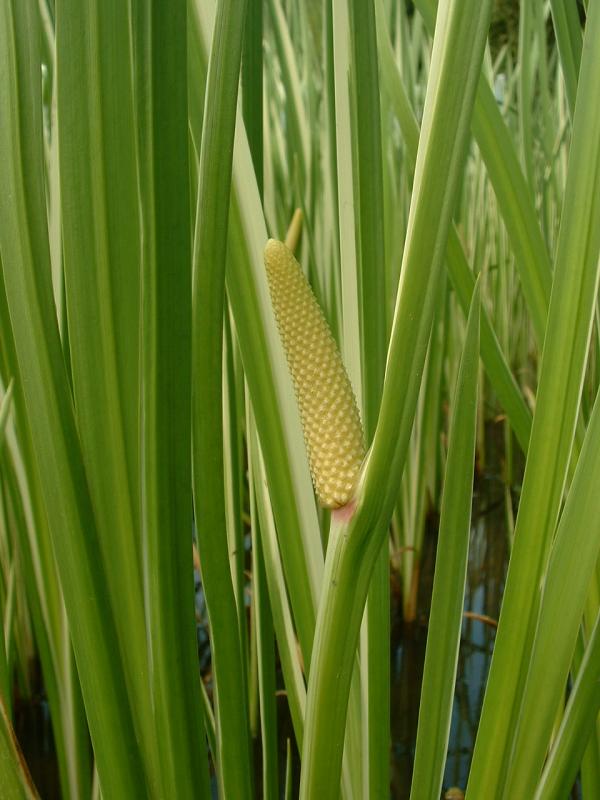
Acorus americanus grows in marshes, muddy shorelines, shallow water, and along the edges of quiet water. Its bright green leaves have between two and six raised veins and a citrus-like, spicy fragrance.
Written 26 November 2026 from the sources listed below. Each statement was checked against the passage it cites; statements that could not be supported were removed.
Appearance
Its inconspicuous flowers are arranged on a lateral spadix. Fertilized flowers produce berries containing jelly.[1][2]
The plant can reach a mature height of three to four feet. Its leaf blades can reach three-quarters of an inch in width, and its vegetative leaves measure three to four feet in length.[3][4][5]
Habitat
The species prefers muddy shorelines and shallow water. It grows in marshes and along the edges of quiet water.[6][7]
The plant can also grow in consistently moist garden soils.[8]
Behaviour
The species spreads at a moderate rate through its rhizomes. It does not tolerate shade.[9][10]
Reproduction and life cycle
The species is a fertile diploid and produces viable seeds capable of germination. Its flowers bloom between May and June.[11][12][13]
Its flowers produce berries containing jelly.[14]
Conservation
American Sweet-Flag is protected as a state endangered plant in Pennsylvania and is listed as a protected plant in Pennsylvania.[15][16]
The species has become extinct in the southern part of its range, including Virginia and states farther south.[17]
Uses
Native Americans used the species in ceremonies, medicine, and trade. Early Native American groups valued its rhizomes and traded them.[18][19]
Similar species
American Sweet-Flag can resemble cattails and Blue Flag Iris at first glance. It is closely similar in appearance to the European species Acorus calamus.[20][21][22]
Classification of the American Sweet-Flag
| Kingdom | Plantae |
|---|---|
| Subkingdom | Pteridobiotina |
| Phylum | Tracheophyta |
| Class | Liliopsida |
| Order | Acorales |
| Family | Acoraceae (Sweetflag Family) |
| Genus | Acorus (Sweetflag) |
| Species | Acorus americanus (Raf.) Raf. |
Where the American Sweet-Flag is found
Checklists and occurrence records place Acorus americanus in 8 countries across Asia, Europe and North America. GBIF holds 2,423 georeferenced records of it.
Countries where it is native or its origin is not stated
Countries where it has been introduced
Regions and cities with the most records
- Ontario, Canada 329
- Minnesota, United States 299
- Wisconsin, United States 197
- Michigan, United States 84
- Illinois, United States 64
- Nova Scotia, Canada 53
- Quebec, Canada 53
- Iowa, United States 47
- New York, United States 39
- Alberta, Canada 38
- Manitoba, Canada 37
- Kanagawa, Japan 36
- Maine, United States 34
- Longfellow Community, United States 27
- Bloomington, United States 23
- Minneapolis, United States 23
- New Brunswick, Canada 23
- Richfield, United States 23
- Eagan, United States 22
- Edina, United States 22
- British Columbia, Canada 21
- Burnsville, United States 19
- Gurnee, United States 19
- Nebraska, United States 19
- Saint Louis Park, United States 19
- Savage, United States 19
- Waukegan, United States 19
- Yamato, Japan 19
- Zama, Japan 19
- Ayase, Japan 18
- Isehara, Japan 18
- Machida, Japan 18
- New Brighton, United States 18
- Roseville, United States 18
- Saskatchewan, Canada 18
- West Saint Paul, United States 18
A number beside a place is its count of GBIF occurrence records. A place without a number comes from a checklist alone. Records show where a species has been observed or collected, which can include escapes and vagrants.
Common names
English
- American Sweet-Flag
- American Sweetflag
- Several-veined Sweetflag
- Sweet-flag
- Sweetflag
Names in 6 other languages
- Arabic
- وج أمريكي
- Dutch
- Amerikaanse kalmoes
- French
- acore d'Amérique, acore d’Amérique, acorus d'Amérique, belle-angélique
- Russian
- Аир американский
- Thai
- ว่านน้ำอเมริกัน
- oji
- Wiikensh
Synonyms
One other scientific name has been used for this species and is now treated as a synonym of Acorus americanus.
- Acorus calamus var. americanus Raf.
Subspecies and varieties
- Acorus americanus subsp. americanus subspecies
- Acorus americanus subsp. triqueter subspecies
Related species

Compare
Questions and answers
What is the scientific name of the American Sweet-Flag?
The scientific name of the American Sweet-Flag is Acorus americanus. Written with its author, the full name is Acorus americanus (Raf.) Raf..
Which family does the American Sweet-Flag belong to?
Acorus americanus belongs to the family Acoraceae, in the order Acorales and the class Liliopsida.
Where is the American Sweet-Flag found?
Checklists and occurrence records place Acorus americanus in 8 countries, including Canada, Japan, Russia, South Korea, Mongolia and China.
What other names does the American Sweet-Flag have?
Acorus americanus is also known in English as American Sweetflag, Several-veined Sweetflag, Sweet-flag and Sweetflag.
What are the medicinal uses of sweet flag?
Native Americans used American Sweet-Flag in medicine, ceremonies, and trade.[18]
Sources
Passages the profile rests on
- Its inconspicuous flowers are arranged on a lateral spadix. Source passage: “inconspicuous flowers that are arranged on a lateral spadix” — English Wikipedia
- Its fertilized flowers produce berries containing jelly. Source passage: “the fertilized flowers produce berries with a jelly inside.” — English Wikipedia
- The plant can reach a mature height of three to four feet. Source passage: “at maturity, can reach a height of 3 to 4 feet.” — plants.ces.ncsu.edu
- Its leaf blades can reach three-quarters of an inch in width. Source passage: “sword-shaped leaf blades (to 3/4 of an inch wide)” — plants.ces.ncsu.edu
- Its vegetative leaves measure three to four feet in length. Source passage: “Vegetative leaves are 3 to 4 feet” — plants.ces.ncsu.edu
- The species prefers muddy shorelines and shallow water. Source passage: “Its preferred habitat is mucky shorelines and shallows” — fs.usda.gov
- It grows in marshes and along the edges of quiet water. Source passage: “often found in wet open areas, such as marshes, or along the edges of quiet water.” — plants.ces.ncsu.edu
- It can grow in consistently moist garden soils. Source passage: “consistently moist garden soils.” — plants.ces.ncsu.edu
- The species spreads at a moderate rate through its rhizomes. Source passage: “It will spread, at a moderate rate, by means of rhizomes.” — plants.ces.ncsu.edu
- The plant does not tolerate shade. Source passage: “does not tolerate shade.” — plants.ces.ncsu.edu
- The species is a fertile diploid. Source passage: “the latter is a native fertile diploid.” — fs.usda.gov
- The species produces viable seeds capable of germination. Source passage: “it produces viable seeds, which can germinate.” — mdc.mo.gov
- The flowers bloom between May and June. Source passage: “Yellow flowers blossom from May to June.” — plants.ces.ncsu.edu
- Its flowers produce berries containing jelly. Source passage: “Fertilized flowers produce berries with a jelly inside.” — plants.ces.ncsu.edu
- The species is protected as a state endangered plant in Pennsylvania. Source passage: “This plant is protected as a state endangered species in Pennsylvania.” — English Wikipedia
- The species is listed as a protected plant in Pennsylvania. Source passage: “it is listed as a protected plant in Pennsylvania.” — plants.ces.ncsu.edu
- The species has become extinct in the southern part of its range, including Virginia and states farther south. Source passage: “the plant has gone extinct in the southern part of its range (Virginia and states further south)” — plants.ces.ncsu.edu
- Native Americans used the species in ceremonies, medicine, and trade. Source passage: “it was used in ceremonies, medicines, and for trade.” — fs.usda.gov
- Early Native American groups valued the plant's rhizomes and traded them. Source passage: “Sweet Flag rhizomes and plants were valued by early Native American groups and were objects of trade” — plants.ces.ncsu.edu
- The species can resemble cattails at first glance. Source passage: “a colony of Sweet Flag may resemble cattail (Typha spp.)” — fs.usda.gov
- The species can also resemble Blue Flag Iris. Source passage: “or Blue Flag Iris (Iris versicolor)” — fs.usda.gov
- The species is closely similar in appearance to the European species Acorus calamus. Source passage: “The plants are so similar that A. americanus is sometimes considered a variety of A. calamus.” — plants.ces.ncsu.edu
Data
- Catalogue of Life, 2026-10-16 XR cc by
- Global Biodiversity Information Facility CC BY 4.0
- Wikidata CC0
- GeoNames CC BY 4.0
- Wikimedia Commons per image; credit shown with each image
- Within the Catalogue of Life, this name comes from The World Checklist of Vascular Plants (WCVP) cc by
References
- New Fl. 1: 57 (1836) where the name was published
This species in other databases
- Catalogue of Life 9HG7
- Wikidata Q342167
- iNaturalist 157984
- World Flora Online wfo-0000349983-2026-06
- GRIN 418734
Page built on 27 November 2026. See how the catalog is made and all sources and licences.
Cite this page
ScientificNames.org. (2026). Acorus americanus (American Sweet-Flag). Retrieved November 27, 2026, from https://scientificnames.org/species/acorus-americanus
“Acorus americanus (American Sweet-Flag).” ScientificNames.org, 2026, scientificnames.org/species/acorus-americanus. Accessed 27 Nov. 2026.
ScientificNames.org. “Acorus americanus (American Sweet-Flag).” Accessed November 27, 2026. https://scientificnames.org/species/acorus-americanus.
@misc{scientificnames_acorus_americanus_american_sweet_flag,
  author = {{ScientificNames.org}},
  title = {Acorus americanus (American Sweet-Flag)},
  year = {2026},
  url = {https://scientificnames.org/species/acorus-americanus},
  note = {Accessed 2026-11-27}
}