Species · Flowering plants
Sweet Flag Acorus calamus
The scientific name of the Sweet Flag is Acorus calamus. It is a species of flowering plant in the family Acoraceae (sweetflag family), order Acorales.
- Scientific name
- Acorus calamus L.
- Common name
- Sweet Flag
- Genus
- Acorus
- Family
- Acoraceae (Sweetflag Family)
- Order
- Acorales
- Class
- Liliopsida
- Red List category
- LC Least Concern
- Recorded in
- 56 countries
- Name status
- accepted in the Catalogue of Life
Overview
Acorus calamus grows in wet soils, including marshes, swamps, ponds, rivers, and other aquatic and semiaquatic habitats.
Written 26 November 2026 from the sources listed below. Each statement was checked against the passage it cites; statements that could not be supported were removed.
Appearance
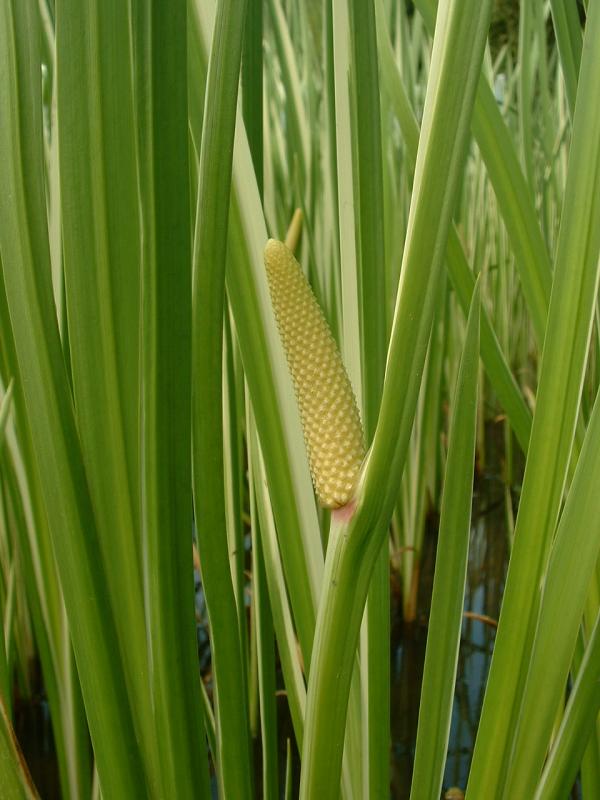
The plant produces tiny greenish-yellow flowers crowded onto a cylindrical spadix measuring approximately 5–10 cm in length. Its branched rhizome is cylindrical, knobby, approximately as thick as a human finger, and has a brown exterior and white interior.[1][2][3][4]
The plant can reach approximately 2 metres in height. Its leaves can grow 4–8 feet long and ½–1 inch wide.[5][6]
Habitat
Sweet Flag occurs along the edges of small lakes, ponds, and rivers, as well as in marshes and swamps. It also grows in ditches, fens, prairie swales, spring branches, pond margins, and sloughs.[7][8]
The species usually grows as an emergent aquatic plant in wet soils.[9][10]
Behaviour
New clusters of leaves develop as the rhizome grows horizontally beneath the soil surface. The species spreads vegetatively when detached pieces of its rootstock establish new colonies.[11][12]
Reproduction and life cycle
Only plants growing in water produce flowers. In Europe, the species flowers for approximately one month in late spring or early summer but does not produce fruit.[13][14]
The Missouri form is genetically sterile and cannot reproduce through seeds. It produces dry seeds that remain shriveled and fail to mature.[15][16]
Uses
Dried rhizomes and their extracts have historically been used in medicine, perfumery, and food and beverage flavoring. The essential oil is used in the perfume industry.[17][18]
The rhizome essence has been used to flavor foods, alcoholic beverages, and bitters in Europe. Young inner stems can be eaten raw when the stalks are shorter than 30 cm, and rhizomes can be boiled and simmered in syrup to make candy.[19][20][21]
Sweet Flag has traditionally been used in Chinese, Nepalese, and Indian herbal medicine. It has also been used as a natural insecticide because its asarone compounds possess insecticidal properties.[22][23]
The species is cultivated as a pond-edge or bog plant. It has historically been scattered on floors to provide a pleasant aroma when walked on.[24][25]
Conservation
Sweet Flag rhizomes contain toxic substances, and the species has been banned as a food additive in the United States.[26]
Sweet Flag and other rooted shoreline plants help stabilize soils and prevent erosion.[27]
Classification of the Sweet Flag
| Kingdom | Plantae |
|---|---|
| Subkingdom | Pteridobiotina |
| Phylum | Tracheophyta |
| Class | Liliopsida |
| Order | Acorales |
| Family | Acoraceae (Sweetflag Family) |
| Genus | Acorus (Sweetflag) |
| Species | Acorus calamus L. |
Where the Sweet Flag is found
Checklists and occurrence records place Acorus calamus in 56 countries across Africa, Asia, Europe and North America. GBIF holds 65,890 georeferenced records of it.
Countries where it is native or its origin is not stated
- Afghanistan 5
- Armenia 3
- Bhutan 11
- British Indian Ocean Territory 4
- Czechia 703
- Estonia 770
- Georgia 4
- Iran 4
- Japan 492
- Kazakhstan 65
- Macao 3
- Malaysia 12
- Mongolia 4
- Myanmar 3
- North Korea 13
- Philippines 35
- South Korea 214
- Sri Lanka 4
- Taiwan 4
- Thailand 12
- Vietnam 11
Countries where it has been introduced
- Albania
- Austria 515
- Bangladesh 1
- Belgium 3,596
- Bulgaria
- Canada 421
- China 698
- Denmark 2,198
- Faroe Islands
- Finland 749
- France 2,246
- Germany 9,536
- Hungary 10
- Iceland 1
- India 70
- Indonesia 41
- Ireland 7
- Italy 38
- Kyrgyzstan
- Nepal 28
- Norway 547
- Pakistan 5
- Poland 2,244
- Romania 15
- Russia 1,609
- South Africa 11
- Svalbard and Jan Mayen
- Sweden 5,107
- Switzerland 907
- The Netherlands 19,716
- Turkey 5
- Ukraine 402
- United Kingdom 9,705
- United States 3,083
- Uzbekistan 3
Regions and cities with the most records
- England, United Kingdom 8,818
- Boskoop, The Netherlands 7,535
- Waddinxveen, The Netherlands 7,481
- Woerden, The Netherlands 7,358
- Bodegraven, The Netherlands 7,123
- Gouda, The Netherlands 6,884
- Benthuizen, The Netherlands 6,660
- Alphen aan den Rijn, The Netherlands 6,429
- Zoetermeer, The Netherlands 5,448
- Bergschenhoek, The Netherlands 5,330
- Mijdrecht, The Netherlands 5,181
- Berkel en Rodenrijs, The Netherlands 5,022
- Capelle aan den IJssel, The Netherlands 4,844
- Krimpen aan den IJssel, The Netherlands 4,720
- De Meern, The Netherlands 4,713
- Maarssen, The Netherlands 4,359
- Bavaria, Germany 4,150
- Uithoorn, The Netherlands 4,150
- Alblasserdam, The Netherlands 4,093
- Ridderkerk, The Netherlands 3,887
- Leiderdorp, The Netherlands 3,820
- Rotterdam, The Netherlands 3,796
- Hendrik-Ido-Ambacht, The Netherlands 3,615
- Pijnacker, The Netherlands 3,594
- Papendrecht, The Netherlands 3,475
- Sliedrecht, The Netherlands 3,434
- IJsselstein, The Netherlands 3,361
- Nieuw-Vennep, The Netherlands 3,244
- Barendrecht, The Netherlands 2,983
- Leiden, The Netherlands 2,856
- Dordrecht, The Netherlands 2,788
- Voorschoten, The Netherlands 2,787
- Amstelveen, The Netherlands 2,778
- Zwijndrecht, The Netherlands 2,732
- Utrecht, The Netherlands 2,676
- Nieuwegein, The Netherlands 2,622
13 more countries have a few records outside this range
These countries hold a few records of Acorus calamus but lie outside the range the checklists give for it. Such records are often zoo or garden specimens, museum material or vagrants, so the species is not counted as occurring there.
A number beside a place is its count of GBIF occurrence records. A place without a number comes from a checklist alone. Records show where a species has been observed or collected, which can include escapes and vagrants.
Common names
English
- Sweet Flag
- Asian Sweet-Flag
- Calamus Root
- Calamus Sweet Flag
- Calmus
- Drug Sweetflag
- Eurasian Sweet-Flag
- Eurasian Sweetflag
- European Sweet-flag
- European Sweetflag
- Myrtle Flag
- Myrtle Grass
- Myrtle Sedge
- Rat Root
- Single-veined Sweetflag
- Sweet Calomel
- Sweet Cane
- Sweet Colomel
- Sweet Rush
- Sweet Sedge
- Sweet-Flag
- Vegetable Calomel
- Beewort
- Calamus
- Flag-root
- Flagroot
- Gladdon
- Myrtle-flag
- Old World Sweetflag
- Pine Root
- Single-vein Sweetflag
- Sweet Calamus
- Sweet Cinnamon
- Sweet Myrtle
- Sweet Segg
- Sweetroot
Names in 65 other languages
- Afrikaans
- Makkalmoes, makkalmus
- Albanian
- Kashtëfryza
- Arabic
- وج, وج آسيوي
- Armenian
- Խնկեղեգ ճահճային
- Azerbaijani
- Bataqlıq kəcəvəri
- Basque
- Lasturrin
- Belarusian
- Аер звычайны
- Bengali
- বচ
- Catalan
- Càlam
- Chinese
- 水菖蒲, 菖蒲
- Croatian
- Iđirot
- Czech
- puškvorec obecný
- Danish
- Almindelig kalmus, Kalmus
- Dutch
- Kalmoes
- Esperanto
- Kalam-akoro
- Estonian
- harilik kalmus
- Finnish
- rohtokalmojuuri
- French
- acore, acore aromatique, acore calame, acore odorant, acore roseau, acore vrai, acorus roseau, belle-angélique
- German
- Gewöhnlicher Kalmus, Indischer Kalmus
- Hindi
- बच
- Hungarian
- Kálmos, orvosi kálmos
- Indonesian
- Jerangau, jeringau
- Italian
- Calamo aromatico, calamo
- Japanese
- ショウブ
- Kannada
- ಬಜೆ
- Kazakh
- Шалшық андызы
- Korean
- Chang-po, 창포
- Lithuanian
- Balinis ajeras
- Malay
- Pokok Jerangau
- Malayalam
- വയമ്പ്
- Nepali
- बोझो
- Norwegian Bokmål
- kalmusrot
- Polish
- Tatarak zwyczajny
- Portuguese
- Cálamo-aromático
- Romanian
- Obligeană
- Russian
- Аир болотный, Аир обыкновенный, Аир тростниковый
- Sinhala
- වදකහ
- Slovak
- puškvorec obyčajný
- Slovenian
- pravi kolmež
- Spanish
- calamís, cálamo acuático asiático, cálamo aromático, cálamo aromático asiático, Ácoro verdadero
- Tamil
- வசம்பு
- Thai
- ว่านน้ำ
- Turkish
- eğirkökü
- Ukrainian
- Лепеха звичайна
- Urdu
- داج قلموس
- Vietnamese
- Thủy xương bồ
- Welsh
- Gellesg Pêr, Gellesgen Beraroglaidd, Gellesgen Bêr, Gellhesgen Beraroglaidd, Gellhesgen Perarogl
- Zulu
- ikalamuzi, ikhalamusi, inDawocwatha, indawolucwatha
- ace
- Jeureunggèë
- ang
- Bēowyrt
- ban
- Jangu
- bjn
- Jariangau
- chr
- ᎤᏲᏓᎵ
- cre
- wacaskomêciwin, wîhkês
- csb
- Zwëczajny kalmùs
- frr
- Swaanenbruad
- fry
- Kalmuswoartel
- hsb
- Wšědny kalmus
- ido
- Akoro
- kir
- Жөнөкөй айыр
- liv
- Kalvīer
- oji
- Wiiken (Na'bûgûck)
- pnb
- ملٹھی
- sah
- Манчаары
- san
- वामनी
Synonyms
25 other scientific names have been used for this species and are now treated as synonyms of Acorus calamus.
- Acorus angustatus Raf.
- Acorus angustifolius Schott
- Acorus aromaticus Gilib.
- Acorus belangeri Schott
- Acorus calamus f. submersa Glück
- Acorus calamus subsp. vulgaris (L.) Ehrh.
- Acorus calamus var. angustifolius (Schott) Engl.
- Acorus calamus var. angustifolius Zapał.
- Acorus calamus var. belangeri (Schott) Engl.
- Acorus calamus var. calamus
- Acorus calamus var. europeus Raf.
- Acorus calamus var. vulgaris L.
- Acorus calamus-aromaticus Clairv.
- Acorus casia Bertol.
- Acorus commersonii Schott
- Acorus elatus Salisb.
- Acorus europaeus Dumort.
- Acorus flexuosus Raf.
- Acorus floridanus Raf.
- Acorus odoratus Lam.
- Acorus undulatus Stokes
- Calamus aromaticus Garsault
- Calamus aromaticus Gueldenst. ex Ledeb.
- Acorus terrestris Spreng. ambiguous synonym
- Acorus verus Garsault ambiguous synonym
Related species
-
 Japanese Sweet FlagAcorus gramineus
-
 American Sweet-FlagAcorus americanus
- Acorus verus
- Acorus shannai
Compare
Questions and answers
What is the scientific name of the Sweet Flag?
The scientific name of the Sweet Flag is Acorus calamus. Written with its author, the full name is Acorus calamus L..
Which family does the Sweet Flag belong to?
Acorus calamus belongs to the family Acoraceae, in the order Acorales and the class Liliopsida.
Where is the Sweet Flag found?
Checklists and occurrence records place Acorus calamus in 56 countries, including Estonia, Czechia, Japan, South Korea, Kazakhstan and Philippines.
What is the conservation status of the Sweet Flag?
The IUCN Red List category recorded for Acorus calamus is Least Concern (LC).
What other names does the Sweet Flag have?
Acorus calamus is also known in English as Asian Sweet-Flag, Calamus Root, Calamus Sweet Flag, Calmus, Drug Sweetflag and Eurasian Sweet-Flag.
Why was calamus banned?
Sweet Flag rhizomes contain toxic substances, and the species has been banned as a food additive in the United States.[26]
What are the medicinal uses of sweet flag?
Sweet Flag has traditionally been used in Chinese, Nepalese, and Indian herbal medicine. Its dried rhizomes and extracts have historically been used in medicine.[17][22]
Is sweet flag grass invasive?
Sweet Flag spreads vegetatively when detached pieces of its rootstock establish new colonies. It has been widely introduced throughout the world and has become naturalized throughout much of North America.[12][28][29]
Where is Acorus calamus native to?
Sweet Flag is native to Eurasia.[30]
Sources
Passages the profile rests on
- The plant produces tiny greenish-yellow flowers crowded onto a cylindrical spadix. Source passage: “The spadix is densely crowded with tiny greenish-yellow flowers.” — English Wikipedia
- The spadix measures approximately 5–10 cm in length. Source passage: “The spadix is solid, cylindrical, tapers at each end, and is 5 to 10 cm in length.” — English Wikipedia
- Its rhizome is branched, cylindrical, knobby, and approximately as thick as a human finger. Source passage: “The branched, cylindrical, knobby rhizome is the thickness of a human finger” — English Wikipedia
- The rhizome has a brown exterior and a white interior. Source passage: “The exterior is brown and the interior white.” — English Wikipedia
- The plant can reach approximately 2 metres in height. Source passage: “Sweet flag is a herbaceous perennial, 2 m (79 in) tall.” — English Wikipedia
- Its leaves can grow 4–8 feet long and ½–1 inch wide. Source passage: “The leaves may be 4–8 feet long and ½–1 inch wide” — mdc.mo.gov
- The species occurs along the edges of small lakes, ponds, and rivers, as well as in marshes and swamps. Source passage: “Habitats include edges of small lakes, ponds and rivers, marshes, swamps, and other wetlands.” — English Wikipedia
- It occurs in aquatic and semiaquatic habitats including ditches, fens, prairie swales, spring branches, pond margins, and sloughs. Source passage: “Occurs in various aquatic and semiaquatic habitats, including ditches, fens, prairie swales, spring branches, pond margins, and sloughs.” — mdc.mo.gov
- The species usually grows as an emergent aquatic plant. Source passage: “Usually grows as an emergent aquatic plant.” — mdc.mo.gov
- Sweet flag grows in wet soils. Source passage: “Like them, sweet flag lives in wet soils.” — mdc.mo.gov
- New clusters of leaves develop as the rhizome grows horizontally beneath the soil surface. Source passage: “As the rhizome grows horizontally under the soil surface, new whorls of leaves arise in clusters.” — mdc.mo.gov
- The species spreads vegetatively when detached pieces of its rootstock establish new colonies. Source passage: “It readily spreads when a small section of rootstock, broken away from the parent plant, begins a new colony somewhere else.” — mdc.mo.gov
- Only plants growing in water produce flowers. Source passage: “Only plants that grow in water bear flowers.” — English Wikipedia
- In Europe, the species flowers for approximately one month in late spring or early summer but does not produce fruit. Source passage: “In Europe, it flowers for about a month in late spring or early summer, but does not bear fruit.” — English Wikipedia
- The Missouri form of Acorus calamus is genetically sterile and cannot reproduce through seeds. Source passage: “It is genetically sterile and cannot reproduce by seed.” — mdc.mo.gov
- The sterile form produces dry seeds that remain shriveled and fail to mature. Source passage: “Its dry seeds appear sunken in or shriveled and do not mature.” — mdc.mo.gov
- The dried rhizomes and their extracts have historically been used in medicine, perfumery, and food and beverage flavoring. Source passage: “The dried rhizomes of sweet flag, called “calamus root,” and derivative extracts have a long history of use as medicine, perfume additives, and food and beverage flavoring.” — mdc.mo.gov
- The essential oil is used in the perfume industry. Source passage: “the aroma of its essential oil is used in the perfume industry.” — English Wikipedia
- The rhizome essence has been used to flavor foods, alcoholic beverages, and bitters in Europe. Source passage: “The essence from the rhizome is used as a flavor for foods, alcoholic beverages, and bitters in Europe.” — English Wikipedia
- The young inner stems can be eaten raw when the stalks are shorter than 30 cm. Source passage: “The young stalks can be pulled when under 30 cm (12 in); the inner stems can be eaten raw.” — English Wikipedia
- The rhizomes can be boiled and simmered in syrup to make candy. Source passage: “The roots can be washed, peeled, cut into small pieces, boiled, and simmered in syrup to make candy.” — English Wikipedia
- Sweet flag has traditionally been used in Chinese, Nepalese, and Indian herbal medicine. Source passage: “Sweet flag has a long history of use in Chinese, Nepalese, and Indian herbal traditions.” — English Wikipedia
- The species has been used as a natural insecticide because its asarone compounds possess insecticidal properties. Source passage: “The asarone from A. calamus, found most abundantly in the dried and pulverized roots, has been identified as having insecticidal properties.” — English Wikipedia
- The species is cultivated as a pond-edge or bog plant. Source passage: “Sweet flag is a hardy and attractive plant for water gardening, and it’s been widely cultivated as a pondside or bog plant.” — mdc.mo.gov
- Sweet flag has historically been scattered on floors to provide a pleasant aroma when walked on. Source passage: “In medieval England and pioneer America, people scattered it on floors to give a pleasant aroma when it was walked on.” — mdc.mo.gov
- Sweet flag rhizomes contain toxic substances, and the species has been banned as a food additive in the United States. Source passage: “Calamus root, however, contains toxic substances and has been banned as a food additive by the U.S. Food and Drug Administration.” — mdc.mo.gov
- Sweet flag and other rooted shoreline plants help stabilize soils and prevent erosion. Source passage: “Sweet flag and other rooted shoreline plants are important for holding soils in place and preventing erosion.” — mdc.mo.gov
- The species has been widely introduced throughout the world. Source passage: “Sweet flag is native to the Irtysh River valley in Kazakhstan, but has been widely introduced worldwide.” — English Wikipedia
- The species has become naturalized throughout much of North America. Source passage: “Like the common dandelion and the daylily, it has become naturalized throughout much of North America.” — mdc.mo.gov
- The species is native to Eurasia. Source passage: “Sweet flag, A. calamus (the subject of this page), is native to Eurasia and was introduced to North America in the 1600s.” — mdc.mo.gov
Data
- Catalogue of Life, 2026-10-16 XR cc by
- Global Biodiversity Information Facility CC BY 4.0
- Wikidata CC0
- GeoNames CC BY 4.0
- Wikimedia Commons per image; credit shown with each image
- Within the Catalogue of Life, this name comes from The World Checklist of Vascular Plants (WCVP) cc by
References
- Sp. Pl.: 324 (1753) where the name was published
This species in other databases
Page built on 28 November 2026. See how the catalog is made and all sources and licences.
Cite this page
ScientificNames.org. (2026). Acorus calamus (Sweet Flag). Retrieved November 28, 2026, from https://scientificnames.org/species/acorus-calamus
“Acorus calamus (Sweet Flag).” ScientificNames.org, 2026, scientificnames.org/species/acorus-calamus. Accessed 28 Nov. 2026.
ScientificNames.org. “Acorus calamus (Sweet Flag).” Accessed November 28, 2026. https://scientificnames.org/species/acorus-calamus.
@misc{scientificnames_acorus_calamus_sweet_flag,
  author = {{ScientificNames.org}},
  title = {Acorus calamus (Sweet Flag)},
  year = {2026},
  url = {https://scientificnames.org/species/acorus-calamus},
  note = {Accessed 2026-11-28}
}