Species · Flowering plants
Japanese Sweet Flag Acorus gramineus
The scientific name of the Japanese Sweet Flag is Acorus gramineus. It is a species of flowering plant in the family Acoraceae (sweetflag family), order Acorales.
- Scientific name
- Acorus gramineus Aiton
- Common name
- Japanese Sweet Flag
- Genus
- Acorus
- Family
- Acoraceae (Sweetflag Family)
- Order
- Acorales
- Class
- Liliopsida
- Red List category
- LC Least Concern
- Recorded in
- 20 countries
- Name status
- accepted in the Catalogue of Life

Overview
Acorus gramineus typically grows in wetlands, shallow water, and very moist soil. It is characterized by narrow, slightly curved leaves arranged in fans and can form clumps reaching approximately 30 cm in height.
Written 26 November 2026 from the sources listed below. Each statement was checked against the passage it cites; statements that could not be supported were removed.
Appearance
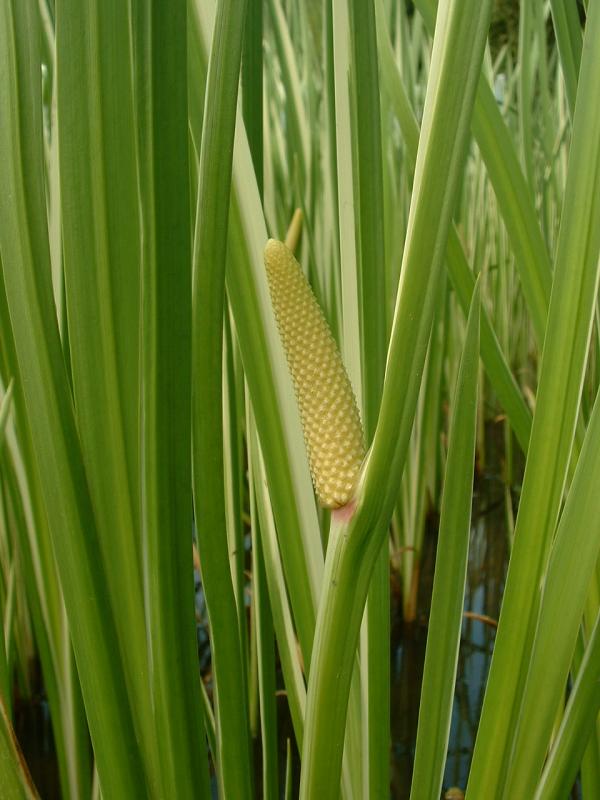
Japanese sweet flag has long, narrow, slightly curved, mid-green leaves arranged in fans. Its leaves can reach 30 cm in height, and the plant forms clumps of approximately 30 cm in height.[1][2][3][4]
The pusillus variety has slightly shorter, more rigid, glossy green leaves than the typical form. The variegatus variety has longer leaves with yellow streaks.[5][6]
The species is a semi-evergreen perennial and forms tufts of linear or sword-shaped leaves.[7][8]
Habitat
Japanese sweet flag typically grows in wetlands and shallow water. It can grow fully submerged, partially submerged, or in very moist soil.[9][10]
The species grows well in wet or very moist fertile soils. It can be cultivated in baskets submerged in shallow water up to 10 cm deep.[11][12]
Behaviour
Japanese sweet flag spreads aggressively through its rhizomes under favorable conditions. It can also develop congested growth.[13][14]
Congested growth can be managed by dividing the plant every few years.[14]
Reproduction and life cycle
Japanese sweet flag generally flowers only when it is at least partially submerged. It produces insignificant spike-like flowers near the tips of central leaf-like stems.[15][16]
The species can be propagated by dividing its fleshy underwater rhizome and planting the base in shallow water.[17]
Uses
Japanese sweet flag is frequently planted around pond and water garden edges. It is also used as a submerged plant in freshwater aquaria and is suitable for cultivation as an aquarium plant.[18][19][20]
In aquarium conditions, the species is short-lived when water temperatures remain above 22°C for extended periods.[21]
The Miao nationality in China uses the species to treat chest distentions, nausea, and loss of appetite. The Hani people use it to treat rheumatoid arthritis and dyspepsia.[22][23]
Classification of the Japanese Sweet Flag
| Kingdom | Plantae |
|---|---|
| Subkingdom | Pteridobiotina |
| Phylum | Tracheophyta |
| Class | Liliopsida |
| Order | Acorales |
| Family | Acoraceae (Sweetflag Family) |
| Genus | Acorus (Sweetflag) |
| Species | Acorus gramineus Aiton |
Where the Japanese Sweet Flag is found
Checklists and occurrence records place Acorus gramineus in 20 countries across Asia, Europe and North America. GBIF holds 3,607 georeferenced records of it.
Countries where it is native or its origin is not stated
- Bangladesh
- Cambodia
- China 1,953
- Germany 5
- Hong Kong 88
- India 3
- Japan 810
- Laos 3
- Macao 58
- Malaysia 4
- Myanmar 11
- Philippines 8
- Russia 1
- South Korea 168
- Taiwan 262
- Thailand 58
- Ukraine 3
- Vietnam 51
Countries where it has been introduced
Regions and cities with the most records
- Sichuan, China 210
- Guangdong, China 187
- Taiwan, Taiwan 183
- Hubei, China 148
- Zhejiang, China 122
- Chongqing, China 113
- Guangxi, China 111
- Hyōgo, Japan 103
- Shaanxi, China 87
- Kanagawa, Japan 78
- Guizhou, China 76
- Hunan, China 76
- Kochi, Japan 76
- England, United Kingdom 73
- Tai Po, Hong Kong 71
- Jiangxi, China 70
- Shuen Wan, Hong Kong 70
- Fanling, Hong Kong 69
- Hong Lok Yuen, Hong Kong 69
- Kam Ying, Hong Kong 69
- Lee On, Hong Kong 69
- Ma On Shan, Hong Kong 69
- Tai Mei Tuk, Hong Kong 69
- Tai Shui Hang, Hong Kong 69
- City One, Hong Kong 68
- Fo Tan, Hong Kong 68
- Keng Hau, Hong Kong 68
- Pok Hong, Hong Kong 68
- San Tin, Hong Kong 68
- Sha Tin, Hong Kong 68
- Sha Tin Wai, Hong Kong 68
- Shui Chuen O, Hong Kong 68
- Siu Lek Yuen, Hong Kong 68
- Sun Tin Wai, Hong Kong 68
- Tai Wai, Hong Kong 68
- Wo Che, Hong Kong 68
3 more countries have a few records outside this range
These countries hold a few records of Acorus gramineus but lie outside the range the checklists give for it. Such records are often zoo or garden specimens, museum material or vagrants, so the species is not counted as occurring there.
A number beside a place is its count of GBIF occurrence records. A place without a number comes from a checklist alone. Records show where a species has been observed or collected, which can include escapes and vagrants.
Common names
English
- Japanese Sweet Flag
- Grass-leaved Sweet-Flag
- Grassleaf Sweet-Flag
- Grassy-leaved Sweet Flag
- Slender Sweet-Flag
- Grass-leaf Sweet-flag
- Grassleaf Sweetflag
- Slender Sweet Flag
Names in 16 other languages
- Arabic
- وج قزم, وج ياباني
- Belarusian
- Аер злакавы
- Chinese
- jin qian pu, 石菖蒲, 金錢蒲
- Czech
- puškvorec trávovitý
- Dutch
- Dwergkalmoes
- Estonian
- Kõrskalmus
- Finnish
- heinäkalmojuuri
- German
- Gras-Kalmus
- Japanese
- セキショウ, セキショウ(石菖)
- Korean
- 석창포
- Lithuanian
- Siauralapis ajeras
- Polish
- tatarak trawiasty
- Russian
- Аир злаковый
- Thai
- ว่านน้ำญี่ปุ่น
- Turkish
- Kısa Eğirotu
- Welsh
- Gellesg Pêr Main, Gellesgen Bêr Fain
Synonyms
9 other scientific names have been used for this species and are now treated as synonyms of Acorus gramineus.
- Acorus gramineus var. flavomarginatus K.M.Liu
- Acorus gramineus var. japonicus M.Hotta
- Acorus gramineus var. macrospadiceus Yamam.
- Acorus gramineus var. pusillus (Siebold ex Miq.) Engl.
- Acorus gramineus var. variegatus Ed. Otto
- Acorus humilis Salisb.
- Acorus macrospadiceus (Yamam.) F.N.Wei & Y.K.Li
- Acorus pusillus Siebold ex Miq.
- Acorus xiangyeus Z.Y.Zhu
Related species

Compare
Questions and answers
What is the scientific name of the Japanese Sweet Flag?
The scientific name of the Japanese Sweet Flag is Acorus gramineus. Written with its author, the full name is Acorus gramineus Aiton.
Which family does the Japanese Sweet Flag belong to?
Acorus gramineus belongs to the family Acoraceae, in the order Acorales and the class Liliopsida.
Where is the Japanese Sweet Flag found?
Checklists and occurrence records place Acorus gramineus in 20 countries, including China, Japan, Taiwan, South Korea, Hong Kong and Macao.
What is the conservation status of the Japanese Sweet Flag?
The IUCN Red List category recorded for Acorus gramineus is Least Concern (LC).
What other names does the Japanese Sweet Flag have?
Acorus gramineus is also known in English as Grass-leaved Sweet-Flag, Grassleaf Sweet-Flag, Grassy-leaved Sweet Flag, Slender Sweet-Flag, Grass-leaf Sweet-flag and Grassleaf Sweetflag.
What are the uses and benefits of sweet flag?
Japanese sweet flag is planted around pond and water garden edges and used as a submerged plant in freshwater aquaria. The Miao nationality in China uses it to treat chest distentions, nausea, and loss of appetite, while the Hani people use it to treat rheumatoid arthritis and dyspepsia.[18][19][22][23]
Sources
Passages the profile rests on
- The species has long, narrow, slightly curved leaves. Source passage: “This shrubby plant's long, narrow, slightly curved leaves may grow to 30 cm (12 inches) in height.” — English Wikipedia
- The leaves can reach 30 cm in height. Source passage: “leaves may grow to 30 cm (12 inches) in height.” — English Wikipedia
- The species forms clumps reaching approximately 30 cm in height. Source passage: “comprising fans of leaves making clumps to a height of 30cm” — rhs.org.uk
- The species has narrow, mid-green leaves arranged in fans. Source passage: “comprising fans of leaves making clumps to a height of 30cm, with narrow mid-green leaves” — rhs.org.uk
- The pusillus variety has slightly shorter, more rigid, glossy green leaves than the typical form. Source passage: “Var. pusillus has slightly shorter, more rigid glossy green leaves” — English Wikipedia
- The variegatus variety has longer leaves with yellow streaks. Source passage: “var. variegatus has longer leaves streaked with yellow.” — English Wikipedia
- The species is a semi-evergreen perennial. Source passage: “A compact, semi-evergreen marginal aquatic perennial” — rhs.org.uk
- The species forms tufts of linear or sword-shaped leaves. Source passage: “Acorus are deciduous or semi-evergreen, moisture-loving rhizomatous perennials forming tufts of linear or sword-shaped leaves” — rhs.org.uk
- The species typically grows in wetlands and shallow water. Source passage: “The plant usually grows in wetlands and shallow water.” — English Wikipedia
- The species can grow fully submerged, partially submerged, or in very moist soil. Source passage: “It can grow fully or partially submerged, or in very moist soil” — English Wikipedia
- The species grows well in wet or very moist fertile soils. Source passage: “Easy to grow in wet or very moist fertile soils.” — rhs.org.uk
- The species can be cultivated in baskets submerged in shallow water up to 10 cm deep. Source passage: “Can be planted in baskets in shallow water up to 10cm deep.” — rhs.org.uk
- The species spreads aggressively through its rhizomes under favorable conditions. Source passage: “Acorus gramineus spreads aggressively by rhizome” — English Wikipedia
- The species can develop congested growth that is managed by dividing it every few years. Source passage: “Divide every few years to prevent congestion.” — rhs.org.uk
- The species generally flowers only when it is at least partially submerged. Source passage: “it will usually only flower when at least partially submerged.” — English Wikipedia
- The species produces insignificant spike-like flowers near the tips of central leaf-like stems. Source passage: “with insignificant spike-like flowers borne near the tips of central leaf-like stems” — rhs.org.uk
- The species can be propagated by dividing its fleshy underwater rhizome and planting the base in shallow water. Source passage: “It can be propagated by dividing the fleshy underwater rhizome and planting the base in shallow water.” — English Wikipedia
- The species is frequently planted around pond and water garden edges. Source passage: “it is frequently used around the edges of ponds and water gardens” — English Wikipedia
- The species is used as a submerged plant in freshwater aquaria. Source passage: “as well as submerged in freshwater aquaria.” — English Wikipedia
- The species is suitable for cultivation as an aquarium plant. Source passage: “It also makes a useful aquarium plant” — rhs.org.uk
- The species is short-lived in aquarium conditions when water temperatures remain above 22°C for extended periods. Source passage: “but is short-lived where water temperatures exceed 22°C for long periods.” — rhs.org.uk
- The species is used by the Miao nationality in China to treat chest distentions, nausea, and loss of appetite. Source passage: “A. gramineus to treat chest distentions, nausea, and loss of appetite.” — pmc.ncbi.nlm.nih.gov
- The Hani people use the species to treat rheumatoid arthritis and dyspepsia. Source passage: “and A. gramineus to treat rheumatoid arthritis and dyspepsia.” — pmc.ncbi.nlm.nih.gov
Data
- Catalogue of Life, 2026-10-16 XR cc by
- Global Biodiversity Information Facility CC BY 4.0
- Wikidata CC0
- GeoNames CC BY 4.0
- Wikimedia Commons per image; credit shown with each image
- Within the Catalogue of Life, this name comes from The World Checklist of Vascular Plants (WCVP) cc by
References
- Hortus Kew. 1: 474 (1789) where the name was published
This species in other databases
Page built on 27 November 2026. See how the catalog is made and all sources and licences.
Cite this page
ScientificNames.org. (2026). Acorus gramineus (Japanese Sweet Flag). Retrieved November 27, 2026, from https://scientificnames.org/species/acorus-gramineus
“Acorus gramineus (Japanese Sweet Flag).” ScientificNames.org, 2026, scientificnames.org/species/acorus-gramineus. Accessed 27 Nov. 2026.
ScientificNames.org. “Acorus gramineus (Japanese Sweet Flag).” Accessed November 27, 2026. https://scientificnames.org/species/acorus-gramineus.
@misc{scientificnames_acorus_gramineus_japanese_sweet_flag,
  author = {{ScientificNames.org}},
  title = {Acorus gramineus (Japanese Sweet Flag)},
  year = {2026},
  url = {https://scientificnames.org/species/acorus-gramineus},
  note = {Accessed 2026-11-27}
}