Species · Amphibians
Blanchard's Cricket Frog Acris blanchardi
The scientific name of the Blanchard's Cricket Frog is Acris blanchardi. It is a species of amphibian in the family Hylidae (hylids), order Anura. The name dates from 1947.
- Scientific name
- Acris blanchardi Harper, 1947
- Common name
- Blanchard's Cricket Frog
- Genus
- Acris
- Family
- Hylidae (Hylids)
- Order
- Anura
- Class
- Amphibia
- Red List category
- LC Least Concern
- Recorded in
- 3 countries
- Name status
- accepted in the Catalogue of Life

Overview
Acris blanchardi occurs from central Nebraska south through Texas to northeastern Mexico, extending eastward to central Ohio, and is also recorded in the southern halves of Wisconsin and Michigan. Adults have warty skin, long hind limbs, fully webbed hind toes, and two light-colored bars extending from the corners of their jaws to their eyes.
Written 26 November 2026 from the sources listed below. Each statement was checked against the passage it cites; statements that could not be supported were removed.
Appearance
Adults have warty skin with brown, tan, olive, or gray dorsal coloration and green, reddish, or black blotches. They have long hind limbs, fully webbed hind toes, and toe tips without expanded pads.[1][2]
Two light-colored bars extend from the corners of the jaws to the eyes. Adult males have yellowish vocal sacs mottled with gray and a thick pad on the inner surface of their thumbs.[3][4][5]
Tadpoles have tan skin and prominent black blotches on the upper surface of their tails. The species has heavily vascularized skin that allows substances to enter its body quickly.[6][7]
Habitat
Blanchard's Cricket Frogs inhabit shallow margins of lakes, ponds, marshes, and streams. They are commonly associated with slow-moving or still water and wet, muddy banks.[8][9]
Adults can inhabit open hillsides and closed-canopy deciduous forests when riparian water sources are accessible. They shelter in mud, rocks, or vegetation near bodies of water.[10][11]
Tadpoles inhabit shallow water in streams, ponds, and lakes. In West Virginia, recorded habitat elevations range from 164 to 183 meters above sea level.[12][13]
Diet
Adults consume small terrestrial insects and spiders.[14]
Behaviour
Adults are most active from late March through mid-October when ambient temperatures exceed 15 °C. During cooler months, individuals brumate under debris or in shoreline burrows.[15][16]
Adults generally remain close to water and may travel up to 60 meters away during rainy conditions. When disturbed, individuals commonly leap into water and quickly swim back to shore.[17][18]
Breeding males produce a series of sharp, cricket-like clicking sounds.[19]
Reproduction and life cycle
Breeding generally occurs once annually between mid-May and early July. Males produce mating calls between April and August.[20][21]
Males dig underground nests that receptive females enter for mating. Fertilization occurs externally, usually in shallow water among aquatic vegetation.[22][23]
Fertilized eggs hatch within 6 to 21 days, depending on air and water temperatures. Tadpoles begin metamorphosis 5 to 10 weeks after hatching.[24][25]
Newly metamorphosed froglets can reach sexual maturity and reproduce within one year. Adults provide no parental care beyond mating.[26][27]
Conservation
The species is classified as endangered in Wisconsin and threatened in Michigan.[28]
Habitat loss, chemical contaminants, and competition for resources have been proposed as contributors to population declines. The principal cause of population declines remains unknown.[29][30]
Similar species
Young western and upland chorus frogs can resemble Blanchard's Cricket Frogs in size but lack their warty skin and dark triangular marking between the eyes.[31]
Northern cricket frogs resemble Blanchard's Cricket Frogs but have green coloration on their heads and dorsal surfaces.[32]
Classification of the Blanchard's Cricket Frog
| Kingdom | Animalia |
|---|---|
| Phylum | Chordata |
| Subphylum | Vertebrata |
| Infraphylum | Gnathostomata |
| Parvphylum | Osteichthyes |
| Megaclass | Tetrapoda |
| Class | Amphibia (Amphibians) |
| Order | Anura (Frogs) |
| Family | Hylidae (Hylids) |
| Genus | Acris (Cricket Frog) |
| Species | Acris blanchardi Harper, 1947 |
Where the Blanchard's Cricket Frog is found
Checklists and occurrence records place Acris blanchardi in 3 countries across North America. GBIF holds 39,168 georeferenced records of it.
Countries
Regions and cities with the most records
- Texas, United States 14,581
- Oklahoma, United States 5,142
- Kansas, United States 3,060
- Missouri, United States 2,742
- Illinois, United States 2,239
- Arkansas, United States 1,677
- Indiana, United States 1,546
- Ohio, United States 1,232
- Haltom City, United States 904
- Louisiana, United States 890
- Round Rock, United States 877
- Fort Worth, United States 849
- North Richland Hills, United States 842
- Brushy Creek, United States 826
- Iowa, United States 785
- Hurst, United States 776
- Grapevine, United States 759
- Watauga, United States 746
- Cedar Park, United States 723
- Euless, United States 703
- Nebraska, United States 689
- Arlington, United States 688
- Southlake, United States 680
- Leander, United States 679
- Bedford, United States 678
- Colleyville, United States 668
- Georgetown, United States 636
- Pflugerville, United States 614
- Addison, United States 595
- Saginaw, United States 595
- Austin, United States 593
- Grand Prairie, United States 577
- Frisco, United States 560
- The Colony, United States 539
- Highland Village, United States 532
- Plano, United States 529
Range as the checklists state it
Middle America
North America
A number beside a place is its count of GBIF occurrence records. A place without a number comes from a checklist alone. Records show where a species has been observed or collected, which can include escapes and vagrants.
Common names
English
- Blanchard's Cricket Frog
Names in 6 other languages
- Arabic
- ضفدع الجدجد بلانشارد
- French
- rainette grillon de Blanchard
- German
- Blanchards Grillenfrosch
- Japanese
- ブランチャードコオロギガエル
- Portuguese
- Rã-grilo-de-Blanchard
- Spanish
- Rana grillo del noreste
Synonyms
5 other scientific names have been used for this species and are now treated as synonyms of Acris blanchardi.
- Acris crepitans blanchardi Harper, 1947
- Acris crepitans paludicola Burger, Smith & Smith, 1949
- Acris gryllus blanchardi Harper, 1947
- Acris gryllus paludicola Burger, Smith & Smith, 1949
- Hyla ocularis blanchardi (Harper, 1947)
Related species
-
 Northern Cricket FrogAcris crepitans
-
 Southern Cricket FrogAcris gryllus
-
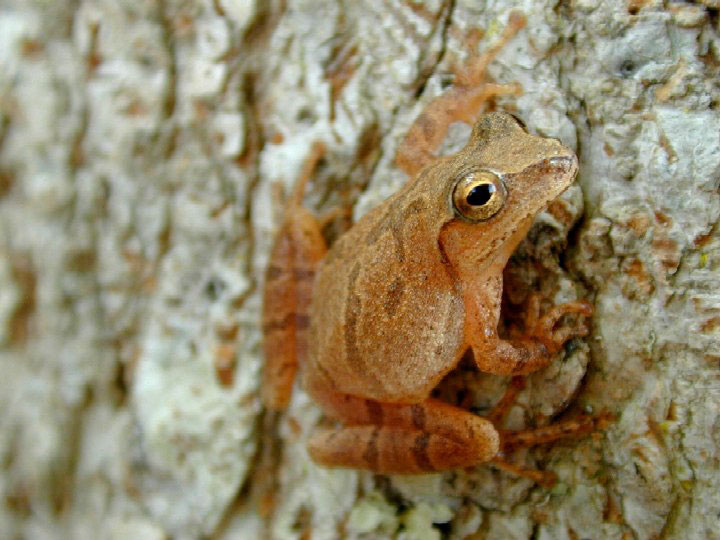 Spring PeeperPseudacris crucifer
-
 Cuban Tree FrogOsteopilus septentrionalis
-
 Pacific Tree FrogPseudacris regilla
-
 Rabbs' Fringe-limbed TreefrogEcnomiohyla rabborum
- European Tree FrogHyla arborea
-
 Mission Golden-eyed Tree FrogTrachycephalus resinifictrix
Compare
Questions and answers
What is the scientific name of the Blanchard's Cricket Frog?
The scientific name of the Blanchard's Cricket Frog is Acris blanchardi. Written with its author, the full name is Acris blanchardi Harper, 1947.
Which family does the Blanchard's Cricket Frog belong to?
Acris blanchardi belongs to the family Hylidae, in the order Anura and the class Amphibia.
Where is the Blanchard's Cricket Frog found?
Checklists and occurrence records place Acris blanchardi in 3 countries: United States, Mexico and Canada.
What is the conservation status of the Blanchard's Cricket Frog?
The IUCN Red List category recorded for Acris blanchardi is Least Concern (LC).
Why are cricket frogs called cricket frogs?
Breeding males produce a series of sharp, cricket-like clicking sounds.[19]
Where do Blanchard's cricket frogs live?
They inhabit shallow margins of lakes, ponds, marshes, and streams, commonly near slow-moving or still water and wet, muddy banks. Their range extends from central Nebraska south through Texas to northeastern Mexico and eastward to central Ohio.[8][9][33][34]
What do cricket frogs eat?
Adult Blanchard's Cricket Frogs consume small terrestrial insects and spiders.[14]
Sources
Passages the profile rests on
- Adults have warty skin with brown, tan, olive, or gray dorsal coloration and green, reddish, or black blotches. Source passage: “The dorsal region of their bodies are brown, tan, olive, or grey with green, reddish, or black blotches.” — animaldiversity.org
- Adults have long hind limbs, fully webbed hind toes, and toe tips without expanded pads. Source passage: “Adult Blanchard’s cricket frogs have warty skin, long hind limbs, fully-webbed hind toes, and unexpanded toe tips.” — animaldiversity.org
- Adults have two light-colored bars extending from the corners of their jaws to their eyes. Source passage: “they have two light-colored bars spanning from the corners of their jaws to their eyes.” — animaldiversity.org
- Adult males have yellowish vocal sacs mottled with gray. Source passage: “they also have yellowish, mottled grey vocal sacs.” — animaldiversity.org
- Adult males have a thick pad on the inner surface of their thumbs. Source passage: “Adult males have a thick pad on the inner part of their thumbs” — animaldiversity.org
- Tadpoles have tan skin and prominent black blotches on the upper surface of their tails. Source passage: “they have tan skin with small but prominent black blotches on the dorsal portion of their tails.” — animaldiversity.org
- The species has heavily vascularized skin that allows substances to enter its body quickly. Source passage: “Their skin is also heavily vascularized, which allows substances to get into their bodies quickly” — English Wikipedia
- The species inhabits shallow margins of lakes, ponds, marshes, and streams. Source passage: “Shallow margins of lakes, ponds, marshes, and streams” — herpetology.inhs.illinois.edu
- The species is commonly associated with slow-moving or still water and wet, muddy banks. Source passage: “Blanchard’s cricket frogs are mainly found near slow-moving or still waters with wet, muddy banks.” — animaldiversity.org
- Adults can inhabit open hillsides and closed-canopy deciduous forests when riparian water sources are accessible. Source passage: “They can live on open hillsides or in closed-canopy deciduous forests, so long as they have sufficient access to riparian areas.” — animaldiversity.org
- Adults shelter in mud, rocks, or vegetation near bodies of water. Source passage: “Adults shelter in mud, rocks, or vegetation close to bodies of water.” — animaldiversity.org
- Tadpoles inhabit shallow water in streams, ponds, and lakes. Source passage: “As tadpoles, Blanchard’s cricket frogs inhabit shallow water in streams, ponds, and lakes.” — animaldiversity.org
- In West Virginia, recorded habitat elevations range from 164 to 183 meters above sea level. Source passage: “in West Virginia, habitat elevations range from 164 to 183 m above sea level.” — animaldiversity.org
- Adults consume small terrestrial insects and spiders. Source passage: “Adult diet includes small terrestrial insects and spiders.” — herpetology.inhs.illinois.edu
- Adults are most active from late March through mid-October when ambient temperatures exceed 15 °C. Source passage: “Blanchard’s cricket frogs are most active from the end of March until mid-October, at ambient temperatures higher than 15 °C.” — animaldiversity.org
- During cooler months, individuals brumate under debris or in shoreline burrows. Source passage: “In cooler months, they brumate under debris or in burrows along the shorelines of nearby water sources.” — animaldiversity.org
- Adults generally remain close to water and may travel up to 60 meters away during rainy conditions. Source passage: “Blanchard’s cricket frogs are fairly sedentary, and typically remain close to water. However, they are reported to travel up to 60 m away from bodies of water in rainy conditions.” — animaldiversity.org
- When disturbed, individuals commonly leap into water and quickly swim back to shore. Source passage: “This small frog commonly leaps into water when disturbed, then almost immediately swims back to shore.” — herpetology.inhs.illinois.edu
- Breeding males produce a series of sharp, cricket-like clicking sounds. Source passage: “emits a series of sharp clicks, cricket-like or like the sound of striking marbles.” — herpetology.inhs.illinois.edu
- Breeding generally occurs once annually between mid-May and early July. Source passage: “Blanchard’s cricket frogs breed once every year, from mid-May through early July.” — animaldiversity.org
- Males produce mating calls between April and August. Source passage: “Male Blanchard's cricket frogs produce mating calls from April to August” — animaldiversity.org
- Males dig underground nests that receptive females enter for mating. Source passage: “Males dig underground nests, which females enter if they are receptive to mating.” — animaldiversity.org
- Fertilization occurs externally, usually in shallow water among aquatic vegetation. Source passage: “Fertilization occurs externally, typically in shallow water among aquatic vegetation.” — animaldiversity.org
- Fertilized eggs hatch within 6 to 21 days, depending on air and water temperatures. Source passage: “Fertilized eggs hatch in 6 to 21 days, depending on air and water temperatures” — animaldiversity.org
- Tadpoles begin metamorphosis 5 to 10 weeks after hatching. Source passage: “metamorphosis begins 5 to 10 weeks after hatching” — animaldiversity.org
- Newly metamorphosed froglets can reach sexual maturity and reproduce within one year. Source passage: “some reach sexual maturity and breed within one year.” — animaldiversity.org
- Adults provide no parental care beyond mating. Source passage: “Blanchard’s cricket frogs provide no parental investment beyond the act of mating.” — animaldiversity.org
- The species is classified as endangered in Wisconsin and threatened in Michigan. Source passage: “It is an endangered species in Wisconsin, and is a threatened species in Michigan” — English Wikipedia
- Habitat loss, chemical contaminants, and competition for resources have been proposed as contributors to population declines. Source passage: “Habitat loss, chemical contaminants, and competition for resources have been posited as reasons for this decline.” — English Wikipedia
- The principal cause of population declines remains unknown. Source passage: “the major reason for the decrease is still unknown.” — English Wikipedia
- Young western and upland chorus frogs can resemble this species in size but lack its warty skin and dark triangular marking between the eyes. Source passage: “Young western and upland chorus frogs are about the same size, but they do not have warty skin or a triangle between the eyes.” — herpetology.inhs.illinois.edu
- Northern cricket frogs resemble Blanchard's cricket frogs but have green coloration on their heads and dorsal surfaces. Source passage: “They look similar to Blanchard’s cricket frogs, but they have green on their heads and dorsal sides, as compared to the darker coloration of Blanchard’s cricket frogs.” — animaldiversity.org
- The species occurs from central Nebraska south through Texas to northeastern Mexico. Source passage: “they are found as far west as central Nebraska and southward to most of Texas and even parts of northeastern Mexico.” — animaldiversity.org
- Its range extends eastward to central Ohio. Source passage: “Their geographic range extends as far east as central Ohio” — animaldiversity.org
Data
- Catalogue of Life, 2026-10-16 XR cc by
- Global Biodiversity Information Facility CC BY 4.0
- Wikidata CC0
- GeoNames CC BY 4.0
- Wikimedia Commons per image; credit shown with each image
- Within the Catalogue of Life, this name comes from The Integrated Taxonomic Information System cc0
This species in other databases
Page built on 27 November 2026. See how the catalog is made and all sources and licences.
Cite this page
ScientificNames.org. (2026). Acris blanchardi (Blanchard's Cricket Frog). Retrieved November 27, 2026, from https://scientificnames.org/species/acris-blanchardi
“Acris blanchardi (Blanchard's Cricket Frog).” ScientificNames.org, 2026, scientificnames.org/species/acris-blanchardi. Accessed 27 Nov. 2026.
ScientificNames.org. “Acris blanchardi (Blanchard's Cricket Frog).” Accessed November 27, 2026. https://scientificnames.org/species/acris-blanchardi.
@misc{scientificnames_acris_blanchardi_blanchards_cricket_frog,
  author = {{ScientificNames.org}},
  title = {Acris blanchardi (Blanchard's Cricket Frog)},
  year = {2026},
  url = {https://scientificnames.org/species/acris-blanchardi},
  note = {Accessed 2026-11-27}
}