Species · Flowering plants
Actaea arizonica
Actaea arizonica has no English name on record in the checklists used here. It is a species of flowering plant in the family Ranunculaceae (crowfoot family), order Ranunculales.
- Scientific name
- Actaea arizonica (S.Watson) Compton
- Genus
- Actaea
- Family
- Ranunculaceae (Crowfoot Family)
- Order
- Ranunculales
- Class
- Magnoliopsida
- Recorded in
- 1 country
- Name status
- accepted in the Catalogue of Life
Overview
Actaea arizonica is a perennial herb with rhizomes. It is endemic to central Arizona. It produces hairless stems reaching heights of up to 1.5–2 meters.
Written 27 November 2026 from the sources listed below. Each statement was checked against the passage it cites; statements that could not be supported were removed.
Appearance
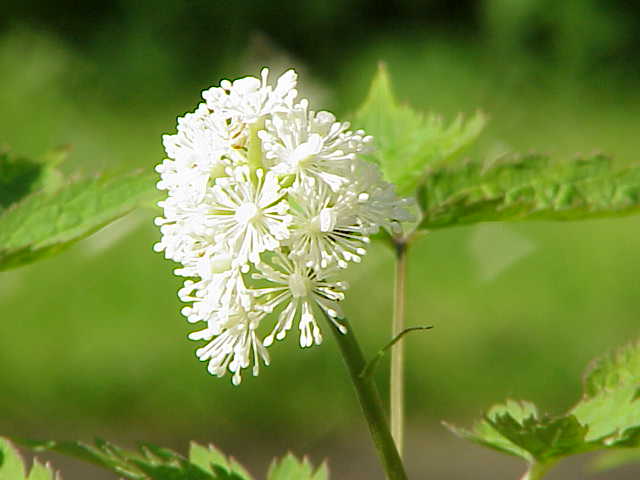
Actaea arizonica produces hairless stems reaching heights of up to 1.5–2 meters. Its leaves consist of toothed leaflets divided into three lobes, measuring up to 17.5 centimeters long and 12.5 centimeters wide. The leaves are supported by petioles measuring up to 35 centimeters long.[1][2][3][4][5]
Its inflorescence is a panicle with several elongated branches that grow upright or lean. Each flower has five sepals, consisting of two greenish sepals and three cream-colored sepals. White petals may occur but are frequently absent, and each flower contains numerous stamens.[6][7][8][9]
Its fruit is a follicle described as having a bottle-brush appearance. Its seeds resemble small furry insects.[10][11]
Reproduction and life cycle
Flowering occurs during July and August. Three bumblebee species, Bombus occidentalis, Bombus morrisoni, and Bombus huntii, pollinate its flowers.[12][13]
Its flowers undergo abortion when insect pollination does not occur or when pollination is prevented by circumstances such as heavy rain.[14]
Habitat
Actaea arizonica grows in the transition zone between coniferous forest and riparian habitat. Its documented habitat occurs at elevations of approximately 5,300–7,000 feet, and some populations grow in canyons.[15][16][17]
The species also occurs in very moist environments, including seeps and springs on mountain slopes. It grows in soils rich in humus and in well-shaded locations.[18][19]
Actaea arizonica shares its habitat with the Mexican spotted owl (Strix occidentalis lucida).[20]
Classification of Actaea arizonica
| Kingdom | Plantae |
|---|---|
| Subkingdom | Pteridobiotina |
| Phylum | Tracheophyta |
| Class | Magnoliopsida |
| Order | Ranunculales |
| Family | Ranunculaceae (Crowfoot Family) |
| Subfamily | Ranunculoideae |
| Tribe | Helleboreae |
| Genus | Actaea (Cohosh) |
| Species | Actaea arizonica (S.Watson) Compton |
Where Actaea arizonica is found
Checklists and occurrence records place Actaea arizonica in 1 country across North America. GBIF holds 150 georeferenced records of it.
Countries
Regions and cities with the most records
Range as the checklists state it
USA (Arizona)
A number beside a place is its count of GBIF occurrence records. A place without a number comes from a checklist alone. Records show where a species has been observed or collected, which can include escapes and vagrants.
Common names
Names in 1 other language
- Chinese
- 亞利桑那升麻
Synonyms
One other scientific name has been used for this species and is now treated as a synonym of Actaea arizonica.
- Cimicifuga arizonica S.Watson
Related species
-
 White BaneberryActaea pachypoda
-
 Black CohoshActaea racemosa
-
 Red BaneberryActaea rubra
-
 BaneberryActaea spicata
-
 American BugbaneActaea podocarpa
-
 Actaea elata
-
 Actaea japonica
-
 Actaea heracleifolia
Compare
Sources
Passages the profile rests on
- Actaea arizonica produces hairless stems. Source passage: “This rhizomatous perennial herb produces hairless stems” — English Wikipedia
- The stems of Actaea arizonica reach heights of up to 1.5–2 meters. Source passage: “stems up to 1.5 to 2 meters tall.” — English Wikipedia
- Its leaves consist of toothed leaflets divided into three lobes. Source passage: “The leaves are each made up of triple-lobed, toothed leaflets” — English Wikipedia
- Its leaflets can reach 17.5 centimeters in length and 12.5 centimeters in width. Source passage: “up to 17.5 centimeters long by 12.5 wide.” — English Wikipedia
- Its leaves are supported by petioles measuring up to 35 centimeters long. Source passage: “They are borne on long petioles up to 35 centimeters in length.” — English Wikipedia
- Its inflorescence is a panicle with several elongated branches that grow upright or lean. Source passage: “The inflorescence is a panicle with several long branches, growing erect or leaning.” — English Wikipedia
- Its flowers have five sepals, consisting of two greenish sepals and three cream-colored sepals. Source passage: “The flowers have five sepals, two of which are greenish and three of which are cream in color.” — English Wikipedia
- White petals may occur in its flowers, but they are frequently absent. Source passage: “There are sometimes white petals as well, but these are often absent.” — English Wikipedia
- Each flower contains numerous stamens. Source passage: “There are many stamens in each flower.” — English Wikipedia
- Its fruit is a follicle described as having a bottle-brush appearance. Source passage: “The fruit is a follicle that has "a bottle-brush appearance,"” — English Wikipedia
- Its seeds resemble small furry insects. Source passage: “the seeds resemble furry little bugs.” — English Wikipedia
- Flowering occurs during July and August. Source passage: “Flowering occurs in July and August.” — English Wikipedia
- Three bumblebee species, Bombus occidentalis, Bombus morrisoni, and Bombus huntii, pollinate its flowers. Source passage: “The flowers are pollinated by three species of bumblebee, Bombus occidentalis, Bombus morrisoni, and Bombus huntii.” — English Wikipedia
- Its flowers undergo abortion when insect pollination does not occur or pollination is prevented by circumstances such as heavy rain. Source passage: “If the flowers are not pollinated by insects, or if pollination is prevented, for example, by a heavy rain, the flowers undergo abortion.” — English Wikipedia
- Actaea arizonica grows in the transition zone between coniferous forest and riparian habitat. Source passage: “where it grows in the ecotone between coniferous forest and the riparian zone.” — English Wikipedia
- Its documented habitat occurs at elevations of approximately 5,300–7,000 feet. Source passage: “The elevation is about 5300–7000 feet.” — English Wikipedia
- Some populations grow in canyons. Source passage: “Some plants grow in canyons” — English Wikipedia
- The species also occurs in very moist environments, including seeps and springs on mountain slopes. Source passage: “some grow in very moist habitat such as seeps and springs on mountain slopes.” — English Wikipedia
- It grows in soils rich in humus and in well-shaded locations. Source passage: “The soils are rich with humus and are well-shaded.” — English Wikipedia
- Actaea arizonica shares its habitat with the Mexican spotted owl (Strix occidentalis lucida). Source passage: “It shares its habitat with the Mexican spotted owl (Strix occidentalis lucida).” — English Wikipedia
Data
- Catalogue of Life, 2026-10-16 XR cc by
- Global Biodiversity Information Facility CC BY 4.0
- Wikidata CC0
- GeoNames CC BY 4.0
- Within the Catalogue of Life, this name comes from Synonymic Checklists of the Vascular Plants of the World cc by
References
- Compton. (1998). Taxon 47: 618 (1998). where the name was published
This species in other databases
- Catalogue of Life 9RZ8
- Wikidata Q15362785
- iNaturalist 158001
- World Flora Online wfo-0000519054
- GRIN 411896
Page built on 27 November 2026. See how the catalog is made and all sources and licences.
Cite this page
ScientificNames.org. (2026). Actaea arizonica. Retrieved November 27, 2026, from https://scientificnames.org/species/actaea-arizonica
“Actaea arizonica.” ScientificNames.org, 2026, scientificnames.org/species/actaea-arizonica. Accessed 27 Nov. 2026.
ScientificNames.org. “Actaea arizonica.” Accessed November 27, 2026. https://scientificnames.org/species/actaea-arizonica.
@misc{scientificnames_actaea_arizonica,
  author = {{ScientificNames.org}},
  title = {Actaea arizonica},
  year = {2026},
  url = {https://scientificnames.org/species/actaea-arizonica},
  note = {Accessed 2026-11-27}
}