Species · Flowering plants
Moschatel Adoxa moschatellina
The scientific name of the Moschatel is Adoxa moschatellina. It is a species of flowering plant in the family Viburnaceae (elder family), order Dipsacales.
- Scientific name
- Adoxa moschatellina L.
- Common name
- Moschatel
- Genus
- Adoxa
- Family
- Viburnaceae (Elder Family)
- Order
- Dipsacales
- Class
- Magnoliopsida
- Recorded in
- 51 countries
- Name status
- accepted in the Catalogue of Life
Overview
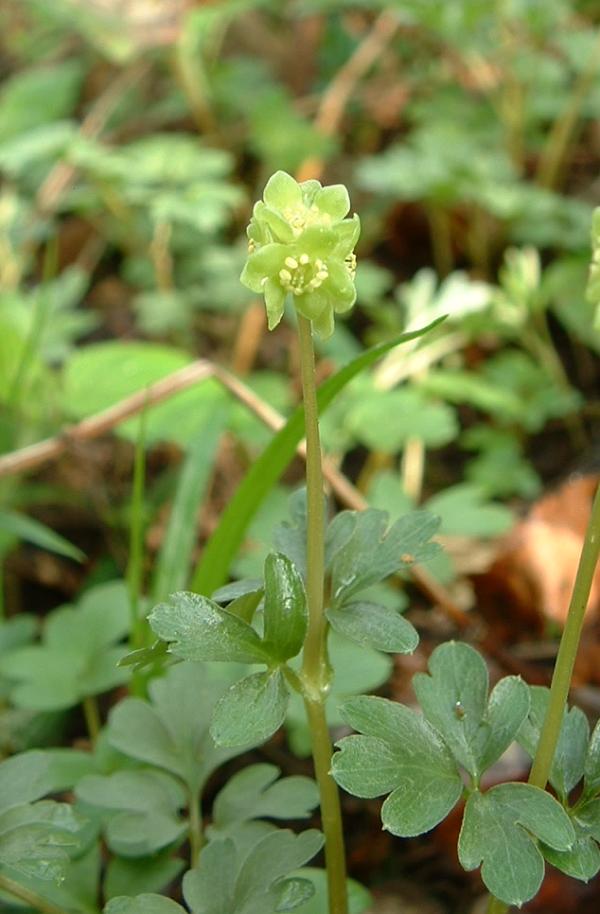
Adoxa moschatellina grows in woodland, scrub, stream edges and shaded open habitats across Europe, Asia and North America, extending into Morocco. It is distinguished by an inflorescence of five green flowers arranged in a cube, with four flowers on the sides and one on top.
Written 26 November 2026 from the sources listed below. Each statement was checked against the passage it cites; statements that could not be supported were removed.
Appearance
Moschatel has pale green foliage and a delicate appearance. The plant is entirely hairless.[1][2]
Its basal leaves are dull green on the upper surface and silvery and succulent underneath. They are divided into three lobes or twice divided into three lobes, while the stem leaves have two or three lobes.[3][4][5]
Its inflorescence consists of five green flowers arranged in a cube, with four flowers occupying the sides and the fifth occupying the top. The flowers have a faint musk-like scent.[6][7][8]
The fruits are relatively dry drupes partly enclosed by the expanded fleshy calyx.[9]
The plant typically grows to approximately 10–15 cm tall. Its basal leaves can reach 5 cm in length, its stem leaf blades can reach 3 cm, and its flower cluster is approximately 0.5 cm in diameter.[10][11][12][13]
Its fruits measure approximately 4.5–5.55 mm in diameter.[14]
Habitat
Moschatel grows in woodland and scrub, particularly in fairly lightly shaded locations. It also occurs in relatively sunny locations in old woodland, including stream edges, and in shaded open habitats such as rock crevices in limestone pavements.[15][16][17]
It occurs in deciduous woods beneath ash, pedunculate oak, sessile oak, hornbeam and beech trees. It also grows in elder scrub along riverbanks and juniper scrub in the Scottish Highlands and Snowdonia.[18][19][20]
In Wisconsin, moschatel occurs on moist shaded ledges and bare soil at cliff bases.[21]
Behaviour
Moschatel spreads vegetatively through its long stolons and has limited capacity to spread through seed dispersal. It flowers in spring and dies back after flowering in May or June.[22][23][24]
Its flowers are pollinated by flies and nocturnal moths.[25]
Reproduction and life cycle
Moschatel reproduces mainly vegetatively through stolons and rhizomes. It has swollen, fleshy rhizomes and long, slender stolons.[26][27]
In England, fruits develop between April and May. Each flower can produce between two and five fruits.[28][29]
The fruiting peduncle expands and spirals to deposit fruits near the parent plant.[30]
Conservation
Moschatel is generally not considered threatened within its natural range. It is classified as secure in the United States but threatened in Wisconsin, and is reported as endangered in several areas.[31][32][33][34]
The species has not been assessed internationally by the IUCN.[35]
Classification of the Moschatel
| Kingdom | Plantae |
|---|---|
| Subkingdom | Pteridobiotina |
| Phylum | Tracheophyta |
| Class | Magnoliopsida |
| Order | Dipsacales |
| Family | Viburnaceae (Elder Family) |
| Subfamily | Adoxoideae |
| Tribe | Adoxeae |
| Genus | Adoxa (Moschatel) |
| Species | Adoxa moschatellina L. |
Where the Moschatel is found
Checklists and occurrence records place Adoxa moschatellina in 51 countries across Africa, Asia, Europe and North America. GBIF holds 206,131 georeferenced records of it.
Countries where it is native or its origin is not stated
- Aland Islands 84
- Albania 4
- Austria 2,863
- Azerbaijan
- Belarus 113
- Belgium 32,349
- Bosnia and Herzegovina 9
- Bulgaria 9
- Canada 373
- China 271
- Croatia 30
- Czechia 1,176
- Denmark 1,621
- Estonia 641
- Finland 1,375
- France 39,318
- Georgia 2
- Germany 16,157
- Greece 2
- Hungary 82
- India 18
- Italy 359
- Japan 760
- Kazakhstan 27
- Kosovo
- Kyrgyzstan 5
- Latvia 43
- Liechtenstein 10
- Lithuania 150
- Luxembourg 1,005
- Moldova 3
- Mongolia 30
- Montenegro 6
- North Korea 8
- Norway 2,237
- Poland 5,283
- Romania 35
- Russia 4,731
- Serbia 5
- Slovakia 331
- Slovenia 102
- South Korea 609
- Spain 5
- Sweden 10,199
- Switzerland 5,256
- The Netherlands 12,407
- Ukraine 766
- United Kingdom 64,104
- United States 1,157
Countries where it has been introduced
Regions and cities with the most records
- England, United Kingdom 50,405
- Auvergne-Rhône-Alpes, France 9,455
- Kessel-Lo, Belgium 8,861
- Blauwput, Belgium 8,706
- Leuven, Belgium 8,680
- Heverlee, Belgium 8,617
- Herent, Belgium 8,522
- Maastricht, The Netherlands 7,902
- Hauts-de-France, France 7,732
- Kortenberg, Belgium 7,655
- Zaventem, Belgium 7,599
- Rotselaar, Belgium 7,512
- Scotland, United Kingdom 7,492
- Evere, Belgium 7,330
- Woluwe-Saint-Lambert, Belgium 7,279
- Haaltert, Belgium 7,121
- Herzele, Belgium 7,104
- Denderleeuw, Belgium 7,038
- Schaerbeek, Belgium 7,030
- Ninove, Belgium 6,938
- Saint-Josse-ten-Noode, Belgium 6,938
- Hoensbroek, The Netherlands 6,844
- Aalst, Belgium 6,838
- Etterbeek, Belgium 6,837
- Ixelles, Belgium 6,810
- Auderghem, Belgium 6,697
- Aarschot, Belgium 6,651
- Bavaria, Germany 6,580
- Zottegem, Belgium 6,489
- Riemst, Belgium 6,441
- Lanaken, Belgium 6,427
- Watermael-Boitsfort, Belgium 6,400
- Tervuren, Belgium 6,354
- Brussels, Belgium 6,348
- Visé, Belgium 6,230
- Asse, Belgium 6,178
A number beside a place is its count of GBIF occurrence records. A place without a number comes from a checklist alone. Records show where a species has been observed or collected, which can include escapes and vagrants.
Common names
English
- Moschatel
- Town-Hall Clock
- Five-faced Bishop
- Muskroot
- Townhall Clock
- Townhall-clock
Names in 27 other languages
- Chinese
- 五福花
- Danish
- Desmerurt
- Dutch
- Muskuskruid
- Estonian
- muskuslill
- Finnish
- tesmayrtti
- French
- Adoxe moscatelline, Muscatelle, adoxa, adoxe muscatelle, adoxe musquée, herbe musquée, moscatelline, moschatelline
- German
- Bisamkraut, Europäisches Moschuskraut, Moschuskraut
- Hungarian
- európai pézsmaboglár
- Irish
- Moscadal
- Italian
- Moscatella
- Japanese
- レンプクソウ
- Kazakh
- Мүскүс адокса
- Korean
- 연복초
- Lithuanian
- Muskusinis ūksminas
- Macedonian
- Пиженце
- Mongolian
- Задьлаг ларзит
- Northern Sami
- deasmeurttas
- Norwegian Bokmål
- moskusurt
- Polish
- Piżmaczek wiosenny
- Russian
- Адокса мускусная
- Slovak
- pižmovka mošusová
- Slovenian
- navadna pižmica
- Spanish
- hierba del almizcle, moscatelina
- Swedish
- Desmansknopp, Myskört, desmeknopp
- Ukrainian
- Пижмівка звичайна
- Welsh
- Anfri, Cloc Neuadd y Dref, Diaddurn, Mwglys, Mwsglys, Mwsglys y Ddaear, Mysglys
- tat
- Гамбәр чәчәге
Synonyms
2 other scientific names have been used for this species and are now treated as synonyms of Adoxa moschatellina.
- Adoxa moschatella Linnaeus, 1754
- Adoxa moschatellina var. moschatellina
Subspecies and varieties
- Adoxa moschatellina subsp. cescae subspecies
- Adoxa moschatellina subsp. moschatellina subspecies
Related species
-
 European Cranberry BushViburnum opulus
-
 ElderSambucus nigra
-
 LaurustinusViburnum tinus
-
 American ElderberrySambucus canadensis
-
 Sweet ViburnumViburnum odoratissimum
-
 Red ElderberrySambucus racemosa
-
 Wayfaring TreeViburnum lantana
-
 Maple-leaved ArrowwoodViburnum acerifolium
Compare
Questions and answers
What is the scientific name of the Moschatel?
The scientific name of the Moschatel is Adoxa moschatellina. Written with its author, the full name is Adoxa moschatellina L..
Which family does the Moschatel belong to?
Adoxa moschatellina belongs to the family Viburnaceae, in the order Dipsacales and the class Magnoliopsida.
Where is the Moschatel found?
Checklists and occurrence records place Adoxa moschatellina in 51 countries, including United Kingdom, France, Belgium, Germany, The Netherlands and Sweden.
What other names does the Moschatel have?
Adoxa moschatellina is also known in English as Town-Hall Clock, Five-faced Bishop, Muskroot, Townhall Clock and Townhall-clock.
Where is moschatel distributed?
Moschatel has a boreal, circumpolar distribution across Europe, Asia and North America, extending into Morocco. It is widely distributed in northern regions.[36][37]
Where does moschatel occur in Britain and Ireland?
It is widespread across most parts of Britain but is not common. It is scarce in northern and western Britain where soils are too acidic, and absent from Ireland except at a few locations where it was probably introduced.[38][39][40]
How does moschatel spread?
It spreads mainly vegetatively through stolons and rhizomes, with limited capacity for seed dispersal.[22][23][26][27]
When does moschatel flower and fruit?
It flowers in spring and dies back after flowering in May or June. In England, its fruits develop between April and May.[24][28]
How are moschatel flowers pollinated?
Its flowers are pollinated by flies and nocturnal moths.[25]
What is the chromosome number of moschatel?
Its chromosome number is 2n = 36.[41]
Does moschatel hybridise with other species?
Moschatel is not known to hybridise with other species.[42]
Sources
Passages the profile rests on
- The plant has pale green foliage and a delicate appearance. Source passage: “with pale green foliage and a delicate appearance.” — English Wikipedia
- The plant is entirely hairless. Source passage: “The whole plant is entirely glabrous (hairless).” — English Wikipedia
- Its basal leaves are dull green on the upper surface and silvery and succulent underneath. Source passage: “The basal leaves are a dull green above, silvery and succulent below” — English Wikipedia
- Its basal leaves are divided into three lobes or twice divided into three lobes. Source passage: “The basal leaves are ternate (i.e. divided into 3 lobes) or twice ternate” — English Wikipedia
- Its stem leaves have two or three lobes. Source passage: “the stem leaves have 2 or 3 lobes” — English Wikipedia
- Its inflorescence consists of five green flowers arranged in a cube. Source passage: “It consists of a cubical cluster of 5 green flowers” — English Wikipedia
- Four flowers occupy the sides of the inflorescence cube and the fifth occupies its top. Source passage: “with four 5-petalled flowers on the sides of the cube and one 4-petalled flower at the top.” — English Wikipedia
- The flowers have a faint musk-like scent. Source passage: “They are said to smell faintly of musk” — English Wikipedia
- The fruits are relatively dry drupes that are partly enclosed by the expanded fleshy calyx. Source passage: “which are rather dry drupes, 4.5–5.55 mm in diameter, partially encased by the expanded, fleshy calyx.” — English Wikipedia
- The plant typically grows to approximately 10–15 cm tall. Source passage: “about 10–15 cm (4–6 in) tall” — English Wikipedia
- Its basal leaves can reach 5 cm in length. Source passage: “and up to 5 cm (2 in) long” — English Wikipedia
- Its stem leaf blades can reach 3 cm in length. Source passage: “with blades up to 3 cm (1.2 in) long.” — English Wikipedia
- The flower cluster is approximately 0.5 cm in diameter. Source passage: “about 0.5 cm in diameter” — English Wikipedia
- Its fruits measure approximately 4.5–5.55 mm in diameter. Source passage: “4.5–5.55 mm in diameter” — English Wikipedia
- The species grows in relatively sunny locations in old woodland, including stream edges. Source passage: “in relatively sunny places in old woodland, such as the edges of streams” — English Wikipedia
- The species also occupies shaded open habitats such as rock crevices in limestone pavements. Source passage: “in shady places in open habitats such as rock crevices in limestone pavements.” — English Wikipedia
- The species grows in woodland and scrub, particularly in fairly lightly shaded locations. Source passage: “Moschatel grows in woodland and scrub, typically in places with fairly light shade” — English Wikipedia
- The species occurs in deciduous woods beneath ash, pedunculate oak, sessile oak, hornbeam, and beech trees. Source passage: “It is found in deciduous woods under ash, pedunculate oak, sessile oak, hornbeam or beech trees” — English Wikipedia
- The species occurs in elder scrub along riverbanks. Source passage: “It is also recorded in elder scrub (W6d) along riverbanks.” — English Wikipedia
- The species occurs in juniper scrub in the Scottish Highlands and Snowdonia. Source passage: “In the Scottish Highlands and Snowdonia, it occurs in juniper scrub (W19)” — English Wikipedia
- In Wisconsin, the species occurs on moist shaded ledges and bare soil at cliff bases. Source passage: “is found on moist shaded ledges and bare soil at cliff bases” — apps.dnr.wi.gov
- The species spreads vegetatively through its long stolons. Source passage: “expands vegetatively via its long stolons.” — English Wikipedia
- The species has limited capacity to spread through seed dispersal. Source passage: “It has a limited ability to spread by seed” — English Wikipedia
- The species flowers in spring and dies back after flowering in May or June. Source passage: “It is a spring-flowering species which dies back after flowering in May or June.” — English Wikipedia
- Its flowers are pollinated by flies and nocturnal moths. Source passage: “The rather plain flowers are pollinated by flies and nocturnal moths” — English Wikipedia
- The species reproduces mainly vegetatively through stolons and rhizomes. Source passage: “Fruiting is uncommon, as reproduction is mainly vegetative, through the stolons and rhizomes.” — English Wikipedia
- The species has swollen, fleshy rhizomes and long, slender stolons. Source passage: “It has swollen, fleshy rhizomes as well as long, slender stolons.” — English Wikipedia
- Fruits develop between April and May in England. Source passage: “Fruits are formed in April to May in England.” — English Wikipedia
- Each flower can produce between two and five fruits. Source passage: “Each flower can develop 2–5 fruits” — English Wikipedia
- The fruiting peduncle expands and spirals to deposit fruits near the parent plant. Source passage: “the peduncle expands and spirals, bending towards to ground to deposit the fruits close to the parent plant.” — English Wikipedia
- The species is generally not considered threatened within its natural range. Source passage: “is not considered to be threatened within its natural range.” — English Wikipedia
- The species is classified as secure in the United States. Source passage: “in the United States it is classified as "secure"” — English Wikipedia
- The species is classified as threatened in Wisconsin. Source passage: “Muskroot (Adoxa moschatellina), a Wisconsin Threatened plant” — apps.dnr.wi.gov
- The species is reported as endangered in several areas. Source passage: “though it is endangered in several areas.” — britannica.com
- The species has not been assessed internationally by the IUCN. Source passage: “while it has not been assessed internationally by the IUCN” — English Wikipedia
- The species has a boreal, circumpolar distribution across Europe, Asia, and North America, extending into Morocco. Source passage: “has a boreal, circumpolar distribution in Europe, Asia and North America, and just extending into Morocco in North Africa.” — English Wikipedia
- The species is widely distributed in northern regions. Source passage: “Muskroot (Adoxa moschatellina) is widely distributed in northern regions” — britannica.com
- The species is widespread across most parts of Britain but is not common. Source passage: “It is widespread in most parts of Britain but not common” — English Wikipedia
- The species is scarce in northern and western Britain where soils are too acidic for it. Source passage: “It becomes scarce in the north and west, where the soils are too acid for it” — English Wikipedia
- The species is absent from Ireland except at a few locations where it was probably introduced. Source passage: “It is absent from Ireland except in a couple of places where it was probably introduced, deliberately or accidentally.” — English Wikipedia
- The species has a chromosome number of 2n = 36. Source passage: “Its chromosome number is 2n = 36.” — English Wikipedia
- The species is not known to hybridise with other species. Source passage: “It is not known to hybridise with any other species.” — English Wikipedia
- The genus name Adoxa combines a Greek word meaning glory or splendour with a Latin prefix meaning without. Source passage: “The word "Adoxa" comes from the Ancient Greek δόξᾰ (doxa), meaning glory or splendour, and the Latin prefix a-, which means "not" or "without"” — English Wikipedia
- The specific epithet moschatellina derives from the Latin word for musk and refers to the scent of the flowers. Source passage: “The specific epithet moschatellina and the common name moschatel come from the Latin word for musk” — English Wikipedia
Data
- Catalogue of Life, 2026-10-16 XR cc by
- Global Biodiversity Information Facility CC BY 4.0
- Wikidata CC0
- GeoNames CC BY 4.0
- Wikimedia Commons per image; credit shown with each image
- Within the Catalogue of Life, this name comes from Synonymic Checklists of the Vascular Plants of the World cc by
References
- L. where the name was published
This species in other databases
Page built on 29 November 2026. See how the catalog is made and all sources and licences.
Cite this page
ScientificNames.org. (2026). Adoxa moschatellina (Moschatel). Retrieved November 29, 2026, from https://scientificnames.org/species/adoxa-moschatellina
“Adoxa moschatellina (Moschatel).” ScientificNames.org, 2026, scientificnames.org/species/adoxa-moschatellina. Accessed 29 Nov. 2026.
ScientificNames.org. “Adoxa moschatellina (Moschatel).” Accessed November 29, 2026. https://scientificnames.org/species/adoxa-moschatellina.
@misc{scientificnames_adoxa_moschatellina_moschatel,
  author = {{ScientificNames.org}},
  title = {Adoxa moschatellina (Moschatel)},
  year = {2026},
  url = {https://scientificnames.org/species/adoxa-moschatellina},
  note = {Accessed 2026-11-29}
}