Species · Flowering plants
Elder Sambucus nigra
The scientific name of the Elder is Sambucus nigra. It is a species of flowering plant in the family Viburnaceae (elder family), order Dipsacales.
- Scientific name
- Sambucus nigra L.
- Common name
- Elder
- Genus
- Sambucus
- Family
- Viburnaceae (Elder Family)
- Order
- Dipsacales
- Class
- Magnoliopsida
- Red List category
- LC Least Concern
- Recorded in
- 78 countries
- Name status
- accepted in the Catalogue of Life

Overview
Elder is a deciduous shrub or small tree. It is native to Europe as far east as Turkey and is native to and common throughout the British Isles. It produces ivory-white flowers in large, flat clusters and glossy, dark purple to black fruits.
Written 26 November 2026 from the sources listed below. Each statement was checked against the passage it cites; statements that could not be supported were removed.
Appearance
Elder is a deciduous shrub or small tree that commonly reaches 6–10 metres in height. Exceptional individuals can reach 15 metres, and plants generally take 10–20 years to reach maturity.[1][2][3][4]
Young stems are hollow. The leaves grow in opposite pairs and are pinnately compound, usually bearing five to seven leaflets with serrated margins.[5][6][7]
The hermaphroditic flowers have five stamens and are ivory white, measuring approximately 5.5–7.5 millimetres in diameter. They grow in large, flat clusters measuring 8–24 centimetres across.[8][9][10]
The fruit is a glossy, dark purple to black drupe containing three to five seeds.[11][12]
Elder typically lives for up to 60 years. Exceptional individuals can live for more than 200 years.[13][14]
Habitat
Elder grows in woodland, grassland, hedgerows, scrub, river banks, roadsides, railway banks and waste ground. It also commonly grows in open fields and woodland edges.[15][16]
The species is generally associated with open or disturbed, nutrient-rich habitats. It favours disturbed soils rich in base minerals and nitrogen.[17][18]
Elder is not tolerant of drought and avoids saline soils.[19]
Diet
The ripe fruit is an important food source for numerous bird species. At least 22 bird species have been observed eating the fruit.[20][21]
Behaviour
Elder flowers produce a strong scent that attracts pollinating flies, beetles and bees.[22]
Reproduction and life cycle
Elder produces flowers from late spring to mid-summer, including May, June and July. The fruit develops in drooping clusters in late autumn.[23][24]
Seed maturation generally occurs in October and is influenced by mean temperatures. Seeds cannot mature when the mean temperature is below 7.2 degrees Celsius, while maturation is possible at mean temperatures up to 15 degrees Celsius.[25][26][27]
Conservation
Elder contains the potentially toxic cyanogenic glycoside sambunigrin. All green parts of the plant contain cyanogenic glycosides.[28][29]
Elderberry also contains potentially toxic cyanogenic glycosides.[30]
Uses
Elder is widely cultivated as an ornamental shrub or small tree. It is also cultivated commercially for its flowers and fruit.[31][32]
The flowers and berries have traditionally been used to make cordial and wine. The berries can also be processed into jam and jelly, while the flowers are commonly used to prepare infusions in Northern Europe and the Balkans.[33][34][35]
Elderberry raw materials are used primarily in the food and pharmaceutical industries.[36]
Commercial plantations commonly propagate elder using hardwood cuttings from one-year-old shoots.[37]
Classification of the Elder
| Kingdom | Plantae |
|---|---|
| Subkingdom | Pteridobiotina |
| Phylum | Tracheophyta |
| Class | Magnoliopsida |
| Order | Dipsacales |
| Family | Viburnaceae (Elder Family) |
| Subfamily | Adoxoideae |
| Tribe | Sambuceae |
| Genus | Sambucus (Elder) |
| Species | Sambucus nigra L. |
Where the Elder is found
Checklists and occurrence records place Sambucus nigra in 78 countries across Africa, Asia, Europe, North America, Oceania and South America. GBIF holds 1,163,069 georeferenced records of it.
Countries where it is native or its origin is not stated
- Aland Islands 6
- Albania 25
- Andorra 34
- Armenia 32
- Austria 31,695
- Azerbaijan 10
- Belarus 365
- Belgium 50,563
- Bosnia and Herzegovina 60
- Brazil 414
- Bulgaria 90
- Colombia 1,385
- Croatia 504
- Cyprus 5
- Czechia 9,175
- Denmark 43,394
- France 247,113
- Georgia 37
- Germany 140,998
- Guernsey 32
- Hungary 793
- Iceland 5
- India 19
- Iran 5
- Iraq
- Ireland 3,284
- Isle of Man 2,049
- Israel 28
- Italy 6,781
- Japan 4
- Jersey 22
- Kazakhstan 38
- Kosovo 8
- Kyrgyzstan 6
- Latvia 42
- Lebanon
- Liechtenstein 63
- Lithuania 253
- Luxembourg 4,878
- Malta
- Moldova 29
- Montenegro 15
- North Macedonia 16
- Poland 18,264
- Romania 365
- Russia 3,620
- San Marino 1
- Serbia 171
- Slovakia 6,587
- Slovenia 428
- Spain 11,332
- Switzerland 22,510
- Syria
- The Netherlands 117,340
- Turkey 92
- Ukraine 5,294
- United Kingdom 406,731
Countries where it has been introduced
- Algeria 7
- Argentina 50
- Australia 544
- Bangladesh
- Bolivia 19
- Canada 47
- Chile 51
- China 14
- Ecuador 171
- Estonia 262
- Finland 75
- Greece 194
- Morocco 29
- New Zealand 2,542
- Norway 2,597
- Pakistan 3
- Portugal 3,322
- Sweden 15,468
- Tunisia 1
- United States 656
- Uzbekistan 7
Regions and cities with the most records
- England, United Kingdom 338,280
- Bavaria, Germany 98,879
- Auvergne-Rhône-Alpes, France 45,029
- Scotland, United Kingdom 37,291
- Île-de-France, France 34,882
- Hauts-de-France, France 31,028
- Gelderland, The Netherlands 25,242
- Centre-Val de Loire, France 24,913
- Bourgogne-Franche-Comté, France 23,343
- Grand Est, France 21,443
- Upper Austria, Austria 21,065
- Wales, United Kingdom 16,631
- Kingswood, United Kingdom 15,071
- Keynsham, United Kingdom 14,929
- Bristol, United Kingdom 13,569
- Mangotsfield, United Kingdom 13,184
- Bath, United Kingdom 12,715
- Occitanie, France 11,900
- South Denmark, Denmark 11,729
- Central Jutland, Denmark 11,557
- Halewood, United Kingdom 11,409
- Prescot, United Kingdom 11,319
- Allerton, United Kingdom 11,271
- Huyton, United Kingdom 11,217
- Speke, United Kingdom 11,213
- Runcorn, United Kingdom 11,135
- Old Swan, United Kingdom 11,114
- Widnes, United Kingdom 11,068
- Yate, United Kingdom 10,954
- St Helens, United Kingdom 10,872
- Maastricht, The Netherlands 10,827
- Garston, United Kingdom 10,802
- Kirkby, United Kingdom 10,787
- Fazakerley, United Kingdom 10,696
- Haydock, United Kingdom 10,399
- Hoensbroek, The Netherlands 10,238
13 more countries have a few records outside this range
These countries hold a few records of Sambucus nigra but lie outside the range the checklists give for it. Such records are often zoo or garden specimens, museum material or vagrants, so the species is not counted as occurring there.
Range as the checklists state it
England (England, Wales, Isle of Man, Scotland, Outer Hebrides, +Orkney Isl., +Shetland Isl., Isles of Scilly, +St. Kilda Isl.); Ireland (Ireland, Northern Ireland); Denmark; Norway [I]; Sweden [I]; Finland [I]; Netherlands; Belgium; Luxembourg; Germany (Brandenburg, Berlin, Baden-Württemberg, Bayern, Hessen, Hamburg, Mecklenburg-Vorpommern, Niedersachsen, Nordrhein-Westfalen, Rheinland-Pfalz, Schleswig-Holstein, Saarland, Sachsen, Sachsen-Anhalt, Thüringen); Switzerland; Liechtenstein; Austria; Poland; Czech Republic; Slovakia; Hungary; Portugal; Spain; Andorra; France; Channel Isl. (Alderney, Guernsey, Jersey, Sark); Corsica; Sardinia; Italy; Sicily; Malta; San Marino; Slovenia; Croatia; Bosnia & Hercegovina; Montenegro; Serbia; Kosovo; North Macedonia; Albania; Romania; Bulgaria; European Turkey; Greece (widespread mainland, Kerkyra, Ionian Isl., Thasos, Samothraki, Limnos, rare Kiklades); Crete [I]; Estonia [I]; Belarus; C-European Russia; E-European Russia; Ukraine; Crimea; Morocco [I]; Algeria [I]; Tunisia [I]; Azores (Sao Miguel Isl., Terceira, Graciosa, Sao Jorge, Pico, Faial, Flores Isl., Corvo Isl.); Madeira [I] (Madeira Isl. [I]); Uzbekistan [I]; Northern Caucasus; Georgia [Caucasus]; Armenia; Azerbaijan; East Aegaean Isl. (Lesvos, Chios, Ikaria, Samos, Kos, Nisyros, Simi, Rhodos); Turkey (E-Anatolia, N-Anatolia, NE-Anatolia, NW-Anatolia: Bithynia, W-Anatolia); Iraq (NE-Iraq); Iran (W-Iran); Lebanon (C-Lebanon); Syria (NW-Syria); Israel (N-Israel); China [I] (Jiangsu [I], Shandong [I], Shanghai [I]); Pakistan [I]; Bangladesh [I]; Australia [I] (South Australia [I], New South Wales [I], Victoria [I]); New Zealand [I]; Chatham Isl. [I]; Canada [I] (Ontario [I]); USA [I] (Connecticut [I], Pennsylvania [I], Virginia [I]); Ecuador [I]; Bolivia [I]; Argentina [I]; Chile [I] (Maule [I], Ñuble [I], Biobío [I], Araucanía [I], Los Rios [I], Los Lagos [I], Magallanes [I])
A number beside a place is its count of GBIF occurrence records. A place without a number comes from a checklist alone. Records show where a species has been observed or collected, which can include escapes and vagrants.
Common names
English
- Elder
- Elderberry
- European Elderberry
- Europen Elder
- Black Elderberry
Names in 9 other languages
- Danish
- Almindelig hyld
- Dutch
- Gewone vlier
- Finnish
- mustaselja
- French
- grand sureau, sureau noir
- German
- Schwarzer Holunder
- Norwegian Bokmål
- svarthyll
- Scottish Gaelic
- dromain, droman, ruis
- Swedish
- fläder, hyll, vanlig fläder, äkta fläder
- Welsh
- Dagrau Lesu, Pren Ysgaw, Pren Ysgo, Ysgaw, Ysgawen, Ysgawen Gyffredin, Ysgawlwyn Cyffredin
Synonyms
70 other scientific names have been used for this species and are now treated as synonyms of Sambucus nigra.
- Sambucus alba Raf.
- Sambucus aurea (Sweet) Carrière
- Sambucus columnaris Lebas
- Sambucus dissecta K.Koch
- Sambucus elegans K.Koch
- Sambucus floribunda K.Koch
- Sambucus florida Salisb.
- Sambucus hirta Tausch
- Sambucus leucocarpa K.Koch
- Sambucus linearis K.Koch
- Sambucus lucida Tausch
- Sambucus medullosa Gilib.
- Sambucus monstrosa Loudon
- Sambucus nigra f. alba (Weston) Rehder
- Sambucus nigra f. albomarmorata Geerinck
- Sambucus nigra f. albovariegata (Weston) Schwer.
- Sambucus nigra f. aurea (Sweet) Schwer.
- Sambucus nigra f. chlorocarpa (Hayne) Geerinck
- Sambucus nigra f. dissecta K.Koch
- Sambucus nigra f. heterophylla (Pépin) Schwer.
- Sambucus nigra f. leucocarpa Vollm.
- Sambucus nigra f. linearis (G.Kirchn.) C.K.Schneid.
- Sambucus nigra f. luteomarmorata Geerinck
- Sambucus nigra f. luteovariegata (Weston) Schwer.
- Sambucus nigra f. nigra
- Sambucus nigra f. pendula Dippel
- Sambucus nigra f. porphyrophylla E.C.Nelson
- Sambucus nigra f. pyramidalis (H.Jaeger) Dippel
- Sambucus nigra f. pyramidata (Lebas) Schwer.
- Sambucus nigra f. rotundifolia (DC.) Dippel
- Sambucus nigra f. virescens (Desf.) Vollm.
- Sambucus nigra f. viridis (Weston) Schwer.
- Sambucus nigra subsp. nigra
- Sambucus nigra subsp. vulgaris Ehrh.
- Sambucus nigra var. alba Weston
- Sambucus nigra var. albida Sweet
- Sambucus nigra var. albovariegata Weston
- Sambucus nigra var. albovariegata Nordh.
- Sambucus nigra var. aurea Sweet
- Sambucus nigra var. aureovariegata Rehder
Showing 40 of 70.
Subspecies and varieties
- Sambucus nigra var. laciniata (Cut-Leaved Elder) variety
Related species
-
 American ElderberrySambucus canadensis
-
 Red ElderberrySambucus racemosa
-
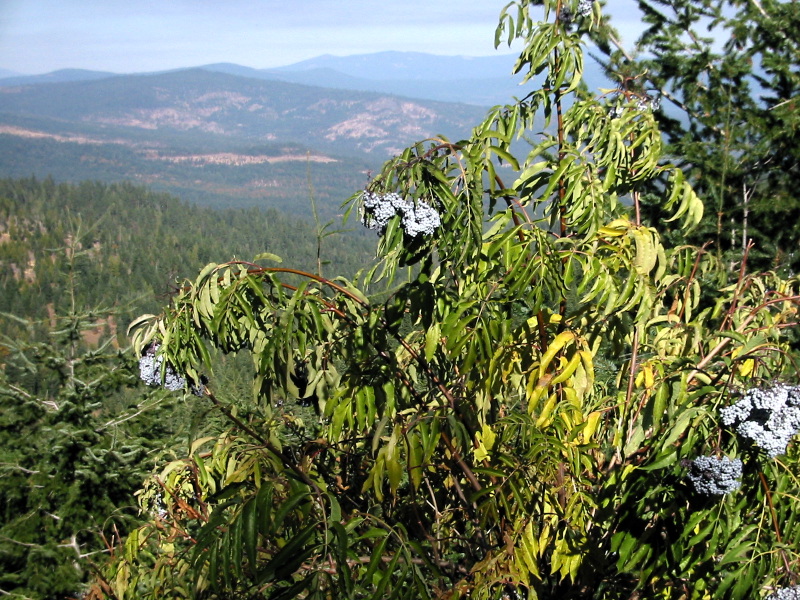 Blue ElderberrySambucus cerulea
-
 Dwarf ElderSambucus ebulus
-
 Blue ElderberrySambucus mexicana
-
 Chinese ElderSambucus javanica
-
 Native ElderSambucus australasica
-
 White ElderberrySambucus gaudichaudiana
Compare
Questions and answers
What is the scientific name of the Elder?
The scientific name of the Elder is Sambucus nigra. Written with its author, the full name is Sambucus nigra L..
Which family does the Elder belong to?
Sambucus nigra belongs to the family Viburnaceae, in the order Dipsacales and the class Magnoliopsida.
Where is the Elder found?
Checklists and occurrence records place Sambucus nigra in 78 countries, including United Kingdom, France, Germany, The Netherlands, Belgium and Denmark.
What is the conservation status of the Elder?
The IUCN Red List category recorded for Sambucus nigra is Least Concern (LC).
What other names does the Elder have?
Sambucus nigra is also known in English as Elderberry, European Elderberry, Europen Elder and Black Elderberry.
Sources
Passages the profile rests on
- Sambucus nigra is a deciduous shrub or small tree. Source passage: “Common elder is a deciduous shrub or small tree often growing to 6–10 metres (20–33 ft) tall” — English Wikipedia
- The species commonly reaches a height of 6–10 metres. Source passage: “often growing to 6–10 metres (20–33 ft) tall” — English Wikipedia
- Exceptional individuals can reach 15 metres in height. Source passage: “exceptionally, trees can reach 15 m (49 ft) tall.” — English Wikipedia
- Plants generally take 10–20 years to reach maturity. Source passage: “taking 10-20 years to reach maturity” — English Wikipedia
- Young stems of the species are hollow. Source passage: “The young stems are hollow.” — English Wikipedia
- The leaves grow in opposite pairs and are pinnately compound, usually bearing five to seven leaflets. Source passage: “The leaves are arranged in opposite pairs, 10–30 cm (4–12 in) long, pinnate with five to seven (rarely nine) leaflets” — English Wikipedia
- The leaflets have serrated margins. Source passage: “with a serrated margin.” — English Wikipedia
- The flowers are hermaphroditic and have five stamens. Source passage: “The hermaphroditic flowers have five stamens” — English Wikipedia
- The flowers are ivory white and measure approximately 5.5–7.5 millimetres in diameter. Source passage: “The individual flowers are ivory white, 5.5–7.5 millimetres (0.22–0.30 in) in diameter” — English Wikipedia
- The flowers are arranged in large, flat clusters measuring 8–24 centimetres across. Source passage: “large, flat corymbs 8–24 cm in diameter” — English Wikipedia
- The fruit is a glossy, dark purple to black drupe. Source passage: “The fruit is a glossy, dark purple to black drupe 5–6 mm diameter” — English Wikipedia
- Each fruit contains three to five seeds. Source passage: “containing 3-5 seeds” — English Wikipedia
- The species typically lives for up to 60 years. Source passage: “They typically live for up to 60 years” — English Wikipedia
- Exceptional individuals can live for more than 200 years. Source passage: “but can exceptionally reach over 200 years.” — English Wikipedia
- The species grows in woodland, grassland, hedgerows, scrub, river banks, roadsides, railway banks and waste ground. Source passage: “including woodland, grassland, hedgerows, scrub, river banks, roadsides, railway banks and waste ground.” — English Wikipedia
- The species commonly grows in open fields and woodland edges. Source passage: “Sambucus nigra L. usually grows in open fields or at woodland edges.” — pmc.ncbi.nlm.nih.gov
- The species is generally associated with open or disturbed, nutrient-rich habitats. Source passage: “It is generally associated with open or disturbed, nutrient-rich sites” — English Wikipedia
- The species favours disturbed soils rich in base minerals and nitrogen. Source passage: “Black elderberry favours disturbed, base-rich and nitrogen-rich soils” — pmc.ncbi.nlm.nih.gov
- The species is not tolerant of drought and avoids saline soils. Source passage: “it is not tolerant of drought and avoids saline soils.” — English Wikipedia
- The ripe fruit is an important food source for numerous bird species. Source passage: “The soft, very juicy fruit are an important food for many birds” — English Wikipedia
- At least 22 bird species have been observed eating the fruit. Source passage: “A total of 22 species were observed eating elderberries” — English Wikipedia
- The flowers produce a strong scent that attracts pollinating flies, beetles and bees. Source passage: “produce a strong scent which attracts pollinating flies, beetles, and bees.” — English Wikipedia
- The species produces flowers from late spring to mid-summer, including May, June and July. Source passage: “in late spring to mid-summer (late May, June, July).” — English Wikipedia
- The fruit develops in drooping clusters in late autumn. Source passage: “produced in drooping clusters in late autumn.” — English Wikipedia
- Seed maturation generally occurs in October and is influenced by mean temperatures. Source passage: “Seed maturation in October is determined by mean temperatures.” — pmc.ncbi.nlm.nih.gov
- Seeds cannot mature when the mean temperature is below 7.2 degrees Celsius. Source passage: “Below 7.2 °C seeds are unable to mature” — pmc.ncbi.nlm.nih.gov
- Seed maturation is possible at mean temperatures up to 15 degrees Celsius. Source passage: “the maximum mean temperature in which seed maturation is possible is 15 °C” — pmc.ncbi.nlm.nih.gov
- The plant contains the potentially toxic cyanogenic glycoside sambunigrin. Source passage: “containing the cyanogenic glycoside sambunigrin” — English Wikipedia
- All green parts of the plant contain cyanogenic glycosides. Source passage: “All green parts of the plant contain cyanogenic glycosides.” — English Wikipedia
- Elderberry contains cyanogenic glycosides that are potentially toxic. Source passage: “Elderberry also contains cyanogenic glycosides which are potentially toxic.” — pmc.ncbi.nlm.nih.gov
- The species is widely cultivated as an ornamental shrub or small tree. Source passage: “The plant is widely grown as an ornamental shrub or small tree.” — English Wikipedia
- The species is cultivated commercially for its flowers and fruit. Source passage: “The species is also cultivated commercially for flowers and fruit.” — English Wikipedia
- The flowers and berries have traditionally been used to make cordial and wine. Source passage: “Both the flowers and the berries have a long tradition of culinary use, primarily for cordial and wine.” — English Wikipedia
- The berries can be processed into jam, jelly and wine. Source passage: “They can also be used to make jam, jelly, and wine.” — English Wikipedia
- The flowers are commonly used to prepare infusions in Northern Europe and the Balkans. Source passage: “Commonly, the flowerheads are used in infusions, giving a drink in Northern Europe and the Balkans.” — English Wikipedia
- Elderberry raw materials are used primarily in the food and pharmaceutical industries. Source passage: “elderberry is used primarily in food and pharmaceutical industry.” — pmc.ncbi.nlm.nih.gov
- Commercial plantations commonly propagate the species using hardwood cuttings from one-year-old shoots. Source passage: “Plants for commercial plantations are usually propagated from own-rooted hardwood cuttings taken from one-year-old shoots.” — English Wikipedia
Data
- Catalogue of Life, 2026-10-16 XR cc by
- Global Biodiversity Information Facility CC BY 4.0
- Wikidata CC0
- GeoNames CC BY 4.0
- Wikimedia Commons per image; credit shown with each image
- Within the Catalogue of Life, this name comes from Synonymic Checklists of the Vascular Plants of the World cc by
References
- L. (1753). Sp. Pl. [Linnaeus] 1: 269 (1753). where the name was published
This species in other databases
Page built on 29 November 2026. See how the catalog is made and all sources and licences.
Cite this page
ScientificNames.org. (2026). Sambucus nigra (Elder). Retrieved November 29, 2026, from https://scientificnames.org/species/sambucus-nigra
“Sambucus nigra (Elder).” ScientificNames.org, 2026, scientificnames.org/species/sambucus-nigra. Accessed 29 Nov. 2026.
ScientificNames.org. “Sambucus nigra (Elder).” Accessed November 29, 2026. https://scientificnames.org/species/sambucus-nigra.
@misc{scientificnames_sambucus_nigra_elder,
  author = {{ScientificNames.org}},
  title = {Sambucus nigra (Elder)},
  year = {2026},
  url = {https://scientificnames.org/species/sambucus-nigra},
  note = {Accessed 2026-11-29}
}