Species · Flowering plants
American Elderberry Sambucus canadensis
The scientific name of the American Elderberry is Sambucus canadensis. It is a species of flowering plant in the family Viburnaceae (elder family), order Dipsacales.
- Scientific name
- Sambucus canadensis L.
- Common name
- American Elderberry
- Genus
- Sambucus
- Family
- Viburnaceae (Elder Family)
- Order
- Dipsacales
- Class
- Magnoliopsida
- Recorded in
- 44 countries
- Name status
- accepted in the Catalogue of Life

Overview
American elderberry (Sambucus canadensis L.) is a deciduous shrub in the family Viburnaceae, order Dipsacales, and class Magnoliopsida. It commonly grows in marshes, swamps, and open woodland floodplains. It produces clusters of white flowers during summer and dark purple to black berries in drooping clusters during autumn.
Written 26 November 2026 from the sources listed below. Each statement was checked against the passage it cites; statements that could not be supported were removed.
Similar species
American elderberry is closely related to the European species Sambucus nigra. Some authors classify it as the same species as Sambucus nigra under the subspecies name Sambucus nigra subsp. canadensis.[1][2]
Appearance
American elderberry is a deciduous shrub that produces suckers and has a more shrub-like growth habit than European black elder.[3][4]
The shrub can reach a height of 6 metres. It can also grow to approximately 8–10 feet tall.[5][6]
Its leaves grow in opposite pairs and are pinnate, with five to eleven leaflets per leaf. The leaflets average 10 centimetres in length and 4 centimetres in width.[7][8]
The plant produces large clusters of white flowers above its foliage during summer. The clusters measure 20–30 centimetres in diameter, and individual flowers measure approximately 5–6 millimetres in diameter.[9][10][11]
During autumn, the plant produces dark purple to black berries in drooping clusters. The berries measure approximately 3–5 millimetres in diameter.[12][13]
Habitat
American elderberry commonly occurs in marshes, swamps, and open woodland floodplains.[14]
It grows in conditions ranging from full sun to partial shade and tolerates moist sandy and clay soils with medium pH.[15][16]
Diet
Ripe berries can be cooked for food after their seeds have been removed. Traditional food preparations include sweetened jams, jellies, and syrups.[17][18]
Reproduction and life cycle
The flowers are hermaphroditic and are pollinated by insects.[19]
Uses
A beverage can be prepared by soaking the flower heads in water for eight hours. The fruit is also used to produce wine, jelly, and dye.[20][21]
The leaves and inner bark have been used as insecticides and dyes. The Iroquois used boiled inner bark as a topical pain reliever for toothaches.[22][23]
The genus name Sambucus derives from the Greek word sambuce, referring to an ancient wind instrument. The name also refers to the historical use of hollowed plant twigs to make whistles.[24][25]
Classification of the American Elderberry
| Kingdom | Plantae |
|---|---|
| Subkingdom | Pteridobiotina |
| Phylum | Tracheophyta |
| Class | Magnoliopsida |
| Order | Dipsacales |
| Family | Viburnaceae (Elder Family) |
| Subfamily | Adoxoideae |
| Tribe | Sambuceae |
| Genus | Sambucus (Elder) |
| Species | Sambucus canadensis L. |
Where the American Elderberry is found
Checklists and occurrence records place Sambucus canadensis in 44 countries across Africa, Asia, Europe, North America, Oceania and South America. GBIF holds 58,533 georeferenced records of it.
Countries where it is native or its origin is not stated
- Bermuda 3
- Canada 4,508
- China 16
- Costa Rica 74
- El Salvador 32
- Guatemala 38
- Honduras 9
- Indonesia 11
- Japan 3
- Malaysia 4
- Mexico 778
- Nicaragua 51
- Panama 22
- Philippines
- Saint Barthelemy 3
- South Korea 18
- Vietnam 4
Countries where it has been introduced
- Bangladesh
- Barbados 1
- Bhutan 1
- Bolivia 16
- Bonaire, Saint Eustatius and Saba 3
- Burundi
- Cameroon 3
- Cuba 23
- Democratic Republic of the Congo 9
- Dominica 8
- Dominican Republic 27
- Ethiopia
- Guadeloupe 6
- Guam
- Haiti 24
- India 12
- Jamaica 14
- Laos 4
- Martinique 7
- Nepal 10
- Palau
- Puerto Rico 28
- Rwanda
- Thailand 4
- Trinidad and Tobago 5
- United Kingdom 409
- United States 52,345
Regions and cities with the most records
- Florida, United States 5,181
- Texas, United States 4,229
- Illinois, United States 3,017
- Ontario, Canada 2,845
- Pennsylvania, United States 2,424
- Wisconsin, United States 2,417
- Virginia, United States 2,131
- New York, United States 1,988
- Ohio, United States 1,885
- Louisiana, United States 1,759
- North Carolina, United States 1,600
- Michigan, United States 1,599
- Massachusetts, United States 1,579
- Georgia, United States 1,390
- Maryland, United States 1,326
- Indiana, United States 1,209
- Tennessee, United States 1,188
- Alabama, United States 1,151
- Minnesota, United States 1,008
- New Jersey, United States 842
- Missouri, United States 806
- Quebec, Canada 801
- Kentucky, United States 747
- Idylwood, United States 746
- West Falls Church, United States 742
- Merrifield, United States 733
- Arlington, United States 725
- Baileys Crossroads, United States 715
- Mississippi, United States 696
- Vermont, United States 688
- West Springfield, United States 679
- Franconia, United States 673
- Foggy Bottom, United States 672
- Springfield, United States 670
- Rose Hill, United States 669
- Golden Triangle, United States 667
23 more countries have a few records outside this range
These countries hold a few records of Sambucus canadensis but lie outside the range the checklists give for it. Such records are often zoo or garden specimens, museum material or vagrants, so the species is not counted as occurring there.
Range as the checklists state it
England [I] (England [I], Wales [I], S-Scotland [I]); Canary Isl. [I] (Gran Canaria [I]); Cameroon [I]; D. R. Congo [Zaire] [I]; Rwanda [I]; Burundi [I]; Ethiopia [I]; Nepal [I]; Bhutan [I]; India [I] (Arunachal Pradesh [I], Meghalaya [I], Sikkim [I], West Bengal [I]); Bangladesh [I]; Thailand [I]; Laos [I]; Vietnam [c]; Philippines [c]; Jawa [I]; Lesser Sunda Isl. [I] (Bali [I]); Cook Isl. [I] (Rarotonga [I], Mangaia [I], Aitutaki [I], Ngaputoru Group [I]); Society Isl. [I] (Tahiti [I]); Palau [I] (Koror [I]); Northern Marianas [I] (Agrihan [I]); Guam [I]; Fed. States of Micronesia [I] (Pohnpei [I]); Fed. States of Micronesia [I] (Yap [I]); Marshall Isl. [I] (Majuro [I], Jaluit [I]); Hawaii [I] (Kauai [I], Oahu [I], Maui [I], Hawaii Isl. [I]); Canada (Manitoba, New Brunswick, Nova Scotia, Ontario, Prince Edward Isl., Québec); USA (Alabama, Arkansas, Arizona, California, Colorado, Connecticut, District of Columbia, Delaware, Florida, Georgia, Iowa, Illinois, Indiana, Kansas, Kentucky, Louisiana, Massachusetts, Maryland, Maine, Michigan, Minnesota, Missouri, Mississippi, Montana, North Carolina, North Dakota, Nebraska, New Hampshire, New Jersey, New Mexico, New York, Ohio, Oklahoma, Pennsylvania, Rhode Island, South Carolina, South Dakota, Tennessee, Texas, Virginia, Vermont, Wisconsin, West Virginia, Wyoming); Mexico (Aguascalientes, Baja California Norte, Campeche, Chiapas, Chihuahua, Coahuila, Colima, Ciudad de Mexico, Durango, Guanajuato, Guerrero, Hidalgo, Jalisco, México State, Michoacán, Morelos, Nayarit, Nuevo León, Oaxaca, Puebla, Queretaro, Quintana Roo, San Luis Potosí, Sinaloa, Sonora, Tabasco, Tamaulipas, Tlaxcala, Veracruz, Yucatán, Zacatecas); Guatemala; Honduras; Nicaragua; Costa Rica; Panama; Cuba [I]; Cayman Isl. [I]; Jamaica [I]; Dominican Republic [I]; Haiti [I]; Puerto Rico [I]; Virgin Isl. [I] (Tortola [I]); St. Barthélémy [I]; Saba [I]; St. Eustatius [I]; Guadeloupe [I]; Dominica [I]; Martinique [I]; St. Vincent [I]; Barbados [I]; Trinidad & Tobago [I]; Bolivia [I]
A number beside a place is its count of GBIF occurrence records. A place without a number comes from a checklist alone. Records show where a species has been observed or collected, which can include escapes and vagrants.
Common names
English
- American Elderberry
- American Black Elderberry
- American Elder
- Canada Elderberry
- Canadian Elder
- Black Elderberry
- Common Elder
- Common Elderberry
- Desert Elderberry
- Elderberry
- Sweet Elder
- White Elder
Names in 28 other languages
- Afrikaans
- Kanadese vlier
- Chinese
- 美洲接骨木
- Czech
- bez kanadský
- Danish
- canadisk hyld
- Dutch
- Amerikaanse vlier
- Finnish
- kanadanselja
- French
- sirop blanc, sureau blanc, sureau du Canada
- German
- Kanadischer Holunder
- Hungarian
- kanadai bodza
- Italian
- sambuco canadese
- Japanese
- アメリカニワトコ
- Korean
- 캐나다딱총나무
- Lithuanian
- kanadinis šeivamedis
- Russian
- Бузина канадская
- Slovak
- baza kanadská
- Spanish
- Tilo
- Swedish
- kanadafläder
- Thai
- พวงไข่มุก
- Ukrainian
- Бузина канадська
- Welsh
- Ysgaw America, Ysgawen America, Ysgawen Borffor
- chr
- ᎪᏒᎦ
- frc
- Pied de Sureau
- mus
- coskelepv, echoskelepv
- oji
- Bibigwemin (bibigwewanashk)
- ono
- Otgoʔdaʔgónah
- tsz
- kondémbasi
- tzh
- chijilté
- yua
- shiksh
Synonyms
37 other scientific names have been used for this species and are now treated as synonyms of Sambucus canadensis.
- Aralia sololensis Donn.Sm.
- Sambucus canadensis f. atroflavula House
- Sambucus canadensis f. aurea (J.F.Cowell ex L.H.Bailey) Rehder
- Sambucus canadensis f. canadensis
- Sambucus canadensis f. chlorocarpa Rehder
- Sambucus canadensis f. delicatissima Schwer.
- Sambucus canadensis f. engelmannii Rehder
- Sambucus canadensis f. maxima (Hesse) Schwer.
- Sambucus canadensis f. repens Schwer.
- Sambucus canadensis f. rosicalyx Schwer.
- Sambucus canadensis f. rubra E.J.Palmer & Steyerm.
- Sambucus canadensis subsp. laciniata (A.Gray) A.E.Murray
- Sambucus canadensis var. aurea J.F.Cowell ex L.H.Bailey
- Sambucus canadensis var. canadensis
- Sambucus canadensis var. delicatissima Schwer.
- Sambucus canadensis var. glabra Schwer.
- Sambucus canadensis var. laciniata A.Gray
- Sambucus canadensis var. maxima (Hesse) C.K.Schneid.
- Sambucus canadensis var. rubella Schwer.
- Sambucus canadensis var. submollis Rehder
- Sambucus canadensis var. tarda Schwer.
- Sambucus cerulea var. arizonica Sarg.
- Sambucus eberhardtii (Pierre) Danguy
- Sambucus intermedia var. insularis Schwer.
- Sambucus nigra subsp. canadensis (L.) Bolli
- Sambucus nigra var. canadensis (L.) B.L.Turner
- Sambucus orbiculata Greene
- Sambucus orbiculata var. glabra Schwer.
- Sambucus orbiculata var. puberula Schwer.
- Sambucus planteriensis Simon-Louis ex Dippel
- Sambucus plantierensis Koehne
- Sambucus pubens var. maxima Hesse
- Sambucus rehderiana Schwer.
- Sambucus repens Raf.
- Sambucus simpsonii Rehder
- Sambucus bipinnata Moench ambiguous synonym
- Sambucus humilis Raf. ambiguous synonym
Related species
-
 ElderSambucus nigra
-
 Red ElderberrySambucus racemosa
-
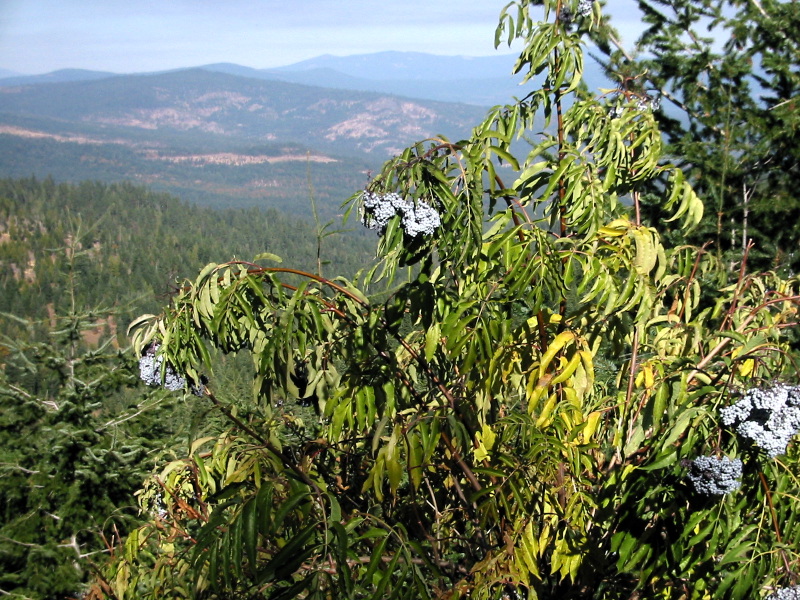 Blue ElderberrySambucus cerulea
-
 Dwarf ElderSambucus ebulus
-
 Blue ElderberrySambucus mexicana
-
 Chinese ElderSambucus javanica
-
 Native ElderSambucus australasica
-
 White ElderberrySambucus gaudichaudiana
Compare
Questions and answers
What is the scientific name of the American Elderberry?
The scientific name of the American Elderberry is Sambucus canadensis. Written with its author, the full name is Sambucus canadensis L..
Which family does the American Elderberry belong to?
Sambucus canadensis belongs to the family Viburnaceae, in the order Dipsacales and the class Magnoliopsida.
Where is the American Elderberry found?
Checklists and occurrence records place Sambucus canadensis in 44 countries, including Canada, Mexico, Costa Rica, Nicaragua, Guatemala and El Salvador.
What other names does the American Elderberry have?
Sambucus canadensis is also known in English as American Black Elderberry, American Elder, Canada Elderberry, Canadian Elder, Black Elderberry and Common Elder.
Which elderberry is not edible?
Most parts of American elderberry contain cyanogenic glycosides and are toxic. Its leaves, stems, roots, seeds, and unripe fruits can be toxic because they contain cyanogenic glycosides and alkaloids.[26][27]
Can you eat Sambucus canadensis?
Ripe berries can be cooked for food after their seeds have been removed. Traditional preparations include sweetened jams, jellies, and syrups. Most parts of the plant contain cyanogenic glycosides and are toxic.[17][18][26]
Where does elderberry grow naturally?
American elderberry is native to a large region of North America east of the Rocky Mountains. Its native range extends south through mainland America to Bolivia.[28][29]
What type of elderberry is medicinal?
The boiled inner bark of American elderberry was used by the Iroquois as a topical pain reliever for toothaches.[23]
Sources
Passages the profile rests on
- Sambucus canadensis is closely related to the European species Sambucus nigra. Source passage: “It is closely related to the European Sambucus nigra.” — English Wikipedia
- Some authors classify Sambucus canadensis as the same species as Sambucus nigra under the subspecies name Sambucus nigra subsp. canadensis. Source passage: “Some authors treat it as conspecific, under the name Sambucus nigra subsp. canadensis.” — English Wikipedia
- Sambucus canadensis is a deciduous shrub that produces suckers. Source passage: “It is a deciduous suckering shrub growing to 6 metres (20 feet) tall.” — English Wikipedia
- American elderberry is described as having a more shrub-like growth habit than European black elder. Source passage: “American elderberry ( Sambucus canadensis) is more shrub-like” — extension.wvu.edu
- The shrub can reach a height of 6 metres. Source passage: “growing to 6 metres (20 feet) tall.” — English Wikipedia
- American elderberry can grow to approximately 8–10 feet tall. Source passage: “can grow up to 8 to 10 feet high” — extension.wvu.edu
- The plant's leaves average 10 centimetres in leaflet length and 4 centimetres in leaflet width. Source passage: “the leaflets averaging 10 centimetres (4 inches) long and 4 cm broad.” — English Wikipedia
- Its leaves grow in opposite pairs and are pinnate, with five to eleven leaflets per leaf. Source passage: “The leaves are arranged in opposite pairs, pinnate with five to eleven leaflets” — English Wikipedia
- The plant produces large clusters of white flowers above its foliage during summer. Source passage: “In summer, it bears large corymbs, 20–30 cm or 8–12 in diameter, of white flowers above the foliage” — English Wikipedia
- Its flower clusters measure 20–30 centimetres in diameter. Source passage: “large corymbs, 20–30 cm or 8–12 in diameter” — English Wikipedia
- Individual flowers measure approximately 5–6 millimetres in diameter. Source passage: “the individual flowers 5–6 millimetres (3⁄16–1⁄4 in) diameter” — English Wikipedia
- The plant produces dark purple to black berries in drooping clusters during autumn. Source passage: “The fruit (known as an elderberry) is a dark purple to black berry 3–5 mm diameter, produced in drooping clusters in the fall.” — English Wikipedia
- Its berries measure approximately 3–5 millimetres in diameter. Source passage: “a dark purple to black berry 3–5 mm diameter” — English Wikipedia
- The species commonly occurs in marshes, swamps, and open woodland floodplains. Source passage: “primarily found in habitat types such as marshes, swamps, and open woodland floodplains” — English Wikipedia
- The plant grows in conditions ranging from full sun to partial shade. Source passage: “It grows in full sun to partial shade” — English Wikipedia
- The species tolerates moist sandy and clay soils with medium pH. Source passage: “can tolerate moist sandy to clay soil with a medium pH.” — English Wikipedia
- Ripe berries can be cooked for food after their seeds have been removed. Source passage: “the ripe berries can be cooked for food use with the seeds removed.” — English Wikipedia
- Traditional food preparations made from the berries include sweetened jams, jellies, and syrups. Source passage: “Traditional methods of consuming elderberry includes sweetened jams, jellies, and syrups” — English Wikipedia
- The flowers are hermaphroditic and are pollinated by insects. Source passage: “They are hermaphrodite and pollinated by insects.” — English Wikipedia
- A beverage can be prepared by soaking the flower heads in water for eight hours. Source passage: “A drink can be made from soaking the flower heads in water for eight hours.” — English Wikipedia
- The fruit is also used to produce wine, jelly, and dye. Source passage: “Other uses for the fruit include wine, jelly and dye.” — English Wikipedia
- The leaves and inner bark have been used as insecticides and dyes. Source passage: “The leaves and inner bark may be used as an insecticide and a dye.” — English Wikipedia
- The Iroquois used boiled inner bark of the elderberry as a topical pain reliever for toothaches. Source passage: “The boiled inner bark of the elderberry was used by the Iroquois of North America as a pain reliever in toothaches” — English Wikipedia
- The genus name Sambucus derives from the Greek word sambuce, referring to an ancient wind instrument. Source passage: “The genus name comes from the Greek word sambuce, an ancient wind instrument” — English Wikipedia
- The genus name refers to the historical use of hollowed plant twigs to make whistles. Source passage: “in reference to the removal of pith from the twigs of this and other species to make whistles.” — English Wikipedia
- Most parts of the plant contain cyanogenic glycosides and are toxic. Source passage: “Most parts of the plant are toxic with cyanogenic glycosides” — English Wikipedia
- The leaves, stems, roots, seeds, and unripe fruits can be toxic because they contain cyanogenic glycosides and alkaloids. Source passage: “the leaves, stems, roots, seeds and unripe fruits, can be toxic due to the presence of cyanogenic glycosides and alkaloids.” — English Wikipedia
- The species is native to a large region of North America east of the Rocky Mountains. Source passage: “The species is native to a large area of North America east of the Rocky Mountains” — English Wikipedia
- Its native range extends south through mainland America to Bolivia. Source passage: “south throughout the mainland Americas to Bolivia.” — English Wikipedia
Data
- Catalogue of Life, 2026-10-16 XR cc by
- Global Biodiversity Information Facility CC BY 4.0
- Wikidata CC0
- GeoNames CC BY 4.0
- Wikimedia Commons per image; credit shown with each image
- Within the Catalogue of Life, this name comes from Synonymic Checklists of the Vascular Plants of the World cc by
References
- L. (1753). Sp. Pl. [Linnaeus] 1: 269 (1753). where the name was published
This species in other databases
- Catalogue of Life 6XHYD
- Wikidata Q21877280
- iNaturalist 84300
- World Flora Online wfo-0000439346
- GRIN 32983
Page built on 29 November 2026. See how the catalog is made and all sources and licences.
Cite this page
ScientificNames.org. (2026). Sambucus canadensis (American Elderberry). Retrieved November 29, 2026, from https://scientificnames.org/species/sambucus-canadensis
“Sambucus canadensis (American Elderberry).” ScientificNames.org, 2026, scientificnames.org/species/sambucus-canadensis. Accessed 29 Nov. 2026.
ScientificNames.org. “Sambucus canadensis (American Elderberry).” Accessed November 29, 2026. https://scientificnames.org/species/sambucus-canadensis.
@misc{scientificnames_sambucus_canadensis_american_elderberry,
  author = {{ScientificNames.org}},
  title = {Sambucus canadensis (American Elderberry)},
  year = {2026},
  url = {https://scientificnames.org/species/sambucus-canadensis},
  note = {Accessed 2026-11-29}
}