Species · Birds
Ameline Swiftlet Aerodramus amelis
The scientific name of the Ameline Swiftlet is Aerodramus amelis. It is a species of bird in the family Apodidae (swift), order Apodiformes. The name dates from 1906.
- Scientific name
- Aerodramus amelis (Oberholser, 1906)
- Common name
- Ameline Swiftlet
- Genus
- Aerodramus
- Family
- Apodidae (Swift)
- Order
- Apodiformes
- Class
- Aves
- Recorded in
- 1 country
- Name status
- accepted in the Catalogue of Life

Overview
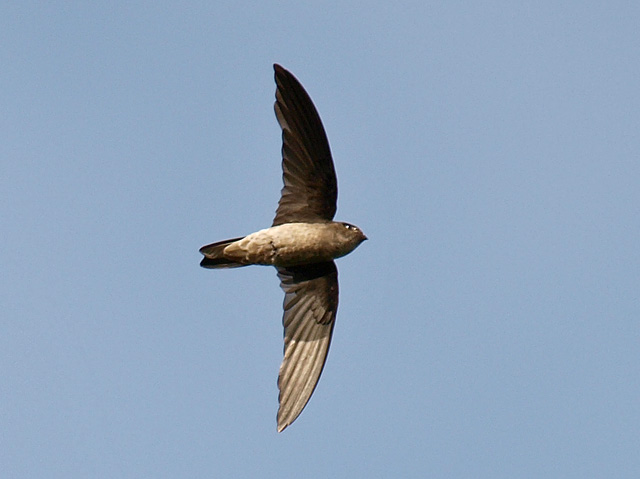
The Ameline Swiftlet (Aerodramus amelis) is a medium-sized bird in the family Apodidae and order Apodiformes. It inhabits tropical moist lowland forests and occurs in coastal areas, forests, agricultural lands and grasslands in the Philippines. It is brownish, has a weakly forked tail and feeds on small insects while flying.
Written 26 November 2026 from the sources listed below. Each statement was checked against the passage it cites; statements that could not be supported were removed.
Appearance
The Ameline Swiftlet is a medium-sized, brownish swiftlet with a weakly forked tail.[1][2]
Habitat
The Ameline Swiftlet inhabits tropical moist lowland forests. It occurs in coastal areas, forests, agricultural lands and grasslands and is found only in the Philippine lowlands.[3][4][5]
Diet
The Ameline Swiftlet feeds on small insects while flying.[6]
Behaviour
The Ameline Swiftlet is typically encountered alone or in loose groups. It also forms groups containing up to 40 individuals and associates with other swiftlets.[7][8]
Reproduction and life cycle
The Ameline Swiftlet typically nests in dark caves. Its round nest consists of plant matter, moss and saliva.[9][10]
The species has an average clutch size of one to two eggs.[11]
Conservation
The Ameline Swiftlet is reported as Least Concern, although its independent recognition by the IUCN is not established. The IUCN has assessed the parent species, the Uniform swiftlet, as Least Concern rather than recognizing the Ameline Swiftlet separately.[12][13]
Similar species
The Ameline Swiftlet was formerly treated as a subspecies of the Uniform swiftlet and is usually classified as a subspecies of that species.[14][15]
Classification of the Ameline Swiftlet
| Kingdom | Animalia |
|---|---|
| Phylum | Chordata |
| Subphylum | Vertebrata |
| Infraphylum | Gnathostomata |
| Parvphylum | Osteichthyes |
| Megaclass | Tetrapoda |
| Class | Aves (Bird) |
| Order | Apodiformes (Swifts) |
| Family | Apodidae (Swift) |
| Subfamily | Apodinae |
| Genus | Aerodramus (Edible-nest Swiftlets) |
| Species | Aerodramus amelis (Oberholser, 1906) |
Where the Ameline Swiftlet is found
Checklists and occurrence records place Aerodramus amelis in 1 country across Asia. GBIF holds 6,393 georeferenced records of it.
Countries
Regions and cities with the most records
- Taytay, Philippines 2,039
- Cainta, Philippines 2,038
- Antipolo, Philippines 2,021
- Bel Air, Philippines 1,981
- Makati City, Philippines 1,980
- Pasig City, Philippines 1,978
- Pateros, Philippines 1,978
- San Juan, Philippines 1,975
- Mandaluyong City, Philippines 1,974
- Calumpang, Philippines 1,973
- Mandaluyong, Philippines 1,973
- Quezon City, Philippines 1,969
- Angono, Philippines 1,967
- Bagong Pagasa, Philippines 1,958
- Marikina City, Philippines 1,958
- Manila, Philippines 1,946
- Caloocan, Philippines 1,933
- Taguig, Philippines 1,927
- Pasay, Philippines 1,926
- Upper Bicutan, Philippines 1,922
- Baclaran, Philippines 1,910
- Bagong Barrio, Philippines 1,891
- Talipapa, Philippines 1,880
- Commonwealth, Philippines 1,858
- Navotas, Philippines 1,849
- Paranaque City, Philippines 1,845
- Malabon, Philippines 1,827
- Tanza, Philippines 1,827
- Valenzuela, Philippines 1,822
- Las Piñas, Philippines 1,749
- Bacoor, Philippines 1,745
- Cavite City, Philippines 1,725
- Imus, Philippines 1,723
- Kawit, Philippines 1,720
- Muntinlupa, Philippines 1,717
- Poblacion, Philippines 1,696
Range as the checklists state it
Southern Asia
A number beside a place is its count of GBIF occurrence records. A place without a number comes from a checklist alone. Records show where a species has been observed or collected, which can include escapes and vagrants.
Common names
English
- Ameline Swiftlet
Names in 20 other languages
- Arabic
- سمامة أملين
- Chinese
- 阿姆利納金絲燕, 阿美林金丝燕
- Czech
- salangana hnědavá
- Danish
- Grå Salangan
- Dutch
- Filipijnse Salangaan, Filippijnse Salangaan
- Esperanto
- griza salangano
- Estonian
- filipiini pruunsalangaan
- Finnish
- itäfilippiiniensalangaani
- French
- Salangane grise
- German
- Grausalangane
- Italian
- Rondone grigio delle Filippine
- Japanese
- ハイイロアナツバメ
- Polish
- salangana szara
- Portuguese
- andorinhão-de-mindanau, salangana-cinzenta
- Russian
- Серая салангана, Шиферная салангана
- Serbian
- Siva čiopica
- Slovak
- salangána sivobruchá
- Spanish
- Rabitojo de Mindano, Salangana de Mindanao
- Turkish
- Ameline Yelyutanı
- Ukrainian
- салангана сіра
Synonyms
6 other scientific names have been used for this species and are now treated as synonyms of Aerodramus amelis.
- Collocalia amelis Oberholser, HC, 1906
- Collocalia inexpectata amelis Oberholser, HC, 1906
- Collocalia unicolor amelis Oberholser, 1906
- Collocalia vanicorensis amelis Oberholser, HC, 1906
- Collocalia vanikorensis amelis Oberholser, HC, 1906
- Hirundo vanikorensis amelis Oberholser, HC, 1906
Subspecies and varieties
- Aerodramus amelis amelis subspecies
- Aerodramus amelis palawanensis (Palawan Swiftlet) subspecies
Related species
-
 Edible-nest SwiftletAerodramus fuciphagus
-
 Edible-nest SwiftletAerodramus germani
-
 Black-nest SwiftletAerodramus maximus
-
 Indian SwiftletAerodramus unicolor
-
 Himalayan SwiftletAerodramus brevirostris
- Mariana SwiftletAerodramus bartschi
-
 Australian SwiftletAerodramus terraereginae
-
 White-rumped SwiftletAerodramus spodiopygius
Compare
Questions and answers
What is the scientific name of the Ameline Swiftlet?
The scientific name of the Ameline Swiftlet is Aerodramus amelis. Written with its author, the full name is Aerodramus amelis (Oberholser, 1906).
Which family does the Ameline Swiftlet belong to?
Aerodramus amelis belongs to the family Apodidae, in the order Apodiformes and the class Aves.
Where is the Ameline Swiftlet found?
Checklists and occurrence records place Aerodramus amelis in 1 country: Philippines.
What does Swiftlet eat?
The Ameline Swiftlet feeds on small insects while flying.[6]
Sources
Passages the profile rests on
- The Ameline swiftlet is a medium-sized, brownish swiftlet with a weakly forked tail. Source passage: “Medium-sized brownish swiftlet with a weakly forked tail.” — ebird.org
- The Ameline swiftlet is described as a medium-sized swiftlet. Source passage: “Medium-sized brownish swiftlet” — ebird.org
- The Ameline swiftlet inhabits tropical moist lowland forests. Source passage: “Its natural habitat is tropical moist lowland forests.” — English Wikipedia
- The species occurs in coastal areas, forests, agricultural lands and grasslands. Source passage: “It is found in a wide range of habitat including coastal areas, forest and agricultural lands and grassland.” — English Wikipedia
- The species is found only in the Philippine lowlands. Source passage: “Found only in the Philippine lowlands.” — ebird.org
- The Ameline swiftlet feeds on small insects while flying. Source passage: “It feeds small insects in flight.” — English Wikipedia
- The species forms groups containing up to 40 individuals and associates with other swiftlets. Source passage: “Forms groups of up to 40 individuals associating with other swiftlets.” — English Wikipedia
- The Ameline swiftlet is typically encountered alone or in loose groups. Source passage: “Typically encountered alone or in loose groups over various” — ebird.org
- The Ameline swiftlet typically nests in dark caves. Source passage: “Typically nests in dark caves.” — English Wikipedia
- Its nest is round and consists of plant matter, moss and saliva. Source passage: “Nest is round, composted of plant matter, moss and saliva.” — English Wikipedia
- The species has an average clutch size of one to two eggs. Source passage: “Average clutch is just 1-2 eggs.” — English Wikipedia
- The species is reported as Least Concern, although its independent recognition by the IUCN is not established. Source passage: “Despite some fears around conservation, the species remains a Least-concern species.” — English Wikipedia
- The IUCN has assessed the parent species, the Uniform swiftlet, as Least Concern rather than recognizing the Ameline swiftlet separately. Source passage: “International Union for Conservation of Nature does not yet recognize this as its own species. It has assessed its parent species, the Uniform swiftlet as least-concern species.” — English Wikipedia
- The Ameline swiftlet was formerly treated as a subspecies of the Uniform swiftlet. Source passage: “It was formerly considered as a subspecies of the uniform swiftlet.” — English Wikipedia
- The Ameline swiftlet is usually classified as a subspecies of the Uniform swiftlet. Source passage: “is usually considered a subspecies of the uniform swiftlet,” — inaturalist.org
Data
- Catalogue of Life, 2026-10-16 XR cc by
- Global Biodiversity Information Facility CC BY 4.0
- Wikidata CC0
- GeoNames CC BY 4.0
- Wikimedia Commons per image; credit shown with each image
- Within the Catalogue of Life, this name comes from The Integrated Taxonomic Information System cc0
References
- Dickinson, Edward C., ed. (2003). The Howard and Moore Complete Checklist of the Birds of the World, 3rd Edition.
This species in other databases
Page built on 27 November 2026. See how the catalog is made and all sources and licences.
Cite this page
ScientificNames.org. (2026). Aerodramus amelis (Ameline Swiftlet). Retrieved November 27, 2026, from https://scientificnames.org/species/aerodramus-amelis
“Aerodramus amelis (Ameline Swiftlet).” ScientificNames.org, 2026, scientificnames.org/species/aerodramus-amelis. Accessed 27 Nov. 2026.
ScientificNames.org. “Aerodramus amelis (Ameline Swiftlet).” Accessed November 27, 2026. https://scientificnames.org/species/aerodramus-amelis.
@misc{scientificnames_aerodramus_amelis_ameline_swiftlet,
  author = {{ScientificNames.org}},
  title = {Aerodramus amelis (Ameline Swiftlet)},
  year = {2026},
  url = {https://scientificnames.org/species/aerodramus-amelis},
  note = {Accessed 2026-11-27}
}