Species · Birds
Seychelles Swiftlet Aerodramus elaphrus
The scientific name of the Seychelles Swiftlet is Aerodramus elaphrus. It is a species of bird in the family Apodidae (swift), order Apodiformes. The name dates from 1906.
- Scientific name
- Aerodramus elaphrus (Oberholser, 1906)
- Common name
- Seychelles Swiftlet
- Genus
- Aerodramus
- Family
- Apodidae (Swift)
- Order
- Apodiformes
- Class
- Aves
- Red List category
- VU Vulnerable
- Recorded in
- 1 country
- Name status
- accepted in the Catalogue of Life

Overview
Aerodramus elaphrus occurs exclusively in the Seychelles Islands in the Indian Ocean. It is usually easy to identify because it is the only resident swift in the Seychelles.
Written 26 November 2026 from the sources listed below. Each statement was checked against the passage it cites; statements that could not be supported were removed.
Appearance
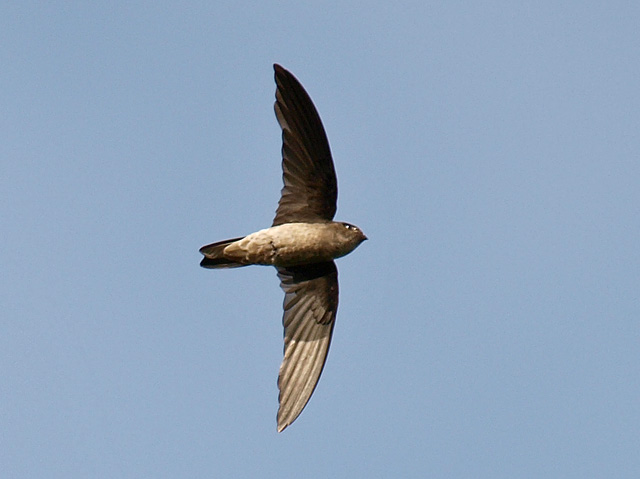
The Seychelles Swiftlet has dark grey-brown upperparts that are slightly paler on the rump and pale grey-brown underparts that are darkest on the undertail-coverts. Its bill and legs are black, and its tail is dark and slightly forked.[1][2][3]
Its wings are long and narrow but less pointed than those of other swift species that occasionally visit the Seychelles. Its wingspan is approximately 28 cm, and it weighs approximately 10 g.[4][5][6]
Habitat
The Seychelles Swiftlet frequently feeds over freshwater habitats and mountain passes. It uses caves as breeding sites.[7][8]
Diet
The Seychelles Swiftlet feeds on flying insects, particularly ants.[9]
Behaviour
Feeding flocks produce soft, twittering calls while flying. In caves, the species uses low-pitched metallic clicking calls for echolocation.[10][11]
Reproduction and life cycle
The Seychelles Swiftlet breeds throughout the year. Its bracket-shaped nest is constructed from lichen strands and casuarina needles bound together with saliva.[12][13]
Each breeding attempt produces one white egg, which is incubated for approximately 25–30 days. Both parents feed the young birds, which fledge after approximately 42 days.[14][15][16][17]
Conservation
The Seychelles Swiftlet is classified as Vulnerable by the IUCN. Its estimated population is 2,500–3,000 birds.[18][19]
Its conservation status is affected by its limited number of breeding sites. Documented threats include disturbance, insecticide use and predation by introduced barn owls and cats.[20][21]
Similar species
The Seychelles Swiftlet is related to the smaller and paler Mascarene Swiftlet (Aerodramus francicus), which is found on Mauritius and Réunion. The two species are estimated to have diverged approximately 500,000 years ago.[22][23]
The Seychelles Swiftlet was historically treated as a subspecies of the Mascarene Swiftlet.[24]
Classification of the Seychelles Swiftlet
| Kingdom | Animalia |
|---|---|
| Phylum | Chordata |
| Subphylum | Vertebrata |
| Infraphylum | Gnathostomata |
| Parvphylum | Osteichthyes |
| Megaclass | Tetrapoda |
| Class | Aves (Bird) |
| Order | Apodiformes (Swifts) |
| Family | Apodidae (Swift) |
| Subfamily | Apodinae |
| Genus | Aerodramus (Edible-nest Swiftlets) |
| Species | Aerodramus elaphrus (Oberholser, 1906) |
Where the Seychelles Swiftlet is found
Checklists and occurrence records place Aerodramus elaphrus in 1 country across Africa. GBIF holds 1,110 georeferenced records of it.
Countries
Regions and cities with the most records
- Victoria, Seychelles 504
- La Digue and Inner Islands, Seychelles 220
- Baie Sainte Anne, Seychelles 159
- Port Glaud, Seychelles 54
- Mont Fleuri, Seychelles 30
- Beau Vallon, Seychelles 29
- Bel Air, Seychelles 28
- Glacis, Seychelles 27
- Cascade, Seychelles 23
- Anse Royale, Seychelles 14
- Baie Lazare, Seychelles 14
- Roche Caiman, Seychelles 14
- Au Cap, Seychelles 12
- Pointe La Rue, Seychelles 10
- Anse Etoile, Seychelles 9
- Anse Boileau, Seychelles 6
- Takamaka, Seychelles 6
- Les Mamelles, Seychelles 5
- Plaisance, Seychelles 5
- Saint Louis, Seychelles 5
Range as the checklists state it
Africa
A number beside a place is its count of GBIF occurrence records. A place without a number comes from a checklist alone. Records show where a species has been observed or collected, which can include escapes and vagrants.
Common names
English
- Seychelles Swiftlet
Names in 24 other languages
- Arabic
- سمامة سيشيل
- Catalan
- salangana de les Seychelles
- Chinese
- 塞席爾金絲燕, 塞舌尔金丝燕
- Czech
- salangana seychelská
- Danish
- Seycheller Salangan
- Dutch
- Seychellensalangaan
- Esperanto
- sejŝela salangano
- Estonian
- seišelli salangaan
- Finnish
- seychelliensalangaani
- French
- Salangane des Seychelles
- German
- Seychellen-Salangane, Seychellensalangane
- Hungarian
- seychelle-szigeteki szalangána
- Italian
- Rondone delle Seychelles, Salangana delle Seychelles
- Japanese
- セーシェルアナツバメ
- Lithuanian
- seišelinis erodramas
- Norwegian
- seychellsalangan
- Polish
- salangana seszelska
- Portuguese
- andorinhão-das-seicheles, salangana-das-seicheles
- Russian
- Салангана сейшельская, Сейшельская салангана
- Serbian
- Sejšelska čiopica
- Slovak
- salangána seychelská
- Spanish
- Salangana de Seychelles
- Turkish
- Seyşeller Yelyutanı
- Ukrainian
- салангана сейшельська
Synonyms
5 other scientific names have been used for this species and are now treated as synonyms of Aerodramus elaphrus.
- Aerodramus elaphra Oberholser, HC, 1906
- Aerodramus elephra Oberholser, HC, 1906
- Collocalia elaphra Oberholser, 1906
- Collocalia francica elaphra Oberholser, HC, 1906
- Collocalia fuciphaga elaphra Oberholser, 1906
Related species
-
 Edible-nest SwiftletAerodramus fuciphagus
-
 Edible-nest SwiftletAerodramus germani
-
 Black-nest SwiftletAerodramus maximus
-
 Indian SwiftletAerodramus unicolor
-
 Himalayan SwiftletAerodramus brevirostris
- Mariana SwiftletAerodramus bartschi
-
 Australian SwiftletAerodramus terraereginae
-
 White-rumped SwiftletAerodramus spodiopygius
Compare
Questions and answers
What is the scientific name of the Seychelles Swiftlet?
The scientific name of the Seychelles Swiftlet is Aerodramus elaphrus. Written with its author, the full name is Aerodramus elaphrus (Oberholser, 1906).
Which family does the Seychelles Swiftlet belong to?
Aerodramus elaphrus belongs to the family Apodidae, in the order Apodiformes and the class Aves.
Where is the Seychelles Swiftlet found?
Checklists and occurrence records place Aerodramus elaphrus in 1 country: Seychelles.
What is the conservation status of the Seychelles Swiftlet?
The IUCN Red List category recorded for Aerodramus elaphrus is Vulnerable (VU).
What does Swiftlet eat?
The Seychelles Swiftlet feeds on flying insects, particularly ants.[9]
Sources
Passages the profile rests on
- The Seychelles Swiftlet has dark grey-brown upperparts that are slightly paler on the rump and pale grey-brown underparts that are darkest on the undertail-coverts. Source passage: “The upperparts are dark grey-brown and are slightly paler on the rump. The underparts are pale grey-brown, darkest on the undertail-coverts.” — English Wikipedia
- The species has a black bill and black legs. Source passage: “The bill and legs are black.” — English Wikipedia
- Its tail is dark and slightly forked. Source passage: “The tail is dark and slightly forked.” — English Wikipedia
- Its wings are long and narrow but less pointed than those of other swift species that occasionally visit the Seychelles. Source passage: “The wings are long and narrow but are less pointed than those of the other swift species which sometimes visit the islands.” — English Wikipedia
- Its wingspan is approximately 28 cm. Source passage: “with a wingspan of 28 cm” — English Wikipedia
- The species weighs approximately 10 g. Source passage: “and a weight of about 10 g.” — English Wikipedia
- The species frequently feeds over freshwater habitats and mountain passes. Source passage: “It often feeds over freshwater and mountain passes” — English Wikipedia
- The species uses caves as breeding sites. Source passage: “Breeding takes place all year round at a small number of colonies in caves.” — English Wikipedia
- The Seychelles Swiftlet feeds on flying insects, particularly ants. Source passage: “It feeds on flying insects, particularly ants.” — English Wikipedia
- Feeding flocks produce soft, twittering calls while flying. Source passage: “A soft, twittering call is given in flight by feeding flocks” — English Wikipedia
- The species uses low-pitched metallic clicking calls for echolocation in caves. Source passage: “the birds also have a low-pitched, metallic clicking call used for echolocation in caves.” — English Wikipedia
- The species breeds throughout the year. Source passage: “Breeding takes place all year round” — English Wikipedia
- Its nest is bracket-shaped and constructed from lichen strands and casuarina needles bound together with saliva. Source passage: “The nest is bracket-shaped and made of strands of lichen and casuarina needles held together by saliva.” — English Wikipedia
- Each breeding attempt produces one white egg. Source passage: “One white egg is laid” — English Wikipedia
- The egg is incubated for approximately 25–30 days. Source passage: “is incubated for about 25 to 30 days.” — English Wikipedia
- Both parents feed the young birds. Source passage: “The young birds are fed by both parents” — English Wikipedia
- Young Seychelles Swiftlets fledge after approximately 42 days. Source passage: “and fledge after 42 days.” — English Wikipedia
- The Seychelles Swiftlet is classified as Vulnerable by the IUCN. Source passage: “The species is classified as Vulnerable by the IUCN” — English Wikipedia
- The estimated population of the species is 2,500–3,000 birds. Source passage: “small population (2,500 to 3,000 birds)” — English Wikipedia
- Its conservation status is affected by its limited number of breeding sites. Source passage: “and limited number of breeding sites.” — English Wikipedia
- Documented threats include disturbance, insecticide use and predation by introduced barn owls and cats. Source passage: “Threats include disturbance, use of insecticides and predation by introduced barn owls and cats.” — English Wikipedia
- The Seychelles Swiftlet is related to the smaller and paler Mascarene Swiftlet (Aerodramus francicus) found on Mauritius and Réunion. Source passage: “The Seychelles swiftlet is related to the smaller, paler Mascarene swiftlet (Aerodramus francicus) of Mauritius and Réunion” — English Wikipedia
- The Seychelles Swiftlet and Mascarene Swiftlet are estimated to have diverged approximately 500,000 years ago. Source passage: “The two are thought to have separated about 500,000 years ago.” — English Wikipedia
- The Seychelles Swiftlet was historically treated as a subspecies of the Mascarene Swiftlet. Source passage: “and has been treated as a subspecies of it in the past.” — English Wikipedia
Data
- Catalogue of Life, 2026-10-16 XR cc by
- Global Biodiversity Information Facility CC BY 4.0
- Wikidata CC0
- GeoNames CC BY 4.0
- Wikimedia Commons per image; credit shown with each image
- Within the Catalogue of Life, this name comes from The Integrated Taxonomic Information System cc0
References
- Gill, Frank, & and Minturn Wright. (2006). Birds of the World: Recommended English Names.
This species in other databases
Page built on 29 November 2026. See how the catalog is made and all sources and licences.
Cite this page
ScientificNames.org. (2026). Aerodramus elaphrus (Seychelles Swiftlet). Retrieved November 29, 2026, from https://scientificnames.org/species/aerodramus-elaphrus
“Aerodramus elaphrus (Seychelles Swiftlet).” ScientificNames.org, 2026, scientificnames.org/species/aerodramus-elaphrus. Accessed 29 Nov. 2026.
ScientificNames.org. “Aerodramus elaphrus (Seychelles Swiftlet).” Accessed November 29, 2026. https://scientificnames.org/species/aerodramus-elaphrus.
@misc{scientificnames_aerodramus_elaphrus_seychelles_swiftlet,
  author = {{ScientificNames.org}},
  title = {Aerodramus elaphrus (Seychelles Swiftlet)},
  year = {2026},
  url = {https://scientificnames.org/species/aerodramus-elaphrus},
  note = {Accessed 2026-11-29}
}