Species · Birds
Tahiti Swiftlet Aerodramus leucophaeus
The scientific name of the Tahiti Swiftlet is Aerodramus leucophaeus. It is a species of bird in the family Apodidae (swift), order Apodiformes. The name dates from 1849.
- Scientific name
- Aerodramus leucophaeus (Peale, 1849)
- Common name
- Tahiti Swiftlet
- Genus
- Aerodramus
- Family
- Apodidae (Swift)
- Order
- Apodiformes
- Class
- Aves
- Red List category
- LC Least Concern
- Recorded in
- 1 country
- Name status
- accepted in the Catalogue of Life
Overview
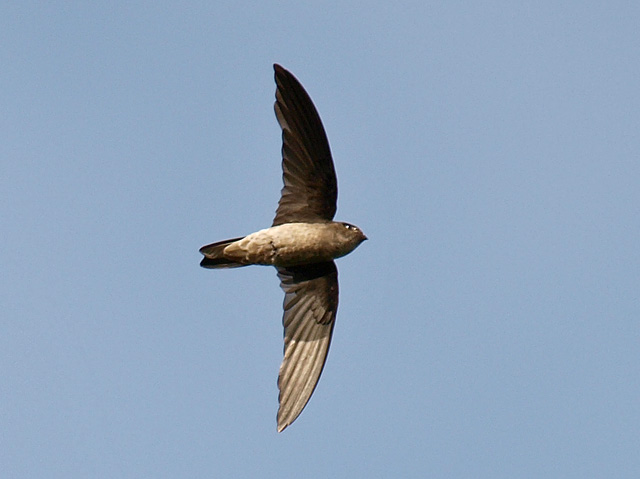
Aerodramus leucophaeus is endemic to the Society Islands in French Polynesia and occurs on Tahiti and Moorea. It has dark brown upperparts, grey-brown underparts and a forked tail, and is approximately 11 cm long.
Written 26 November 2026 from the sources listed below. Each statement was checked against the passage it cites; statements that could not be supported were removed.
Similar species
The Tahiti Swiftlet is closely related to Aerodramus sawtelli.[1]
Appearance
The species measures approximately 11 cm in length, including its forked tail.[2]
Habitat
The Tahiti Swiftlet prefers wet, rocky and forested valleys at high elevations.[3]
It nests in shallow depressions beneath overhanging rocks, coastal cliffs and caves.[4]
Diet
The Tahiti Swiftlet feeds on insects captured while flying.[5]
Behaviour
The Tahiti Swiftlet feeds at high elevations and is commonly found in flocks containing up to 100 individuals.[6][7]
The species produces a dry call at repeated intervals. Its call has an insect-like, trilling quality.[8][9]
The species has been reported to exhibit some form of echolocation. It uses echolocation to navigate dark caves and locate nesting sites.[10][11]
Reproduction and life cycle
The Tahiti Swiftlet constructs nests from vegetable matter bound together with saliva. It typically lays two eggs per clutch.[12][13]
Conservation
The Tahiti Swiftlet is classified as vulnerable but stable. Its population was estimated at 200–500 birds in 1984, and it is currently thought to number fewer than 1,000 individuals.[14][15][16]
The most important subpopulation was estimated at 100 birds in Papehue Valley. The species remains rare and survives in only a few valleys.[17][18]
Predation on eggs is identified as a conservation concern for the species.[19]
Classification of the Tahiti Swiftlet
| Kingdom | Animalia |
|---|---|
| Phylum | Chordata |
| Subphylum | Vertebrata |
| Infraphylum | Gnathostomata |
| Parvphylum | Osteichthyes |
| Megaclass | Tetrapoda |
| Class | Aves (Bird) |
| Order | Apodiformes (Swifts) |
| Family | Apodidae (Swift) |
| Subfamily | Apodinae |
| Genus | Aerodramus (Edible-nest Swiftlets) |
| Species | Aerodramus leucophaeus (Peale, 1849) |
Where the Tahiti Swiftlet is found
Checklists and occurrence records place Aerodramus leucophaeus in 1 country across Oceania. GBIF holds 232 georeferenced records of it.
Countries
Regions and cities with the most records
- Îles du Vent, French Polynesia 206
- Papeete, French Polynesia 201
- Punaauia, French Polynesia 200
- Faaa, French Polynesia 199
- Marquesas Islands, French Polynesia 7
Range as the checklists state it
Oceania
A number beside a place is its count of GBIF occurrence records. A place without a number comes from a checklist alone. Records show where a species has been observed or collected, which can include escapes and vagrants.
Common names
English
- Tahiti Swiftlet
- Polynesian Swiftlet
Names in 23 other languages
- Arabic
- سمامة تاهيتي
- Catalan
- salangana de la Polinèsia
- Chinese
- 塔岛金丝燕, 波里尼西亞金絲燕
- Czech
- salangana tahitská
- Danish
- Tahitisalangan
- Dutch
- Tahitisalangaan
- Esperanto
- tahitia salangano
- Estonian
- polüneesia salangaan
- Finnish
- tahitinsalangaani
- French
- Salangane de la Société
- German
- Polynesien-Salangane, Polynesiensalangane
- Hungarian
- tahiti szalangána
- Italian
- Salangana di Polinesia
- Japanese
- タヒチアナツバメ
- Lithuanian
- polinezinis erodramas
- Polish
- salangana czarna
- Portuguese
- andorinhão-polinésio, salangana-do-taiti
- Russian
- Полинезийская салангана, Таитянская салангана
- Serbian
- Polinezijska čiopica
- Slovak
- salangána čierna
- Spanish
- Salangana polinesia
- Turkish
- Polinezya Yelyutanı
- Ukrainian
- салангана таїтійська
Synonyms
5 other scientific names have been used for this species and are now treated as synonyms of Aerodramus leucophaeus.
- Aerodramus leucophaeus leucophaeus (Peale, 1849)
- Collocalia cinerea Finsch, 1877
- Collocalia leucophaea Peale, TR, 1849
- Collocalia leucophaea leucophaea Peale, TR, 1849
- Macropteryx leucophaeus Peale, 1849
Related species
-
 Edible-nest SwiftletAerodramus fuciphagus
-
 Edible-nest SwiftletAerodramus germani
-
 Black-nest SwiftletAerodramus maximus
-
 Indian SwiftletAerodramus unicolor
-
 Himalayan SwiftletAerodramus brevirostris
- Mariana SwiftletAerodramus bartschi
-
 Australian SwiftletAerodramus terraereginae
-
 White-rumped SwiftletAerodramus spodiopygius
Compare
Questions and answers
What is the scientific name of the Tahiti Swiftlet?
The scientific name of the Tahiti Swiftlet is Aerodramus leucophaeus. Written with its author, the full name is Aerodramus leucophaeus (Peale, 1849).
Which family does the Tahiti Swiftlet belong to?
Aerodramus leucophaeus belongs to the family Apodidae, in the order Apodiformes and the class Aves.
Where is the Tahiti Swiftlet found?
Checklists and occurrence records place Aerodramus leucophaeus in 1 country: French Polynesia.
What is the conservation status of the Tahiti Swiftlet?
The IUCN Red List category recorded for Aerodramus leucophaeus is Least Concern (LC).
What other names does the Tahiti Swiftlet have?
Aerodramus leucophaeus is also known in English as Polynesian Swiftlet.
What does Swiftlet eat?
The Tahiti Swiftlet feeds on insects captured while flying.[5]
Sources
Passages the profile rests on
- Aerodramus leucophaeus is closely related to Aerodramus sawtelli. Source passage: “Aerodramus leucophaeus is closely related to Aerodramus sawtelli.” — English Wikipedia
- The species measures approximately 11 cm in length, including its forked tail. Source passage: “This bird is about 11 cm with a forked tail.” — English Wikipedia
- The species prefers wet, rocky and forested valleys at high elevations. Source passage: “It prefers wet, rocky and forested valleys at high elevations” — English Wikipedia
- The species nests in shallow depressions beneath overhanging rocks, coastal cliffs and caves. Source passage: “nests either in shallow depressions with overhanging rocks, coastal cliffs or caves.” — English Wikipedia
- The species feeds on insects captured while flying. Source passage: “The Swiftlet feeds on insects, which it captures while in flight” — English Wikipedia
- The species feeds at high elevations. Source passage: “feeding at high elevations.” — English Wikipedia
- The species is commonly found in flocks containing up to 100 individuals. Source passage: “They are mostly found in flocks, (up to 100).” — English Wikipedia
- The species produces a dry call at repeated intervals. Source passage: “They have a dry call with repeated intervals.” — English Wikipedia
- The species' call has an insect-like, trilling quality. Source passage: “The call is also heard as insect-like and trilling.” — English Wikipedia
- The species has been reported to exhibit some form of echolocation. Source passage: “It has been reported that this species has some form of echolocation.” — English Wikipedia
- The species uses echolocation to navigate dark caves and locate nesting sites. Source passage: “use echolocation to locate their way around dark caves and nesting locations” — English Wikipedia
- The species typically lays two eggs per clutch. Source passage: “It is typical of this species to lay two eggs at a time.” — English Wikipedia
- The species constructs nests from vegetable matter bound together with saliva. Source passage: “Nests of this species are made with vegetable matter and held together by saliva.” — English Wikipedia
- The species is classified as vulnerable but stable in the first document. Source passage: “They are classified as vulnerable, but stable.” — English Wikipedia
- The species was estimated to have a population of 200–500 birds in 1984. Source passage: “Total population estimate of 200–500 birds in 1984” — English Wikipedia
- The species is currently thought to number fewer than 1,000 individuals. Source passage: “currently still thought to number fewer than 1000 individuals” — English Wikipedia
- The most important subpopulation was estimated at 100 birds in Papehue Valley. Source passage: “the most important subpopulation (100 birds) is in Papehue Valley.” — English Wikipedia
- The species remains rare and survives in only a few valleys. Source passage: “This species remains rare, surviving in only a few valleys” — English Wikipedia
- Predation on eggs is identified as a conservation concern for the species. Source passage: “This is due to predation on eggs.” — English Wikipedia
Data
- Catalogue of Life, 2026-10-16 XR cc by
- Global Biodiversity Information Facility CC BY 4.0
- Wikidata CC0
- GeoNames CC BY 4.0
- Within the Catalogue of Life, this name comes from The Integrated Taxonomic Information System cc0
References
- Gill, Frank, & and Minturn Wright. (2006). Birds of the World: Recommended English Names.
This species in other databases
Page built on 29 November 2026. See how the catalog is made and all sources and licences.
Cite this page
ScientificNames.org. (2026). Aerodramus leucophaeus (Tahiti Swiftlet). Retrieved November 29, 2026, from https://scientificnames.org/species/aerodramus-leucophaeus
“Aerodramus leucophaeus (Tahiti Swiftlet).” ScientificNames.org, 2026, scientificnames.org/species/aerodramus-leucophaeus. Accessed 29 Nov. 2026.
ScientificNames.org. “Aerodramus leucophaeus (Tahiti Swiftlet).” Accessed November 29, 2026. https://scientificnames.org/species/aerodramus-leucophaeus.
@misc{scientificnames_aerodramus_leucophaeus_tahiti_swiftlet,
  author = {{ScientificNames.org}},
  title = {Aerodramus leucophaeus (Tahiti Swiftlet)},
  year = {2026},
  url = {https://scientificnames.org/species/aerodramus-leucophaeus},
  note = {Accessed 2026-11-29}
}