Species · Birds
Volcano Swiftlet Aerodramus vulcanorum
The scientific name of the Volcano Swiftlet is Aerodramus vulcanorum. It is a species of bird in the family Apodidae (swift), order Apodiformes. The name dates from 1926.
- Scientific name
- Aerodramus vulcanorum (Stresemann, 1926)
- Common name
- Volcano Swiftlet
- Genus
- Aerodramus
- Family
- Apodidae (Swift)
- Order
- Apodiformes
- Class
- Aves
- Red List category
- LC Least Concern
- Recorded in
- 1 country
- Name status
- accepted in the Catalogue of Life

Overview
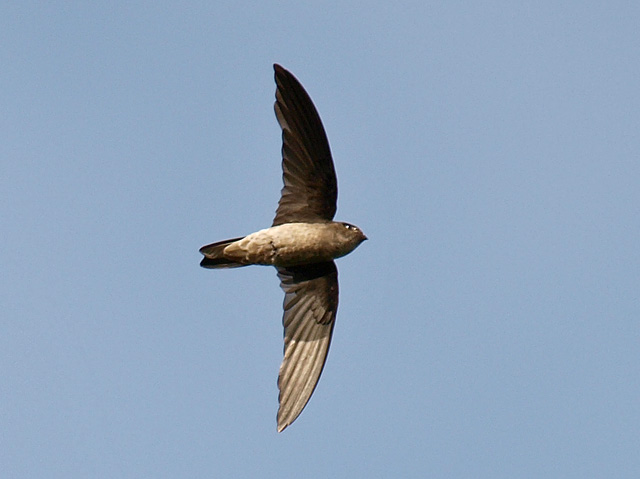
Aerodramus vulcanorum occurs on the Indonesian islands of Java and Bali. It has dark gray plumage, a distinct brown rump band, a forked tail and black wings with a purple sheen.
Written 26 November 2026 from the sources listed below. Each statement was checked against the passage it cites; statements that could not be supported were removed.
Appearance
The Volcano Swiftlet typically measures 13–14 centimetres in length. Adults have dark gray plumage and a distinct brown rump band, while juveniles have a less distinct rump band.[1][2][3]
The species has a forked tail and black wings with a purple sheen. Males have bare tarsi, whereas females have feathered tarsi, and both sexes possess white feather rami.[4][5][6]
Habitat
The Volcano Swiftlet inhabits mountainous forest areas around volcanic peaks and ridges. It nests in rock crevices at elevations of 2,200–3,000 metres.[7][8]
Some individuals inhabit volcanic craters, although this is uncommon. The species forages over volcanic craters and the surrounding montane areas.[9][10]
Diet
The Volcano Swiftlet's diet is poorly documented. It is thought to forage while flying, capturing small insects and possibly other airborne prey.[11][12]
Behaviour
The Volcano Swiftlet produces a distinctive clicking vocalization described as 'Teeree teereeeee teeereeeee'.[13]
The species is classified as non-migrant and remains within its native range throughout the year, although it moves within that range. It is not strictly sedentary.[14][15][16]
The species is less refined at using echolocation to capture prey than some other echolocating animals. It is described as highly capable of colonizing islands.[17][18]
Reproduction and life cycle
The Volcano Swiftlet breeds in the craters of a small number of active volcanoes. All known breeding sites are located on active volcanoes.[19][20]
Colonies typically contain approximately 25 pairs. The estimated number of colonies is approximately one per site.[21][22]
Conservation
The global population of the Volcano Swiftlet is estimated at approximately 400 individuals. Its resident and breeding extent of occurrence is 17,700 square kilometres.[23][24]
Volcanic activity is a potential cause of extinction for the species. It faces potential extinction because all known breeding sites are situated on active volcanoes.[25][26]
Similar species
The Volcano Swiftlet was formerly considered the same species as the Himalayan swiftlet (Aerodramus brevirostris).[27]
Classification of the Volcano Swiftlet
| Kingdom | Animalia |
|---|---|
| Phylum | Chordata |
| Subphylum | Vertebrata |
| Infraphylum | Gnathostomata |
| Parvphylum | Osteichthyes |
| Megaclass | Tetrapoda |
| Class | Aves (Bird) |
| Order | Apodiformes (Swifts) |
| Family | Apodidae (Swift) |
| Subfamily | Apodinae |
| Genus | Aerodramus (Edible-nest Swiftlets) |
| Species | Aerodramus vulcanorum (Stresemann, 1926) |
Where the Volcano Swiftlet is found
Checklists and occurrence records place Aerodramus vulcanorum in 1 country across Asia. GBIF holds 245 georeferenced records of it.
Countries
Regions and cities with the most records
- Banjar, Indonesia 93
- Leuwiliang, Indonesia 93
- Soreang, Indonesia 92
- Caringin, Indonesia 79
- Sukabumi, Indonesia 71
- Cianjur, Indonesia 41
- Lembang, Indonesia 35
- Cimahi, Indonesia 34
- Padalarang, Indonesia 34
- Bandung, Indonesia 33
- Bogor, Indonesia 5
- Ciampea, Indonesia 5
- Kuningan, Indonesia 5
- Cicurug, Indonesia 4
- Sumber, Indonesia 3
Range as the checklists state it
Southern Asia
A number beside a place is its count of GBIF occurrence records. A place without a number comes from a checklist alone. Records show where a species has been observed or collected, which can include escapes and vagrants.
Common names
English
- Volcano Swiftlet
Names in 25 other languages
- Arabic
- سمامة البركان
- Catalan
- salangana dels volcans
- Chinese
- 火山金丝燕, 火山金絲燕
- Czech
- salangana jávská
- Danish
- Javasalangan
- Dutch
- Vulkaansalangaan
- Esperanto
- vulkana salangano
- Estonian
- vulkaanisalangaan
- Finnish
- Tulivuorisalangaani
- French
- Salangane des volcans
- German
- Vulkansalangane
- Hungarian
- volcano szalangána
- Indonesian
- Walet gunung
- Italian
- Salangana dei vulcani
- Japanese
- ミヤマアナツバメ
- Lithuanian
- vulkaninis erodramas
- Polish
- salangana jawajska
- Portuguese
- andorinhão-vulcânico, salangana-dos-vulcões
- Russian
- Вулканическая салангана
- Serbian
- Vulkanska čiopica
- Slovak
- salangána kráterová
- Spanish
- Salangana de los volcanes, Salangana volcánica
- Swedish
- vulkansalangan
- Turkish
- Yanardağ Yelyutanı
- Ukrainian
- салангана вулканійська
Synonyms
5 other scientific names have been used for this species and are now treated as synonyms of Aerodramus vulcanorum.
- Aerodramus brevirostris vulcanorum (Stresemann, 1926)
- Aerodramus maximus vulcanorum Stresemann, EFT, 1926
- Collocalia brevirostris vulcanorum Stresemann, 1926
- Collocalia lowi vulcanorum Stresemann, EFT, 1926
- Collocalia vulcanorum Stresemann, 1926
Related species
-
 Edible-nest SwiftletAerodramus fuciphagus
-
 Edible-nest SwiftletAerodramus germani
-
 Black-nest SwiftletAerodramus maximus
-
 Indian SwiftletAerodramus unicolor
-
 Himalayan SwiftletAerodramus brevirostris
- Mariana SwiftletAerodramus bartschi
-
 Australian SwiftletAerodramus terraereginae
-
 White-rumped SwiftletAerodramus spodiopygius
Compare
Questions and answers
What is the scientific name of the Volcano Swiftlet?
The scientific name of the Volcano Swiftlet is Aerodramus vulcanorum. Written with its author, the full name is Aerodramus vulcanorum (Stresemann, 1926).
Which family does the Volcano Swiftlet belong to?
Aerodramus vulcanorum belongs to the family Apodidae, in the order Apodiformes and the class Aves.
Where is the Volcano Swiftlet found?
Checklists and occurrence records place Aerodramus vulcanorum in 1 country: Indonesia.
What is the conservation status of the Volcano Swiftlet?
The IUCN Red List category recorded for Aerodramus vulcanorum is Least Concern (LC).
Is there a bird that lays eggs in a volcano?
The Volcano Swiftlet breeds in the craters of a small number of active volcanoes. Its known breeding sites are located on active volcanoes.[19][20]
What kind of birds live in volcanoes?
The Volcano Swiftlet inhabits mountainous forest areas around volcanic peaks and ridges. Some individuals inhabit volcanic craters, although this is uncommon.[7][9]
Sources
Passages the profile rests on
- The volcano swiftlet typically measures 13–14 centimetres in length. Source passage: “The volcano swiftlet is commonly measured at 13–14 centimetres (5.1–5.5 in) long” — English Wikipedia
- The adult volcano swiftlet has dark gray plumage and a distinct brown rump band. Source passage: “characterized as dark gray with an unmissable brown rump band” — English Wikipedia
- Juvenile volcano swiftlets have a less distinct rump band than adults. Source passage: “younger individuals show a less defined band.” — English Wikipedia
- The volcano swiftlet has a forked tail and black wings with a purple sheen. Source passage: “The main distinguishing characteristics of the volcano swiftlet are its tail fork and black wings that appear glossed with a purple shimmer.” — English Wikipedia
- Male volcano swiftlets have bare tarsi, whereas females have feathered tarsi. Source passage: “The male swiftlet has a bare tarsus while the female has a feathered tarsus.” — English Wikipedia
- Both sexes possess white feather rami. Source passage: “Both sexes however share the distinctive feature of having white rami” — English Wikipedia
- The volcano swiftlet inhabits mountainous forest areas around volcanic peaks and ridges. Source passage: “they can also be found around peaks and ridges of volcanoes over mountainous forest areas.” — English Wikipedia
- The species nests in rock crevices at elevations of 2,200–3,000 metres. Source passage: “The swiftlet tends to nest in rock crevices at 2200–3000 meters” — English Wikipedia
- Some individuals inhabit volcanic craters, although this is uncommon. Source passage: “Some swiftlets can also live in craters, but this is not common” — English Wikipedia
- The volcano swiftlet forages over volcanic craters and the surrounding montane areas. Source passage: “Forages over the craters and surrounding montane” — ebird.org
- The volcano swiftlet's diet is poorly documented. Source passage: “Little is known about the diet of the volcano swiftlet.” — English Wikipedia
- The species is thought to forage while flying, capturing small insects and possibly other airborne prey. Source passage: “they most likely forage in flight, catching small insects and possibly other airborne prey.” — English Wikipedia
- The volcano swiftlet produces a distinctive clicking vocalization described as 'Teeree teereeeee teeereeeee'. Source passage: “the unique "Teeree teereeeee teeereeeee" clicking sound they make.” — English Wikipedia
- The volcano swiftlet is classified as a non-migrant species. Source passage: “Migratory status Not a Migrant” — datazone.birdlife.org
- The species remains within its native range throughout the year, although it moves within that range. Source passage: “they stay in the same places year-round and don't migrate.” — English Wikipedia
- The volcano swiftlet is not strictly sedentary and moves within its native range. Source passage: “This species is not strictly residential and it moves within its native range.” — English Wikipedia
- The species is less refined at using echolocation to capture prey than some other echolocating animals. Source passage: “they are much less educated and less refined in using it for capturing prey.” — English Wikipedia
- The volcano swiftlet is described as highly capable of colonizing islands. Source passage: “the volcano swiftlet is highly skilled in colonizing islands.” — English Wikipedia
- The species breeds in the craters of a small number of active volcanoes. Source passage: “this rare and enigmatic swiftlet breeds in the craters of a handful of active volcanoes.” — ebird.org
- Known breeding sites of the volcano swiftlet are located on active volcanoes. Source passage: “All known breeding sites of the volcano swiftlet are on active volcanoes” — English Wikipedia
- Colonies typically contain approximately 25 pairs of volcano swiftlets. Source passage: “there are typically around 25 pairs in a colony” — English Wikipedia
- The estimated number of colonies is approximately one per site. Source passage: “there is around one colony per site” — English Wikipedia
- The species has a resident and breeding extent of occurrence of 17,700 square kilometres. Source passage: “Extent of Occurrence (resident/breeding) 17,700 km²” — datazone.birdlife.org
- The global population of the volcano swiftlet is estimated at approximately 400 individuals. Source passage: “there are probably around 400 volcano swiftlets in the world.” — English Wikipedia
- Volcanic activity is identified as a potential cause of extinction for the species. Source passage: “There aren't many threats to the volcano swiftlet species other than an occasional extinction because of volcanic activity” — English Wikipedia
- The species faces potential extinction because all known breeding sites are situated on active volcanoes. Source passage: “all of their known breeding sites are on active volcanoes.” — English Wikipedia
- The volcano swiftlet was formerly considered the same species as the Himalayan swiftlet (Aerodramus brevirostris). Source passage: “formerly considered conspecific with the Himalayan swiftlet (Aerodramus brevirostris).” — English Wikipedia
Data
- Catalogue of Life, 2026-10-16 XR cc by
- Global Biodiversity Information Facility CC BY 4.0
- Wikidata CC0
- GeoNames CC BY 4.0
- Wikimedia Commons per image; credit shown with each image
- Within the Catalogue of Life, this name comes from The Integrated Taxonomic Information System cc0
This species in other databases
Page built on 27 November 2026. See how the catalog is made and all sources and licences.
Cite this page
ScientificNames.org. (2026). Aerodramus vulcanorum (Volcano Swiftlet). Retrieved November 27, 2026, from https://scientificnames.org/species/aerodramus-vulcanorum
“Aerodramus vulcanorum (Volcano Swiftlet).” ScientificNames.org, 2026, scientificnames.org/species/aerodramus-vulcanorum. Accessed 27 Nov. 2026.
ScientificNames.org. “Aerodramus vulcanorum (Volcano Swiftlet).” Accessed November 27, 2026. https://scientificnames.org/species/aerodramus-vulcanorum.
@misc{scientificnames_aerodramus_vulcanorum_volcano_swiftlet,
  author = {{ScientificNames.org}},
  title = {Aerodramus vulcanorum (Volcano Swiftlet)},
  year = {2026},
  url = {https://scientificnames.org/species/aerodramus-vulcanorum},
  note = {Accessed 2026-11-27}
}