Species · Other invertebrates
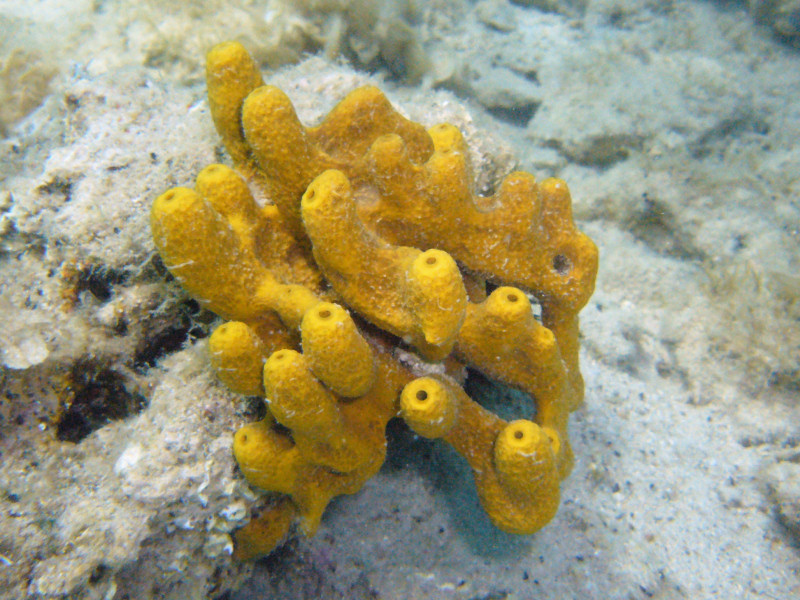
Branching Tube Sponge Aiolochroia crassa
The scientific name of the Branching Tube Sponge is Aiolochroia crassa. It is a species of animal in the family Aplysinidae, order Verongiida. The name dates from 1875.
- Scientific name
- Aiolochroia crassa (Hyatt, 1875)
- Common name
- Branching Tube Sponge
- Genus
- Aiolochroia
- Family
- Aplysinidae
- Order
- Verongiida
- Class
- Demospongiae
- Environment
- marine
- Recorded in
- 32 countries
- Name status
- accepted in the Catalogue of Life

Overview
Aiolochroia crassa occurs in seagrass habitats and reef environments at depths ranging from 3 to 30 metres. It lacks spicules and consists entirely of protein spongin fibers, with large, outward-pointing lobes developing from its base.
Written 27 November 2026 from the sources listed below. Each statement was checked against the passage it cites; statements that could not be supported were removed.
Appearance
The sponge's external coloration can be green, orange, bright yellow, purple, or a combination of these colors. Its internal tissue is usually yellow.[1][2]
It develops large, outward-pointing, cone-shaped projections called lobes from its base. The lobes are normally spaced approximately 1 cm apart and measure about 3–4 mm in height.[3][4]
The openings at the tops of its projections, called oscules, measure approximately 1–2 cm across. Larger individuals can reach lengths or dimensions of approximately 15–45 cm.[5][6]
The sponge lacks spicules and consists entirely of protein spongin fibers. Its thick texture has been described as resembling cheese, and its spongin fibers are larger than those of any other sponge in the Verongida order.[7][8][9]
Habitat
The species occurs in seagrass habitats and reef environments at depths ranging from 3 to 30 metres. It is particularly dominant on inner reef slopes.[10][11][12]
Its geographic range extends from South Florida to the Caribbean Sea. It is particularly dominant on some reefs in the southern and northeastern Caribbean.[13][14]
Diet
The sponge obtains food by filtering water through its choanocytes and collecting small particles. Its reported particulate organic carbon diet consists of approximately 80% particulate organic matter and 20% microscopically resolvable particulate material.[15][16]
Behaviour
The species' defensive properties have been proposed as a contributing factor to its dominance in reef environments.[17]
Uses
The species has attracted biomedical research interest because it contains bioactive bromotyrosine alkaloids. Bioactive compounds found in the species have been investigated for their potential medical applications.[18][19]
A protein identified in the species, called AcrL, can inhibit bacteria from forming protective layers. AcrL has been investigated for its potential to enhance antibiotic treatment against bacterial infections.[20][21]
Classification of the Branching Tube Sponge
| Kingdom | Animalia |
|---|---|
| Phylum | Porifera |
| Class | Demospongiae (Demosponge) |
| Subclass | Verongimorpha |
| Order | Verongiida |
| Family | Aplysinidae |
| Genus | Aiolochroia |
| Species | Aiolochroia crassa (Hyatt, 1875) |
Where the Branching Tube Sponge is found
Checklists and occurrence records place Aiolochroia crassa in 32 countries. GBIF holds 2,275 georeferenced records of it.
Countries
- Antigua and Barbuda 3
- Bahamas 64
- Barbados 3
- Belize 36
- Bermuda 45
- Bonaire, Saint Eustatius and Saba 194
- Brazil 160
- British Virgin Islands 6
- Cayman Islands 239
- Colombia 5
- Cuba 138
- Curacao 39
- Dominica 27
- Dominican Republic 10
- French Guiana 3
- Guadeloupe 288
- Guyana 3
- Honduras 35
- Jamaica 12
- Martinique 115
- Mexico 383
- Panama 56
- Puerto Rico 63
- Saint Barthelemy 17
- Saint Kitts and Nevis 3
- Saint Martin 11
- Sint Maarten 20
- Suriname 4
- Trinidad and Tobago 7
- U.S. Virgin Islands 38
- United States 238
- Venezuela 10
Regions and cities with the most records
- George Town, Cayman Islands 192
- West Bay, Cayman Islands 191
- Kralendijk, Bonaire, Saint Eustatius and Saba 188
- Basse-Terre, Guadeloupe 135
- Cozumel, Mexico 68
- Sainte-Rose, Guadeloupe 63
- Ducos, Martinique 62
- Allende, Mexico 61
- Coatzacoalcos, Mexico 61
- Fraccionamiento Ciudad Olmeca, Mexico 61
- Nanchital de Lázaro Cárdenas del Río, Mexico 61
- Fort-de-France, Martinique 52
- Le Lamentin, Martinique 52
- Minatitlán, Mexico 50
- Saint-Joseph, Martinique 45
- Hamilton, Bermuda 43
- Bonaire, Bonaire, Saint Eustatius and Saba 37
- Philipsburg, Sint Maarten 32
- Marigot, Saint Martin 31
- Bandariba, Curacao 30
- Willemstad, Curacao 30
- Playa del Carmen, Mexico 26
- Roseau, Dominica 22
- Les Abymes, Guadeloupe 19
- Baie-Mahault, Guadeloupe 18
- Killarney, Bahamas 18
- Gustavia, Saint Barthelemy 17
- Nassau, Bahamas 16
- Ponce, Puerto Rico 15
- Le François, Martinique 14
- Saint Croix, U.S. Virgin Islands 14
- Charlotte Amalie, U.S. Virgin Islands 13
- Pointe-à-Pitre, Guadeloupe 13
- Hamilton, Bermuda 12
- Yauco, Puerto Rico 12
- Bocas del Toro Province, Panama 11
1 more country has a few records outside this range
These countries hold a few records of Aiolochroia crassa but lie outside the range the checklists give for it. Such records are often zoo or garden specimens, museum material or vagrants, so the species is not counted as occurring there.
A number beside a place is its count of GBIF occurrence records. A place without a number comes from a checklist alone. Records show where a species has been observed or collected, which can include escapes and vagrants.
Common names
English
- Branching Tube Sponge
- Blue Bleeder
Names in 2 other languages
- French
- Éponge multicolore
- Portuguese
- Esponja-tubular-multicolorida
Synonyms
9 other scientific names have been used for this species and are now treated as synonyms of Aiolochroia crassa.
- Aiolochroia ianthella (de Laubenfels, 1949)
- Aplysina crassa (Hyatt, 1877)
- Dendrospongia crassa Hyatt, 1875
- Ianthella ardis de Laubenfels, 1950
- Ianthella ianthella de Laubenfels, 1949
- Pseudoceratina crassa (Hyatt, 1875)
- Verongia crassa (Hyatt, 1875)
- Verongula ardis (de Laubenfels, 1950)
- Ianthella basta misapplied
Related species
- Aiolochroia thiona
- Aiolochroia janusi
-
 Yellow Tube SpongeAplysina fistularis
-
 Stove-pipe SpongeAplysina archeri
-
 Gold SpongeAplysina aerophoba
-
 Row Pore Rope SpongeAplysina cauliformis
- Pitted SpongeVerongula rigida
-
 Scattered Pore Rope SpongeAplysina fulva
Compare
Questions and answers
What is the scientific name of the Branching Tube Sponge?
The scientific name of the Branching Tube Sponge is Aiolochroia crassa. Written with its author, the full name is Aiolochroia crassa (Hyatt, 1875).
Which family does the Branching Tube Sponge belong to?
Aiolochroia crassa belongs to the family Aplysinidae, in the order Verongiida and the class Demospongiae.
Where is the Branching Tube Sponge found?
Checklists and occurrence records place Aiolochroia crassa in 32 countries, including Mexico, Guadeloupe, Cayman Islands, United States, Bonaire, Saint Eustatius and Saba and Brazil.
What other names does the Branching Tube Sponge have?
Aiolochroia crassa is also known in English as Blue Bleeder.
Sources
Passages the profile rests on
- The sponge's external coloration can be green, orange, bright yellow, purple, or a combination of these colors. Source passage: “External colors are normally green, orange, bright yellow, purple or sometimes multiple of these colors.” — English Wikipedia
- Its internal tissue is usually yellow. Source passage: “Internally the color of the branching tube sponge is usually yellow.” — English Wikipedia
- The sponge develops large, outward-pointing, cone-shaped projections called lobes from its base. Source passage: “Aiolochroia crassa grows in large cone shaped projections known as "lobes" pointing outward from the base” — English Wikipedia
- Its lobes are normally spaced approximately 1 cm apart and measure about 3–4 mm in height. Source passage: “These projections are normally up to 1 cm apart and about 3-4 mm high.” — English Wikipedia
- The openings at the tops of its projections, called oscules, measure approximately 1–2 cm across. Source passage: “At the top of these projections are Oscules opening about 1-2 cm wide.” — English Wikipedia
- Larger individuals can reach lengths or dimensions of approximately 15–45 cm. Source passage: “The larger forms of this sponge can get as large as 15 to 45 cm.” — English Wikipedia
- The sponge lacks spicules and consists entirely of protein spongin fibers. Source passage: “Aiolochroia crassa has no spicules and is made only of protein spongin fibers.” — English Wikipedia
- Its thick texture has been described as resembling cheese. Source passage: “These spongin fibers lead to the sponge be very thick and many have described it to be "cheese like."” — English Wikipedia
- Its spongin fibers are larger than those of any other sponge in the Verongida order. Source passage: “In fact Aiolochroia crassa has the largest sponging fiber size than any other sponge in the Verongida order.” — English Wikipedia
- The species occurs in seagrass habitats and reef environments. Source passage: “In these locations they are commonly found in seagrasses and reefs.” — English Wikipedia
- The species occurs at depths ranging from 3 to 30 metres. Source passage: “They also can be found at numerous depths ranging 3 – 30 meters in depth.” — English Wikipedia
- The species is particularly dominant on inner reef slopes. Source passage: “Particularly, in inner reef slopes they are especially dominant compared to other reef zones.” — English Wikipedia
- The species occurs across a geographic range extending from South Florida to the Caribbean Sea. Source passage: “Aiolochroia crassa can be found on reefs over a very large geographic range from South Florida to the Caribbean Sea.” — English Wikipedia
- The species is particularly dominant on some reefs in the southern and northeastern Caribbean. Source passage: “They are very dominant in reef environments, especially in the southern and northeast Caribbean where at certain reefs they are the most dominant sponge.” — English Wikipedia
- The sponge obtains food by filtering water through its choanocytes and collecting small particles. Source passage: “It is a filter feeder which pumps water through with its choanocytes collecting small particles to consume.” — English Wikipedia
- Its reported particulate organic carbon diet consists of approximately 80% particulate organic matter and 20% microscopically resolvable particulate material. Source passage: “This sponge family has a POC diet of about 80 percent particulate organic matter and 20 percent microscopically resolvable particulate material.” — English Wikipedia
- The species' defensive properties have been proposed as a contributing factor to its dominance in reef environments. Source passage: “This dominance has been attributed by some to the defensive properties of the sponge allowing it to have higher fitness.” — English Wikipedia
- The species has attracted biomedical research interest because it contains bioactive bromotyrosine alkaloids. Source passage: “Aiolochroia crassa has drawn lots of research attention in the medical field due to bioactive bromotyrosine alkalois found inside of them.” — English Wikipedia
- Bioactive compounds found in the species have been investigated for their potential medical applications. Source passage: “The outlook of this compound is still unknown as its discovery was relatively recent. Some scientist believe it could be used in future medical advancements.” — English Wikipedia
- A protein identified in the species, called AcrL, can inhibit bacteria from forming protective layers. Source passage: “This protein, called AcrL, can stop bacteria from forming protective layers that make them harder to kill.” — English Wikipedia
- AcrL has been investigated for its potential to enhance antibiotic treatment against bacterial infections. Source passage: “This means that when combined with antibiotics it could create an extremely effective treatment to infection.” — English Wikipedia
Data
- Catalogue of Life, 2026-10-16 XR cc by
- Global Biodiversity Information Facility CC BY 4.0
- Wikidata CC0
- GeoNames CC BY 4.0
- Wikimedia Commons per image; credit shown with each image
- Within the Catalogue of Life, this name comes from World Porifera Database cc by
This species in other databases
- Catalogue of Life BCL7
- Wikidata Q2600449
- iNaturalist 131713
- WoRMS urn:lsid:marinespecies.org:taxname:169632
- ITIS 47659
Page built on 29 November 2026. See how the catalog is made and all sources and licences.
Cite this page
ScientificNames.org. (2026). Aiolochroia crassa (Branching Tube Sponge). Retrieved November 29, 2026, from https://scientificnames.org/species/aiolochroia-crassa
“Aiolochroia crassa (Branching Tube Sponge).” ScientificNames.org, 2026, scientificnames.org/species/aiolochroia-crassa. Accessed 29 Nov. 2026.
ScientificNames.org. “Aiolochroia crassa (Branching Tube Sponge).” Accessed November 29, 2026. https://scientificnames.org/species/aiolochroia-crassa.
@misc{scientificnames_aiolochroia_crassa_branching_tube_sponge,
  author = {{ScientificNames.org}},
  title = {Aiolochroia crassa (Branching Tube Sponge)},
  year = {2026},
  url = {https://scientificnames.org/species/aiolochroia-crassa},
  note = {Accessed 2026-11-29}
}