Species · Other invertebrates
Gold Sponge Aplysina aerophoba
The scientific name of the Gold Sponge is Aplysina aerophoba. It is a species of animal in the family Aplysinidae, order Verongiida. The name dates from 1833.
- Scientific name
- Aplysina aerophoba (Nardo, 1833)
- Common name
- Gold Sponge
- Genus
- Aplysina
- Family
- Aplysinidae
- Order
- Verongiida
- Class
- Demospongiae
- Environment
- marine
- Recorded in
- 9 countries
- Name status
- accepted in the Catalogue of Life
Overview
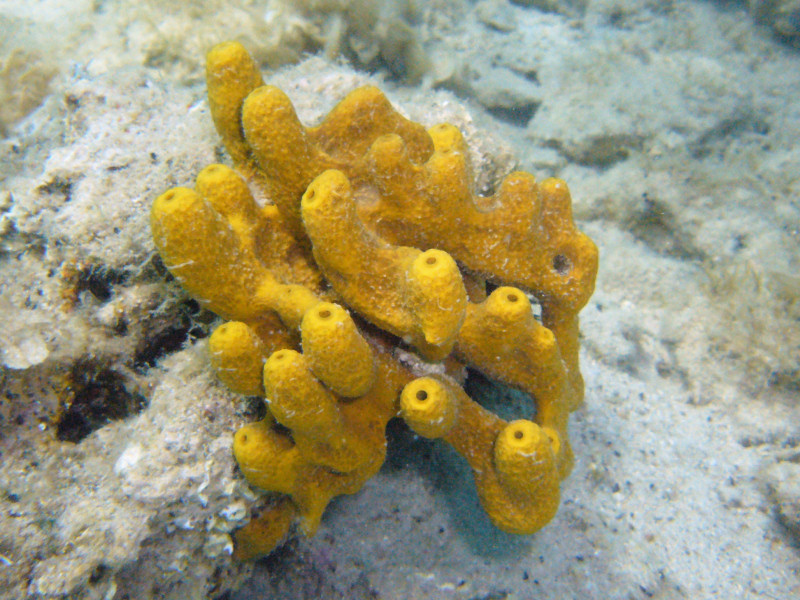
Aplysina aerophoba usually inhabits sunlit marine locations, from the lower intertidal zone to approximately 20 metres deep. Its surface is slippery and its texture firm and rubbery, and it turns blue when taken out of water.
Written 26 November 2026 from the sources listed below. Each statement was checked against the passage it cites; statements that could not be supported were removed.
Appearance
The sponge turns blue when taken out of water. Individual tubular processes can reach 4 centimetres in length and 2.5 centimetres in width, while colonies can reach 1 metre in diameter.[1][2][3]
Habitat
The Gold Sponge usually inhabits sunlit marine locations. It occurs from the lower intertidal zone to approximately 20 metres deep.[4][5]
The species is primarily distributed throughout the Mediterranean Sea. Its Atlantic distribution includes Portugal and northwestern Spain, and it is common in the Canary Islands.[6][7][8]
The Adriatic Sea is the type locality of the species.[9]
Reproduction and life cycle
The Gold Sponge is hermaphroditic. It releases gametes into seawater, where fertilisation takes place.[10][11]
Its larvae are planktonic before settling in suitable locations and developing into juvenile sponges.[12]
The species can also reproduce asexually by producing buds that detach and establish new colonies.[13]
Classification of the Gold Sponge
| Kingdom | Animalia |
|---|---|
| Phylum | Porifera |
| Class | Demospongiae (Demosponge) |
| Subclass | Verongimorpha |
| Order | Verongiida |
| Family | Aplysinidae |
| Genus | Aplysina |
| Species | Aplysina aerophoba (Nardo, 1833) |
Where the Gold Sponge is found
Checklists and occurrence records place Aplysina aerophoba in 9 countries. GBIF holds 4,553 georeferenced records of it.
Countries
- Croatia 740
- Cyprus 6
- France 1,290
- Greece 648
- Italy 130
- Montenegro 6
- Portugal 47
- Slovenia 46
- Spain 1,640
Regions and cities with the most records
- Roses, Spain 1,073
- Catalonia, Spain 395
- Ajaccio, France 349
- Lattes, France 227
- Canary Islands, Spain 206
- Montpellier, France 189
- Castelnau-le-Lez, France 165
- Mauguio, France 164
- Primorje-Gorski Kotar, Croatia 162
- Frontignan, France 157
- Tías, Spain 134
- Agde, France 131
- Puerto del Carmen, Spain 130
- Teguise, Spain 130
- Yaiza, Spain 123
- Arrecife, Spain 119
- San Bartolomé, Spain 119
- Pula, Croatia 116
- Palafrugell, Spain 93
- Sète, France 87
- Koper, Slovenia 70
- Corsica, France 68
- Figueres, Spain 67
- Telde, Spain 66
- Marseille 09, France 51
- Granadilla de Abona, Spain 48
- San Isidro, Spain 47
- San Miguel De Abona, Spain 47
- Arona, Spain 46
- Marseille 11, France 46
- Agüimes, Spain 45
- Carrizal, Spain 45
- Ingenio, Spain 45
- Marignane, France 45
- Marseille 10, France 45
- Marseille 12, France 45
3 more countries have a few records outside this range
These countries hold a few records of Aplysina aerophoba but lie outside the range the checklists give for it. Such records are often zoo or garden specimens, museum material or vagrants, so the species is not counted as occurring there.
A number beside a place is its count of GBIF occurrence records. A place without a number comes from a checklist alone. Records show where a species has been observed or collected, which can include escapes and vagrants.
Common names
English
- Gold Sponge
- Aureate Sponge
- Yellow Tube Sponge
Names in 11 other languages
- Catalan
- aplisina, esponja d'or
- Croatian
- Promjenjiva sumporača
- Czech
- houba komínová
- Dutch
- Gouden spons
- French
- Aplysina des grottes superficielles, vérongia
- Galician
- Esponxa áurea
- German
- Farbwechselnder Zylinderschwamm, Goldschwamm, goldener Zapfenschwamm
- Hungarian
- Aranyszivacs
- Italian
- Verongia comune, verongia
- Portuguese
- esponja amarela
- Spanish
- esponja de tubo amarilla
Synonyms
4 other scientific names have been used for this species and are now treated as synonyms of Aplysina aerophoba.
- Aplysia aerophoba Nardo, 1833
- Aplysina carnosa Schmidt, 1862
- Verongia aerophoba (Nardo, 1833)
- Verongia aerophoba Vacelet, 1959
Related species
-
 Yellow Tube SpongeAplysina fistularis
-
 Stove-pipe SpongeAplysina archeri
-
 Row Pore Rope SpongeAplysina cauliformis
-
 Scattered Pore Rope SpongeAplysina fulva
- Yellow Tube SpongeAplysina insularis
-
 Yellow Cave SpongeAplysina cavernicola
- Giant Tube SpongeAplysina lacunosa
- Aplysina chiriquiensis
Compare
Questions and answers
What is the scientific name of the Gold Sponge?
The scientific name of the Gold Sponge is Aplysina aerophoba. Written with its author, the full name is Aplysina aerophoba (Nardo, 1833).
Which family does the Gold Sponge belong to?
Aplysina aerophoba belongs to the family Aplysinidae, in the order Verongiida and the class Demospongiae.
Where is the Gold Sponge found?
Checklists and occurrence records place Aplysina aerophoba in 9 countries, including Spain, France, Croatia, Greece, Italy and Portugal.
What other names does the Gold Sponge have?
Aplysina aerophoba is also known in English as Aureate Sponge and Yellow Tube Sponge.
Sources
Passages the profile rests on
- The sponge turns blue when taken out of water. Source passage: “When removed from water, this sponge turns blue” — English Wikipedia
- Colonies can reach 1 metre in diameter. Source passage: “Aplysina aerophoba forms colonies up to 1 m (3 ft) across” — English Wikipedia
- Individual tubular processes can reach 4 centimetres in length and 2.5 centimetres in width. Source passage: “Individual tubes are up to 4 cm (1.6 in) long and 2.5 cm (1.0 in) wide” — English Wikipedia
- The species usually inhabits sunlit marine locations. Source passage: “usually being found in sunlit locations.” — English Wikipedia
- The species occurs from the lower intertidal zone to approximately 20 metres deep. Source passage: “Its depth range is from the lower intertidal zone to about 20 m (70 ft)” — English Wikipedia
- The species is primarily distributed throughout the Mediterranean Sea. Source passage: “Aplysina aerophoba is chiefly a Mediterranean species” — English Wikipedia
- Its Atlantic distribution includes Portugal and northwestern Spain. Source passage: “adjacent parts of the Atlantic Ocean in Portugal and northwestern Spain.” — English Wikipedia
- The species is common in the Canary Islands. Source passage: “It is common in the Canary Islands.” — English Wikipedia
- The Adriatic Sea is the type locality of the species. Source passage: “the type locality is the Adriatic Sea.” — English Wikipedia
- Aplysina aerophoba is hermaphroditic. Source passage: “It is a hermaphrodite;” — English Wikipedia
- The species releases gametes into seawater, where fertilisation takes place. Source passage: “the gametes are released into the sea where fertilisation occurs” — English Wikipedia
- Its larvae are planktonic before settling in suitable locations and developing into juvenile sponges. Source passage: “the larvae are planktonic and soon settle in a suitable location and undergo metamorphosis into juvenile sponges.” — English Wikipedia
- The species can reproduce asexually by producing buds that detach and establish new colonies. Source passage: “Under certain conditions, the sponge can produce buds which separate off from the parent and form new colonies.” — English Wikipedia
Data
- Catalogue of Life, 2026-10-16 XR cc by
- Global Biodiversity Information Facility CC BY 4.0
- Wikidata CC0
- GeoNames CC BY 4.0
- Wikimedia Commons per image; credit shown with each image
- Within the Catalogue of Life, this name comes from World Porifera Database cc by
This species in other databases
- Catalogue of Life FQ78
- Wikidata Q139182
- iNaturalist 326154
- WoRMS urn:lsid:marinespecies.org:taxname:133911
Page built on 29 November 2026. See how the catalog is made and all sources and licences.
Cite this page
ScientificNames.org. (2026). Aplysina aerophoba (Gold Sponge). Retrieved November 29, 2026, from https://scientificnames.org/species/aplysina-aerophoba
“Aplysina aerophoba (Gold Sponge).” ScientificNames.org, 2026, scientificnames.org/species/aplysina-aerophoba. Accessed 29 Nov. 2026.
ScientificNames.org. “Aplysina aerophoba (Gold Sponge).” Accessed November 29, 2026. https://scientificnames.org/species/aplysina-aerophoba.
@misc{scientificnames_aplysina_aerophoba_gold_sponge,
  author = {{ScientificNames.org}},
  title = {Aplysina aerophoba (Gold Sponge)},
  year = {2026},
  url = {https://scientificnames.org/species/aplysina-aerophoba},
  note = {Accessed 2026-11-29}
}