Species · Other invertebrates
Stove-pipe Sponge Aplysina archeri
The scientific name of the Stove-pipe Sponge is Aplysina archeri. It is a species of animal in the family Aplysinidae, order Verongiida. The name dates from 1875.
- Scientific name
- Aplysina archeri (Higgin, 1875)
- Common name
- Stove-pipe Sponge
- Genus
- Aplysina
- Family
- Aplysinidae
- Order
- Verongiida
- Class
- Demospongiae
- Environment
- marine
- Recorded in
- 20 countries
- Name status
- accepted in the Catalogue of Life

Overview
The Stove-pipe Sponge occurs primarily in the Western Atlantic Ocean, including the Caribbean, The Bahamas, Florida, and Bonaire. It has elongated, cylindrical tubes that can reach 1.5 metres in height and occur in lavender, pink, gray, or brown.
Written 26 November 2026 from the sources listed below. Each statement was checked against the passage it cites; statements that could not be supported were removed.
Appearance
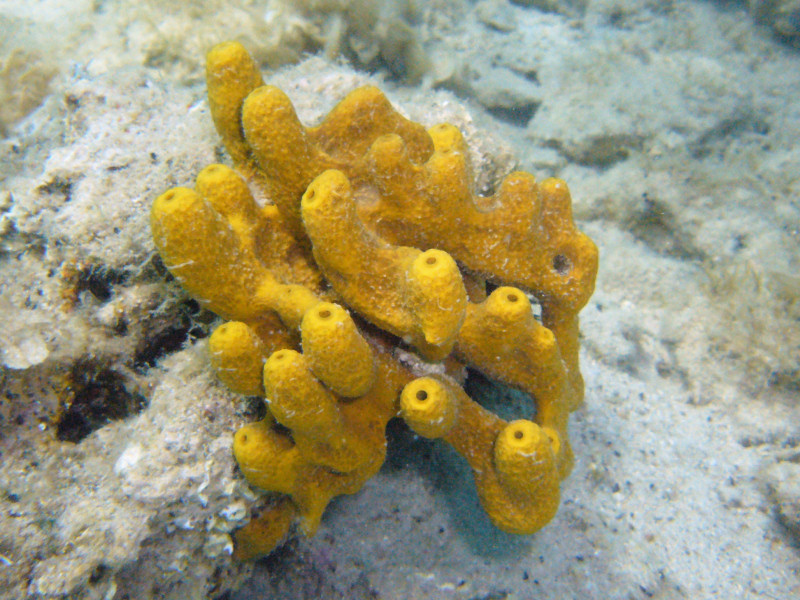
The Stove-pipe Sponge has elongated, cylindrical, tube-shaped structures. Individual tubes can occur in lavender, pink, gray, or brown.[1][2]
An individual tube can reach 1.5 metres in height and 7.6 centimetres in thickness. Its common name refers to its shape.[3][4][5]
Behaviour
The Stove-pipe Sponge can grow as a solitary tube or in groups containing as many as 22 tubes. Snails are among its natural predators.[6][7]
The species can take hundreds of years to grow and continues growing until death.[8]
Reproduction and life cycle
The Stove-pipe Sponge reproduces through both sexual and asexual processes.[9]
Conservation
The population density of the Stove-pipe Sponge is decreasing in association with oil spills and other pollution.[10]
Habitat
The Stove-pipe Sponge occurs primarily in the Western Atlantic Ocean. Recorded areas of occurrence include the Caribbean, The Bahamas, Florida, and Bonaire.[11][12]
Diet
The Stove-pipe Sponge feeds by filtering plankton and suspended detritus from passing water.[13]
Classification of the Stove-pipe Sponge
| Kingdom | Animalia |
|---|---|
| Phylum | Porifera |
| Class | Demospongiae (Demosponge) |
| Subclass | Verongimorpha |
| Order | Verongiida |
| Family | Aplysinidae |
| Genus | Aplysina |
| Species | Aplysina archeri (Higgin, 1875) |
Where the Stove-pipe Sponge is found
Checklists and occurrence records place Aplysina archeri in 20 countries. GBIF holds 974 georeferenced records of it.
Countries
- Aruba 5
- Bahamas 21
- Belize 18
- Bonaire, Saint Eustatius and Saba 524
- British Virgin Islands 9
- Cuba 77
- Curacao 134
- Dominica 3
- Guadeloupe 35
- Haiti 3
- Honduras 40
- Jamaica 12
- Martinique 7
- Mexico 15
- Panama 5
- Puerto Rico 7
- Saint Barthelemy 6
- Sint Maarten 3
- U.S. Virgin Islands 38
- United States 12
Regions and cities with the most records
- Kralendijk, Bonaire, Saint Eustatius and Saba 492
- Bonaire, Bonaire, Saint Eustatius and Saba 127
- Willemstad, Curacao 92
- Bandariba, Curacao 85
- Basse-Terre, Guadeloupe 17
- Charlotte Amalie, U.S. Virgin Islands 17
- Saint Croix, U.S. Virgin Islands 13
- Sainte-Rose, Guadeloupe 10
- Road Town, British Virgin Islands 9
- Baie-Mahault, Guadeloupe 6
- Gustavia, Saint Barthelemy 6
- Les Abymes, Guadeloupe 6
- Santa Cruz, Aruba 5
- Cozumel, Mexico 4
- Le François, Martinique 4
- Marigot, Saint Martin 4
- Noord, Aruba 4
- Oranjestad, Aruba 4
- Philipsburg, Sint Maarten 4
- Tanki Leendert, Aruba 4
- Saba, Bonaire, Saint Eustatius and Saba 3
2 more countries have a few records outside this range
These countries hold a few records of Aplysina archeri but lie outside the range the checklists give for it. Such records are often zoo or garden specimens, museum material or vagrants, so the species is not counted as occurring there.
A number beside a place is its count of GBIF occurrence records. A place without a number comes from a checklist alone. Records show where a species has been observed or collected, which can include escapes and vagrants.
Common names
English
- Stove-pipe Sponge
- Stovepipe Sponge
Names in 1 other language
- Portuguese
- Esponja-tubo-de-fogão
Synonyms
2 other scientific names have been used for this species and are now treated as synonyms of Aplysina archeri.
- Luffaria archeri Higgin, 1875
- Verongia archeri (Higgin, 1875)
Related species
-
 Yellow Tube SpongeAplysina fistularis
-
 Gold SpongeAplysina aerophoba
-
 Row Pore Rope SpongeAplysina cauliformis
-
 Scattered Pore Rope SpongeAplysina fulva
- Yellow Tube SpongeAplysina insularis
-
 Yellow Cave SpongeAplysina cavernicola
- Giant Tube SpongeAplysina lacunosa
- Aplysina chiriquiensis
Compare
Questions and answers
What is the scientific name of the Stove-pipe Sponge?
The scientific name of the Stove-pipe Sponge is Aplysina archeri. Written with its author, the full name is Aplysina archeri (Higgin, 1875).
Which family does the Stove-pipe Sponge belong to?
Aplysina archeri belongs to the family Aplysinidae, in the order Verongiida and the class Demospongiae.
Where is the Stove-pipe Sponge found?
Checklists and occurrence records place Aplysina archeri in 20 countries, including Bonaire, Saint Eustatius and Saba , Curacao, Cuba, Honduras, U.S. Virgin Islands and Guadeloupe.
What other names does the Stove-pipe Sponge have?
Aplysina archeri is also known in English as Stovepipe Sponge.
Sources
Passages the profile rests on
- Aplysina archeri has elongated, cylindrical, tube-shaped structures. Source passage: “has long tube-like structures of cylindrical shape.” — English Wikipedia
- Individual tubes of Aplysina archeri can occur in lavender, pink, gray, or brown. Source passage: “Tubes occur in varying colors including lavender, pink, gray, and brown.” — English Wikipedia
- An individual tube can reach 1.5 metres in height. Source passage: “A single tube can grow up to 5 feet (1.5 m) high” — English Wikipedia
- An individual tube can reach 7.6 centimetres in thickness. Source passage: “3 inches (7.6 cm) thick.” — English Wikipedia
- The common name stove-pipe sponge refers to the species' shape. Source passage: “also known as a stove-pipe sponge because of its shape” — English Wikipedia
- The species can grow as a solitary tube or in groups containing as many as 22 tubes. Source passage: “Although they can grow in a single tube, they often grow in large groups of up to 22 tubes.” — English Wikipedia
- Snails are among the natural predators of Aplysina archeri. Source passage: “Snails are among their natural predators.” — English Wikipedia
- The species can take hundreds of years to grow and continues growing until death. Source passage: “These sponges take hundreds of years to grow and never stop growing until they die.” — English Wikipedia
- Aplysina archeri reproduces through both sexual and asexual processes. Source passage: “They reproduce both by asexual and sexual reproduction.” — English Wikipedia
- The population density of Aplysina archeri is decreasing in association with oil spills and other pollution. Source passage: “The population density of these sponges is decreasing because of oil spills and other pollution.” — English Wikipedia
- The species occurs primarily in the Western Atlantic Ocean. Source passage: “These sponges mostly live in the Western Atlantic Ocean” — English Wikipedia
- Recorded areas of occurrence include the Caribbean, The Bahamas, Florida, and Bonaire. Source passage: “the Caribbean, The Bahamas, Florida, and Bonaire.” — English Wikipedia
- Aplysina archeri feeds by filtering plankton and suspended detritus from passing water. Source passage: “they eat food such as plankton or suspended detritus as it passes them.” — English Wikipedia
Data
- Catalogue of Life, 2026-10-16 XR cc by
- Global Biodiversity Information Facility CC BY 4.0
- Wikidata CC0
- GeoNames CC BY 4.0
- Wikimedia Commons per image; credit shown with each image
- Within the Catalogue of Life, this name comes from World Porifera Database cc by
This species in other databases
- Catalogue of Life FQ7D
- Wikidata Q2378051
- iNaturalist 128106
- WoRMS urn:lsid:marinespecies.org:taxname:169636
Page built on 29 November 2026. See how the catalog is made and all sources and licences.
Cite this page
ScientificNames.org. (2026). Aplysina archeri (Stove-pipe Sponge). Retrieved November 29, 2026, from https://scientificnames.org/species/aplysina-archeri
“Aplysina archeri (Stove-pipe Sponge).” ScientificNames.org, 2026, scientificnames.org/species/aplysina-archeri. Accessed 29 Nov. 2026.
ScientificNames.org. “Aplysina archeri (Stove-pipe Sponge).” Accessed November 29, 2026. https://scientificnames.org/species/aplysina-archeri.
@misc{scientificnames_aplysina_archeri_stove_pipe_sponge,
  author = {{ScientificNames.org}},
  title = {Aplysina archeri (Stove-pipe Sponge)},
  year = {2026},
  url = {https://scientificnames.org/species/aplysina-archeri},
  note = {Accessed 2026-11-29}
}