Species · Birds
Goeldi's Antbird Akletos goeldii
The scientific name of the Goeldi's Antbird is Akletos goeldii. It is a species of bird in the family Thamnophilidae (antbird), order Passeriformes. The name dates from 1908.
- Scientific name
- Akletos goeldii (E. Snethlage, 1908)
- Common name
- Goeldi's Antbird
- Genus
- Akletos
- Family
- Thamnophilidae (Antbird)
- Order
- Passeriformes
- Class
- Aves
- Red List category
- LC Least Concern
- Recorded in
- 3 countries
- Name status
- accepted in the Catalogue of Life

Overview
Akletos goeldii occurs in southeastern Peru, northwestern Bolivia, and the Brazilian states of Acre and Amazonas. It has a prominent red eye surrounded by a ring of bare bluish-gray skin.
Written 27 November 2026 from the sources listed below. Each statement was checked against the passage it cites; statements that could not be supported were removed.
Appearance
Goeldi's Antbird is chunky and short-tailed. It measures 17–18 cm in length and weighs approximately 42 g.[1][2][3]
Adult males are predominantly black and have a usually concealed white patch between their scapulars. Both sexes have a ring of bare bluish-gray skin around the eye, which is paler in females.[4][5]
Adult females have a blackish-gray forecrown, lores, and face, with rufous-brown crowns, upperparts, and wings. Their tails are dark reddish-brown, their throats are white, and their predominantly light-cinnamon underparts have tawny flanks and crissum.[6][7][8][9][10]
Habitat
Goeldi's Antbird primarily inhabits the forest floor and understory of evergreen várzea forest. Its habitat also includes transitional forest, bamboo thickets, and secondary forest.[11][12]
It favors shrubby, vine-tangled vegetation immediately adjoining rivers, particularly Guadua bamboo stands on river floodplains and elevated shelves above them. It occurs mainly below 500 m elevation but reaches 800 m locally in Peru.[13][14][15]
Diet
Goeldi's Antbird feeds on insects and probably other arthropods.[16]
Behaviour
Goeldi's Antbird typically forages alone, in pairs, or in family groups. It searches dense vegetation, mostly on the ground and within approximately 2 m above it.[17][18]
While foraging, it hops between short feeding stops and pumps its tail. It captures prey by gleaning, reaching, or pouncing to the ground from a perch.[19][20]
Goeldi's Antbird occasionally follows army ant swarms to capture prey fleeing from the ants. It only occasionally joins mixed-species feeding flocks.[21][22]
Goeldi's Antbird is believed to remain in its range throughout the year.[23]
Reproduction and life cycle
The breeding season extends from August through November in Peru and may include December in Brazil. Goeldi's Antbird builds a cup-shaped nest from dry leaves and twigs on or near the ground.[24][25]
It lays clutches of one or two eggs, which are white with reddish-brown blotches. Both parents incubate the eggs.[26][27][28]
Conservation
Goeldi's Antbird was assessed as Least Concern in the 2024 IUCN Red List assessment. Its population size is unknown and its population is believed to be stable.[29][30]
The species is considered fairly common throughout its range. No immediate threats to Goeldi's Antbird have been identified.[31][32]
Classification of the Goeldi's Antbird
| Kingdom | Animalia |
|---|---|
| Phylum | Chordata |
| Subphylum | Vertebrata |
| Infraphylum | Gnathostomata |
| Parvphylum | Osteichthyes |
| Megaclass | Tetrapoda |
| Class | Aves (Bird) |
| Order | Passeriformes (Passerine) |
| Family | Thamnophilidae (Antbird) |
| Genus | Akletos (White-shouldered and Goeldi's Antbirds) |
| Species | Akletos goeldii (E. Snethlage, 1908) |
Where the Goeldi's Antbird is found
Checklists and occurrence records place Akletos goeldii in 3 countries across South America. GBIF holds 5,348 georeferenced records of it.
Countries
Regions and cities with the most records
- Madre de Dios, Peru 3,920
- Cuzco Department, Peru 800
- Acre, Brazil 448
- Tambopata, Peru 260
- Puerto Maldonado, Peru 208
- Pando, Bolivia 54
- Ucayali, Peru 45
- Senador Guiomard, Brazil 15
- Rio Branco, Brazil 10
- La Paz Department, Bolivia 8
- Rondônia, Brazil 8
- Junin, Peru 6
- Amazonas, Brazil 5
- Riberalta, Bolivia 3
Range as the checklists state it
South America
A number beside a place is its count of GBIF occurrence records. A place without a number comes from a checklist alone. Records show where a species has been observed or collected, which can include escapes and vagrants.
Common names
English
- Goeldi's Antbird
Names in 23 other languages
- Catalan
- formiguera de Goeldi
- Chinese
- 巴西蟻鳥, 高氏蚁鸟
- Croatian
- goeldijeva mravarica
- Czech
- mravenčík Goeldiův
- Danish
- Rødøjet Myrefugl
- Dutch
- Goeldi's Miervogel
- Esperanto
- ruĝokula formikulo
- Finnish
- isonokimuura
- French
- Alapi de Goeldi, Batara de Goeldi
- German
- Goeldiameisenvogel
- Italian
- Formichiere di Goeldi
- Japanese
- ブラジルアリドリ
- Lithuanian
- Geldžio devynbalsė skruzdinukė
- Norwegian
- amahuacamaurfugl
- Polish
- czarnomrowik czerwonooki
- Portuguese
- Formiguero-de-goeldi, formigueiro-de-goeldi, formigueiro-grande-do-acre
- Russian
- Боливийский муравьеловка, Славковая муравьянка
- Slovak
- mravcovka červenooká
- Spanish
- Hormiguero de Goeldi
- Swedish
- amahuacamyrfågel, göldimyrfågel
- Turkish
- Goeldi Karıncakuşu
- Ukrainian
- покривник червоноокий
- Welsh
- aderyn morgrug Goeldi
Synonyms
4 other scientific names have been used for this species and are now treated as synonyms of Akletos goeldii.
- Inundicola goeldii (E. Snethlage, 1908)
- Myrmeciza goeldii (E. Snethlage, 1908)
- Myrmelastes goeldii E. Snethlage, 1908
- Percnostola goeldii Snethlage, HMMEE, 1908
Related species
-
 White-shouldered AntbirdAkletos melanoceps
-
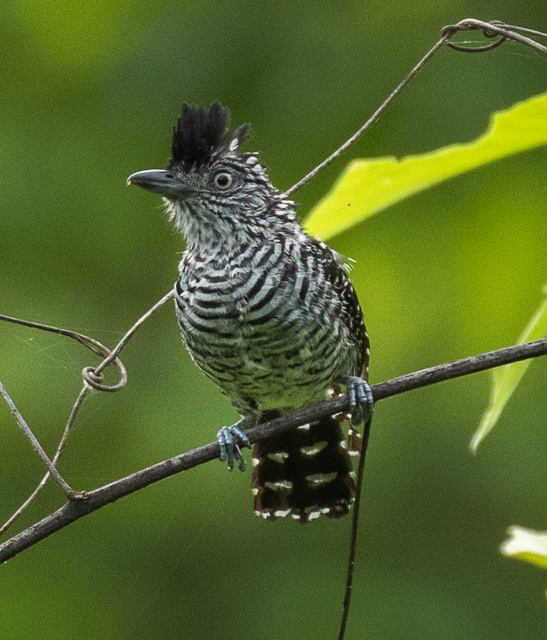 Barred AntshrikeThamnophilus doliatus
-
 Great AntshrikeTaraba major
-
 Black-crowned AntshrikeThamnophilus atrinucha
-
 Ocellated AntbirdPhaenostictus mcleannani
-
 Bicolored AntbirdGymnopithys bicolor
-
 Fasciated AntshrikeCymbilaimus lineatus
-
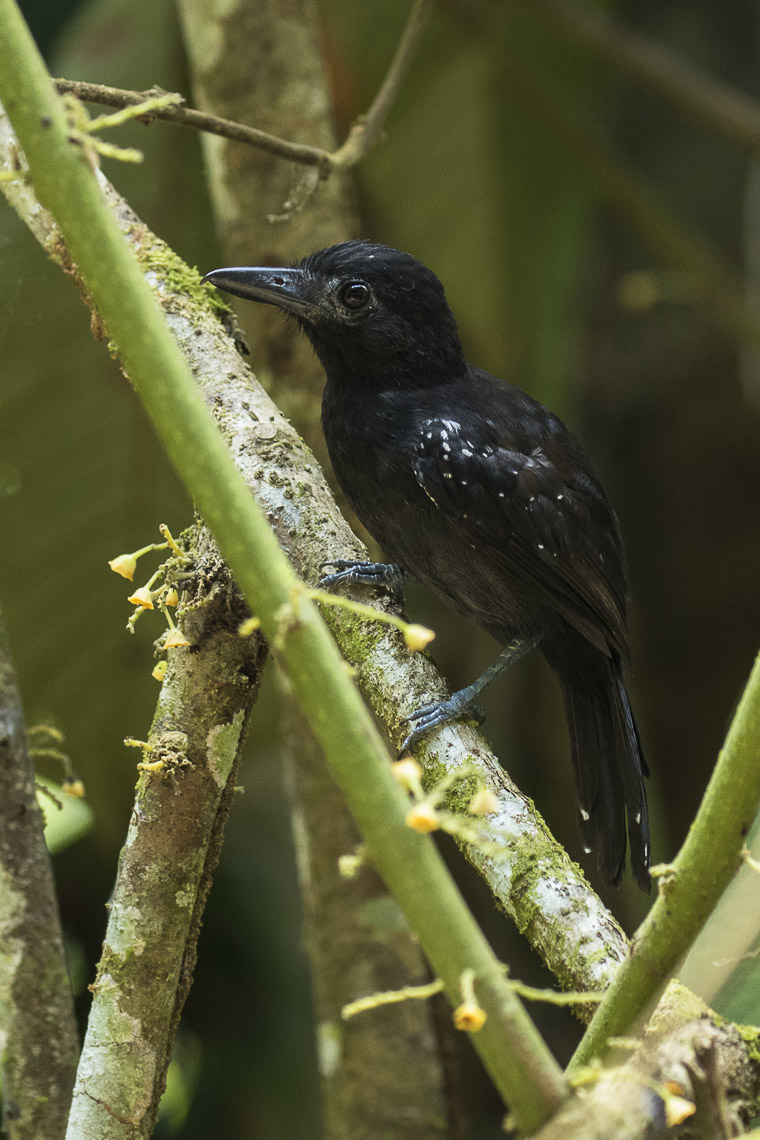 Black-hooded AntshrikeThamnophilus bridgesi
Compare
Questions and answers
What is the scientific name of the Goeldi's Antbird?
The scientific name of the Goeldi's Antbird is Akletos goeldii. Written with its author, the full name is Akletos goeldii (E. Snethlage, 1908).
Which family does the Goeldi's Antbird belong to?
Akletos goeldii belongs to the family Thamnophilidae, in the order Passeriformes and the class Aves.
Where is the Goeldi's Antbird found?
Checklists and occurrence records place Akletos goeldii in 3 countries: Peru, Brazil and Bolivia.
What is the conservation status of the Goeldi's Antbird?
The IUCN Red List category recorded for Akletos goeldii is Least Concern (LC).
Sources
Passages the profile rests on
- Goeldi's Antbird is described as chunky and short-tailed. Source passage: “Chunky, short-tailed antbird of humid lowlands.” — ebird.org
- Goeldi's Antbird measures 17–18 cm in length. Source passage: “Goeldi's antbird is 17 to 18 cm (6.7 to 7.1 in) long” — English Wikipedia
- Goeldi's Antbird weighs approximately 42 g. Source passage: “and weighs about 42 g (1.5 oz).” — English Wikipedia
- Both sexes have a ring of bare bluish-gray skin around the eye, which is paler in females. Source passage: “Both sexes have a ring of bare bluish gray skin around their eye, though the female's is paler, and a red iris.” — English Wikipedia
- Adult males are predominantly black and have a usually concealed white patch between their scapulars. Source passage: “Adult males are mostly black with a usually concealed white patch between their scapulars.” — English Wikipedia
- Adult females have a blackish-gray forecrown, lores, and face. Source passage: “Adult females have a blackish gray forecrown, lores, and face.” — English Wikipedia
- Adult females have rufous-brown crowns, upperparts, and wings. Source passage: “Their crown, upperparts, and wings are rufous-brown” — English Wikipedia
- Adult females have dark reddish-brown tails. Source passage: “and their tail dark reddish brown.” — English Wikipedia
- Adult females have white throats. Source passage: “Their throat is white.” — English Wikipedia
- Adult females have predominantly light-cinnamon underparts with tawny flanks and crissum. Source passage: “Their underparts are mostly light cinnamon with tawny flanks and crissum.” — English Wikipedia
- Goeldi's Antbird primarily inhabits the forest floor and understory of evergreen várzea forest. Source passage: “It primarily inhabits the floor and understorey of várzea evergreen forest” — English Wikipedia
- Its habitat also includes transitional forest, bamboo thickets, and secondary forest. Source passage: “but also transitional forest, bamboo thickets, and secondary forest.” — English Wikipedia
- Goeldi's Antbird favors shrubby, vine-tangled vegetation immediately adjoining rivers. Source passage: “It favors the shrubby vine-tangled areas immediately adjoining rivers” — English Wikipedia
- The species favors Guadua bamboo stands on river floodplains and elevated shelves above them. Source passage: “and stands of Guadua bamboo on the river floodplain and on shelves above it.” — English Wikipedia
- Goeldi's Antbird occurs mainly below 500 m elevation but reaches 800 m locally in Peru. Source passage: “In elevation it mostly occurs below 500 m (1,600 ft) but reaches 800 m (2,600 ft) locally in Peru.” — English Wikipedia
- Goeldi's Antbird feeds on insects and probably other arthropods. Source passage: “Goeldi's antbird feeds on insects and probably other arthropods.” — English Wikipedia
- The species typically forages alone, in pairs, or in family groups. Source passage: “It typically forages singly, in pairs, or in family groups” — English Wikipedia
- Goeldi's Antbird forages in dense vegetation, mostly on the ground and within approximately 2 m above it. Source passage: “in dense vegetation, mostly on the ground and within about 2 m (7 ft) above it.” — English Wikipedia
- While foraging, the species hops between short feeding stops and pumps its tail. Source passage: “It hops between short feeding stops, pumping its tail.” — English Wikipedia
- The species captures prey by gleaning, reaching, or pouncing to the ground from a perch. Source passage: “It captures prey by gleaning, reaching, or pouncing to the ground from a perch.” — English Wikipedia
- Goeldi's Antbird occasionally follows army ant swarms to capture prey fleeing from the ants. Source passage: “It occasionally, and perhaps regularly, follows army ant swarms to capture prey fleeing the ants” — English Wikipedia
- The species only occasionally joins mixed-species feeding flocks. Source passage: “and only occasionally joins mixed-species feeding flocks.” — English Wikipedia
- Goeldi's Antbird is believed to remain in its range throughout the year. Source passage: “Goeldi's antbird is believed to be a year-round resident throughout its range.” — English Wikipedia
- The breeding season extends from August through November in Peru and may include December in Brazil. Source passage: “The breeding season of Goeldi's antbird has not been detailed but spans from August to November in Peru and perhaps includes December in Brazil.” — English Wikipedia
- The species builds a cup-shaped nest from dry leaves and twigs on or near the ground. Source passage: “Its nest is a cup made of dry leaves and twigs on or near the ground.” — English Wikipedia
- Goeldi's Antbird lays clutches of one or two eggs. Source passage: “Its clutch is one or two eggs” — English Wikipedia
- Its eggs are white with reddish-brown blotches. Source passage: “that are white with reddish brown blotches.” — English Wikipedia
- Both parents incubate the eggs. Source passage: “Both parents incubate the clutch.” — English Wikipedia
- Goeldi's Antbird was assessed as Least Concern in the 2024 IUCN Red List assessment. Source passage: “Goeldi's Antbird Akletos goeldii has most recently been assessed for The IUCN Red List of Threatened Species in 2024. Akletos goeldii is listed as Least Concern” — iucnredlist.org
- The population size of Goeldi's Antbird is unknown and its population is believed to be stable. Source passage: “its population size is not known and is believed to be stable.” — English Wikipedia
- No immediate threats to Goeldi's Antbird have been identified. Source passage: “No immediate threats have been identified.” — English Wikipedia
- Goeldi's Antbird is considered fairly common throughout its range. Source passage: “It is considered fairly common across its range.” — English Wikipedia
Data
- Catalogue of Life, 2026-10-16 XR cc by
- Global Biodiversity Information Facility CC BY 4.0
- Wikidata CC0
- GeoNames CC BY 4.0
- Wikimedia Commons per image; credit shown with each image
- Within the Catalogue of Life, this name comes from The Integrated Taxonomic Information System cc0
This species in other databases
Page built on 28 November 2026. See how the catalog is made and all sources and licences.
Cite this page
ScientificNames.org. (2026). Akletos goeldii (Goeldi's Antbird). Retrieved November 28, 2026, from https://scientificnames.org/species/akletos-goeldii
“Akletos goeldii (Goeldi's Antbird).” ScientificNames.org, 2026, scientificnames.org/species/akletos-goeldii. Accessed 28 Nov. 2026.
ScientificNames.org. “Akletos goeldii (Goeldi's Antbird).” Accessed November 28, 2026. https://scientificnames.org/species/akletos-goeldii.
@misc{scientificnames_akletos_goeldii_goeldis_antbird,
  author = {{ScientificNames.org}},
  title = {Akletos goeldii (Goeldi's Antbird)},
  year = {2026},
  url = {https://scientificnames.org/species/akletos-goeldii},
  note = {Accessed 2026-11-28}
}