Species · Birds
Fasciated Antshrike Cymbilaimus lineatus
The scientific name of the Fasciated Antshrike is Cymbilaimus lineatus. It is a species of bird in the family Thamnophilidae (antbird), order Passeriformes. The name dates from 1814.
- Scientific name
- Cymbilaimus lineatus (Leach, 1814)
- Common name
- Fasciated Antshrike
- Genus
- Cymbilaimus
- Family
- Thamnophilidae (Antbird)
- Order
- Passeriformes
- Class
- Aves
- Red List category
- LC Least Concern
- Recorded in
- 13 countries
- Name status
- accepted in the Catalogue of Life

Overview
Cymbilaimus lineatus occurs in Central America from Honduras southward and throughout mainland South America except Argentina, Chile, Paraguay, and Uruguay. It exhibits significant sexual dimorphism, with finely barred black-and-white plumage in adult males and predominantly dark brown and pale yellowish brown barred plumage in females.
Written 26 November 2026 from the sources listed below. Each statement was checked against the passage it cites; statements that could not be supported were removed.
Appearance
Adult males of the nominate subspecies have a black forehead and crown with thin white bars and black-and-white barred plumage elsewhere. Adult males have finely barred black-and-white plumage and a more solid black cap.[1][2]
Females of the nominate subspecies have a rufous crown and predominantly dark brown and pale yellowish brown barred plumage.[3]
Both sexes have red irises and heavy bills with hooked tips. The species exhibits significant sexual dimorphism.[4][5]
The species measures 17–18 cm in length and weighs 35–40 g.[6][7]
Habitat
The species inhabits primary and secondary evergreen forests in lowlands and Andean foothills. In Central America, it generally occupies second growth and thickets rather than forest interiors.[8][9]
It favors vine tangles and dense mid-storey vegetation throughout its range. It typically occurs below 800 m elevation across most of its range, but in Colombia it occurs up to 1,400 m.[10][11][12]
Diet
The species feeds primarily on large insects belonging to several families. Its diet also includes spiders, small lizards, frogs, and small quantities of fruit.[13][14]
Behaviour
The species forages individually or in pairs and sometimes joins mixed-species feeding flocks. It typically forages in vine clusters and near tree trunks at heights of 5–20 m above the ground.[15][16]
It captures prey by reaching, lunging, and making short sallies from perches. It sometimes follows army ants to capture prey flushed by them but is not an obligate ant-follower.[17][18]
The species is presumed to remain in its range throughout the year. It is more frequently heard than seen because it generally remains high in dense vegetation.[19][20]
Reproduction and life cycle
The breeding season varies geographically and extends from April to June in Costa Rica and from July to November in Amazonian Brazil. Recently fledged young have been recorded in the Guianas during September and October.[21][22][23]
The nest is a cup constructed from plant and fungal fibers and attached by its rim in a branch fork. It is generally positioned 2–10 m above the ground and concealed by foliage.[24][25]
The usual clutch consists of two eggs. The eggs are creamy white with blotches ranging from lilac to olivaceous brown.[26][27]
Both parents incubate during the day, while the female incubates alone at night.[28]
Conservation
The species is classified as Least Concern by the IUCN. Its estimated population comprises at least 500,000 mature individuals and is believed to be decreasing.[29][30]
No immediate threats have been identified for the species. It is described as fairly common, being uncommon to common across most of its range but rare to uncommon in Honduras and parts of Costa Rica.[31][32][33]
Classification of the Fasciated Antshrike
| Kingdom | Animalia |
|---|---|
| Phylum | Chordata |
| Subphylum | Vertebrata |
| Infraphylum | Gnathostomata |
| Parvphylum | Osteichthyes |
| Megaclass | Tetrapoda |
| Class | Aves (Bird) |
| Order | Passeriformes (Passerine) |
| Family | Thamnophilidae (Antbird) |
| Genus | Cymbilaimus (Fasciated Antshrikes) |
| Species | Cymbilaimus lineatus (Leach, 1814) |
Where the Fasciated Antshrike is found
Checklists and occurrence records place Cymbilaimus lineatus in 13 countries across North America and South America. GBIF holds 41,133 georeferenced records of it.
Countries
- Bolivia 346
- Brazil 5,950
- Colombia 2,013
- Costa Rica 10,022
- Ecuador 2,656
- French Guiana 692
- Guyana 617
- Honduras 91
- Nicaragua 141
- Panama 13,833
- Peru 3,671
- Suriname 708
- Venezuela 393
Regions and cities with the most records
- Alcalde Díaz, Panama 11,558
- Chilibre, Panama 11,332
- Colón, Panama 7,740
- Heredia Province, Costa Rica 6,300
- Panamá, Panama 4,629
- Panama City, Panama 4,244
- Arraiján, Panama 4,224
- Curundú, Panama 4,209
- Ancón, Panama 4,204
- San Miguelito, Panama 3,337
- Veracruz, Panama 2,585
- Alajuela Province, Costa Rica 2,387
- Madre de Dios, Peru 2,264
- Amazonas, Brazil 1,906
- Juan Díaz, Panama 1,707
- Pará, Brazil 1,546
- Mato Grosso, Brazil 1,469
- Orellana Province, Ecuador 1,160
- Limón Province, Costa Rica 789
- Loreto, Peru 719
- Coclé, Panama 583
- Rondônia, Brazil 501
- Sucumbíos, Ecuador 479
- Sipaliwini District, Suriname 436
- Darién, Panama 395
- Vaupés, Colombia 391
- Puerto Maldonado, Peru 389
- Napo, Ecuador 374
- Cartago Province, Costa Rica 342
- Potaro-Siparuni, Guyana 334
- Turrialba, Costa Rica 326
- Mitú, Colombia 283
- Antioquia, Colombia 280
- San Martín Department, Peru 263
- Bolívar, Venezuela 246
- Amazonas Department, Colombia 242
1 more country has a few records outside this range
These countries hold a few records of Cymbilaimus lineatus but lie outside the range the checklists give for it. Such records are often zoo or garden specimens, museum material or vagrants, so the species is not counted as occurring there.
Range as the checklists state it
Middle America
South America
A number beside a place is its count of GBIF occurrence records. A place without a number comes from a checklist alone. Records show where a species has been observed or collected, which can include escapes and vagrants.
Common names
English
- Fasciated Antshrike
Names in 24 other languages
- Catalan
- batarà barrat
- Chinese
- 带斑蚁鵙, 帶斑蟻鵙
- Croatian
- crvenooka mravarica
- Czech
- mravenčík proužkovaný
- Danish
- Båndmyretornskade
- Dutch
- Zebramierklauwier
- Esperanto
- zebrostria formikulo
- Finnish
- isonokkamuura
- French
- Batara fascié
- German
- Zebra- Ameisenwürger, Zebraameisenwürger
- Hungarian
- amazoni hangyászgébics
- Italian
- Averla formichiera fasciata, Averla formichiera lineata
- Japanese
- サザナミアリモズ
- Lithuanian
- paprastoji dryžoji skruzdlesė
- Norwegian
- gittermaurvarsler
- Polish
- zebrzak wielkodzioby
- Portuguese
- formigueiro-de-bico-grosso, papa-formiga-barrado
- Russian
- Зебровый колючник, Полосатый колючник
- Slovak
- batara pruhovaná
- Spanish
- Batará capirotado, Batará lineado
- Swedish
- zebramyrtörnskata
- Turkish
- Yazılı Karıncaavcısı
- Ukrainian
- колючник смугастий
- Welsh
- morgrugydd llinellog penddu
Synonyms
One other scientific name has been used for this species and is now treated as a synonym of Cymbilaimus lineatus.
- Lanius lineatus Leach, 1814
Subspecies and varieties
- Cymbilaimus lineatus fasciatus subspecies
- Cymbilaimus lineatus intermedius subspecies
- Cymbilaimus lineatus lineatus subspecies
Related species
-
 Bamboo AntshrikeCymbilaimus sanctaemariae
-
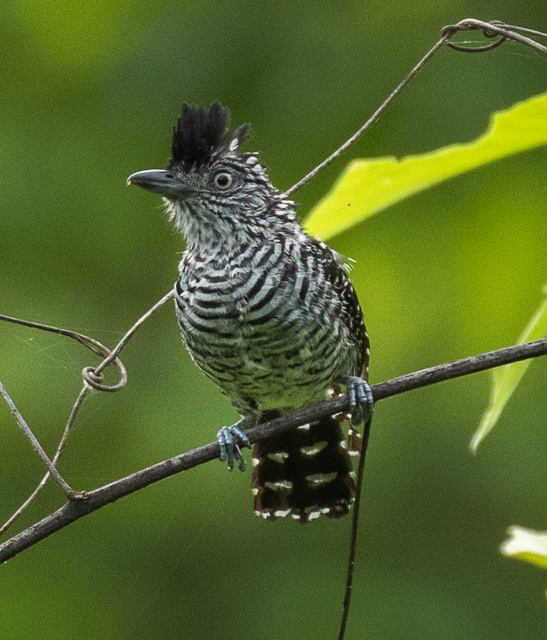 Barred AntshrikeThamnophilus doliatus
-
 Great AntshrikeTaraba major
-
 Black-crowned AntshrikeThamnophilus atrinucha
-
 Ocellated AntbirdPhaenostictus mcleannani
-
 Bicolored AntbirdGymnopithys bicolor
-
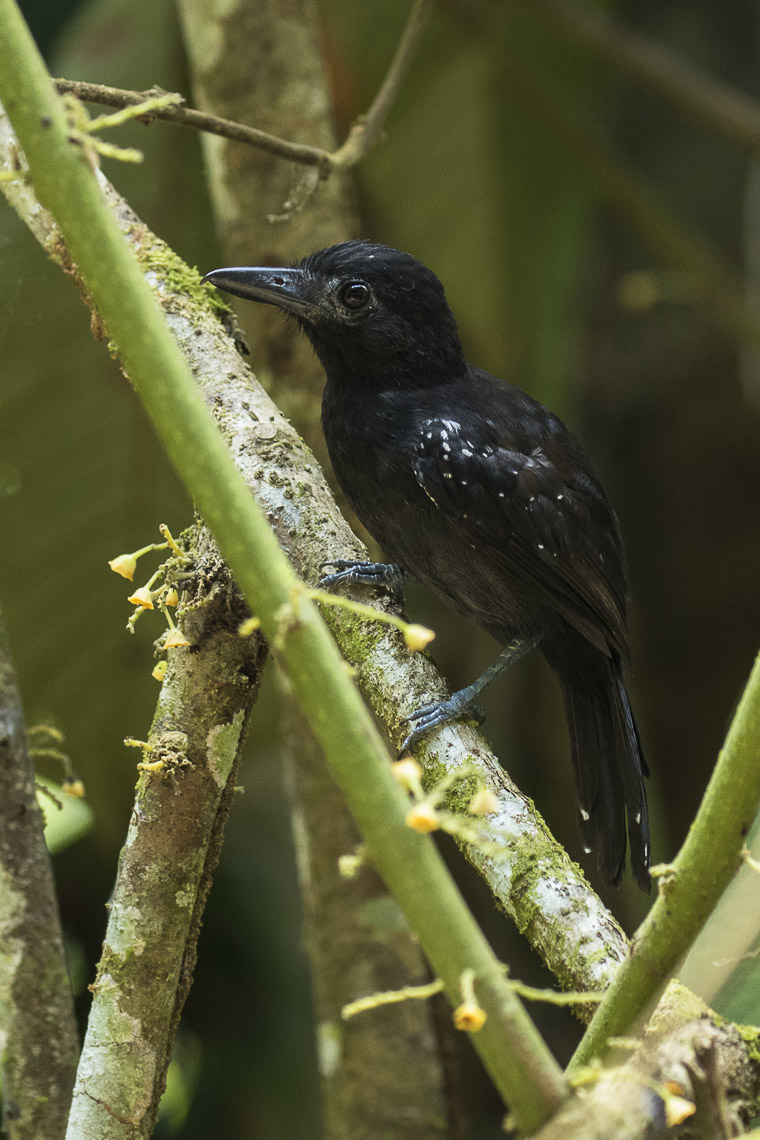 Black-hooded AntshrikeThamnophilus bridgesi
-
 Black-crested AntshrikeSakesphorus canadensis
Compare
Questions and answers
What is the scientific name of the Fasciated Antshrike?
The scientific name of the Fasciated Antshrike is Cymbilaimus lineatus. Written with its author, the full name is Cymbilaimus lineatus (Leach, 1814).
Which family does the Fasciated Antshrike belong to?
Cymbilaimus lineatus belongs to the family Thamnophilidae, in the order Passeriformes and the class Aves.
Where is the Fasciated Antshrike found?
Checklists and occurrence records place Cymbilaimus lineatus in 13 countries, including Panama, Costa Rica, Brazil, Peru, Ecuador and Colombia.
What is the conservation status of the Fasciated Antshrike?
The IUCN Red List category recorded for Cymbilaimus lineatus is Least Concern (LC).
Where does the Fasciated Antshrike occur?
It occurs in Central America from Honduras southward and throughout mainland South America except Argentina, Chile, Paraguay, and Uruguay. Its geographic distribution is disjunct.[34][35]
What are the subspecies and their distributions?
C. l. fasciatus occurs from southeastern Honduras through Nicaragua, Costa Rica, and Panama. C. l. intermedius occurs from southern Colombia and Venezuela south through eastern Ecuador and eastern Peru into Bolivia. The nominate subspecies occurs in eastern Venezuela, Guyana, Suriname, French Guiana, and northern Amazonian Brazil.[36][37][38]
Sources
Passages the profile rests on
- Adult males of the nominate subspecies have a black forehead and crown with thin white bars and black-and-white barred plumage elsewhere. Source passage: “Adult males of the nominate subspecies have a black forehead and crown with a few very thin white bars. The rest of their plumage is thin black and white bars.” — English Wikipedia
- Adult males have finely barred black-and-white plumage and a more solid black cap. Source passage: “Male is finely barred black-and-white all over with a more solid black cap.” — ebird.org
- Females of the nominate subspecies have a rufous crown and predominantly dark brown and pale yellowish brown barred plumage. Source passage: “Females have a rufous crown. Most of the rest of their plumage is thin dark brown and pale yellowish brown bars” — English Wikipedia
- Both sexes have red irises and heavy bills with hooked tips. Source passage: “Both sexes of all subspecies have a red iris and a heavy bill with a hook at the end like true shrikes.” — English Wikipedia
- The species exhibits significant sexual dimorphism. Source passage: “This species exhibits significant sexual dimorphism.” — English Wikipedia
- The species measures 17–18 cm in length. Source passage: “The fasciated antshrike is 17 to 18 cm (6.7 to 7.1 in) long” — English Wikipedia
- The species weighs 35–40 g. Source passage: “weighs 35 to 40 g (1.2 to 1.4 oz).” — English Wikipedia
- The species inhabits both primary and secondary evergreen forests in lowlands and Andean foothills. Source passage: “The fasciated antshrike inhabits evergreen forest both primary and secondary in the lowlands and Andean foothills.” — English Wikipedia
- In Central America, the species generally occupies second growth and thickets rather than forest interiors. Source passage: “In Central America it tends to be in second growth and thickets rather than the forest interior.” — English Wikipedia
- The species favors vine tangles and dense mid-storey vegetation throughout its range. Source passage: “In all areas it favors vine tangles and dense mid-storey vegetation.” — English Wikipedia
- The species typically occurs below 800 m elevation across most of its range. Source passage: “in most of the rest of its range it occurs below 800 m (2,600 ft).” — English Wikipedia
- In Colombia, the species occurs up to 1,400 m elevation. Source passage: “1,400 m (4,600 ft) in Colombia” — English Wikipedia
- The species feeds primarily on large insects belonging to several families. Source passage: “The fasciated antshrike feeds primarily on large insects of several families” — English Wikipedia
- Its diet also includes spiders, small lizards, frogs, and small quantities of fruit. Source passage: “its diet also includes other arthropods like spiders, small lizards, frogs, and small amounts of fruit.” — English Wikipedia
- The species forages individually or in pairs and sometimes joins mixed-species feeding flocks. Source passage: “It forages singly or in pairs and sometimes joins mixed-species feeding flocks as they pass through its territory.” — English Wikipedia
- The species typically forages in vine clusters and near tree trunks at heights of 5–20 m above the ground. Source passage: “It typically feeds in vine clusters and near tree trunks between 5 and 20 m (15 and 65 ft) above the ground” — English Wikipedia
- The species captures prey by reaching, lunging, and making short sallies from perches. Source passage: “It hops sluggishly through vegetation taking prey by reaching, lunging, and making short sallies from a perch.” — English Wikipedia
- The species sometimes follows army ants to capture prey flushed by them but is not an obligate ant-follower. Source passage: “It will also follow army ants to take prey flushed by them, but they are not obligate ant-followers.” — English Wikipedia
- The species is presumed to remain in its range throughout the year. Source passage: “The fasciated antshrike is presumed to be a year-round resident throughout its range.” — English Wikipedia
- The species is more frequently heard than seen because it generally remains high in dense vegetation. Source passage: “Because it mostly stays high in dense vegetation it is more often heard than seen.” — English Wikipedia
- The breeding season varies geographically and extends from April to June in Costa Rica. Source passage: “It spans April to June in Costa Rica” — English Wikipedia
- In Amazonian Brazil, the breeding season extends from July to November. Source passage: “and July to November in Amazonian Brazil” — English Wikipedia
- Recently fledged young have been recorded in the Guianas during September and October. Source passage: “recently fledged young were noted in the Guianas in September and October.” — English Wikipedia
- The nest is a cup constructed from plant and fungal fibers and attached by its rim in a branch fork. Source passage: “Its nest is a cup made from plant and fungal fibers attached by its rim in a branch fork.” — English Wikipedia
- The nest is generally positioned 2–10 m above the ground and concealed by foliage. Source passage: “It is typically placed 2 to 10 m (7 to 30 ft) above the ground and hidden by foliage.” — English Wikipedia
- The usual clutch consists of two eggs. Source passage: “The usual clutch is two eggs;” — English Wikipedia
- The eggs are creamy white with blotches ranging from lilac to olivaceous brown. Source passage: “the eggs are creamy white with blotches that range from lilac to olivaceous brown.” — English Wikipedia
- Both parents incubate during the day, while the female incubates alone at night. Source passage: “Both parents incubate the clutch during the day and the female alone at night.” — English Wikipedia
- The species is classified as Least Concern by the IUCN. Source passage: “The IUCN has assessed the fasciated antshrike as being of Least Concern.” — English Wikipedia
- The estimated population comprises at least 500,000 mature individuals and is believed to be decreasing. Source passage: “its estimated population of at least 500,000 mature individuals is believed to be decreasing.” — English Wikipedia
- No immediate threats have been identified for the species. Source passage: “No immediate threats have been identified.” — English Wikipedia
- The species is described as fairly common. Source passage: “The species is described as 'fairly common'” — datazone.birdlife.org
- The species is uncommon to common across most of its range but rare to uncommon in Honduras and parts of Costa Rica. Source passage: “It is considered uncommon to common in most of its range though rare to uncommon in Honduras and parts of Costa Rica.” — English Wikipedia
- The species occurs in Central America from Honduras southward and throughout mainland South America except Argentina, Chile, Paraguay, and Uruguay. Source passage: “It is found in Central America from Honduras south and in every mainland South American country except Argentina, Chile, Paraguay, and Uruguay.” — English Wikipedia
- The species has a disjunct geographic distribution. Source passage: “The fasciated antshrike has a disjunct distribution.” — English Wikipedia
- Subspecies C. l. fasciatus occurs from southeastern Honduras through Nicaragua, Costa Rica, and Panama. Source passage: “It is found from El Paraíso Department in southeastern Honduras, south through Nicaragua and Costa Rica on the Caribbean slope, and through Panama on both the Caribbean and Pacific slopes though locally in the latter.” — English Wikipedia
- Subspecies C. l. intermedius occurs from southern Colombia and Venezuela south through eastern Ecuador and eastern Peru into Bolivia. Source passage: “Subspecies C. l. intermedius is found from southern Colombia and Venezuela south through eastern Ecuador and eastern Peru into Bolivia” — English Wikipedia
- The nominate subspecies occurs in eastern Venezuela, Guyana, Suriname, French Guiana, and northern Amazonian Brazil. Source passage: “The nominate subspecies C. l. lineatus is found from eastern Bolívar state in Venezuela east through Guyana and Suriname into French Guiana and south into Amazonian Brazil north of the Amazon between the Branco and Negro rivers.” — English Wikipedia
Data
- Catalogue of Life, 2026-10-16 XR cc by
- Global Biodiversity Information Facility CC BY 4.0
- Wikidata CC0
- GeoNames CC BY 4.0
- Wikimedia Commons per image; credit shown with each image
- Within the Catalogue of Life, this name comes from The Integrated Taxonomic Information System cc0
References
- Gill, Frank, & and Minturn Wright. (2006). Birds of the World: Recommended English Names.
This species in other databases
Page built on 28 November 2026. See how the catalog is made and all sources and licences.
Cite this page
ScientificNames.org. (2026). Cymbilaimus lineatus (Fasciated Antshrike). Retrieved November 28, 2026, from https://scientificnames.org/species/cymbilaimus-lineatus
“Cymbilaimus lineatus (Fasciated Antshrike).” ScientificNames.org, 2026, scientificnames.org/species/cymbilaimus-lineatus. Accessed 28 Nov. 2026.
ScientificNames.org. “Cymbilaimus lineatus (Fasciated Antshrike).” Accessed November 28, 2026. https://scientificnames.org/species/cymbilaimus-lineatus.
@misc{scientificnames_cymbilaimus_lineatus_fasciated_antshrike,
  author = {{ScientificNames.org}},
  title = {Cymbilaimus lineatus (Fasciated Antshrike)},
  year = {2026},
  url = {https://scientificnames.org/species/cymbilaimus-lineatus},
  note = {Accessed 2026-11-28}
}