Species · Reptiles
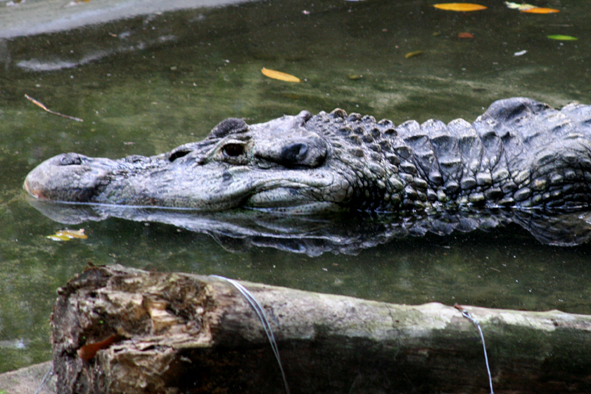
Chinese Alligator Alligator sinensis
The scientific name of the Chinese Alligator is Alligator sinensis. It is a species of reptile in the family Alligatoridae (caimans), order Crocodylia. The name dates from 1879.
- Scientific name
- Alligator sinensis Fauvel, 1879
- Common name
- Chinese Alligator
- Genus
- Alligator
- Family
- Alligatoridae (Caimans)
- Order
- Crocodylia
- Class
- Reptilia
- Red List category
- CR Critically Endangered
- Environment
- freshwater, terrestrial
- Recorded in
- 2 countries
- Name status
- accepted in the Catalogue of Life

Overview
The Chinese alligator (Alligator sinensis; simplified Chinese: 鼍; traditional Chinese: 鼉; pinyin: tuó), also known as the Yangtze alligator (simplified Chinese: 扬子鳄; traditional Chinese: 揚子鱷; pinyin: yángzǐ'è), China alligator, or historically the muddy dragon, is a crocodilian endemic to China. It and the American alligator (A.
Classification of the Chinese Alligator
| Kingdom | Animalia |
|---|---|
| Phylum | Chordata |
| Subphylum | Vertebrata |
| Infraphylum | Gnathostomata |
| Parvphylum | Osteichthyes |
| Megaclass | Tetrapoda |
| Class | Reptilia (Reptile) |
| Order | Crocodylia |
| Family | Alligatoridae (Caimans) |
| Genus | Alligator (Alligators) |
| Species | Alligator sinensis Fauvel, 1879 |
Where the Chinese Alligator is found
Checklists and occurrence records place Alligator sinensis in 2 countries across Asia. GBIF holds 164 georeferenced records of it.
Countries
Regions and cities with the most records
- Anhui, China 36
- Xuancheng, China 11
- Shanghai, China 7
- Fujian, China 6
- Gansu, China 6
- Shaowu, China 6
- Gushu, China 4
- Chongming, China 3
- Hefei, China 3
- Jiangsu, China 3
- Zhejiang, China 1
2 more countries have a few records outside this range
These countries hold a few records of Alligator sinensis but lie outside the range the checklists give for it. Such records are often zoo or garden specimens, museum material or vagrants, so the species is not counted as occurring there.
Range as the checklists state it
China (areas around the lower Yangzi River in Jiangau, Zhejiang, Anhui)
A number beside a place is its count of GBIF occurrence records. A place without a number comes from a checklist alone. Records show where a species has been observed or collected, which can include escapes and vagrants.
Common names
English
- Chinese Alligator
- China Alligator
- Muddy Dragon
- T'o
- Yangtze River Alligator
- Yangtze Alligator
- Yow Lung
Names in 19 other languages
- Afrikaans
- Sjinese Alligator
- Arabic
- قاطور صيني
- Chinese
- 扬子鳄, 揚子鱷
- Czech
- aligátor čínský
- French
- Alligator de Chine
- German
- China-Alligator
- Hungarian
- kínai aligátor
- Italian
- Alligatore cinese
- Japanese
- ヨウスコウアリゲーター, ヨウスコウワニ
- Korean
- 양쯔강악어
- Norwegian Bokmål
- Kinaalligator, Kinesisk Alligator
- Polish
- Aligator chiński
- Portuguese
- Jacaré-chinês
- Russian
- Китайский аллигатор
- Serbian
- кинески алигатор
- Slovenian
- kitajski aligator
- Spanish
- Aligator de China, Aligátor chino
- Thai
- จระเข้ตีนเป็ดจีน
- Ukrainian
- Алігатор китайський
Synonyms
One other scientific name has been used for this species and is now treated as a synonym of Alligator sinensis.
- Caigator sinensis Deraniyagala, 1947
Related species
-
 American AlligatorAlligator mississippiensis
- Alligator hailensis
-
 Black CaimanMelanosuchus niger
-
 Spectacled CaimanCaiman crocodilus
-
 Cuvier's Dwarf CaimanPaleosuchus palpebrosus
-
 Yacare CaimanCaiman yacare
-
 Broad-snouted CaimanCaiman latirostris
-
 Smooth-fronted CaimanPaleosuchus trigonatus
Compare
Questions and answers
What is the scientific name of the Chinese Alligator?
The scientific name of the Chinese Alligator is Alligator sinensis. Written with its author, the full name is Alligator sinensis Fauvel, 1879.
Which family does the Chinese Alligator belong to?
Alligator sinensis belongs to the family Alligatoridae, in the order Crocodylia and the class Reptilia.
Where is the Chinese Alligator found?
Checklists and occurrence records place Alligator sinensis in 2 countries: China and Japan.
What is the conservation status of the Chinese Alligator?
The IUCN Red List category recorded for Alligator sinensis is Critically Endangered (CR).
What other names does the Chinese Alligator have?
Alligator sinensis is also known in English as China Alligator, Muddy Dragon, T'o, Yangtze River Alligator, Yangtze Alligator and Yow Lung.
Sources
Data
- Catalogue of Life, 2026-10-16 XR cc by
- Global Biodiversity Information Facility CC BY 4.0
- Wikidata CC0
- English Wikipedia CC BY-SA 4.0
- GeoNames CC BY 4.0
- Wikimedia Commons per image; credit shown with each image
- Within the Catalogue of Life, this name comes from The Reptile Database cc by
References
- Fauvel, A.A. (1879). Alligators in China: Their History, Description and Identification. J. North-China Branch Royal Asiatic Society (Shanghai) , N.S. 13: 1-36. where the name was published
- Fauvel, A. A. (1879). Alligators in China: Their History, Description and Identification. J. North-China Branch Royal Asiatic Society (Shanghai) , N.S. 13: 1-36.
- Boulenger, G. A. (1889). Catalogue of the chelonians, rhynchocephalians, and crocodiles in the British Museum (Natural History). British Museum, London, 311 Pp.
- Barbour, & Thomas. (1922). Further remarks on the Chinese Alligator. Proc. New England Zool. Club 8: 31-34.
- Stejneger, L. (1925). Chinese amphibians and reptiles in the United States National Museum. Proc. US Natl. Mus. 66 (2562): 1-115.
- Hsiao, S. D. (1934). Natural history notes on the Yangtze alligator, Alligator sinensis Fauvel. Peking Nat. Hist. Bull. 9: 283-292.
- Deraniyagala. (1947). Proc. Third Ann. Sessions Ceylon Assoc. Sci., Pt. 2:12.
- Fishman, H. K., Mitra, J., & Dowling, H. G. (1968). The karyotype of the Chinese alligator (Alligator sinensis). Mammal. Chrom. Newsl. 9: 81-82.
- Garrick, L. D. (1975). Structure and pattern of the roars of Chinese alligators (Alligator sinensis Fauvel). Herpetologica 31 (1): 26-31.
- Wermuth, H., & Fuchs, K. (1978). Bestimmen von Krokodilen und ihrer Häute. Gustav Fischer Verlag, Stuttgart - New York, 100 Pages, [ISBN 3-437-30268-X].
- Chu-chien, & Huang. (1982). The Ecology of the Chinese Alligator and Changes in its Geographical Distribution. In CROCODILES, Proceedings of the 5th Working Meeting of the Crocodile Specialist Group of the Species Survival Commission of the IUCN and Natural Resources, 1980. Iucn Publication New Series: 54-62 [Isbn 2-8032-209-X].
- Huang, Lin, & and Zhang. (1986). Oceanol. Limnol. Sinica 4 (4): 360-371.
- Gu, H.; Ruan, R. & Zhang, Z. (1992). Electrocardiogram Research on the Chinese Alligator (Alligator sinensis). Asiatic Herpetological Research 4: 137-140.
- Chen, B., & Liang, B. (1992). Preliminary Research on the Function of the Eggshell in the Chinese Alligator (Alligator sinensis). Asiatic Herpetological Research 4: 132-136.
- Wang, P. C., & Zhang, J. H. (1993). Resting Metabolic Rate in Three Age-groups of Alligator sinensis. Asiatic Herpetological Research 5: 112-116.
- Zhao, E., & Adler, K. (1993). Herpetology of China. SSAR, Oxford/Ohio, 1-522.
- Trutnau, L. (1994). Krokodile. Westarp Wissenschaften (Magdeburg), 270 Pp.
- Steffen, V. (1998). Das Portrait: Alligator sinensis (Fauvel, 1879). Sauria 20 (2): 1-2.
- Thorbjarnarson, J. B., & Xiaoming, W. (1999). The Conservation Status of the Chinese Alligator. Oryx 33 (2):152-159.
- Thorbjarnarson, J., X. Wang & L. He. (2001). Reproductive Ecology of the Chinese Alligator (Alligator sinensis) and Implications for Conservation. Journal of Herpetology 35 (4): 553-558.
- Wu, Xiao-Bing; Wang, Yi-Quan; Zhou, Kai-Ya; tong, Zong-Zhong; Nie, Ji-Shan; Wang, Chao-Lin and Xie, Wan-Shu. (2001). Systematic relationships of 8 crocodilian species suggested by 12S rRNA gene sequence. Acta Zool. Sinica 47 (5): 522-527.
- Wu, X.-B., Wang, Y.-Q., Zhou, K.-Y., Zhu, W.-Q., Nie, J.-S., Wang, C.-L., & Xie, W.-S. (2002). Genetic Variation in Captive Population of Chinese Alligator, Alligator sinensis, Revealed by Random Amplified Polymorphic DNA (RAPD). Biological Conservation 106:435-441.
- Thorbjarnarson, John; Wang, Xiaoming; Ming, Shao; He, Lijun; Ding, Youzhong; Wu, Yuelong; McMurry, Scott T. (2002). Wild Populations of the Chinese Alligator Approach Extinction. Biological Conservation 103:93-102.
- Olbort, S. (2003). Eingewöhnung und Haltung von Alligator sinensis FAUVEL 1879. Elaphe 11 (4): 40-46.
- Ziegler, T., & Olbort, S. (2004). Genitalstrukturen und Geschlechtsunterscheidung bei Krokodilen. Draco 5 (20): 39-47.
This species in other databases
- Catalogue of Life BTRF
- Wikidata Q194422
- iNaturalist 26156
- WoRMS urn:lsid:marinespecies.org:taxname:1670890
- ITIS 202209
Page built on 24 November 2026. See how the catalog is made and all sources and licences.
Cite this page
ScientificNames.org. (2026). Alligator sinensis (Chinese Alligator). Retrieved November 24, 2026, from https://scientificnames.org/species/alligator-sinensis
“Alligator sinensis (Chinese Alligator).” ScientificNames.org, 2026, scientificnames.org/species/alligator-sinensis. Accessed 24 Nov. 2026.
ScientificNames.org. “Alligator sinensis (Chinese Alligator).” Accessed November 24, 2026. https://scientificnames.org/species/alligator-sinensis.
@misc{scientificnames_alligator_sinensis_chinese_alligator,
  author = {{ScientificNames.org}},
  title = {Alligator sinensis (Chinese Alligator)},
  year = {2026},
  url = {https://scientificnames.org/species/alligator-sinensis},
  note = {Accessed 2026-11-24}
}