Species · Birds
Green Avadavat Amandava formosa
The scientific name of the Green Avadavat is Amandava formosa. It is a species of bird in the family Estrildidae (munias), order Passeriformes. The name dates from 1790.
- Scientific name
- Amandava formosa (Latham, 1790)
- Common name
- Green Avadavat
- Genus
- Amandava
- Family
- Estrildidae (Munias)
- Order
- Passeriformes
- Class
- Aves
- Red List category
- VU Vulnerable
- Recorded in
- 1 country
- Name status
- accepted in the Catalogue of Life

Overview
The Green Avadavat is an Estrildid finch in the family Estrildidae. The species is endemic to the Indian subcontinent, with its largest populations in central and north-western India. It has green and yellow plumage, a bright red bill and black zebra-like stripes on its flanks.
Written 26 November 2026 from the sources listed below. Each statement was checked against the passage it cites; statements that could not be supported were removed.
Appearance
The Green Avadavat measures approximately 10 cm in length. Its upper plumage is olive green, while the lower breast, belly and vent are bright yellow.[1][2]
The species has a waxy red bill, red eyes and pale fleshy or brown legs. Its flanks are distinctly barred with brown and white markings.[3][4][5]
Males have brighter green and yellow plumage than females, which are slightly paler. Both sexes have pale tips on their wing-coverts and tertials.[6][7][8]
Young birds have duller plumage, black bills and unbarred flanks.[9]
Habitat
The Green Avadavat mainly inhabits dry scrub regions and agricultural lands. It is often found near water.[10][11]
At Mount Abu, the species has been observed using agricultural land, tall grasses, bushes and semi-evergreen vegetation. At Mount Abu Wildlife Sanctuary, its occurrence was associated with higher elevations and greater grass and shrub cover.[12][13]
Behaviour
Green Avadavats forage in small groups, particularly outside the breeding season.[14]
The species produces a high-pitched warbling song that ends in a prolonged trill.[15]
Reproduction and life cycle
The Green Avadavat breeds in central India from October to January and has also been recorded breeding in July.[16]
The species constructs spherical nests from broad grass or sugarcane leaves, with an entrance on the side. Breeding pairs may construct several nests near one another in loose colonies.[17][18]
The clutch contains four to six eggs.[19]
Conservation
The Green Avadavat has a restricted distribution and its populations are threatened by the bird trade. The species has declined mainly because of trapping and has been traded as a cage bird since the late nineteenth century.[20][21][22]
The species remains common in some locations, including Oriya village, Achalgarh and Guru Shikhar in Mount Abu, Rajasthan. Habitat awareness and protection efforts at Mount Abu have helped some populations persist.[23][24]
A Mount Abu conservation initiative involved local youth in monitoring potential sites. The Abu Model connected Green Avadavat habitat protection with nature tourism, guiding, birding and livelihood opportunities.[25][26]
A 2023 survey detected the species in 40 of 129 one-square-kilometre survey squares at Mount Abu Wildlife Sanctuary. Sprawl and land-use change were identified as risks to suitable habitat.[27][28]
Removing invasive shrubs requires careful evaluation because some shrub vegetation may provide cover for the species.[29]
Classification of the Green Avadavat
| Kingdom | Animalia |
|---|---|
| Phylum | Chordata |
| Subphylum | Vertebrata |
| Infraphylum | Gnathostomata |
| Parvphylum | Osteichthyes |
| Megaclass | Tetrapoda |
| Class | Aves (Bird) |
| Order | Passeriformes (Passerine) |
| Family | Estrildidae (Munias) |
| Genus | Amandava (Avadavats) |
| Species | Amandava formosa (Latham, 1790) |
Where the Green Avadavat is found
Checklists and occurrence records place Amandava formosa in 1 country. GBIF holds 91 georeferenced records of it.
Countries
Regions and cities with the most records
A number beside a place is its count of GBIF occurrence records. A place without a number comes from a checklist alone. Records show where a species has been observed or collected, which can include escapes and vagrants.
Common names
English
- Green Avadavat
- Green Munia
Names in 29 other languages
- Arabic
- مونيا أخضر
- Bulgarian
- Маслиненозелена муния
- Catalan
- múnia verd
- Chinese
- 綠色梅花雀, 綠色紅梅花雀, 绿梅花雀
- Croatian
- zelena estrilda
- Czech
- tygříček olivový
- Danish
- Olivengrøn Astrild
- Dutch
- Olijfastrild
- Esperanto
- verda estrildo
- Estonian
- viher-amadiin
- Finnish
- vihertiikeripeippo
- French
- Bengali vert
- German
- Grüner Tigerfink, Olivastrild, Olivgrüner Astrild, Schönfink
- Hungarian
- olajzöld asztrild
- Italian
- Bengalino verde
- Japanese
- シマキンカ
- Lithuanian
- alyvinė astrilda
- Norwegian
- gitterastrild
- Polish
- bengalik oliwkowy
- Portuguese
- bengali-verde, bico-de-lacre-verde
- Russian
- Оливково-зелёный астрильд, Оливковый астрильд
- Serbian
- Zelena tigrasta zeba
- Slovak
- amandava olivová
- Spanish
- Bengalí verde
- Swedish
- grön tigerfink
- Turkish
- Yeşil Avadava
- Ukrainian
- бенгалик оливковий
- Welsh
- cwyrbig gwyrdd
- bho
- हरियर मुनिया चिरई
Synonyms
6 other scientific names have been used for this species and are now treated as synonyms of Amandava formosa.
- Estrilda formosa Latham, J, 1790
- Estrilda formosa formosa Collar & Andrew, 1988
- Fringilla formosa Latham, J, 1790
- Fringilla pulchella Forster, JR, 1795
- Sporaeginthus formosa Latham, J, 1790
- Stictospiza formosa Latham, J, 1790
Related species
-
 Red AvadavatAmandava amandava
-
 Orange-breasted WaxbillAmandava subflava
-
 Scaly-breasted MuniaLonchura punctulata
-
 Common WaxbillEstrilda astrild
-
 Indian SilverbillEuodice malabarica
-
 Red-browed FinchNeochmia temporalis
-
 White-rumped MuniaLonchura striata
-
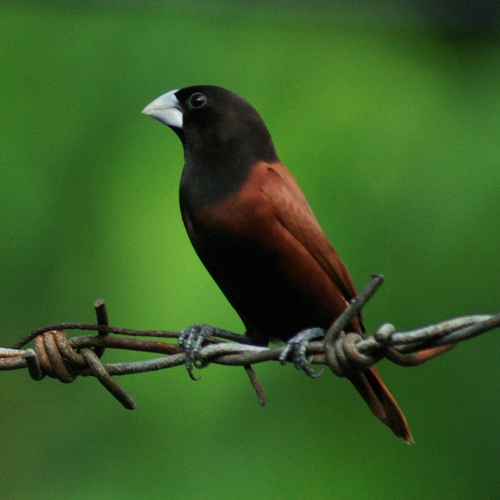 Chestnut MuniaLonchura atricapilla
Compare
Questions and answers
What is the scientific name of the Green Avadavat?
The scientific name of the Green Avadavat is Amandava formosa. Written with its author, the full name is Amandava formosa (Latham, 1790).
Which family does the Green Avadavat belong to?
Amandava formosa belongs to the family Estrildidae, in the order Passeriformes and the class Aves.
Where is the Green Avadavat found?
Checklists and occurrence records place Amandava formosa in 1 country: India.
What is the conservation status of the Green Avadavat?
The IUCN Red List category recorded for Amandava formosa is Vulnerable (VU).
What other names does the Green Avadavat have?
Amandava formosa is also known in English as Green Munia.
Sources
Passages the profile rests on
- The Green Avadavat measures approximately 10 cm in length. Source passage: “The green avadavat is approximately 10 cm long” — English Wikipedia
- The upper plumage is olive green, while the lower breast, belly and vent are bright yellow. Source passage: “The upper plumage is olive green. The upper tail coverts are more yellow and the tail is black and rounded with broad feathers. The chin is pale yellow and the lower breast, belly and vent are brighter yellow.” — English Wikipedia
- The Green Avadavat has brown-and-white barred flanks. Source passage: “The flanks are barred with brown and white.” — English Wikipedia
- Its bill is waxy red and its legs are pale fleshy or brown. Source passage: “The bill is waxy red and the legs are pale fleshy or brown.” — English Wikipedia
- The species has red eyes and distinctly barred flanks. Source passage: “Very pretty small finch-like bird with red bill, red eyes, and distinctly barred flanks.” — ebird.org
- Females are slightly paler than males. Source passage: “The female is slightly paler than the male.” — English Wikipedia
- Both sexes have pale tips on their wing-coverts and tertials. Source passage: “Both sexes have pale tips to wing-coverts and tertials.” — English Wikipedia
- Males have brighter green and yellow plumage than females. Source passage: “Sexes are similar, but males have brighter greens and yellows than ...” — ebird.org
- Young birds have duller plumage, black bills and unbarred flanks. Source passage: “Young birds are duller with a black bill and lack the barring on the flanks.” — English Wikipedia
- The Green Avadavat mainly inhabits dry scrub regions and agricultural lands. Source passage: “This species is found mainly in the dry scrub regions and agricultural lands” — English Wikipedia
- The species is often found near water. Source passage: “and is often found close to water.” — English Wikipedia
- At Mount Abu, the species has been observed using agricultural land, tall grasses, bushes and semi-evergreen vegetation. Source passage: “The observations included birds using agricultural land, tall grasses, bushes and semi-evergreen vegetation.” — English Wikipedia
- At Mount Abu Wildlife Sanctuary, the species' occurrence was associated with higher elevations and greater grass and shrub cover. Source passage: “Occurrence was associated with higher elevations and greater grass and shrub cover” — English Wikipedia
- Green Avadavats forage in small groups, particularly outside the breeding season. Source passage: “They forage in small groups especially in the non-breeding season.” — English Wikipedia
- The species produces a high-pitched warbling song that ends in a prolonged trill. Source passage: “Its voice song is high-pitched warble, ending with prolonged trill” — English Wikipedia
- The Green Avadavat breeds in central India from October to January and has also been recorded breeding in July. Source passage: “They breed in central India from October to January but are also known to breed in July.” — English Wikipedia
- The species constructs spherical nests from broad grass or sugarcane leaves, with an entrance on the side. Source passage: “The nest is made out of broad leaves of grass or sugarcane and is spherical with an entrance on the side.” — English Wikipedia
- Breeding pairs may construct several nests near one another in loose colonies. Source passage: “Several nests may be built in the vicinity by pairs that form a loose colony.” — English Wikipedia
- The clutch contains four to six eggs. Source passage: “The clutch is four to six eggs.” — English Wikipedia
- The Green Avadavat has a restricted distribution and its populations are threatened by the bird trade. Source passage: “They have a restricted distribution and populations are threatened by the bird trade.” — English Wikipedia
- The species has declined mainly because of trapping. Source passage: “but has declined mainly due to trapping.” — English Wikipedia
- The Green Avadavat has been traded as a cage bird since the late nineteenth century. Source passage: “The green avadavat has been a popular cage bird and has been in the bird trade since the late 19th century.” — English Wikipedia
- The species remains common in some locations, including Oriya village, Achalgarh and Guru Shikhar in Mount Abu, Rajasthan. Source passage: “It continues to be common in some areas such as Oriya village, Achalgarh and Guru Shikhar in Mount Abu, Rajasthan” — English Wikipedia
- Habitat awareness and protection efforts at Mount Abu have helped some populations persist. Source passage: “Awareness and protection of habitats at Mt Abu have helped the continued existence of some populations.” — English Wikipedia
- A Mount Abu conservation initiative involved local youth in monitoring potential sites. Source passage: “A socio-ecological model developed around the Green Avadavat involved local youth in monitoring potential sites” — English Wikipedia
- The Abu Model connected Green Avadavat habitat protection with nature tourism, guiding, birding and livelihood opportunities. Source passage: “connecting Green Avadavat habitat protection with nature tourism, nature guiding, birding and livelihood opportunities.” — English Wikipedia
- A 2023 survey detected the species in 40 of 129 one-square-kilometre survey squares at Mount Abu Wildlife Sanctuary. Source passage: “Surveys conducted during March–August 2023 covered 129 1-km² squares, with the species detected in 40 squares.” — English Wikipedia
- Sprawl and land-use change were identified as risks to suitable Green Avadavat habitat at Mount Abu. Source passage: “while sprawl and land-use change were identified as risks to suitable habitat.” — English Wikipedia
- Removing invasive shrubs requires careful evaluation because some shrub vegetation may provide cover for the species. Source passage: “The study also noted that removal of invasive shrubs should be evaluated carefully because some shrub vegetation may provide cover for the species.” — English Wikipedia
- The Green Avadavat has green and yellow plumage, a bright red bill, and black zebra-like stripes on its flanks. Source passage: “with green and yellow on the body, a bright red bill and black "zebra stripes" on the flanks.” — English Wikipedia
- The Green Avadavat is classified as an Estrildid finch. Source passage: “The green avadavat or green munia (Amandava formosa) is a species of Estrildid finch” — English Wikipedia
Data
- Catalogue of Life, 2026-10-16 XR cc by
- Global Biodiversity Information Facility CC BY 4.0
- Wikidata CC0
- GeoNames CC BY 4.0
- Wikimedia Commons per image; credit shown with each image
- Within the Catalogue of Life, this name comes from The Integrated Taxonomic Information System cc0
References
- Dickinson, Edward C., ed. (2003). The Howard and Moore Complete Checklist of the Birds of the World, 3rd Edition.
- Gill, Frank, & and Minturn Wright. (2006). Birds of the World: Recommended English Names.
This species in other databases
Page built on 26 November 2026. See how the catalog is made and all sources and licences.
Cite this page
ScientificNames.org. (2026). Amandava formosa (Green Avadavat). Retrieved November 26, 2026, from https://scientificnames.org/species/amandava-formosa
“Amandava formosa (Green Avadavat).” ScientificNames.org, 2026, scientificnames.org/species/amandava-formosa. Accessed 26 Nov. 2026.
ScientificNames.org. “Amandava formosa (Green Avadavat).” Accessed November 26, 2026. https://scientificnames.org/species/amandava-formosa.
@misc{scientificnames_amandava_formosa_green_avadavat,
  author = {{ScientificNames.org}},
  title = {Amandava formosa (Green Avadavat)},
  year = {2026},
  url = {https://scientificnames.org/species/amandava-formosa},
  note = {Accessed 2026-11-26}
}