Species · Fishes
Hoosier Cavefish Amblyopsis hoosieri
The scientific name of the Hoosier Cavefish is Amblyopsis hoosieri. It is a species of fish in the family Amblyopsidae (cavefishes), order Percopsiformes. The name dates from 2014.
- Scientific name
- Amblyopsis hoosieri Niemiller, Prejean & Chakrabarty, 2014
- Common name
- Hoosier Cavefish
- Genus
- Amblyopsis
- Family
- Amblyopsidae (Cavefishes)
- Order
- Percopsiformes
- Class
- Teleostei
- Environment
- freshwater
- Recorded in
- 1 country
- Name status
- accepted in the Catalogue of Life

Overview
The Hoosier Cavefish is a fish formally described in 2014. It lacks developed eyes and navigates in darkness using rows of bumpy sensory papillae.
Written 26 November 2026 from the sources listed below. Each statement was checked against the passage it cites; statements that could not be supported were removed.
Appearance
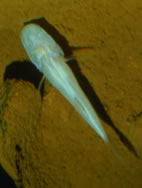
The Hoosier Cavefish has a pinkish-white body with red coloration around the gills and transparent fins. Exposure to light reveals a light pink coloration produced by hemoglobin in its blood.[1][2]
Its body is dorsally flattened but robust, with short rounded fins and a lower jaw that extends beyond the upper jaw. Compared with its congener, it has a particularly plump, wrinkled body and rounded fins.[3][4]
The species lacks functional vision and developed eyes. Its head measures approximately one-quarter of its total body length.[5][6]
Rows of bumpy sensory papillae help the fish navigate in darkness. Its average body length is 6–8 centimetres.[7][8]
Habitat
The Hoosier Cavefish inhabits pools in slow-flowing underground cave streams. It occurs in underground water bodies ranging from approximately 10 centimetres to more than 2 metres deep.[9][10]
The species is distributed across 68 caves and six springs in Indiana, between the Ohio River and the East Fork of the White River. Its geographical range is restricted to caves that remained uncovered by glaciers during the Pleistocene.[11][12]
Diet
The Hoosier Cavefish mainly consumes small crustaceans. Its diet includes amphipods, copepods, isopods, and crayfish.[13][14]
Behaviour
The Hoosier Cavefish compensates for its lack of sight through heightened sensitivity to vibrations. It is considered the apex predator in its subterranean ecosystem.[15][16]
The species has a low metabolic rate that helps it cope with food scarcity. It can survive extended periods between meals using stored fat reserves.[17][18]
Reproduction and life cycle
Breeding occurs between February and April, coinciding with the highest water levels. Females brood their eggs inside their gill cavities.[19][20]
Females provide care for their offspring for four to five months after hatching. Individuals reach sexual maturity at approximately three to four years of age.[21][22]
Conservation
Agricultural sedimentation, human encroachment, and groundwater contamination by herbicides, pesticides, and fertilizers threaten the Hoosier Cavefish. Excessive scientific specimen collection during the late nineteenth and early twentieth centuries may also have adversely affected the species.[23][24]
The original describing authors recommended classifying the species as vulnerable on the IUCN Red List. It is recorded as having moderate vulnerability, with a score of 36 out of 100.[25][26]
The species occurs within the protected area of Spring Mill State Park. Indiana has policies intended to protect species belonging to the genus Amblyopsis.[27][28]
Similar species
Amblyopsis spelaea is the only other congener identified in the species description. The Hoosier Cavefish was formerly considered to belong to the same species as the Northern cavefish, Amblyopsis spelaea.[29][30]
Genetic differences distinguish the Hoosier Cavefish from the related southern population of Amblyopsis spelaea. A genetic mutation resulting in a premature stop codon in rhodopsin occurs in the southern lineage but is absent from the Hoosier Cavefish lineage.[31][32]
Classification of the Hoosier Cavefish
| Kingdom | Animalia |
|---|---|
| Phylum | Chordata |
| Subphylum | Vertebrata |
| Infraphylum | Gnathostomata |
| Parvphylum | Osteichthyes |
| Gigaclass | Actinopterygii |
| Superclass | Actinopteri |
| Class | Teleostei (Teleost) |
| Order | Percopsiformes |
| Family | Amblyopsidae (Cavefishes) |
| Genus | Amblyopsis (Cavefishes) |
| Species | Amblyopsis hoosieri Niemiller, Prejean & Chakrabarty, 2014 |
Origin of the name. Etymology. The specific epithet hoosieri is in reference to this species being from the state of Indiana. It is also a reference to Indiana University, where biologist Carl H. Eigenmann was a Professor of Zoology and studied blind cave vertebrates, including populations of Amblyopsis hoosieri in Lawrence County just to the south of Bloomington (Eigenmann 1909). Indiana University was also home to the Father of American Ichthyology, David Starr Jordan, for most of his illustrious career. We derive the specific epithet from the proper noun " Hoosier. " Notably, the senior author of the manuscript is a fervent fan of Indiana Hoosier basketball while the first author is an alumni of the University of Michigan and is not. Suggested common name, Hoosier Cavefish.
Where the Hoosier Cavefish is found
Checklists and occurrence records place Amblyopsis hoosieri in 1 country. GBIF holds 88 georeferenced records of it.
Countries
Regions and cities with the most records
A number beside a place is its count of GBIF occurrence records. A place without a number comes from a checklist alone. Records show where a species has been observed or collected, which can include escapes and vagrants.
Common names
English
- Hoosier Cavefish
Related species
-
 Northern CavefishAmblyopsis spelaea
- Demon CavefishDemogorgonichthys arcanus
-
 Alabama CavefishSpeoplatyrhinus poulsoni
-
 Southern CavefishTyphlichthys subterraneus
-
 SwampfishChologaster cornuta
-
 Spring CavefishForbesichthys agassizii
- Karst CavefishForbesichthys papilliferus
- Ozark CavefishTroglichthys rosae
Compare
Questions and answers
What is the scientific name of the Hoosier Cavefish?
The scientific name of the Hoosier Cavefish is Amblyopsis hoosieri. Written with its author, the full name is Amblyopsis hoosieri Niemiller, Prejean & Chakrabarty, 2014.
Which family does the Hoosier Cavefish belong to?
Amblyopsis hoosieri belongs to the family Amblyopsidae, in the order Percopsiformes and the class Teleostei.
Where is the Hoosier Cavefish found?
Checklists and occurrence records place Amblyopsis hoosieri in 1 country: United States.
Sources
Passages the profile rests on
- The species has a pinkish-white body with red coloration around the gills and transparent fins. Source passage: “General coloration is pinkish-white, with red around the gills. The fins are transparent.” — English Wikipedia
- Exposure to light reveals a light pink coloration produced by hemoglobin in the blood. Source passage: “When exposed to light, their blood’s hemoglobin gives them a light pink color.” — ag.purdue.edu
- The fish has a dorsally flattened but robust body, short rounded fins, and a lower jaw that extends beyond the upper jaw. Source passage: “The lower jaw extends beyond the upper. The body is flattened dorsally, but robust, with short, rounded fins.” — English Wikipedia
- The species has a particularly plump, wrinkled body and rounded fins compared with its congener. Source passage: “a much plumper, Bibendum-like wrinkled body with rounded fins” — pmc.ncbi.nlm.nih.gov
- The species lacks functional vision and has a head approximately one-quarter of its total body length. Source passage: “The head makes up approximately one quarter of its total length. As typical of cavefish, this species is blind.” — English Wikipedia
- The species lacks developed eyes. Source passage: “Also, like most other cavefish, Hoosier cavefish lack developed eyes.” — ag.purdue.edu
- Rows of bumpy sensory papillae help the fish navigate in darkness. Source passage: “Their bumpy rows of sensory papillae help them navigate through the darkness.” — ag.purdue.edu
- The average body length of the species is 6–8 centimetres. Source passage: “Average length is 6–8 centimetres (2.4–3.1 in).” — English Wikipedia
- The species inhabits pools in slow-flowing underground cave streams. Source passage: “The Hoosier cavefish is usually found in pools in slow-flowing cave streams” — English Wikipedia
- The species occurs in underground water bodies ranging from approximately 10 centimetres to more than 2 metres deep. Source passage: “in water that ranges from more than 2 metres (6.5 ft) deep to as shallow as 10 centimetres (4 in).” — English Wikipedia
- The species is distributed across 68 caves and six springs in Indiana, between the Ohio River and the East Fork of the White River. Source passage: “The subterranean A. hoosieri is distributed among 68 caves and 6 springs throughout Indiana, between the Ohio River and the East Fork of the White River.” — English Wikipedia
- The species' geographical range is restricted to caves that remained uncovered by glaciers during the Pleistocene. Source passage: “Its range is limited to those caves that were not covered by glaciers during the Pleistocene.” — English Wikipedia
- The species feeds on amphipods, copepods, isopods, and crayfish. Source passage: “The species feeds on amphipods, copepods, isopods, and crayfish.” — English Wikipedia
- The species mainly consumes small crustaceans. Source passage: “They mainly eat small crustaceans.” — ag.purdue.edu
- The species is considered the apex predator in its subterranean ecosystem. Source passage: “It is believed to be the apex predator in its environment.” — English Wikipedia
- The species compensates for its lack of sight through heightened sensitivity to vibrations. Source passage: “Cavefish compensate for their lack of sight with increased sensitivity to vibrations.” — ag.purdue.edu
- The species has a low metabolic rate that helps it cope with food scarcity. Source passage: “Food scarcity can be problematic for cavefish so they have developed a low metabolic rate.” — ag.purdue.edu
- The fish can survive extended periods between meals using stored fat reserves. Source passage: “If needed, their fat reserves can sustain them for long periods between meals.” — ag.purdue.edu
- Breeding occurs between February and April, coinciding with the highest water levels. Source passage: “Breeding takes place between February and April, when the water levels are highest.” — English Wikipedia
- Females brood their eggs inside their gill cavities. Source passage: “Eggs are brooded in the females' gill cavity.” — English Wikipedia
- Females provide care for their offspring for four to five months after hatching. Source passage: “After hatching, the females care for the young for 4–5 months.” — English Wikipedia
- Individuals reach sexual maturity at approximately three to four years of age. Source passage: “Individuals become sexually mature at 3–4 years of age.” — English Wikipedia
- Agricultural sedimentation, human encroachment, and groundwater contamination by herbicides, pesticides, and fertilizers threaten the species. Source passage: “sedimentation from agriculture, human encroachment on its habitat, and groundwater pollution by herbicides, pesticides, and fertilizer.” — English Wikipedia
- The species may have been adversely affected by excessive scientific specimen collection during the late nineteenth and early twentieth centuries. Source passage: “The species may also have been affected by over-collection of samples for scientific study during the late nineteenth and early twentieth centuries.” — English Wikipedia
- The species' original describing authors recommended that it be classified as vulnerable on the IUCN Red List. Source passage: “the authors recommended that the species be classified as vulnerable on the IUCN Red List.” — English Wikipedia
- The species is recorded as having moderate vulnerability, with a score of 36 out of 100. Source passage: “Moderate vulnerability (36 of 100).” — fishbase.se
- The species occurs within the protected area of Spring Mill State Park. Source passage: “The Hoosier cavefish is known to occur in the protected Spring Mill State Park.” — English Wikipedia
- Indiana has policies intended to protect species belonging to the genus Amblyopsis. Source passage: “The state of Indiana also has policies in place to protect species of Amblyopsis.” — English Wikipedia
- Amblyopsis spelaea is the only other congener identified in the species description. Source passage: “is distinguished from A. spelaea, its only congener” — pmc.ncbi.nlm.nih.gov
- The Hoosier cavefish was formerly considered to belong to the same species as the Northern cavefish, Amblyopsis spelaea. Source passage: “Until then, Hoosier cavefish were thought to be the same as the Northern cavefish (Amblyopsis spelaea) found in Kentucky’s caves.” — ag.purdue.edu
- Genetic differences distinguish the Hoosier cavefish from the related southern population of Amblyopsis spelaea. Source passage: “Though they look similar, studies showed there are genetic differences between the two” — ag.purdue.edu
- A genetic mutation resulting in a premature stop codon in rhodopsin occurs in the southern lineage but is absent from the Hoosier cavefish lineage. Source passage: “The differences in rhodopsin include a mutation that results in a premature stop codon in the open reading frame of all individuals sampled in the southern lineage that is absent from the northern lineage.” — pmc.ncbi.nlm.nih.gov
Data
- Catalogue of Life, 2026-10-16 XR cc by
- Global Biodiversity Information Facility CC BY 4.0
- Wikidata CC0
- GeoNames CC BY 4.0
- Wikimedia Commons per image; credit shown with each image
- Within the Catalogue of Life, this name comes from World Register of Marine Species cc by
References
- Chakrabarty, P., Prejean, J., & Niemiller, M. (2014). The Hoosier cavefish, a new and endangered species (Amblyopsidae, Amblyopsis) from the caves of southern Indiana. ZooKeys, 412: 41–57. https://doi.org/10.3897/zookeys.412.7245 Link where the name was published
This species in other databases
- Catalogue of Life 5TZLB
- Wikidata Q18979805
- iNaturalist 511402
- WoRMS urn:lsid:marinespecies.org:taxname:1007093
Page built on 29 November 2026. See how the catalog is made and all sources and licences.
Cite this page
ScientificNames.org. (2026). Amblyopsis hoosieri (Hoosier Cavefish). Retrieved November 29, 2026, from https://scientificnames.org/species/amblyopsis-hoosieri
“Amblyopsis hoosieri (Hoosier Cavefish).” ScientificNames.org, 2026, scientificnames.org/species/amblyopsis-hoosieri. Accessed 29 Nov. 2026.
ScientificNames.org. “Amblyopsis hoosieri (Hoosier Cavefish).” Accessed November 29, 2026. https://scientificnames.org/species/amblyopsis-hoosieri.
@misc{scientificnames_amblyopsis_hoosieri_hoosier_cavefish,
  author = {{ScientificNames.org}},
  title = {Amblyopsis hoosieri (Hoosier Cavefish)},
  year = {2026},
  url = {https://scientificnames.org/species/amblyopsis-hoosieri},
  note = {Accessed 2026-11-29}
}