Species · Fishes
Northern Cavefish Amblyopsis spelaea
The scientific name of the Northern Cavefish is Amblyopsis spelaea. It is a species of fish in the family Amblyopsidae (cavefishes), order Percopsiformes. The name dates from 1842.
- Scientific name
- Amblyopsis spelaea DeKay, 1842
- Common name
- Northern Cavefish
- Genus
- Amblyopsis
- Family
- Amblyopsidae (Cavefishes)
- Order
- Percopsiformes
- Class
- Teleostei
- Red List category
- NT Near Threatened
- Environment
- freshwater
- Recorded in
- 1 country
- Name status
- accepted in the Catalogue of Life

Overview
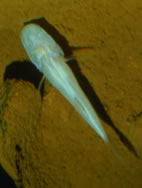
Amblyopsis spelaea occurs in caves in southern Indiana and north-central Kentucky. It lacks eyes and pigmentation and has rows of sensory papillae on its skin that help it navigate in darkness.
Written 26 November 2026 from the sources listed below. Each statement was checked against the passage it cites; statements that could not be supported were removed.
Appearance
The Northern Cavefish lacks eyes and pigmentation as adaptations to permanent darkness. Rows of sensory papillae on its skin help it navigate in darkness.[1][2]
Habitat
At Mammoth Cave, Northern Cavefish occupy deeper waters farther downstream, where food availability is lower than in habitats occupied by southern cavefish. They can coexist with southern cavefish in habitats sufficiently diverse to permit habitat segregation.[3][4]
Diet
The Northern Cavefish feeds on small invertebrates and other small cavefish.[5]
Behaviour
The Northern Cavefish can survive extended periods without feeding by relying on stored fat reserves.[6]
Reproduction and life cycle
The Northern Cavefish breeds between February and April. Females retain eggs in their gill cavities until hatching and carry their young for approximately four to five months.[7][8][9]
The species has a protolarval developmental stage during which the mother retains eggs and newly hatched larvae in her gill chamber. Juveniles eventually become free-swimming and leave the mother's care.[10][11]
The Northern Cavefish reaches sexual maturity at approximately six years of age.[12]
Conservation
Threats include groundwater contamination associated with agricultural operations, urban areas, and industry. Forest loss and surface-water impoundment are additional threats.[13][14]
Groundwater pollution threatens the subterranean habitat of the Northern Cavefish. Reservoir flooding, cave vandalism, and construction can have lasting negative effects on cavefish habitat.[15][16]
Classification of the Northern Cavefish
| Kingdom | Animalia |
|---|---|
| Phylum | Chordata |
| Subphylum | Vertebrata |
| Infraphylum | Gnathostomata |
| Parvphylum | Osteichthyes |
| Gigaclass | Actinopterygii |
| Superclass | Actinopteri |
| Class | Teleostei (Teleost) |
| Order | Percopsiformes |
| Family | Amblyopsidae (Cavefishes) |
| Genus | Amblyopsis (Cavefishes) |
| Species | Amblyopsis spelaea DeKay, 1842 |
Where the Northern Cavefish is found
Checklists and occurrence records place Amblyopsis spelaea in 1 country. GBIF holds 298 georeferenced records of it.
Countries
Regions and cities with the most records
- Indiana, United States 90
- Kentucky, United States 82
- Radcliff, United States 5
- Elizabethtown, United States 3
- Pennsylvania, United States 3
A number beside a place is its count of GBIF occurrence records. A place without a number comes from a checklist alone. Records show where a species has been observed or collected, which can include escapes and vagrants.
Common names
English
- Northern Cavefish
- Northern Blindfish
Names in 3 other languages
- Czech
- hrdlořitka jeskynní
- Polish
- jaskiniówka północna
- Russian
- Пещерная слепоглазка
Synonyms
2 other scientific names have been used for this species and are now treated as synonyms of Amblyopsis spelaea.
- Amblyopsis spelaeus DeKay, 1842
- Amblyopsis spelea DeKay, 1842
Related species
-
 Hoosier CavefishAmblyopsis hoosieri
- Demon CavefishDemogorgonichthys arcanus
-
 Alabama CavefishSpeoplatyrhinus poulsoni
-
 Southern CavefishTyphlichthys subterraneus
-
 SwampfishChologaster cornuta
-
 Spring CavefishForbesichthys agassizii
- Karst CavefishForbesichthys papilliferus
- Ozark CavefishTroglichthys rosae
Compare
Questions and answers
What is the scientific name of the Northern Cavefish?
The scientific name of the Northern Cavefish is Amblyopsis spelaea. Written with its author, the full name is Amblyopsis spelaea DeKay, 1842.
Which family does the Northern Cavefish belong to?
Amblyopsis spelaea belongs to the family Amblyopsidae, in the order Percopsiformes and the class Teleostei.
Where is the Northern Cavefish found?
Checklists and occurrence records place Amblyopsis spelaea in 1 country: United States.
What is the conservation status of the Northern Cavefish?
The IUCN Red List category recorded for Amblyopsis spelaea is Near Threatened (NT).
What other names does the Northern Cavefish have?
Amblyopsis spelaea is also known in English as Northern Blindfish.
What do cave fish eat?
The Northern Cavefish feeds on small invertebrates and other small cavefish.[5]
Why are cavefish blind?
The Northern Cavefish lacks eyes and pigmentation as adaptations to permanent darkness.[1]
Sources
Passages the profile rests on
- The northern cavefish lacks eyes and pigmentation as adaptations to permanent darkness. Source passage: “Complete darkness has caused them to evolve without eyes and without pigment.” — nps.gov
- Rows of sensory papillae on its skin help the northern cavefish navigate in darkness. Source passage: “Rather than eyes, rows of sensory papillae on their skin helps these fish navigate through the depths without light.” — nps.gov
- At Mammoth Cave, northern cavefish occupy deeper waters farther downstream where food availability is lower than in habitats occupied by southern cavefish. Source passage: “Northern cavefish are found in deeper water with less food availability further downstream.” — nps.gov
- Northern cavefish can coexist with southern cavefish in habitats sufficiently diverse to permit habitat segregation. Source passage: “Northern and southern cavefish are able to coexist in areas where the habitat is significantly diverse to allow habitat segregation.” — nps.gov
- The northern cavefish feeds on small invertebrates and other small cavefish. Source passage: “eat small invertebrates or other small cavefish.” — nps.gov
- The northern cavefish can survive extended periods without feeding by relying on stored fat reserves. Source passage: “Their low metabolism allows them to survive for long periods of time on their fat reserves.” — nps.gov
- The northern cavefish breeds between February and April. Source passage: “The northern cavefish breeds from February to April.” — nps.gov
- Females retain eggs in their gill cavities until hatching. Source passage: “Females carry eggs in their gill cavities until they hatch;” — nps.gov
- Female northern cavefish carry their young for a total of approximately four to five months. Source passage: “young are carried for a total of 4-5 months.” — nps.gov
- The species has a protolarval developmental stage during which the mother retains eggs and newly hatched larvae in her gill chamber. Source passage: “In this stage, eggs and those that have recently hatched into protolarvae are kept by the mother internally in a gill chamber.” — English Wikipedia
- Juveniles eventually become free-swimming and leave the mother's care. Source passage: “Juveniles become free swimming and can leave.” — English Wikipedia
- The species reaches sexual maturity at approximately six years of age. Source passage: “reaches sexual maturity at approximately six years of age.” — English Wikipedia
- Threats include groundwater contamination associated with agricultural operations, urban areas, and industry. Source passage: “especially by groundwater contamination from encroaching agricultural operations, cities and industry” — English Wikipedia
- Forest loss and surface-water impoundment are additional threats to the species. Source passage: “forest loss and surface water impoundment.” — English Wikipedia
- Groundwater pollution threatens the subterranean habitat of northern cavefish. Source passage: “Aquatic cave life is especially vulnerable to groundwater pollution from fecal contamination, feedlots, grazing pastures, fertilizers, pesticides, road salting, and other surface materials.” — nps.gov
- Reservoir flooding, cave vandalism, and construction can have lasting negative effects on cavefish habitat. Source passage: “Pollution, flooding of reservoirs, cave vandalism, and construction also have lasting impacts on cavefish habitat and livelihood.” — nps.gov
Data
- Catalogue of Life, 2026-10-16 XR cc by
- Global Biodiversity Information Facility CC BY 4.0
- Wikidata CC0
- GeoNames CC BY 4.0
- Wikimedia Commons per image; credit shown with each image
- Within the Catalogue of Life, this name comes from World Register of Marine Species cc by
References
- DeKay, J. E. (1842). Zoology of New-York, or the New-York fauna; comprising detailed descriptions of all the animals hitherto observed within the state of New-York, with brief notices of those occasionally found near its borders, and accompanied by appropriate illustrations. Part IV. Fishes. W. & A. White & J. Visscher, Albany. (Part Of: Natural History of New York), i–xv + 1–415, Pls. 1–79. [Plates in separate volume; fishes, Pls. 1–79 [most in color].]. https://doi.org/10.5962/bhl.title.2079 Link where the name was published
This species in other databases
- Catalogue of Life CMRC
- Wikidata Q2842127
- iNaturalist 93829
- WoRMS urn:lsid:marinespecies.org:taxname:1022190
- ITIS 164395
Page built on 29 November 2026. See how the catalog is made and all sources and licences.
Cite this page
ScientificNames.org. (2026). Amblyopsis spelaea (Northern Cavefish). Retrieved November 29, 2026, from https://scientificnames.org/species/amblyopsis-spelaea
“Amblyopsis spelaea (Northern Cavefish).” ScientificNames.org, 2026, scientificnames.org/species/amblyopsis-spelaea. Accessed 29 Nov. 2026.
ScientificNames.org. “Amblyopsis spelaea (Northern Cavefish).” Accessed November 29, 2026. https://scientificnames.org/species/amblyopsis-spelaea.
@misc{scientificnames_amblyopsis_spelaea_northern_cavefish,
  author = {{ScientificNames.org}},
  title = {Amblyopsis spelaea (Northern Cavefish)},
  year = {2026},
  url = {https://scientificnames.org/species/amblyopsis-spelaea},
  note = {Accessed 2026-11-29}
}